
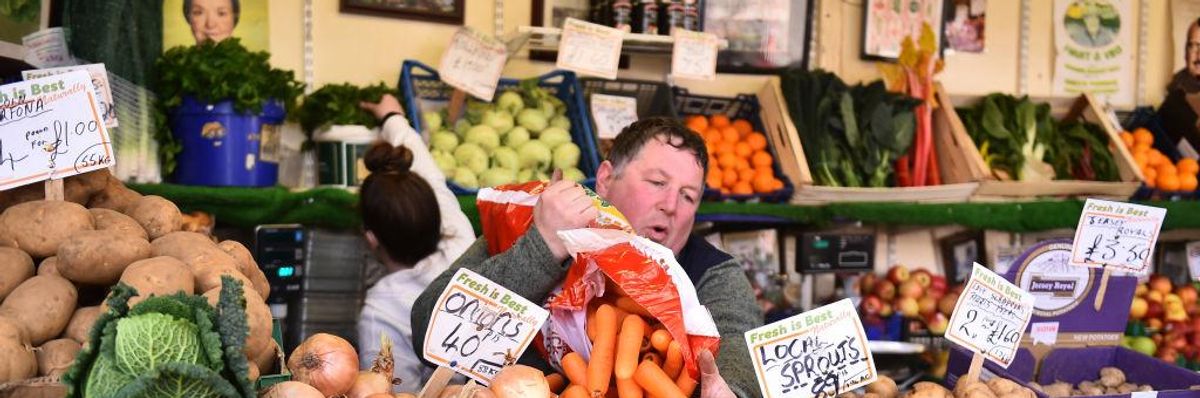
A man prepares his green grocer market stall at Stockport Market on March 12, 2021 in Stockport, England. (Photo: Nathan Stirk/Getty Images)
Community Food Systems Should Be Part of the New Normal
A local, decentralised food system isn’t just good for consumers—it's got big benefits for farmers and our environment as well.
With last year's long queues and supply issues at supermarkets, the Covid pandemic has made us all re-examine how we get our groceries and where they come from. But even before Covid-19, the failures of the current system were clear to see. Inadequate access to healthy diets contribute to one in seven deaths in Great Britain. Diet-related chronic disease accounts for PS6.1bn of annual NHS spending (around 9%) and generates a wider economic loss of more than PS54bn a year (that's 3% of UK GDP).
The damage of our food system has risen to such critical levels that estimates suggest that for every PS1 UK consumers spend on food, it costs global society the same amount in environmental and social costs from antibiotic resistance to damaged ecosystems.
At the same time, the way we produce our food relies on industrial production techniques and monocultures. It uses unsustainable amounts of water, depletes wildlife, and pumps greenhouse gases into our atmosphere. The damage of our food system has risen to such critical levels that estimates suggest that for every PS1 UK consumers spend on food, it costs global society the same amount in environmental and social costs from antibiotic resistance to damaged ecosystems.
At NEF, we've recently worked with the Soil Association to assess one possible alternative to our broken food system. Growing Communities is a community food distributer in north London which runs a subscription-based vegetable scheme and a weekly farmers market. Customers can collect their weekly veg bags from distribution points, which include local businesses and community venues. Growing Communities only source seasonal, agroecological produce (that means produce which is grown using techniques which work with ecosystems, rather than against them) and they purchase from suppliers close by before looking further afield.
Growing Communities has been able to compete with large supermarkets for the past 20 years and currently feeds 2,500 people. They've also helped establish a network of 27 Better Food Traders with 12,500 customers, to expand their reach. And our research has found that, in addition to being financially viable, their model delivers much greater social and environmental value than our mainstream food system.
In total, for every PS1 spent by Growing Communities' customers, we estimate that the scheme generates more than PS3.70 of social, environmental, and economic value. Of this extra value, PS3.46 is generated for the customer and their household. This includes the value of the food they receive, improvements in health and wellbeing, and time saved due to less supermarket shopping. 32p of value is created for the environment, through better farming practices and changes in customer diets which reduce carbon emissions and improve water quality and wildlife health, among other things. Additionally, 13p of value was created for farmers and processors, and 7p for Growing Communities employees.
It looks like the pandemic has shifted how many of us think about our food. In the UK people are now around four times more likely to search online for "veg box" than pre-pandemic. But increased consumer interest isn't the only reason why a radical rethink our food system ought to be a priority.
As well as correcting some of the most glaring environmental damages of our current food system, Growing Communities' model also supports the 'levelling up' agenda that the government is looking to define.
Growing Communities offers very different trading arrangements to farmers compared to supermarkets, promising to buy all of their produce and not to haggle with them on price. As a result, they estimate that more than 50% of the sales price goes to farmers, compared to 14% in the global supermarket system. Not only does this allow producers to adopt farming practices that are better for the planet, but farmers also report meaningful improvements in financial wellbeing and job security. Since working with Growing Communities, farmers reported that their annual turnover increased by an average of PS50,000. These are big numbers for small-scale producers. And as farmers hire employees who go on to spend their salaries locally, this economic impact is amplified. 70% of Growing Communities' supplier spending goes to UK producers and wholesalers--substantially more than the UK as a whole, where just 17% of the fruit and half of the vegetables that we eat are grown in the UK.
In urban areas, where 84% of UK residents live, Growing Communities' model can also have an economic impact. Their staff are all paid a living wage, compared to the retail sector in general, where low-paid insecure work dominates. Their neighbourhood-centric approach also means their premises are based near employees' homes, reducing time and energy used commuting and allowing them more flexibility to care for their children. Other cities, such as Paris, have made this kind of decentralised approach to urban development a policy priority as a way to improve the quality of life of their residents--the most well-known model being the "15-minute city". Growing Communities' model could be part of UK efforts to do the same.
With 59% of people agreeing that government should make big or moderate changes in the wake of the pandemic, supporting regenerative models of community-led agriculture like Growing Communities would be one meaningful way of doing so.
We are at a crossroads
This country and this world are at a monumental crossroads. In a few short weeks, US voters will have an opportunity to beat back the forces of fascism and confront the billionaires who are rigging the economy, our media system, and our democracy, making it increasingly impossible for ordinary people to get by. We’re not just talking about the election. We’re talking about what must be done once these fascist elements are vanquished from power. We need a bolder set of solutions than what either major party has so far been willing to offer and a working-class movement ready to fight like hell for it. Trump didn't emerge from nowhere. The conditions that fueled MAGA authoritarianism were created by decades of radical neoliberal economic policies and a corrupt political system dominated by corporate interests. They slashed taxes on the super-rich, promising that the benefits would trickle down. They said giveaways to the corporate titans would make life more affordable for the rest of us. It was all bullshit. And when a bitter, betrayed populace searches for someone to blame, right-wing demagogues have little trouble finding scapegoats. People know when they're being lied to, but you won't hear any of this from the corporate media. Only independent journalism—powered and funded by people who believe in building a better world—can deliver truly trustworthy daily news. Our Fall Campaign is underway, and we need your help. To power our newsroom through the rest of the year, we need to raise $125,000 by midnight on October 31. So if you share our vision, please contribute whatever you can to sustain our work. |
With last year's long queues and supply issues at supermarkets, the Covid pandemic has made us all re-examine how we get our groceries and where they come from. But even before Covid-19, the failures of the current system were clear to see. Inadequate access to healthy diets contribute to one in seven deaths in Great Britain. Diet-related chronic disease accounts for PS6.1bn of annual NHS spending (around 9%) and generates a wider economic loss of more than PS54bn a year (that's 3% of UK GDP).
The damage of our food system has risen to such critical levels that estimates suggest that for every PS1 UK consumers spend on food, it costs global society the same amount in environmental and social costs from antibiotic resistance to damaged ecosystems.
At the same time, the way we produce our food relies on industrial production techniques and monocultures. It uses unsustainable amounts of water, depletes wildlife, and pumps greenhouse gases into our atmosphere. The damage of our food system has risen to such critical levels that estimates suggest that for every PS1 UK consumers spend on food, it costs global society the same amount in environmental and social costs from antibiotic resistance to damaged ecosystems.
At NEF, we've recently worked with the Soil Association to assess one possible alternative to our broken food system. Growing Communities is a community food distributer in north London which runs a subscription-based vegetable scheme and a weekly farmers market. Customers can collect their weekly veg bags from distribution points, which include local businesses and community venues. Growing Communities only source seasonal, agroecological produce (that means produce which is grown using techniques which work with ecosystems, rather than against them) and they purchase from suppliers close by before looking further afield.
Growing Communities has been able to compete with large supermarkets for the past 20 years and currently feeds 2,500 people. They've also helped establish a network of 27 Better Food Traders with 12,500 customers, to expand their reach. And our research has found that, in addition to being financially viable, their model delivers much greater social and environmental value than our mainstream food system.
In total, for every PS1 spent by Growing Communities' customers, we estimate that the scheme generates more than PS3.70 of social, environmental, and economic value. Of this extra value, PS3.46 is generated for the customer and their household. This includes the value of the food they receive, improvements in health and wellbeing, and time saved due to less supermarket shopping. 32p of value is created for the environment, through better farming practices and changes in customer diets which reduce carbon emissions and improve water quality and wildlife health, among other things. Additionally, 13p of value was created for farmers and processors, and 7p for Growing Communities employees.
It looks like the pandemic has shifted how many of us think about our food. In the UK people are now around four times more likely to search online for "veg box" than pre-pandemic. But increased consumer interest isn't the only reason why a radical rethink our food system ought to be a priority.
As well as correcting some of the most glaring environmental damages of our current food system, Growing Communities' model also supports the 'levelling up' agenda that the government is looking to define.
Growing Communities offers very different trading arrangements to farmers compared to supermarkets, promising to buy all of their produce and not to haggle with them on price. As a result, they estimate that more than 50% of the sales price goes to farmers, compared to 14% in the global supermarket system. Not only does this allow producers to adopt farming practices that are better for the planet, but farmers also report meaningful improvements in financial wellbeing and job security. Since working with Growing Communities, farmers reported that their annual turnover increased by an average of PS50,000. These are big numbers for small-scale producers. And as farmers hire employees who go on to spend their salaries locally, this economic impact is amplified. 70% of Growing Communities' supplier spending goes to UK producers and wholesalers--substantially more than the UK as a whole, where just 17% of the fruit and half of the vegetables that we eat are grown in the UK.
In urban areas, where 84% of UK residents live, Growing Communities' model can also have an economic impact. Their staff are all paid a living wage, compared to the retail sector in general, where low-paid insecure work dominates. Their neighbourhood-centric approach also means their premises are based near employees' homes, reducing time and energy used commuting and allowing them more flexibility to care for their children. Other cities, such as Paris, have made this kind of decentralised approach to urban development a policy priority as a way to improve the quality of life of their residents--the most well-known model being the "15-minute city". Growing Communities' model could be part of UK efforts to do the same.
With 59% of people agreeing that government should make big or moderate changes in the wake of the pandemic, supporting regenerative models of community-led agriculture like Growing Communities would be one meaningful way of doing so.