
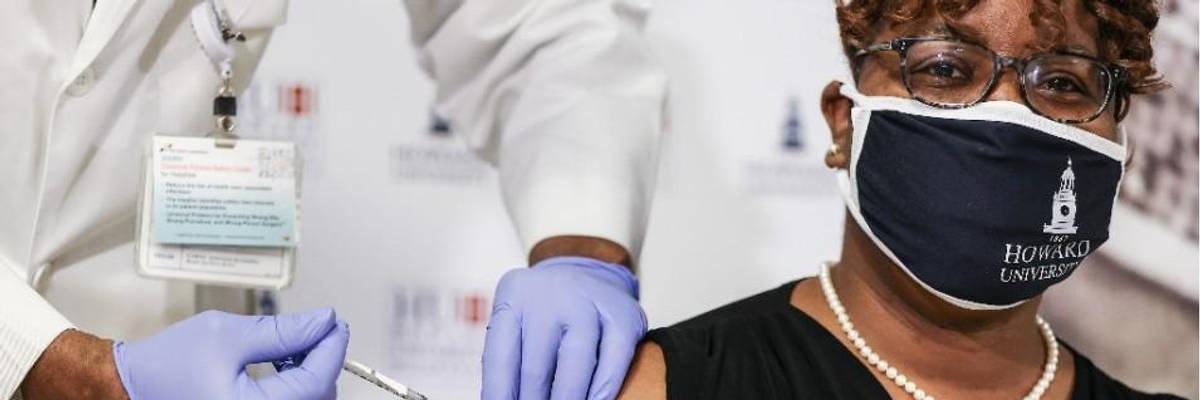
Howard University Hospital staff members received Covid-19 vaccination doses on December 15, 2020 in Washington, D.C. (Photo: Tasos Katopodis/Getty Images)
Covid-19 Vaccinations: A Shot in the Arm for Universal Healthcare?
The national vaccination program has all the features of a single-payer health care system including no copays, no premiums, no insurance company blocking payment, and universal, affordable healthcare for all.
As millions of us get vaccinated against SARS-CoV-2, we will get a first-hand glimpse of what a single-payer, Medicare-for-All approach to health care might mean, at least at the federal level. At the national level, the development and distribution of the vaccines have features of a single-payer approach to health care that set the program apart from business as usual in our private market-oriented health care system.
The vaccine is being treated as a public good, not a private commodity, and its priority process is determined by medical need, not by ability to pay.
Vaccines are not usually profitable for pharmaceutical companies. It was therefore necessary for the federal government to subsidize the development and distribution of the Covid19 vaccines, mainly through Operation Warp Speed. As a result of these subsidies, none of us have to pay to receive the vaccine. Moreover, there are no documentation requirements to show eligibility and no disputes with insurance companies before or after vaccination. According to guidelines from the Centers for Medicaid and Medicare Services (CMS), "Vaccine doses purchased with U.S. taxpayer dollars will be given to the American people at no cost." Additionally, providers "may not seek any reimbursement, including through balance billing, from a vaccine recipient." We will all be covered automatically with no out-of-pocket costs.
The national vaccination program has all the features of a single-payer health care system including no copays, no premiums, no insurance company blocking payment, and universal, affordable healthcare for all. The vaccine is being treated as a public good, not a private commodity, and its priority process is determined by medical need, not by ability to pay. Notably, given all this, the vaccine rollout has drawn no allegations of "socialized medicine" by those opposed to government-financed health care.
One cannot deny that administering the vaccine is a massive undertaking and undoubtedly it had a rocky start, but it has improved dramatically over the past few months. The question remains: will our first-hand experience of the federal response to the pandemic (delayed though it was) dispel the usual objections to single-payer health care? Or will most Americans conclude that the public health crisis caused by this pandemic is a one-off exception? Since we all need access to medical care at some point--whether because of a pandemic, a variant in our genetic code, getting hit by a bus, or being struck by cancer or heart disease--it is clearly short-sighted to regard it as an exception.
Much depends on how many of us get vaccinated and experience the desired community protection and sense of solidarity underlying a universal health care model. If the outcome is positive, increased political momentum for a single-payer health system may be one of the most important results of this horrific pandemic. We're all in this together, and what we're learning is that government is not the problem; it's the solution.
We are at a crossroads
This country and this world are at a monumental crossroads. In a few short weeks, US voters will have an opportunity to beat back the forces of fascism and confront the billionaires who are rigging the economy, our media system, and our democracy, making it increasingly impossible for ordinary people to get by. We’re not just talking about the election. We’re talking about what must be done once these fascist elements are vanquished from power. We need a bolder set of solutions than what either major party has so far been willing to offer and a working-class movement ready to fight like hell for it. Trump didn't emerge from nowhere. The conditions that fueled MAGA authoritarianism were created by decades of radical neoliberal economic policies and a corrupt political system dominated by corporate interests. They slashed taxes on the super-rich, promising that the benefits would trickle down. They said giveaways to the corporate titans would make life more affordable for the rest of us. It was all bullshit. And when a bitter, betrayed populace searches for someone to blame, right-wing demagogues have little trouble finding scapegoats. People know when they're being lied to, but you won't hear any of this from the corporate media. Only independent journalism—powered and funded by people who believe in building a better world—can deliver truly trustworthy daily news. Our Fall Campaign is underway, and we need your help. To power our newsroom through the rest of the year, we need to raise $125,000 by midnight on October 31. So if you share our vision, please contribute whatever you can to sustain our work. |
As millions of us get vaccinated against SARS-CoV-2, we will get a first-hand glimpse of what a single-payer, Medicare-for-All approach to health care might mean, at least at the federal level. At the national level, the development and distribution of the vaccines have features of a single-payer approach to health care that set the program apart from business as usual in our private market-oriented health care system.
The vaccine is being treated as a public good, not a private commodity, and its priority process is determined by medical need, not by ability to pay.
Vaccines are not usually profitable for pharmaceutical companies. It was therefore necessary for the federal government to subsidize the development and distribution of the Covid19 vaccines, mainly through Operation Warp Speed. As a result of these subsidies, none of us have to pay to receive the vaccine. Moreover, there are no documentation requirements to show eligibility and no disputes with insurance companies before or after vaccination. According to guidelines from the Centers for Medicaid and Medicare Services (CMS), "Vaccine doses purchased with U.S. taxpayer dollars will be given to the American people at no cost." Additionally, providers "may not seek any reimbursement, including through balance billing, from a vaccine recipient." We will all be covered automatically with no out-of-pocket costs.
The national vaccination program has all the features of a single-payer health care system including no copays, no premiums, no insurance company blocking payment, and universal, affordable healthcare for all. The vaccine is being treated as a public good, not a private commodity, and its priority process is determined by medical need, not by ability to pay. Notably, given all this, the vaccine rollout has drawn no allegations of "socialized medicine" by those opposed to government-financed health care.
One cannot deny that administering the vaccine is a massive undertaking and undoubtedly it had a rocky start, but it has improved dramatically over the past few months. The question remains: will our first-hand experience of the federal response to the pandemic (delayed though it was) dispel the usual objections to single-payer health care? Or will most Americans conclude that the public health crisis caused by this pandemic is a one-off exception? Since we all need access to medical care at some point--whether because of a pandemic, a variant in our genetic code, getting hit by a bus, or being struck by cancer or heart disease--it is clearly short-sighted to regard it as an exception.
Much depends on how many of us get vaccinated and experience the desired community protection and sense of solidarity underlying a universal health care model. If the outcome is positive, increased political momentum for a single-payer health system may be one of the most important results of this horrific pandemic. We're all in this together, and what we're learning is that government is not the problem; it's the solution.