
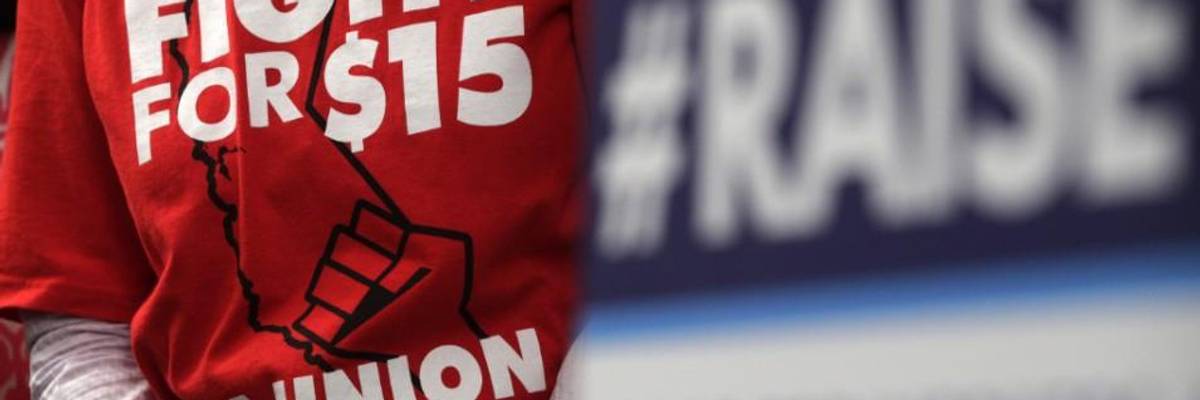
An activist wears a "Fight For $15" shirt during a news conference prior to a vote on the Raise the Wage Act on July 18, 2019 at the U.S. Capitol in Washington, D.C. (Photo: Alex Wong/Getty Images)
65 Billion Reasons the Senate Can Pass a $15 Minimum Wage by Reconciliation
The benefits of a $15 minimum wage are clear. The raise is long overdue.
Congress has not raised the $7.25 federal minimum wage since 2009, despite cost of living rising by more than 20% since the last increase. Although a raise for American workers is clearly overdue, congressional Republicans remain as opposed as ever. But their votes may not be needed for lawmakers to raise the country's pay floor to $15 an hour.
I conservatively estimate that a $15 federal minimum wage in 2025 would have a positive effect on the federal budget to the tune of $65.4 billion per year.
One way to raise the federal floor without any support from Republicans is gaining steam: an arcane process called budget reconciliation requires only 51 votes in the Senate. Senate Democratic leaders, led by Budget Committee Chairman Bernie Sanders, want to use this process to pass the Raise the Wage Act of 2021, which would increase the federal minimum wage to $9.50 this year and then gradually to $15 by 2025.
Vice President Kamala Harris and the Senate's parliamentarian and will ultimately determine whether a minimum wage increase qualifies for the budget reconciliation process. In addition to the usual questions about the effects on employment and poverty, they will want to know whether there are budgetary impacts.
As an economist who has long conducted and published causal studies of minimum wage effects, including on federal and state budgets, I already know that a federal $15 minimum would substantially affect federal revenues and expenditures. I recently assembled what the established economics research literature tells us about the likely budgetary effects of the Raise the Wage Act. I conservatively estimate that a $15 federal minimum wage in 2025 would have a positive effect on the federal budget to the tune of $65.4 billion per year.
Wage increases for low-wage workers will add to payroll and income tax revenues--about $21.2 billion per year. This total includes $5 billion from workers who will delay their retirement. Wage increases will also lead to savings on means-tested safety net programs that phase out as incomes rise. The savings to food stamps, welfare, the Earned Income Tax Credit, and the Childcare Tax Credit will total about $32 billion per year. These findings are well-known among minimum wage economists.
What is less known is that the Social Security Trust fund will realize savings, since some older workers will delay their retirement. When these workers do retire, they will receive larger benefits, but they will be followed by the next cohort of older workers who will also delay their retirement. These savings will add $12.2 billion per year to the Social Security Trust Fund.
Finally, government costs will increase for the 3 million low-wage workers whose pay comes indirectly from federal funds (such as Medicaid). But Medicaid caseloads and costs per recipient will also fall. California's budget experience, with a minimum wage slated to rise to $15 in 2021, shows that the savings to Medicaid more than offset the increased costs.
The center of gravity of economists' research and thinking has clearly moved in the past decade -- to recognizing that a $15 minimum will likely have small disemployment effects and generate large reductions in poverty. Higher pay also leads to other "downstream effects" on health and child and adult poverty.
A $15 federal minimum wage by 2025 would increase the pay of about 32 million workers, with full-year workers getting an annual pay increase of $3,300 or more. These workers will spend much of what they receive in local communities, rather than stash it in bank accounts. They will do things like buy cars, which will help them expand their job opportunities, take their family members to medical appointments and do their shopping errands. The benefits of a $15 minimum wage will be larger for Black workers than for white workers, though low-paid workers of all races, ethnicities and genders will receive increases.
The benefits of a $15 minimum wage are clear. The raise is long overdue. And with my research showing an increase would have a positive effect of more than $65 billion on the federal budget, $15 an hour might soon be reality for tens of millions of workers who so desperately need a raise.
We are at a crossroads
This country and this world are at a monumental crossroads. In a few short weeks, US voters will have an opportunity to beat back the forces of fascism and confront the billionaires who are rigging the economy, our media system, and our democracy, making it increasingly impossible for ordinary people to get by. We’re not just talking about the election. We’re talking about what must be done once these fascist elements are vanquished from power. We need a bolder set of solutions than what either major party has so far been willing to offer and a working-class movement ready to fight like hell for it. Trump didn't emerge from nowhere. The conditions that fueled MAGA authoritarianism were created by decades of radical neoliberal economic policies and a corrupt political system dominated by corporate interests. They slashed taxes on the super-rich, promising that the benefits would trickle down. They said giveaways to the corporate titans would make life more affordable for the rest of us. It was all bullshit. And when a bitter, betrayed populace searches for someone to blame, right-wing demagogues have little trouble finding scapegoats. People know when they're being lied to, but you won't hear any of this from the corporate media. Only independent journalism—powered and funded by people who believe in building a better world—can deliver truly trustworthy daily news. Our Fall Campaign is underway, and we need your help. To power our newsroom through the rest of the year, we need to raise $125,000 by midnight on October 31. So if you share our vision, please contribute whatever you can to sustain our work. |
Congress has not raised the $7.25 federal minimum wage since 2009, despite cost of living rising by more than 20% since the last increase. Although a raise for American workers is clearly overdue, congressional Republicans remain as opposed as ever. But their votes may not be needed for lawmakers to raise the country's pay floor to $15 an hour.
I conservatively estimate that a $15 federal minimum wage in 2025 would have a positive effect on the federal budget to the tune of $65.4 billion per year.
One way to raise the federal floor without any support from Republicans is gaining steam: an arcane process called budget reconciliation requires only 51 votes in the Senate. Senate Democratic leaders, led by Budget Committee Chairman Bernie Sanders, want to use this process to pass the Raise the Wage Act of 2021, which would increase the federal minimum wage to $9.50 this year and then gradually to $15 by 2025.
Vice President Kamala Harris and the Senate's parliamentarian and will ultimately determine whether a minimum wage increase qualifies for the budget reconciliation process. In addition to the usual questions about the effects on employment and poverty, they will want to know whether there are budgetary impacts.
As an economist who has long conducted and published causal studies of minimum wage effects, including on federal and state budgets, I already know that a federal $15 minimum would substantially affect federal revenues and expenditures. I recently assembled what the established economics research literature tells us about the likely budgetary effects of the Raise the Wage Act. I conservatively estimate that a $15 federal minimum wage in 2025 would have a positive effect on the federal budget to the tune of $65.4 billion per year.
Wage increases for low-wage workers will add to payroll and income tax revenues--about $21.2 billion per year. This total includes $5 billion from workers who will delay their retirement. Wage increases will also lead to savings on means-tested safety net programs that phase out as incomes rise. The savings to food stamps, welfare, the Earned Income Tax Credit, and the Childcare Tax Credit will total about $32 billion per year. These findings are well-known among minimum wage economists.
What is less known is that the Social Security Trust fund will realize savings, since some older workers will delay their retirement. When these workers do retire, they will receive larger benefits, but they will be followed by the next cohort of older workers who will also delay their retirement. These savings will add $12.2 billion per year to the Social Security Trust Fund.
Finally, government costs will increase for the 3 million low-wage workers whose pay comes indirectly from federal funds (such as Medicaid). But Medicaid caseloads and costs per recipient will also fall. California's budget experience, with a minimum wage slated to rise to $15 in 2021, shows that the savings to Medicaid more than offset the increased costs.
The center of gravity of economists' research and thinking has clearly moved in the past decade -- to recognizing that a $15 minimum will likely have small disemployment effects and generate large reductions in poverty. Higher pay also leads to other "downstream effects" on health and child and adult poverty.
A $15 federal minimum wage by 2025 would increase the pay of about 32 million workers, with full-year workers getting an annual pay increase of $3,300 or more. These workers will spend much of what they receive in local communities, rather than stash it in bank accounts. They will do things like buy cars, which will help them expand their job opportunities, take their family members to medical appointments and do their shopping errands. The benefits of a $15 minimum wage will be larger for Black workers than for white workers, though low-paid workers of all races, ethnicities and genders will receive increases.
The benefits of a $15 minimum wage are clear. The raise is long overdue. And with my research showing an increase would have a positive effect of more than $65 billion on the federal budget, $15 an hour might soon be reality for tens of millions of workers who so desperately need a raise.