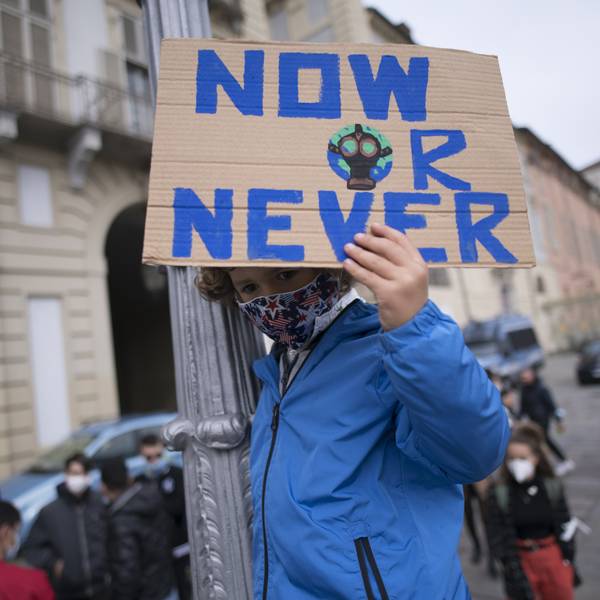


"We are now awakening to the responsibilities that come with our distinctive ability to consciously create our future." (Photo by Aliraza Khatri/Getty Images)
The Time for Postponing Climate Action Is Over
This is our time to step up to the challenge of our age and to create a future consistent with our reality as living beings born of and nurtured by a living Earth.
In 1962, Rachael Carson warned us, with the publication of Silent Spring, that the indiscriminate use of pesticides was disrupting critical ecosystems and causing severe damage to human health.
Her message led to a ban on the use of DDT in the United States and eventual restrictions on its use in much of the world. Her warning also helped launch the environmental movement and its call to humanity to accept responsibility for the consequences of our impact on Earth.
Ten years later, in 1972, the book The Limits to Growth, by an MIT research team led by Donella and Dennis Meadows, again focused global attention on humanity's environmental responsibility. Presented as a report to the Club of Rome, the book used computer modeling to demonstrate that sustained economic growth on a finite planet would lead to environmental and economic collapse in the early- to mid-21st century. It sold more than 3 million copies in some 35 languages.
The book stirred significant public debate at the time and had a defining influence in shaping the lives and thinking of many members of my generation. It came under withering critique, however, from a corporate establishment that profits from growth, and from neoliberal economists who provided intellectual cover for the establishment. To the detriment of people and planet, and unlike Carson's book, The Limits to Growth had no discernible impact on public policy.
Yet, over the next 20 years, concern for the growing human threat to Earth's essential living systems gained in status to become the dominant scientific consensus. In 1992, the Union of Concerned Scientists issued a proclamation, "World Scientists' Warning to Humanity," signed by more than 1,700 scientists, including a majority of the then-living Nobel Laureates in the sciences. Its message was clear and unambiguous:
"The earth is finite.... Current economic practices which damage the environment, in both developed and underdeveloped nations, cannot be continued without the risk that vital global systems will be damaged beyond repair."
In November 2017, exactly 55 years after Silent Spring, 45 years after the Limits to Growth, and 25 years after the "Warning to Humanity," the Alliance of World Scientists issued a new proclamation: "World Scientists' Warning to Humanity: A Second Notice." This one was signed by more than 20,000 scientists in 184 countries. It concluded:
"We face deforestation, ocean acidification, diminishing fresh water supplies, the Earth's sixth mass extinction event, exponential human population growth, overconsumption and a climate system veering outside of the conditions within which human civilization developed."
Less than a year later, in October 2018, the UN Intergovernmental Panel on Climate Change issued a report calling for dramatic action on climate change along with specific targets required to avoid catastrophic and irreparable consequences. The New York Times summarized the key findings and recommendations:
"To prevent 2.7 degrees [Fahrenheit] of warming, the report said, greenhouse pollution must be reduced by 45 percent from 2010 levels by 2030, and 100 percent by 2050. It also found that, by 2050, use of coal as an electricity source would have to drop from nearly 40 percent today to between 1 and 7 percent. Renewable energy such as wind and solar, which make up about 20 percent of the electricity mix today, would have to increase to as much as 67 percent."
BBC environmental correspondent Matt McGrath pointed out last July that to achieve the UN's initial target of a 45% cut in carbon emissions by 2030 will require decisive global action by the end of this year--2020. His point is that reaching that initial target in just 10 years will require massive changes. So, if we don't get going immediately, we will not make it.
Humanity is reawakening to a basic truth understood by earlier humans, by many Indigenous people today, and now confirmed by the leading scientists: We are born of and members of a living Earth community.
We are now awakening to the responsibilities that come with our distinctive ability to consciously create our future. The environmental consequences of our neglect of this responsibility have been known for more than half a century, but for many people, the urgent need to act is just now sinking in.
Science is significantly advancing understanding of how this community works. We now know, for example, that Earth's early microorganisms sequestered Earth's excess carbons and toxins deep underground to create surface conditions that later would support more complex life forms, including humans.
In the arrogance of our quest to bend the living Earth to our will, we have organized much of our economy around extracting these carbons and toxins and releasing them back into Earth's air, waters, and soils. This, and many other human assaults on the planet's regenerative systems, demand immediate remedial action.
As we awaken to the consequences of our self-destructive relationship to Earth, we confront a fundamental truth of our past 5,000 years of history: The past civilizations we have celebrated as affirmations of the greatness of human accomplishment centralized power to exploit people and nature to benefit the rulers at the expense of everyone else. Each of these civilizations collapsed--and our present one is headed in that direction, too--imposing yet more suffering on massive numbers of people over the course of history.
Now, for the first time in the human experience, we are a global species with an interdependent global civilization. But the basic pattern of imperial domination continues. The dominant institutions are now corporations rather than governments and the dominant rulers are financiers and corporate CEOs rather than kings and emperors.
The basic dynamic remains much the same, however, and the consequences are playing out on an unprecedented scale, rendering ever more of Earth's once-livable places unlivable, and driving millions of people from their homes. Current events are only a foretaste of what lies ahead if we continue to hold to our current path.
With luck and collective determination, we may have time to avoid self-extinction and even create a world of joy and meaning. But that will happen only if we prioritize healing over consuming, and cooperation over competition; embrace our individual and collective responsibilities to one another and the Earth; and remake our culture, institutions, technology, and infrastructure in recognition that we are part of a living Earth community. We have just entered humanity's decisive decade. This is our time to step up to the challenge of our age and to create a future consistent with our reality as living beings born of and nurtured by a living Earth.
We are at a crossroads
This country and this world are at a monumental crossroads. In a few short weeks, US voters will have an opportunity to beat back the forces of fascism and confront the billionaires who are rigging the economy, our media system, and our democracy, making it increasingly impossible for ordinary people to get by. We’re not just talking about the election. We’re talking about what must be done once these fascist elements are vanquished from power. We need a bolder set of solutions than what either major party has so far been willing to offer and a working-class movement ready to fight like hell for it. Trump didn't emerge from nowhere. The conditions that fueled MAGA authoritarianism were created by decades of radical neoliberal economic policies and a corrupt political system dominated by corporate interests. They slashed taxes on the super-rich, promising that the benefits would trickle down. They said giveaways to the corporate titans would make life more affordable for the rest of us. It was all bullshit. And when a bitter, betrayed populace searches for someone to blame, right-wing demagogues have little trouble finding scapegoats. People know when they're being lied to, but you won't hear any of this from the corporate media. Only independent journalism—powered and funded by people who believe in building a better world—can deliver truly trustworthy daily news. Our Fall Campaign is underway, and we need your help. To power our newsroom through the rest of the year, we need to raise $125,000 by midnight on October 31. So if you share our vision, please contribute whatever you can to sustain our work. |
In 1962, Rachael Carson warned us, with the publication of Silent Spring, that the indiscriminate use of pesticides was disrupting critical ecosystems and causing severe damage to human health.
Her message led to a ban on the use of DDT in the United States and eventual restrictions on its use in much of the world. Her warning also helped launch the environmental movement and its call to humanity to accept responsibility for the consequences of our impact on Earth.
Ten years later, in 1972, the book The Limits to Growth, by an MIT research team led by Donella and Dennis Meadows, again focused global attention on humanity's environmental responsibility. Presented as a report to the Club of Rome, the book used computer modeling to demonstrate that sustained economic growth on a finite planet would lead to environmental and economic collapse in the early- to mid-21st century. It sold more than 3 million copies in some 35 languages.
The book stirred significant public debate at the time and had a defining influence in shaping the lives and thinking of many members of my generation. It came under withering critique, however, from a corporate establishment that profits from growth, and from neoliberal economists who provided intellectual cover for the establishment. To the detriment of people and planet, and unlike Carson's book, The Limits to Growth had no discernible impact on public policy.
Yet, over the next 20 years, concern for the growing human threat to Earth's essential living systems gained in status to become the dominant scientific consensus. In 1992, the Union of Concerned Scientists issued a proclamation, "World Scientists' Warning to Humanity," signed by more than 1,700 scientists, including a majority of the then-living Nobel Laureates in the sciences. Its message was clear and unambiguous:
"The earth is finite.... Current economic practices which damage the environment, in both developed and underdeveloped nations, cannot be continued without the risk that vital global systems will be damaged beyond repair."
In November 2017, exactly 55 years after Silent Spring, 45 years after the Limits to Growth, and 25 years after the "Warning to Humanity," the Alliance of World Scientists issued a new proclamation: "World Scientists' Warning to Humanity: A Second Notice." This one was signed by more than 20,000 scientists in 184 countries. It concluded:
"We face deforestation, ocean acidification, diminishing fresh water supplies, the Earth's sixth mass extinction event, exponential human population growth, overconsumption and a climate system veering outside of the conditions within which human civilization developed."
Less than a year later, in October 2018, the UN Intergovernmental Panel on Climate Change issued a report calling for dramatic action on climate change along with specific targets required to avoid catastrophic and irreparable consequences. The New York Times summarized the key findings and recommendations:
"To prevent 2.7 degrees [Fahrenheit] of warming, the report said, greenhouse pollution must be reduced by 45 percent from 2010 levels by 2030, and 100 percent by 2050. It also found that, by 2050, use of coal as an electricity source would have to drop from nearly 40 percent today to between 1 and 7 percent. Renewable energy such as wind and solar, which make up about 20 percent of the electricity mix today, would have to increase to as much as 67 percent."
BBC environmental correspondent Matt McGrath pointed out last July that to achieve the UN's initial target of a 45% cut in carbon emissions by 2030 will require decisive global action by the end of this year--2020. His point is that reaching that initial target in just 10 years will require massive changes. So, if we don't get going immediately, we will not make it.
Humanity is reawakening to a basic truth understood by earlier humans, by many Indigenous people today, and now confirmed by the leading scientists: We are born of and members of a living Earth community.
We are now awakening to the responsibilities that come with our distinctive ability to consciously create our future. The environmental consequences of our neglect of this responsibility have been known for more than half a century, but for many people, the urgent need to act is just now sinking in.
Science is significantly advancing understanding of how this community works. We now know, for example, that Earth's early microorganisms sequestered Earth's excess carbons and toxins deep underground to create surface conditions that later would support more complex life forms, including humans.
In the arrogance of our quest to bend the living Earth to our will, we have organized much of our economy around extracting these carbons and toxins and releasing them back into Earth's air, waters, and soils. This, and many other human assaults on the planet's regenerative systems, demand immediate remedial action.
As we awaken to the consequences of our self-destructive relationship to Earth, we confront a fundamental truth of our past 5,000 years of history: The past civilizations we have celebrated as affirmations of the greatness of human accomplishment centralized power to exploit people and nature to benefit the rulers at the expense of everyone else. Each of these civilizations collapsed--and our present one is headed in that direction, too--imposing yet more suffering on massive numbers of people over the course of history.
Now, for the first time in the human experience, we are a global species with an interdependent global civilization. But the basic pattern of imperial domination continues. The dominant institutions are now corporations rather than governments and the dominant rulers are financiers and corporate CEOs rather than kings and emperors.
The basic dynamic remains much the same, however, and the consequences are playing out on an unprecedented scale, rendering ever more of Earth's once-livable places unlivable, and driving millions of people from their homes. Current events are only a foretaste of what lies ahead if we continue to hold to our current path.
With luck and collective determination, we may have time to avoid self-extinction and even create a world of joy and meaning. But that will happen only if we prioritize healing over consuming, and cooperation over competition; embrace our individual and collective responsibilities to one another and the Earth; and remake our culture, institutions, technology, and infrastructure in recognition that we are part of a living Earth community. We have just entered humanity's decisive decade. This is our time to step up to the challenge of our age and to create a future consistent with our reality as living beings born of and nurtured by a living Earth.