
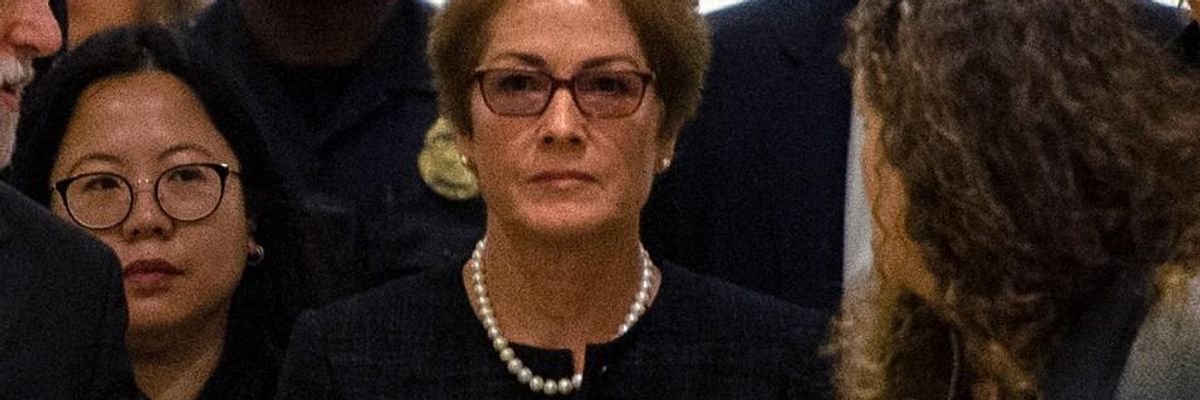
Former U.S. Ambassador to Ukraine Marie Yovanovitch is surrounded by lawyers, aides, and journalists as she arrives at the U.S. Capitol October 11, 2019 in Washington, D.C. (Photo: Chip Somodevilla/Getty Images)
In 2020, Ukrainians Gain Whistleblower Rights Trump Has Forsaken Here
The attacks on Yovanovitch, the Trump/Zelensky call whistleblower, and other career civil servants willing to speak truth to power, despite the risks, represent a frontal assault by the President on norms our American democracy depend upon.
The President is at it again. Just days ago, he re-tweeted--from what appears likely to be a bot Twitter account--the name of the person some suspect exposed Trump's now-infamous call with Ukraine's President Zelensky. This ratcheting-up takes his attacks on the whistleblower to a whole other level.
Donald Trump was impeached by the House because the whistleblower--whoever it is--had the courage to report that White House phone call. If that individual hadn't filed a complaint, the world might never have learned of the call and today would be just another day of business as usual on Pennsylvania Avenue. Regardless of what ultimately transpires in the Senate, by stepping forward the whistleblower changed history.
The president first let loose a few days after the call was revealed, when he told a gathering of State Department employees that he wanted to know the person's identity, and said "you know what we used to do in the old days when we were smart with spies and treason, right?" This, despite federal law that specifically protects intelligence community whistleblowers.
Back in the U.S., the President's campaign of intimidation of civil servants who come forward is having a predictably damaging effect.
Undeterred, a few weeks later he deployed a witness intimidation tactic likely never before seen. Literally while U.S. Ambassador to Ukraine, Marie Yovanovitch, testified before the House Intelligence Committee, Trump tweeted "[e]verywhere Marie Yovanovitch went turned bad." In fact, Yovanovitch is a highly respected foreign service professional, who as U.S. Ambassador to Ukraine promoted anti-corruption measures in that country, while Trump's personal lawyer, Rudy Giuliani, actively undermined her. When Intelligence Committee Chair Adam Schiff read the tweet to her, she was mortified: "It's very intimidating," she replied. No kidding.
The attacks on Yovanovitch, the Trump/Zelensky call whistleblower, and other career civil servants willing to speak truth to power, despite the risks, represent a frontal assault by the President on norms our American democracy depend upon.
How ironic, then, that on November 13--two days before Yovanovitch testified about the campaign to discredit her--Ukraine's President Zelensky signed a landmark whistleblower protection act, effective January 1, 2020. It's one of many pieces of legislation promoted by progressive, civil society reform groups in Ukraine who are working hard to combat corruption and nurture real, participative democracy - the very efforts Yovanovitch had encouraged during her tenure there.
Ukraine's new law provides a host of protections. Whistleblowers who expose corruption are entitled to free legal counsel, and can use many protected ways to report it, including hotlines designed to assure anonymity. Workplace provisions guarantee protection not only for whistleblowers, but for their close relatives too. And, the law provides remuneration for the whistleblower, up to ten percent of the monetary value of the corruption revealed. These are groundbreaking changes.
An electronic manual published by Labor Initiatives, a democracy-building group, provides information on how to expose corruption cases. Aiming to encourage "ordinary people" to break their silence in the face of abuse of power, the manual affirms: "Whistleblower is not a snitch or a rat; instead he is a guardsman of the public interest and a conscious citizen."
George Sandul, a lawyer in Kiev who worked on the manual, applauds Ukraine's new law, and hopes it will be expanded to encompass not only "corruption whistleblowers" but those who report on other information of public interest, like human rights and ecological violations as well. He will also be watching how effectively the law is enforced by the government and the courts.
Meanwhile, Sandul observes somewhat incredulously the U.S. President's messy intrusion into his country's affairs, considering Trump's unclean hands. "Ukraine at the moment is a war-affected region and is fighting both external Russian aggression and the internal disaster of corruption," he told me. "What we notice here is a reference to one state's problems as a justification for the inappropriate actions of another. Similar tactics were used by, for example, the USSR, in response to claims of human rights violations against it." He continues: "Yes, we face many challenges, but, driven by progressive civil society, we've had successes in improving anti-corruption legislation, and we are determined to make the law work effectively. Considering the charges President Trump faces, and his hostile actions towards the whistleblowers involved in his case, he seems to have little standing to make claims about Ukraine."
Back in the U.S., the President's campaign of intimidation of civil servants who come forward is having a predictably damaging effect. A recent Government Business Council survey of federal workers finds that half the respondents said Trump and congressional Republicans' disparaging rhetoric about whistleblowers and the "deep state," has made them feel less safe, and one-third say they are now less likely to report wrongdoing to the appropriate authorities.
Meanwhile, as of the first of the year, Ukrainians have a new legal weapon in their war against the corruption that's stifled their country's forward movement for decades. And their civil society organizations, supported by career diplomats like Yovanovitch, and inspired by individuals like the one with the courage to reveal the White House call, will fight hard to ensure that whistleblowers are in fact protected--because of their critical role as guardians of democracy, fairness, and the rule of law.
President Trump, on the other hand, as his latest re-tweet makes clear, is unrepentant, and, if anything, is escalating his attacks on the White House call whistleblower. Our democracy is wounded as a result, and will need repairing. Maybe the Ukrainians can help.
We are at a crossroads
This country and this world are at a monumental crossroads. In a few short weeks, US voters will have an opportunity to beat back the forces of fascism and confront the billionaires who are rigging the economy, our media system, and our democracy, making it increasingly impossible for ordinary people to get by. We’re not just talking about the election. We’re talking about what must be done once these fascist elements are vanquished from power. We need a bolder set of solutions than what either major party has so far been willing to offer and a working-class movement ready to fight like hell for it. Trump didn't emerge from nowhere. The conditions that fueled MAGA authoritarianism were created by decades of radical neoliberal economic policies and a corrupt political system dominated by corporate interests. They slashed taxes on the super-rich, promising that the benefits would trickle down. They said giveaways to the corporate titans would make life more affordable for the rest of us. It was all bullshit. And when a bitter, betrayed populace searches for someone to blame, right-wing demagogues have little trouble finding scapegoats. People know when they're being lied to, but you won't hear any of this from the corporate media. Only independent journalism—powered and funded by people who believe in building a better world—can deliver truly trustworthy daily news. Our Fall Campaign is underway, and we need your help. To power our newsroom through the rest of the year, we need to raise $125,000 by midnight on October 31. So if you share our vision, please contribute whatever you can to sustain our work. |
The President is at it again. Just days ago, he re-tweeted--from what appears likely to be a bot Twitter account--the name of the person some suspect exposed Trump's now-infamous call with Ukraine's President Zelensky. This ratcheting-up takes his attacks on the whistleblower to a whole other level.
Donald Trump was impeached by the House because the whistleblower--whoever it is--had the courage to report that White House phone call. If that individual hadn't filed a complaint, the world might never have learned of the call and today would be just another day of business as usual on Pennsylvania Avenue. Regardless of what ultimately transpires in the Senate, by stepping forward the whistleblower changed history.
The president first let loose a few days after the call was revealed, when he told a gathering of State Department employees that he wanted to know the person's identity, and said "you know what we used to do in the old days when we were smart with spies and treason, right?" This, despite federal law that specifically protects intelligence community whistleblowers.
Back in the U.S., the President's campaign of intimidation of civil servants who come forward is having a predictably damaging effect.
Undeterred, a few weeks later he deployed a witness intimidation tactic likely never before seen. Literally while U.S. Ambassador to Ukraine, Marie Yovanovitch, testified before the House Intelligence Committee, Trump tweeted "[e]verywhere Marie Yovanovitch went turned bad." In fact, Yovanovitch is a highly respected foreign service professional, who as U.S. Ambassador to Ukraine promoted anti-corruption measures in that country, while Trump's personal lawyer, Rudy Giuliani, actively undermined her. When Intelligence Committee Chair Adam Schiff read the tweet to her, she was mortified: "It's very intimidating," she replied. No kidding.
The attacks on Yovanovitch, the Trump/Zelensky call whistleblower, and other career civil servants willing to speak truth to power, despite the risks, represent a frontal assault by the President on norms our American democracy depend upon.
How ironic, then, that on November 13--two days before Yovanovitch testified about the campaign to discredit her--Ukraine's President Zelensky signed a landmark whistleblower protection act, effective January 1, 2020. It's one of many pieces of legislation promoted by progressive, civil society reform groups in Ukraine who are working hard to combat corruption and nurture real, participative democracy - the very efforts Yovanovitch had encouraged during her tenure there.
Ukraine's new law provides a host of protections. Whistleblowers who expose corruption are entitled to free legal counsel, and can use many protected ways to report it, including hotlines designed to assure anonymity. Workplace provisions guarantee protection not only for whistleblowers, but for their close relatives too. And, the law provides remuneration for the whistleblower, up to ten percent of the monetary value of the corruption revealed. These are groundbreaking changes.
An electronic manual published by Labor Initiatives, a democracy-building group, provides information on how to expose corruption cases. Aiming to encourage "ordinary people" to break their silence in the face of abuse of power, the manual affirms: "Whistleblower is not a snitch or a rat; instead he is a guardsman of the public interest and a conscious citizen."
George Sandul, a lawyer in Kiev who worked on the manual, applauds Ukraine's new law, and hopes it will be expanded to encompass not only "corruption whistleblowers" but those who report on other information of public interest, like human rights and ecological violations as well. He will also be watching how effectively the law is enforced by the government and the courts.
Meanwhile, Sandul observes somewhat incredulously the U.S. President's messy intrusion into his country's affairs, considering Trump's unclean hands. "Ukraine at the moment is a war-affected region and is fighting both external Russian aggression and the internal disaster of corruption," he told me. "What we notice here is a reference to one state's problems as a justification for the inappropriate actions of another. Similar tactics were used by, for example, the USSR, in response to claims of human rights violations against it." He continues: "Yes, we face many challenges, but, driven by progressive civil society, we've had successes in improving anti-corruption legislation, and we are determined to make the law work effectively. Considering the charges President Trump faces, and his hostile actions towards the whistleblowers involved in his case, he seems to have little standing to make claims about Ukraine."
Back in the U.S., the President's campaign of intimidation of civil servants who come forward is having a predictably damaging effect. A recent Government Business Council survey of federal workers finds that half the respondents said Trump and congressional Republicans' disparaging rhetoric about whistleblowers and the "deep state," has made them feel less safe, and one-third say they are now less likely to report wrongdoing to the appropriate authorities.
Meanwhile, as of the first of the year, Ukrainians have a new legal weapon in their war against the corruption that's stifled their country's forward movement for decades. And their civil society organizations, supported by career diplomats like Yovanovitch, and inspired by individuals like the one with the courage to reveal the White House call, will fight hard to ensure that whistleblowers are in fact protected--because of their critical role as guardians of democracy, fairness, and the rule of law.
President Trump, on the other hand, as his latest re-tweet makes clear, is unrepentant, and, if anything, is escalating his attacks on the White House call whistleblower. Our democracy is wounded as a result, and will need repairing. Maybe the Ukrainians can help.