SUBSCRIBE TO OUR FREE NEWSLETTER
Daily news & progressive opinion—funded by the people, not the corporations—delivered straight to your inbox.
5
#000000
#FFFFFF
To donate by check, phone, or other method, see our More Ways to Give page.
Daily news & progressive opinion—funded by the people, not the corporations—delivered straight to your inbox.
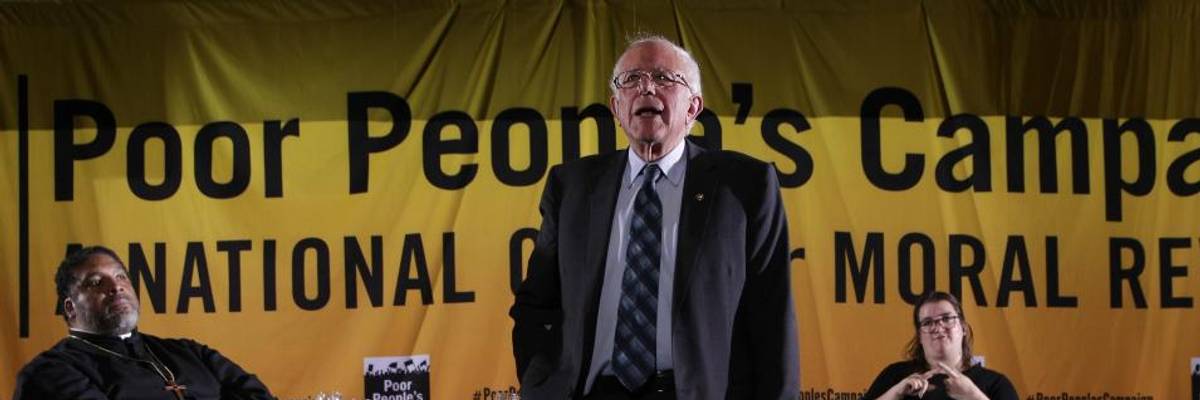
Democratic U.S. presidential candidate Sen. Bernie Sanders (I-VT) addresses the Moral Action Congress of the Poor People's Campaign June 17, 2019 at Trinity Washington University in Washington, DC. The Campaign held the event to focus on issues like "voting rights, health care, housing, equitable education, indigenous sovereignty, living wage jobs and the right to join a union, clean air and water, and an end to gun proliferation and war mongering and other issues in our moral agenda." (Photo by Alex Wong/Getty Images)
This week in Washington, the powers that be heard from a vital new democratic force in this country.
For three days, the Poor People's Campaign brought poor and low-wage Americans to the nation's capital to call for a moral renewal in this nation. They questioned many of those who are seeking the Democratic nomination for president. Congressional hearings showcased their Poor People's Moral Budget.
Their actions should be above the fold of every newspaper in America; they should lead the news shows and fill the talk shows. A movement for common sense and social justice is building, putting every politician on notice: lead or get out of the way, a new moral majority is building and demanding change.
As the co-chairs of the Poor People's Campaign, the Rev. Dr. William Barber II and Rev. Dr. Liz Theoharis, write in their forward, this movement is not partisan. It calls not for liberal or conservative reforms, but for a moral renewal. It is not a deep-pocket lobby. It is mobilizing the 144 million Americans who are poor or one crisis away from poverty into a "new and unsettling force" to "revive the heart of democracy in America."
This movement launched on Mother's Day in May 2018. In 40 days, it triggered 200 actions across many states with 5,000 nonviolent demonstrators committing civil disobedience, and millions following the protests online. Forty states now have coordinating committees build a coalition of poor people and people of faith and conscience across lines of race, religion, region and other lines of division.
They are morally outraged that the richest nation in the world would in a "willful act of policy violence" condemn 140 million -- more than 40 percent of the population -- to live in poverty or near poverty. This includes 39 million children, 60 percent -- 26 million -- of African Americans, 64 percent -- 38 million -- of Latinos, more than one-third -- 66 million -- of white Americans.
These realities -- and the extreme inequality that scars this society -- pre-date the Trump administration, but now Trump is fanning increasing policy violence against the poor. In response, the Poor People's Campaign is doing deep organizing and power building among the poor, turning them from victims to subject actors in history.
Last week, the campaign released their Poor People's Moral Budget. It details authoritatively that the cost of our current inequality, the cost of mass poverty is far greater than what it would cost to invest in people, put them to work at a living wage and guarantee basic economic and political rights. It costs society big time to not provide health care or quality education or clean water and air, to suppress voting rights and to keep wages low.
The moral budget is detailed and authoritatively sourced. The numbers are clear, as is the conclusion.
As the document concludes, "We have been investing in killing people; we most now invest in life. We have been investing in systemic racism and voter suppression; we must now invest in expanding democracy. We have been investing in punishing the poor; we must now invest in the welfare of all. We have been investing in the wealthy and corporations; we must now invest in the people who build this country."
This is not a time for incremental change, but for fundamental transformation of our priorities and our direction. The budget details large reforms -- from automatic voter registration, a living wage, health care for all, quality education from pre-k through college, investment in clean energy and modern infrastructure. It details how these and other reforms can be easily afforded by fair taxes on the wealthy and corporations and by ending our effort to police the world.
The Poor People's Campaign picks up the unfinished work of Dr. Martin Luther King. It realizes that ending the policy of violence on the poor at home cannot be achieved without challenging the costly endless wars and constant arms buildup that only make us less secure. It understands that change will come not from the top down, not from our corrupted big money politics, but from the poor, the worker, people of conscience coming together to revive our democracy and to change our course.
In these troubled times, the promise of this new force is powerful. Across the country, working and poor people are beginning to move. If this movement can continue to grow, it will transform our politics. And it is the only force that can.
Dear Common Dreams reader, It’s been nearly 30 years since I co-founded Common Dreams with my late wife, Lina Newhouser. We had the radical notion that journalism should serve the public good, not corporate profits. It was clear to us from the outset what it would take to build such a project. No paid advertisements. No corporate sponsors. No millionaire publisher telling us what to think or do. Many people said we wouldn't last a year, but we proved those doubters wrong. Together with a tremendous team of journalists and dedicated staff, we built an independent media outlet free from the constraints of profits and corporate control. Our mission has always been simple: To inform. To inspire. To ignite change for the common good. Building Common Dreams was not easy. Our survival was never guaranteed. When you take on the most powerful forces—Wall Street greed, fossil fuel industry destruction, Big Tech lobbyists, and uber-rich oligarchs who have spent billions upon billions rigging the economy and democracy in their favor—the only bulwark you have is supporters who believe in your work. But here’s the urgent message from me today. It's never been this bad out there. And it's never been this hard to keep us going. At the very moment Common Dreams is most needed, the threats we face are intensifying. We need your support now more than ever. We don't accept corporate advertising and never will. We don't have a paywall because we don't think people should be blocked from critical news based on their ability to pay. Everything we do is funded by the donations of readers like you. When everyone does the little they can afford, we are strong. But if that support retreats or dries up, so do we. Will you donate now to make sure Common Dreams not only survives but thrives? —Craig Brown, Co-founder |
This week in Washington, the powers that be heard from a vital new democratic force in this country.
For three days, the Poor People's Campaign brought poor and low-wage Americans to the nation's capital to call for a moral renewal in this nation. They questioned many of those who are seeking the Democratic nomination for president. Congressional hearings showcased their Poor People's Moral Budget.
Their actions should be above the fold of every newspaper in America; they should lead the news shows and fill the talk shows. A movement for common sense and social justice is building, putting every politician on notice: lead or get out of the way, a new moral majority is building and demanding change.
As the co-chairs of the Poor People's Campaign, the Rev. Dr. William Barber II and Rev. Dr. Liz Theoharis, write in their forward, this movement is not partisan. It calls not for liberal or conservative reforms, but for a moral renewal. It is not a deep-pocket lobby. It is mobilizing the 144 million Americans who are poor or one crisis away from poverty into a "new and unsettling force" to "revive the heart of democracy in America."
This movement launched on Mother's Day in May 2018. In 40 days, it triggered 200 actions across many states with 5,000 nonviolent demonstrators committing civil disobedience, and millions following the protests online. Forty states now have coordinating committees build a coalition of poor people and people of faith and conscience across lines of race, religion, region and other lines of division.
They are morally outraged that the richest nation in the world would in a "willful act of policy violence" condemn 140 million -- more than 40 percent of the population -- to live in poverty or near poverty. This includes 39 million children, 60 percent -- 26 million -- of African Americans, 64 percent -- 38 million -- of Latinos, more than one-third -- 66 million -- of white Americans.
These realities -- and the extreme inequality that scars this society -- pre-date the Trump administration, but now Trump is fanning increasing policy violence against the poor. In response, the Poor People's Campaign is doing deep organizing and power building among the poor, turning them from victims to subject actors in history.
Last week, the campaign released their Poor People's Moral Budget. It details authoritatively that the cost of our current inequality, the cost of mass poverty is far greater than what it would cost to invest in people, put them to work at a living wage and guarantee basic economic and political rights. It costs society big time to not provide health care or quality education or clean water and air, to suppress voting rights and to keep wages low.
The moral budget is detailed and authoritatively sourced. The numbers are clear, as is the conclusion.
As the document concludes, "We have been investing in killing people; we most now invest in life. We have been investing in systemic racism and voter suppression; we must now invest in expanding democracy. We have been investing in punishing the poor; we must now invest in the welfare of all. We have been investing in the wealthy and corporations; we must now invest in the people who build this country."
This is not a time for incremental change, but for fundamental transformation of our priorities and our direction. The budget details large reforms -- from automatic voter registration, a living wage, health care for all, quality education from pre-k through college, investment in clean energy and modern infrastructure. It details how these and other reforms can be easily afforded by fair taxes on the wealthy and corporations and by ending our effort to police the world.
The Poor People's Campaign picks up the unfinished work of Dr. Martin Luther King. It realizes that ending the policy of violence on the poor at home cannot be achieved without challenging the costly endless wars and constant arms buildup that only make us less secure. It understands that change will come not from the top down, not from our corrupted big money politics, but from the poor, the worker, people of conscience coming together to revive our democracy and to change our course.
In these troubled times, the promise of this new force is powerful. Across the country, working and poor people are beginning to move. If this movement can continue to grow, it will transform our politics. And it is the only force that can.
This week in Washington, the powers that be heard from a vital new democratic force in this country.
For three days, the Poor People's Campaign brought poor and low-wage Americans to the nation's capital to call for a moral renewal in this nation. They questioned many of those who are seeking the Democratic nomination for president. Congressional hearings showcased their Poor People's Moral Budget.
Their actions should be above the fold of every newspaper in America; they should lead the news shows and fill the talk shows. A movement for common sense and social justice is building, putting every politician on notice: lead or get out of the way, a new moral majority is building and demanding change.
As the co-chairs of the Poor People's Campaign, the Rev. Dr. William Barber II and Rev. Dr. Liz Theoharis, write in their forward, this movement is not partisan. It calls not for liberal or conservative reforms, but for a moral renewal. It is not a deep-pocket lobby. It is mobilizing the 144 million Americans who are poor or one crisis away from poverty into a "new and unsettling force" to "revive the heart of democracy in America."
This movement launched on Mother's Day in May 2018. In 40 days, it triggered 200 actions across many states with 5,000 nonviolent demonstrators committing civil disobedience, and millions following the protests online. Forty states now have coordinating committees build a coalition of poor people and people of faith and conscience across lines of race, religion, region and other lines of division.
They are morally outraged that the richest nation in the world would in a "willful act of policy violence" condemn 140 million -- more than 40 percent of the population -- to live in poverty or near poverty. This includes 39 million children, 60 percent -- 26 million -- of African Americans, 64 percent -- 38 million -- of Latinos, more than one-third -- 66 million -- of white Americans.
These realities -- and the extreme inequality that scars this society -- pre-date the Trump administration, but now Trump is fanning increasing policy violence against the poor. In response, the Poor People's Campaign is doing deep organizing and power building among the poor, turning them from victims to subject actors in history.
Last week, the campaign released their Poor People's Moral Budget. It details authoritatively that the cost of our current inequality, the cost of mass poverty is far greater than what it would cost to invest in people, put them to work at a living wage and guarantee basic economic and political rights. It costs society big time to not provide health care or quality education or clean water and air, to suppress voting rights and to keep wages low.
The moral budget is detailed and authoritatively sourced. The numbers are clear, as is the conclusion.
As the document concludes, "We have been investing in killing people; we most now invest in life. We have been investing in systemic racism and voter suppression; we must now invest in expanding democracy. We have been investing in punishing the poor; we must now invest in the welfare of all. We have been investing in the wealthy and corporations; we must now invest in the people who build this country."
This is not a time for incremental change, but for fundamental transformation of our priorities and our direction. The budget details large reforms -- from automatic voter registration, a living wage, health care for all, quality education from pre-k through college, investment in clean energy and modern infrastructure. It details how these and other reforms can be easily afforded by fair taxes on the wealthy and corporations and by ending our effort to police the world.
The Poor People's Campaign picks up the unfinished work of Dr. Martin Luther King. It realizes that ending the policy of violence on the poor at home cannot be achieved without challenging the costly endless wars and constant arms buildup that only make us less secure. It understands that change will come not from the top down, not from our corrupted big money politics, but from the poor, the worker, people of conscience coming together to revive our democracy and to change our course.
In these troubled times, the promise of this new force is powerful. Across the country, working and poor people are beginning to move. If this movement can continue to grow, it will transform our politics. And it is the only force that can.