The situation is certainly different today. Still, over the last few weeks, those prophetic words, now 22 years old, have been haunting me, as the U.S. war machine kicks into ever higher gear following the horrific Hamas massacre of Israeli civilians and the brutal intensification of the decades-long Israeli siege of civilians in Gaza. Sadly, the words and actions of our nation’s leaders have revealed a staggering, even willful, historical amnesia about the disastrous repercussions of America’s twenty-first-century war-mongering.
Case in point: recently, the United States was the only nation to veto the U.N. Security Council resolution calling for “humanitarian pauses” to deliver life-saving aid to Palestinians in Gaza. Instead, all but a few members of Congress are lining up to support billions more in military aid for Israel and the further mobilization of our armed forces in the Middle East. These moves, experts say, may only accelerate wider regional conflict (something we are already seeing glimmers of vis-à-vis Iraq, Lebanon, Syria, and Yemen) at a time of increasingly profound global instability. In the last few weeks, the U.S. Navy has “assembled one of the greatest concentrations of power in the Eastern Mediterranean in 40 years,” while the Department of Defense is readying thousands of troops for possible deployment. Meanwhile, college administrators are suggesting student-reservists be prepared in case they get called up in the coming weeks.
Amid this frenzy of American bluster and brawn, the U.N. agency for Palestinian refugees reports that Gaza is “fast becoming a hell hole,” riddled with death, disease, starvation, thirst, and displacement. Hundreds of scholars of international law and conflict studies have warned that the Israeli military may already have launched a “potential genocide” of Gazans. At the same time, within Israel, citizen-militias, armed by the far-right minister of national security, have escalated violent attacks on Palestinians, only worsened by the acts of armed Israeli settlers on the West Bank protected by that very military.
Finally allowing a tiny amount of aid across the Egypt-Gaza border, after shutting down all food, water, and fuel for Gaza, Israeli Defense Minister Yoav Gallant made it clear just how much power the United States wields over this unfolding humanitarian crisis. “The Americans insisted,” he reported, “and we are not in a place where we can refuse them. We rely on them for planes and military equipment. What are we supposed to do? Tell them no?”
As Gallant implied, the U.S. could use its influence not only to demand far more aid for Gazans, but to compel quite a different course of action. There should, after all, be no contradiction between condemning Hamas for its heinous slaughter in the south of Israel and denouncing Israel for its decades-old dispossession and oppression of the Palestinian people and its now-indiscriminate killing and destruction in Gaza. There need be no contradiction between decrying terrorism and demanding diplomacy over violence. In truth, the Biden administration could use every non-military tool at its disposal to pressure both Hamas and Israel to pursue an immediate ceasefire, the full release of all hostages, and whatever humanitarian assistance is now needed.
If only, rather than further militarizing the region or questioning the death toll in Gaza, the Biden administration were to focus on making this most recent and ever more ominous crisis a final turning point, not for yet more brutality, but for a long-term political solution focused on achieving real peace, human rights, and equality for everyone in the region. In this moment of grief and rage, when tensions are at a fever pitch and the wheel of history is turning around us, it’s time to demand peace above all else.
The Cruel Manipulation of the Poor
While the U.S. government refuses to use its considerable power as leverage for peace, ordinary Americans seem to know better. Unlike the days after 9/11, recent polls suggest that a majority of Americans oppose sending more weapons to Israel and support delivering humanitarian aid to Gaza, including a majority of people under the age of 44, as well as a majority of Democrats and independents and a significant minority of Republicans. While Representative Rashida Tlaib, the only Palestinian-American in Congress, was made a pariah and is in the process of being censured by some of her colleagues after her plea for a ceasefire, she actually represents the popular will of a significant portion of the public.
And that, in turn, represents a generational shift from even a decade or two ago. In the wake of this country’s disastrous wars in Afghanistan and Iraq, as well as dozens of other military conflicts globally, many Americans, especially Millennials and Gen Zers, see the U.S. military less as a defender of democracy than as a purveyor of death and chaos. Nearly second-by-second online coverage of the Israeli bombing campaign is offering Americans an unprecedented view into the collective punishment of more than two million Gazans, half of them 18 or younger. (Now, with limited Internet and communications, it’s unclear how word of what’s happening in Gaza will continue to get out.) Add to that the slow-burning pain that has marked life in the United States over the last 15 years — the Great Recession, the Covid-19 economic shock, the climate crisis, and the modern movement for racial justice — and the reasons for such a relatively widespread urge for peace become clearer.
Today, half of all Americans are either impoverished or one emergency away from economic ruin. As younger generations face what often feels like a dead-end future, there’s a growing sense among those I speak to (as well as older folks) that the government has abandoned them. At a moment when the Republicans (and some Democrats) argue that we can’t afford universal healthcare or genuine living wages, the military budget for 2023 is $858 billion and the Pentagon still maintains 750 military bases globally. Last week, without a touch of irony, Treasury Secretary Janet Yellen, who claimed last year that student debt relief would hurt the economy, insisted that the U.S. can “certainly afford two wars.”
Millions of us tuned into President Biden’s Oval Office speech on his return from Israel, only the second of his presidency. There, he asked Congress to earmark yet another $100 billion mainly for American military aid to Israel, Ukraine, and Taiwan (a boon to the war-profiteering weapons makers whose CEOs will grow even richer thanks to those new contracts). Just a year after Congress killed the Expanded Child Tax Credit, which had cut official child poverty in half, Biden’s speech represented a further pivot away from socially beneficial policymaking and toward further strengthening of the ravenous engine of our war economy. After the speech, the Nation‘s Katrina vanden Heuvel offered this compelling instant commentary: “Biden tonight rolled out a version of twenty-first-century military Keynesianism. Let’s call his policy just that. No more Bidenomics. And it consigns the U.S. to endless militarization of foreign policy.”
A decision to organize our economy yet more around war will also mean the further militarization of domestic policy, with dire consequences for poor and low-income people. Reverend Martin Luther King, Jr., once called such steps the “cruel manipulation of the poor,” a phrase he coined as part of his denunciation of the Vietnam War in the late 1960s. King was then thinking about the American soldiers fighting and dying in Vietnam “on the side of the wealthy, and the secure, while we create a hell for the poor.”
Today, a similar “cruel manipulation” is playing out. For years, our leaders have invoked the myth of scarcity to justify inaction when it comes to widespread poverty, growing debt, and rising inequality in the United States. Now, some of them are calling for the spending of billions of dollars to functionally fund the bombardment and occupation of impoverished Gaza and a violent Israeli clampdown in the West Bank, not to speak of the possibility of a wider set of Middle Eastern wars. However, polling numbers suggest that a surprising number of Americans have seen through the fog of war and are perhaps coming to believe that our nation’s abundance should be used not as a tool of death but as a lifeline for poor and struggling people at home and abroad.
Not in Our Name
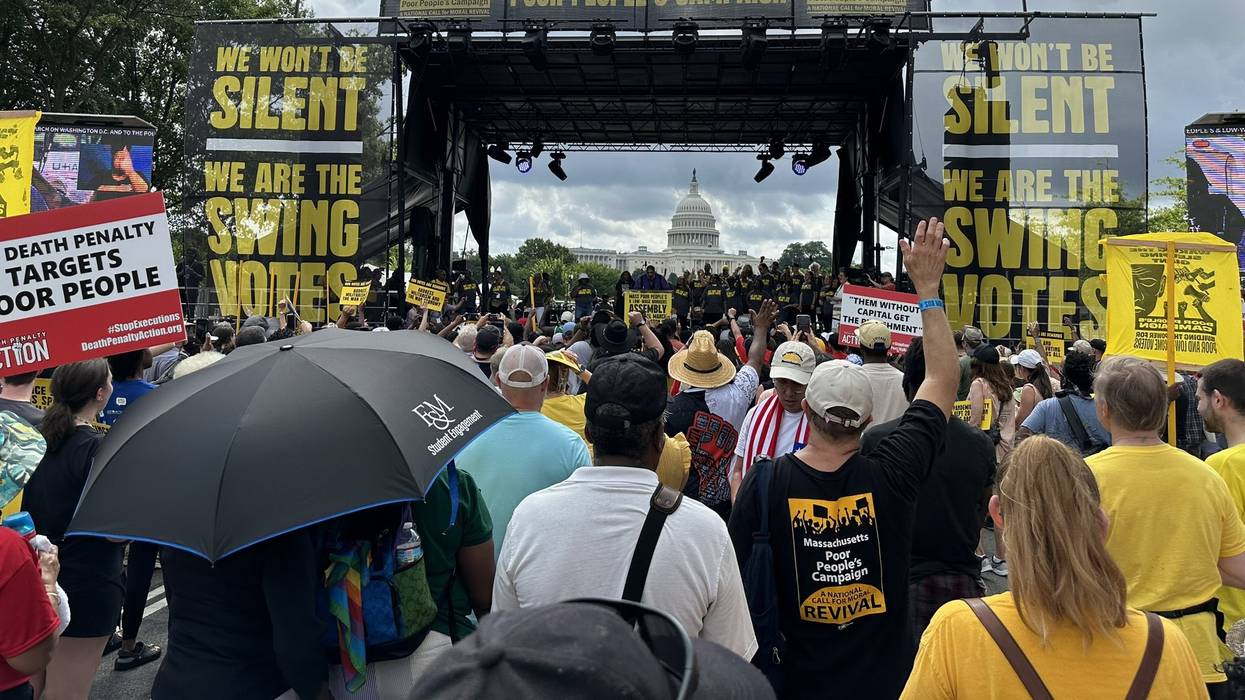
In a time of stifling darkness, one bright light over the last weeks has been the eruption of non-violent, pro-peace protests across the world. In Africa, Asia, Latin America, and Europe, hundreds of thousands of people have hit the streets to demand a ceasefire, including possibly half a million people in London. Here in the U.S., tens of thousands of Americans have followed suit in dozens of cities, from New York to Washington, D.C., Chicago to San Francisco. No less important, those protest marches have been both multi-racial and multi-generational, much like the 2020 uprisings for Breonna Taylor, George Floyd, and the countless other Black lives lost to police brutality.
Recently, close friends and colleagues sent me photos from a march in Washington where Jewish protesters demanded a ceasefire and held up signs with heartrending slogans like “Not in My Name,” “Ceasefire Now,” and “My Grief Is Not Your Weapon.” Ultimately, close to 400 people, including numerous rabbis, were arrested as they peacefully sang and prayed in a congressional office building, while David Friedman, ambassador to Israel under President Trump, hatefully tweeted: “Any American Jew attending this rally is not a Jew — yes I said it!” Representative Marjorie Taylor Greene of Georgia ludicrously claimed that they were leading an insurrection.
Two days later, my organization, the Kairos Center for Religions, Rights, and Social Justice, cosponsored a pro-peace march that drew a large crowd of Palestinians and Muslim-American families. At noon, about 500 protesters, a gorgeous, multicolored sea of humanity participated in the Jumma call to prayer in front of the U.S. Capitol. The following week, folks co-organized a pray-in at New York Representative Hakeem Jeffries’s office, using the phrase “ceasefire is the moral choice.” Faith and movement leaders offered prayers from their various religious traditions and displayed the names of people killed so far.
On October 27th, as Israel expanded its ground invasion of Gaza, I joined thousands of people in Grand Central Station to call for a #CeasefireNow, one of the largest demonstrations in New York since this most recent conflict broke out. Protests continued all week. And on November 4th, there was a mass rally and march in Washington, D.C., to call for an end to war and support the rights of Palestinians, with hundreds of organizations bridging a diversity of views and voices to plead for peace.
Those marches were an inspiring indication of the broad coalition of Americans who desperately want to prevent genocide in Gaza and dream of lasting peace and freedom in Israel/Palestine. At the lead are Palestinians and Jews who refuse to be used as pawns and prop-pieces by military hawks. Alongside them are many Americans all too aware that, though they might not be directly affected by the nightmarish events now unfolding in the Middle East, they are still implicated in the growing violence there thanks to their tax dollars and the actions of our government. Together, we are collectively crying out: “Not in Our Name.”
Such marches undoubtedly represent the largest antiwar mobilization since the invasion of Iraq in 2003 and are weaving together diverse communities — young and old, Black, Brown, and White, Muslim, Jewish, and Christian, poor and working-class — in a way that should prove encouraging indeed for a growing peace movement. Right now, there are new alliances and relationships being forged that will undoubtedly endure for years to come.
Yes, this remains a small victory in what’s likely to prove a terrifying global crisis, but it is a victory nonetheless.
Roses Dressed in Black
The last few weeks have resurrected traumatic memories for many Jews and Palestinians globally — of the Holocaust, the Nakba, and the long history of Islamophobia, anti-Arab hate, anti-Jewish violence, and antisemitism. For many of us who are not Palestinian or Jewish, the recent mass death and violence have also triggered our own painful reckonings with the past.
I’m a descendant of Armenian genocide survivors. When I was a child growing up in Milwaukee, Wisconsin, I heard hushed tales of death marches, hunger, lack of water, barricaded roads, and harrowing escapes. Those stories remain etched into my consciousness, a mournful inheritance my dispossessed ancestors handed down.
My great-grandfather, Charles Ozun Artinian, fled his home in what is now Turkey’s Seyhan River valley after the 1909 Adana Massacre in which Ottoman militants killed 25,000 Armenian Christians. Part of his family escaped over the Caucasus Mountains into Western Europe. They then traveled halfway across the world to Argentina, because so many other nations, including the United States, had closed their borders to Armenian refugees and would only open them years later.
As he was fleeing Adana, Charles wrote a poem, one of the few surviving long-form poems from the region at the time. It begins:
“In the Seyhan valley there rises a smoke
Roses dressed in black, month of April cried
Cries of sadness and mourning were heard everywhere
Broken hearted and sad, everybody cried…”
My family taught my siblings and me that although the genocide against our people was carried out by the Ottoman Empire, it was made possible by the complicity and indifference of the international community, including the world’s richest and most powerful nations. Right now, the smoke rising over Gaza is suffocating and every additional hour the U.S. enables more bombs to fall and tanks to rumble, more roses will be, as my great-grandfather put it, dressed in black. Not only that, but with the detonation of each new American-made bomb, the conditions for the long-term freedom and safety of both Israelis and Palestinians are blasted ever more into rubble.
Let us honor the memories of our ancestors and finally learn the lesson of their many stolen lives: “Not In Our Name!,” “Peace and Justice for All!” and the pleas from Gaza, including “Ceasefire Now!,” “End the Siege,” “Protect Medical Facilities,” and “Gaza is Home!”