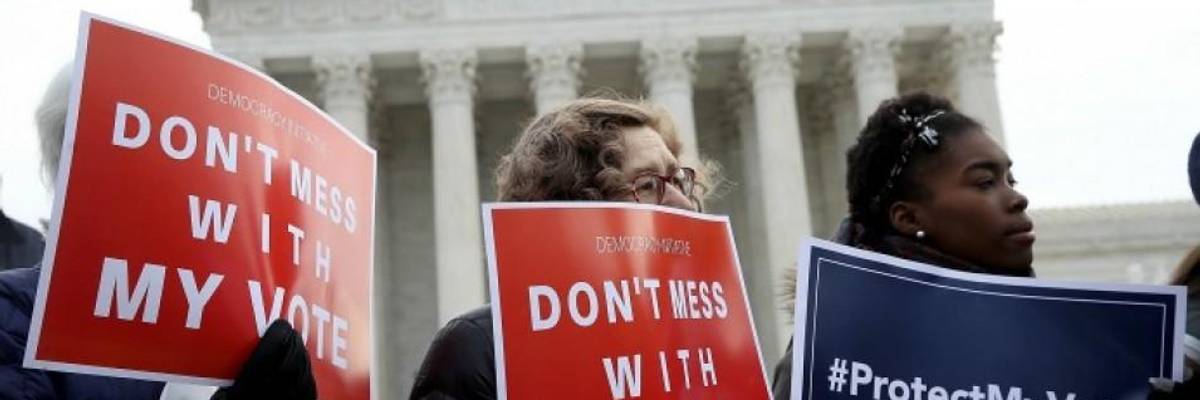
Groups like the American Civil Liberties Union and the Southern Poverty Law Center have challenged voter suppression laws in court. And, on occasion, they've won. The ACLU got voter-ID overturned in Pennsylvania, for example. (Photo: Win McNamee/Getty Images)
Plutocrats Are Planning a Stealth Coup
How will American democracy resist their twisted goal of one-dollar, one-vote plutocracy?
Democracy is tough for 1 percenters.
They've got all that money but, hypothetically, no more voting power than their chauffeur or yacht captain or nanny in a one-person, one-vote democracy.
In this one-person, one-vote democracy, though, they've got a plan to fix all that for themselves. They're paying for it. And they're accomplishing it, even though that means stripping voting rights from non-rich minority groups. Their goal is to make America more of a one-dollar, one-vote plutocracy.
Their scheme is deeply offensive to democratic ideals. In a perfect democracy, each citizen possesses the same power of self-governance as all other individuals, no matter how poor or rich, no matter their religion or skin color, no matter their country of origin or ancestry.
In a perfect democracy, each citizen possesses the same power of self-governance as all other individuals, no matter how poor or rich, no matter their religion or skin color, no matter their country of origin or ancestry.
This equity is unnerving to some 1 percenters who believe their wealth proves their inherent higher value than other human beings, which they feel gives them the right to rule or, at least, the absolute right to choose who rules.
Their attempts to distort the democratic system go back decades. In 1980, their hired hand Paul Weyrich told a group of conservative Christians he didn't want everyone to vote. "Our leverage in the elections, quite candidly, goes up as the voting populace goes down," Weyrich said. He used tens of millions donated by the 1 percent to create the right-wing Heritage Foundation to promote autocracy and to launch the American Legislative Exchange Council (ALEC), an organization dedicated to entertaining state lawmakers at fancy resorts to get them to pass 1 percenter-friendly laws.
In 2014, $8-billionaire Tom Perkins flat out said the rich should get more votes. Perkins recommended the country be run like a corporation: "You pay a million dollars in taxes, you get a million votes."
That plan would deny the right to vote in federal elections to millions of workers who labor at low-wage jobs and pay local and state taxes but not federal income taxes. Meanwhile, idle trust fund babies would receive millions of votes for doing nothing but being born to the right parents.
The 1 percent has schemed since before the heyday of Weyrich to make this true. They've skillfully manipulated Congress, courts and local and state governments to do their bidding. That is purging voter rolls of poor people; curtailing early voting favored by poor people who often have trouble getting time off to vote on Election Day; slashing the number of polling places in poor neighborhoods and frequently moving them; requiring excessively specific types of identification to vote; and gutting the 1965 Voting Rights Act that stood for decades between people of color and attempts by 1 percenters to deny them their voting rights.
The 1 percent have achieved a great deal, including gerrymandered voting districts across the country. These densely pack people of color, other working folks and the poor into a small number of districts while placing the wealthy and upper middle class in a greater number of districts containing fewer people. The effect is to give the rich--usually Republicans--greater representation in government than the rest. Effectively, that makes the votes of the rich count more, just like the now-deceased Tom Perkins wanted.
In June, the Brennan Center for Justice issued its annual State of Voting report detailing restrictions to ballot access nationwide. It said the seven-year-old legislative crusade to limit poor and working people's franchise means that in the midterm elections this fall, voters in 23 states will find it harder to make their voices heard. That includes eight states that restricted voting rights in just the past two years.
In July, the Public Religion Research Institute and the Atlantic magazine released results of a poll they conducted on access to the ballot, which shows America's promise of one-person, one-vote is unfulfilled--and deliberately so.
No one should unfairly lose their franchise, but the poll demonstrated that people of color, that is people less likely to be 1 percenters or Republicans, lost out twice as often as white people.
No one should unfairly lose their franchise, but the poll demonstrated that people of color, that is people less likely to be 1 percenters or Republicans, lost out twice as often as white people.
Nine percent of black respondents and 9 percent of Hispanic respondents told pollsters that in the last election, they or someone in their household were told they lacked proper identification to vote. That happened to 3 percent of white voters. Similarly, 10 percent of black respondents and 11 percent of Hispanic respondents said they were wrongly told they were unlisted on voter rolls. That happened to 5 percent of white voters.
Then, just last week, the U.S. Commission on Civil Rights issued a 498-page report documenting and condemning voting restrictions and calling on Congress to correct the threat to democracy. Of course, what the commission calls a problem the Republican majority in Congress and state legislatures call a solution.
The GOP will ignore commission chair Catherine Lhamon's damning statement describing the situation: "Today's report reflects the reality that citizens in the United States, across many states, not limited only to some parts of the country, continue to suffer significant, and profoundly unequal, limitations on their ability to vote.
"That stark reality denigrates our democracy and diminishes our ideals."
Groups like the American Civil Liberties Union and the Southern Poverty Law Center have challenged voter suppression laws in court. And, on occasion, they've won. The ACLU got voter-ID overturned in Pennsylvania, for example.
In striking down Republican-passed voter-suppression laws in North Carolina in 2016, Fourth Circuit Court of Appeals Judge Diana Gribbon Motz wrote, "In what comes as close to a smoking gun as we are likely to see in modern times, the State's very justification for a challenged statute hinges explicitly on race--specifically its concern that African Americans, who had overwhelmingly voted for Democrats, had too much access to the franchise."
The judge also wrote that the provisions "target African Americans with almost surgical precision."
The U.S. Supreme Court, dominated by right-wingers until Justice Kennedy's retirement last summer, has shown repeatedly that it will not protect the franchise. Beyond crippling the Voting Rights Act, it allowed voter purges in Ohio by contorting the language of federal law. It approved all but one of the 11 Texas congressional districts that a lower court had ruled discriminatory. And it sent back to a lower court for review North Carolina's congressional district map.
The lower court had earlier found the map unconstitutional and in August deemed it unconstitutional again. In a state where more than half of the voters are Democrats and where Democrats held seven of the congressional seats before the map, Republicans managed to take 10 of the seats and leave the majority party with only three after the map. That distortion is exactly the goal one GOP lawmaker said he had when he drew the map.
This is justice for the few. This is control by a tiny wealthy minority. It's not democracy. It's a stealth coup by the rich.
We are at a crossroads
This country and this world are at a monumental crossroads. In a few short weeks, US voters will have an opportunity to beat back the forces of fascism and confront the billionaires who are rigging the economy, our media system, and our democracy, making it increasingly impossible for ordinary people to get by. We’re not just talking about the election. We’re talking about what must be done once these fascist elements are vanquished from power. We need a bolder set of solutions than what either major party has so far been willing to offer and a working-class movement ready to fight like hell for it. Trump didn't emerge from nowhere. The conditions that fueled MAGA authoritarianism were created by decades of radical neoliberal economic policies and a corrupt political system dominated by corporate interests. They slashed taxes on the super-rich, promising that the benefits would trickle down. They said giveaways to the corporate titans would make life more affordable for the rest of us. It was all bullshit. And when a bitter, betrayed populace searches for someone to blame, right-wing demagogues have little trouble finding scapegoats. People know when they're being lied to, but you won't hear any of this from the corporate media. Only independent journalism—powered and funded by people who believe in building a better world—can deliver truly trustworthy daily news. Our Fall Campaign is underway, and we need your help. To power our newsroom through the rest of the year, we need to raise $125,000 by midnight on October 31. So if you share our vision, please contribute whatever you can to sustain our work. |
Democracy is tough for 1 percenters.
They've got all that money but, hypothetically, no more voting power than their chauffeur or yacht captain or nanny in a one-person, one-vote democracy.
In this one-person, one-vote democracy, though, they've got a plan to fix all that for themselves. They're paying for it. And they're accomplishing it, even though that means stripping voting rights from non-rich minority groups. Their goal is to make America more of a one-dollar, one-vote plutocracy.
Their scheme is deeply offensive to democratic ideals. In a perfect democracy, each citizen possesses the same power of self-governance as all other individuals, no matter how poor or rich, no matter their religion or skin color, no matter their country of origin or ancestry.
In a perfect democracy, each citizen possesses the same power of self-governance as all other individuals, no matter how poor or rich, no matter their religion or skin color, no matter their country of origin or ancestry.
This equity is unnerving to some 1 percenters who believe their wealth proves their inherent higher value than other human beings, which they feel gives them the right to rule or, at least, the absolute right to choose who rules.
Their attempts to distort the democratic system go back decades. In 1980, their hired hand Paul Weyrich told a group of conservative Christians he didn't want everyone to vote. "Our leverage in the elections, quite candidly, goes up as the voting populace goes down," Weyrich said. He used tens of millions donated by the 1 percent to create the right-wing Heritage Foundation to promote autocracy and to launch the American Legislative Exchange Council (ALEC), an organization dedicated to entertaining state lawmakers at fancy resorts to get them to pass 1 percenter-friendly laws.
In 2014, $8-billionaire Tom Perkins flat out said the rich should get more votes. Perkins recommended the country be run like a corporation: "You pay a million dollars in taxes, you get a million votes."
That plan would deny the right to vote in federal elections to millions of workers who labor at low-wage jobs and pay local and state taxes but not federal income taxes. Meanwhile, idle trust fund babies would receive millions of votes for doing nothing but being born to the right parents.
The 1 percent has schemed since before the heyday of Weyrich to make this true. They've skillfully manipulated Congress, courts and local and state governments to do their bidding. That is purging voter rolls of poor people; curtailing early voting favored by poor people who often have trouble getting time off to vote on Election Day; slashing the number of polling places in poor neighborhoods and frequently moving them; requiring excessively specific types of identification to vote; and gutting the 1965 Voting Rights Act that stood for decades between people of color and attempts by 1 percenters to deny them their voting rights.
The 1 percent have achieved a great deal, including gerrymandered voting districts across the country. These densely pack people of color, other working folks and the poor into a small number of districts while placing the wealthy and upper middle class in a greater number of districts containing fewer people. The effect is to give the rich--usually Republicans--greater representation in government than the rest. Effectively, that makes the votes of the rich count more, just like the now-deceased Tom Perkins wanted.
In June, the Brennan Center for Justice issued its annual State of Voting report detailing restrictions to ballot access nationwide. It said the seven-year-old legislative crusade to limit poor and working people's franchise means that in the midterm elections this fall, voters in 23 states will find it harder to make their voices heard. That includes eight states that restricted voting rights in just the past two years.
In July, the Public Religion Research Institute and the Atlantic magazine released results of a poll they conducted on access to the ballot, which shows America's promise of one-person, one-vote is unfulfilled--and deliberately so.
No one should unfairly lose their franchise, but the poll demonstrated that people of color, that is people less likely to be 1 percenters or Republicans, lost out twice as often as white people.
No one should unfairly lose their franchise, but the poll demonstrated that people of color, that is people less likely to be 1 percenters or Republicans, lost out twice as often as white people.
Nine percent of black respondents and 9 percent of Hispanic respondents told pollsters that in the last election, they or someone in their household were told they lacked proper identification to vote. That happened to 3 percent of white voters. Similarly, 10 percent of black respondents and 11 percent of Hispanic respondents said they were wrongly told they were unlisted on voter rolls. That happened to 5 percent of white voters.
Then, just last week, the U.S. Commission on Civil Rights issued a 498-page report documenting and condemning voting restrictions and calling on Congress to correct the threat to democracy. Of course, what the commission calls a problem the Republican majority in Congress and state legislatures call a solution.
The GOP will ignore commission chair Catherine Lhamon's damning statement describing the situation: "Today's report reflects the reality that citizens in the United States, across many states, not limited only to some parts of the country, continue to suffer significant, and profoundly unequal, limitations on their ability to vote.
"That stark reality denigrates our democracy and diminishes our ideals."
Groups like the American Civil Liberties Union and the Southern Poverty Law Center have challenged voter suppression laws in court. And, on occasion, they've won. The ACLU got voter-ID overturned in Pennsylvania, for example.
In striking down Republican-passed voter-suppression laws in North Carolina in 2016, Fourth Circuit Court of Appeals Judge Diana Gribbon Motz wrote, "In what comes as close to a smoking gun as we are likely to see in modern times, the State's very justification for a challenged statute hinges explicitly on race--specifically its concern that African Americans, who had overwhelmingly voted for Democrats, had too much access to the franchise."
The judge also wrote that the provisions "target African Americans with almost surgical precision."
The U.S. Supreme Court, dominated by right-wingers until Justice Kennedy's retirement last summer, has shown repeatedly that it will not protect the franchise. Beyond crippling the Voting Rights Act, it allowed voter purges in Ohio by contorting the language of federal law. It approved all but one of the 11 Texas congressional districts that a lower court had ruled discriminatory. And it sent back to a lower court for review North Carolina's congressional district map.
The lower court had earlier found the map unconstitutional and in August deemed it unconstitutional again. In a state where more than half of the voters are Democrats and where Democrats held seven of the congressional seats before the map, Republicans managed to take 10 of the seats and leave the majority party with only three after the map. That distortion is exactly the goal one GOP lawmaker said he had when he drew the map.
This is justice for the few. This is control by a tiny wealthy minority. It's not democracy. It's a stealth coup by the rich.