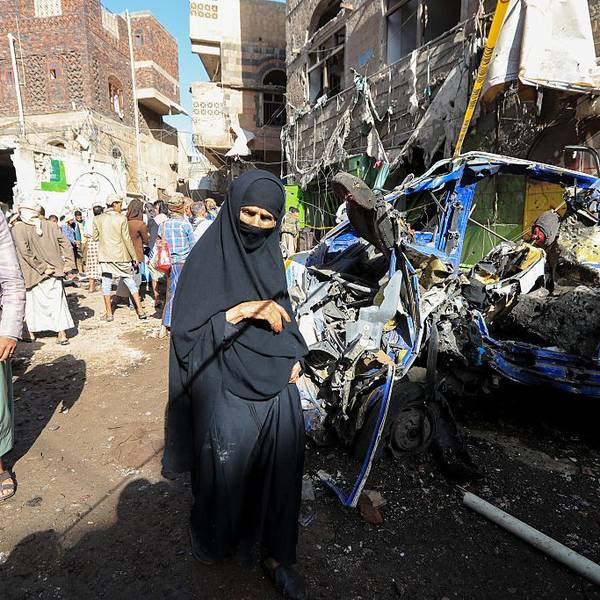
SUBSCRIBE TO OUR FREE NEWSLETTER
Daily news & progressive opinion—funded by the people, not the corporations—delivered straight to your inbox.
5
#000000
#FFFFFF
To donate by check, phone, or other method, see our More Ways to Give page.
Daily news & progressive opinion—funded by the people, not the corporations—delivered straight to your inbox.
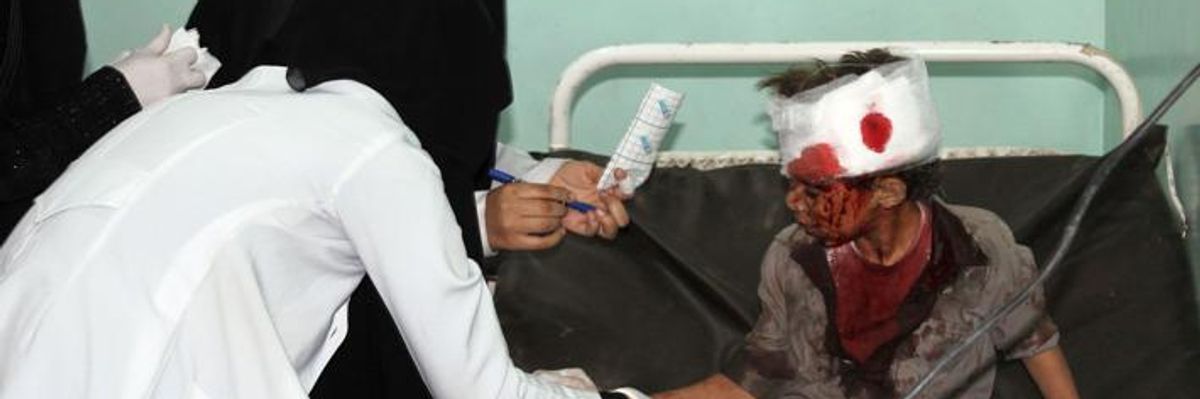
"According to the International Committee of the Red Cross, at least twenty-nine of those killed were children under the age of fifteen, and forty-eight people were wounded, including thirty children." (Photo: BBC News)
On August 9, a U.S.-supported Saudi airstrike bombed a bus carrying schoolchildren in Sa'ada, a city in northern Yemen. The New York Times reported that the students were on a recreational trip. According to the Sa'ada health department, the attack killed at least forty-three people.
According to the International Committee of the Red Cross, at least twenty-nine of those killed were children under the age of fifteen, and forty-eight people were wounded, including thirty children.
CNN aired horrifying, heartbreaking footage of children who survived the attack being treated in an emergency room. One of the children, carrying his UNICEF issued blue backpack, is covered with blood and badly burned.
U.S. companies such as Raytheon, General Dynamics, Boeing, and Lockheed Martin have sold billions of dollars' worth of weapons to Saudi Arabia, the United Arab Emirates and other countries in the Saudi-Emirati-led coalition which is attacking Yemen.
Commenting on the tragedy, CNN's senior correspondent Nima Elbagir emphasized that she had seen unaired video which was even worse than what the CNN segment showed. She then noted that conditions could worsen because Yemen's vital port of Hodeidah, the only port currently functioning in Yemen, has been under attack for weeks of protracted Saudi coalition-led airstrikes. Ms. Elbagir described the port of Hodeidah as "the only lifeline to bring in supplies to Yemen."
"This conflict is backed by the U.S. and the U.K.," Elbagir said, concluding her report with, "They are in full support of the Saudi-led activities in Yemen today."
U.S. companies such as Raytheon, General Dynamics, Boeing, and Lockheed Martin have sold billions of dollars' worth of weapons to Saudi Arabia, the United Arab Emirates and other countries in the Saudi-Emirati-led coalition which is attacking Yemen.
The U.S. military refuels Saudi and Emirati warplanes through midair exercises. And, the United States helps the Saudi coalition warmakers choose their targets.
Isa Blumi, an associate professor at Stockholm University and author of the book Destroying Yemen, has said the United States is "front and center responsible" for the Saudi coalition attacks.
Looking for a helpful way to describe U.S. support for the Saudi-Emirati operation in Yemen, journalist Samuel Oakford recently offered this comparison: "If an airstrike was a drive-by and killed someone, the U.S. provided the car, the wheels, the servicing and repair, the gun, the bullets, help with maintenance of those--and the gas."
The August 9 attack against children and other civilians follows a tragic and sordid list of Saudi-Emirati attacks causing carnage and extreme affliction in Yemen. On June 12, Doctors Without Borders reported an airstrike which destroyed its newly constructed facility for treatment of cholera, in the town of Abs, built in anticipation of a third epidemic outbreak of cholera in Yemen.
Professor Isa Blumi believes the goal is to bludgeon Yemenis into complete submission and exert control over "a gold mine" of resources, including oil reserves, natural gas, minerals, and a strategic location.
Scores of people were killed and wounded in an August 3 attack near the entrance to the port of Hodeidah's Al Thawra hospital. Analysts examining the munitions used in the attack believe the killing and destruction was caused when United Arab Emirates forces situated near the Hodeidah airport fired mortars into the area.
Why have the Saudis and Emiratis led a coalition attacking Yemen, the poorest country in the Arab peninsula, since March of 2015?
Professor Isa Blumi believes the goal is to bludgeon Yemenis into complete submission and exert control over "a gold mine" of resources, including oil reserves, natural gas, minerals, and a strategic location. Blumi notes that the war against Yemen costs the Kingdom of Saudi Arabia 200 million dollars per day, yet Saudi Arabia's Crown Prince Mohammed bin Salman, who commented that a prolonged war is in the interests of Saudi Arabia, seems to believe the cost is worth it, considering potential future gains.
Business profits seem to also motivate U.S. weapon companies that continue benefiting from weapon sales to the Saudi-Emirati led coalition.
The United States is deeply implicated in the appalling carnage in Yemen. It is our responsibility as citizens to do what we can to demand an end to this complicity.
Dear Common Dreams reader, It’s been nearly 30 years since I co-founded Common Dreams with my late wife, Lina Newhouser. We had the radical notion that journalism should serve the public good, not corporate profits. It was clear to us from the outset what it would take to build such a project. No paid advertisements. No corporate sponsors. No millionaire publisher telling us what to think or do. Many people said we wouldn't last a year, but we proved those doubters wrong. Together with a tremendous team of journalists and dedicated staff, we built an independent media outlet free from the constraints of profits and corporate control. Our mission has always been simple: To inform. To inspire. To ignite change for the common good. Building Common Dreams was not easy. Our survival was never guaranteed. When you take on the most powerful forces—Wall Street greed, fossil fuel industry destruction, Big Tech lobbyists, and uber-rich oligarchs who have spent billions upon billions rigging the economy and democracy in their favor—the only bulwark you have is supporters who believe in your work. But here’s the urgent message from me today. It's never been this bad out there. And it's never been this hard to keep us going. At the very moment Common Dreams is most needed, the threats we face are intensifying. We need your support now more than ever. We don't accept corporate advertising and never will. We don't have a paywall because we don't think people should be blocked from critical news based on their ability to pay. Everything we do is funded by the donations of readers like you. When everyone does the little they can afford, we are strong. But if that support retreats or dries up, so do we. Will you donate now to make sure Common Dreams not only survives but thrives? —Craig Brown, Co-founder |
On August 9, a U.S.-supported Saudi airstrike bombed a bus carrying schoolchildren in Sa'ada, a city in northern Yemen. The New York Times reported that the students were on a recreational trip. According to the Sa'ada health department, the attack killed at least forty-three people.
According to the International Committee of the Red Cross, at least twenty-nine of those killed were children under the age of fifteen, and forty-eight people were wounded, including thirty children.
CNN aired horrifying, heartbreaking footage of children who survived the attack being treated in an emergency room. One of the children, carrying his UNICEF issued blue backpack, is covered with blood and badly burned.
U.S. companies such as Raytheon, General Dynamics, Boeing, and Lockheed Martin have sold billions of dollars' worth of weapons to Saudi Arabia, the United Arab Emirates and other countries in the Saudi-Emirati-led coalition which is attacking Yemen.
Commenting on the tragedy, CNN's senior correspondent Nima Elbagir emphasized that she had seen unaired video which was even worse than what the CNN segment showed. She then noted that conditions could worsen because Yemen's vital port of Hodeidah, the only port currently functioning in Yemen, has been under attack for weeks of protracted Saudi coalition-led airstrikes. Ms. Elbagir described the port of Hodeidah as "the only lifeline to bring in supplies to Yemen."
"This conflict is backed by the U.S. and the U.K.," Elbagir said, concluding her report with, "They are in full support of the Saudi-led activities in Yemen today."
U.S. companies such as Raytheon, General Dynamics, Boeing, and Lockheed Martin have sold billions of dollars' worth of weapons to Saudi Arabia, the United Arab Emirates and other countries in the Saudi-Emirati-led coalition which is attacking Yemen.
The U.S. military refuels Saudi and Emirati warplanes through midair exercises. And, the United States helps the Saudi coalition warmakers choose their targets.
Isa Blumi, an associate professor at Stockholm University and author of the book Destroying Yemen, has said the United States is "front and center responsible" for the Saudi coalition attacks.
Looking for a helpful way to describe U.S. support for the Saudi-Emirati operation in Yemen, journalist Samuel Oakford recently offered this comparison: "If an airstrike was a drive-by and killed someone, the U.S. provided the car, the wheels, the servicing and repair, the gun, the bullets, help with maintenance of those--and the gas."
The August 9 attack against children and other civilians follows a tragic and sordid list of Saudi-Emirati attacks causing carnage and extreme affliction in Yemen. On June 12, Doctors Without Borders reported an airstrike which destroyed its newly constructed facility for treatment of cholera, in the town of Abs, built in anticipation of a third epidemic outbreak of cholera in Yemen.
Professor Isa Blumi believes the goal is to bludgeon Yemenis into complete submission and exert control over "a gold mine" of resources, including oil reserves, natural gas, minerals, and a strategic location.
Scores of people were killed and wounded in an August 3 attack near the entrance to the port of Hodeidah's Al Thawra hospital. Analysts examining the munitions used in the attack believe the killing and destruction was caused when United Arab Emirates forces situated near the Hodeidah airport fired mortars into the area.
Why have the Saudis and Emiratis led a coalition attacking Yemen, the poorest country in the Arab peninsula, since March of 2015?
Professor Isa Blumi believes the goal is to bludgeon Yemenis into complete submission and exert control over "a gold mine" of resources, including oil reserves, natural gas, minerals, and a strategic location. Blumi notes that the war against Yemen costs the Kingdom of Saudi Arabia 200 million dollars per day, yet Saudi Arabia's Crown Prince Mohammed bin Salman, who commented that a prolonged war is in the interests of Saudi Arabia, seems to believe the cost is worth it, considering potential future gains.
Business profits seem to also motivate U.S. weapon companies that continue benefiting from weapon sales to the Saudi-Emirati led coalition.
The United States is deeply implicated in the appalling carnage in Yemen. It is our responsibility as citizens to do what we can to demand an end to this complicity.
On August 9, a U.S.-supported Saudi airstrike bombed a bus carrying schoolchildren in Sa'ada, a city in northern Yemen. The New York Times reported that the students were on a recreational trip. According to the Sa'ada health department, the attack killed at least forty-three people.
According to the International Committee of the Red Cross, at least twenty-nine of those killed were children under the age of fifteen, and forty-eight people were wounded, including thirty children.
CNN aired horrifying, heartbreaking footage of children who survived the attack being treated in an emergency room. One of the children, carrying his UNICEF issued blue backpack, is covered with blood and badly burned.
U.S. companies such as Raytheon, General Dynamics, Boeing, and Lockheed Martin have sold billions of dollars' worth of weapons to Saudi Arabia, the United Arab Emirates and other countries in the Saudi-Emirati-led coalition which is attacking Yemen.
Commenting on the tragedy, CNN's senior correspondent Nima Elbagir emphasized that she had seen unaired video which was even worse than what the CNN segment showed. She then noted that conditions could worsen because Yemen's vital port of Hodeidah, the only port currently functioning in Yemen, has been under attack for weeks of protracted Saudi coalition-led airstrikes. Ms. Elbagir described the port of Hodeidah as "the only lifeline to bring in supplies to Yemen."
"This conflict is backed by the U.S. and the U.K.," Elbagir said, concluding her report with, "They are in full support of the Saudi-led activities in Yemen today."
U.S. companies such as Raytheon, General Dynamics, Boeing, and Lockheed Martin have sold billions of dollars' worth of weapons to Saudi Arabia, the United Arab Emirates and other countries in the Saudi-Emirati-led coalition which is attacking Yemen.
The U.S. military refuels Saudi and Emirati warplanes through midair exercises. And, the United States helps the Saudi coalition warmakers choose their targets.
Isa Blumi, an associate professor at Stockholm University and author of the book Destroying Yemen, has said the United States is "front and center responsible" for the Saudi coalition attacks.
Looking for a helpful way to describe U.S. support for the Saudi-Emirati operation in Yemen, journalist Samuel Oakford recently offered this comparison: "If an airstrike was a drive-by and killed someone, the U.S. provided the car, the wheels, the servicing and repair, the gun, the bullets, help with maintenance of those--and the gas."
The August 9 attack against children and other civilians follows a tragic and sordid list of Saudi-Emirati attacks causing carnage and extreme affliction in Yemen. On June 12, Doctors Without Borders reported an airstrike which destroyed its newly constructed facility for treatment of cholera, in the town of Abs, built in anticipation of a third epidemic outbreak of cholera in Yemen.
Professor Isa Blumi believes the goal is to bludgeon Yemenis into complete submission and exert control over "a gold mine" of resources, including oil reserves, natural gas, minerals, and a strategic location.
Scores of people were killed and wounded in an August 3 attack near the entrance to the port of Hodeidah's Al Thawra hospital. Analysts examining the munitions used in the attack believe the killing and destruction was caused when United Arab Emirates forces situated near the Hodeidah airport fired mortars into the area.
Why have the Saudis and Emiratis led a coalition attacking Yemen, the poorest country in the Arab peninsula, since March of 2015?
Professor Isa Blumi believes the goal is to bludgeon Yemenis into complete submission and exert control over "a gold mine" of resources, including oil reserves, natural gas, minerals, and a strategic location. Blumi notes that the war against Yemen costs the Kingdom of Saudi Arabia 200 million dollars per day, yet Saudi Arabia's Crown Prince Mohammed bin Salman, who commented that a prolonged war is in the interests of Saudi Arabia, seems to believe the cost is worth it, considering potential future gains.
Business profits seem to also motivate U.S. weapon companies that continue benefiting from weapon sales to the Saudi-Emirati led coalition.
The United States is deeply implicated in the appalling carnage in Yemen. It is our responsibility as citizens to do what we can to demand an end to this complicity.