SUBSCRIBE TO OUR FREE NEWSLETTER
Daily news & progressive opinion—funded by the people, not the corporations—delivered straight to your inbox.
5
#000000
#FFFFFF
To donate by check, phone, or other method, see our More Ways to Give page.
Daily news & progressive opinion—funded by the people, not the corporations—delivered straight to your inbox.
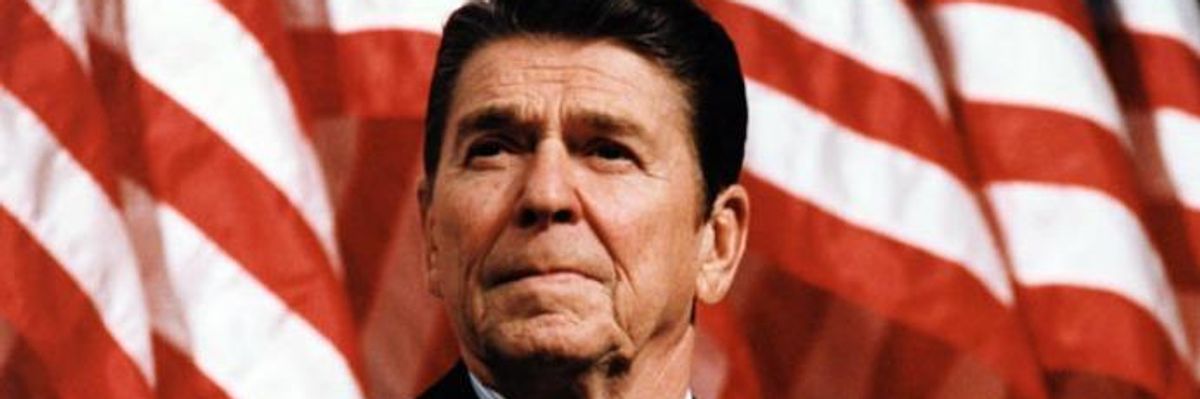
"With his sneering disrespect for government," writes Sachs, "Reagan ushered in nearly four decades of tax cuts, deregulation, and rising inequality that now threaten to devour our future." (Image: Marion Ross/flickr/cc)
As they return from the July Fourth break, the Republican leadership is twisting in agony on the Obamacare repeal and it couldn't happen to a more miserable bunch. President Trump, House Speaker Paul Ryan, and Senate majority leader Mitch McConnell have been trying to jam through a deeply unpopular and cruel piece of legislation, but for once the public is being heard over the lobbyists. And the public is shouting a loud and hopefully decisive "no." But the problem is deeper than health care, and goes back to Ronald Reagan's great lie.
As they return from the July Fourth break, the Republican leadership is twisting in agony on the Obamacare repeal and it couldn't happen to a more miserable bunch. President Trump, House Speaker Paul Ryan, and Senate majority leader Mitch McConnell have been trying to jam through a deeply unpopular and cruel piece of legislation, but for once the public is being heard over the lobbyists. And the public is shouting a loud and hopefully decisive "no." But the problem is deeper than health care, and goes back to Ronald Reagan's great lie.
Our current political travails can be traced to Reagan. In his jovial way, Reagan would quip, "The nine most terrifying words in the English language are, 'I'm from the government and I'm here to help.'" With his sneering disrespect for government, Reagan ushered in nearly four decades of tax cuts, deregulation, and rising inequality that now threaten to devour our future. Trump, Ryan, and McConnell are the scheming and vacuous politicians at the end of a long process of decline.
Aristotle invented the Western study of political science; in his view, politics was about the community expressing its common interests and promoting virtues among the citizenry. It was a vision the Founding Fathers well understood. Yet somehow that positive view became transposed in today's right-wing political thought into the idea that government is inherently evil and must be vanquished.
It's not hard to find the peculiar American roots of this extremist view. The country was born in a rebellion against a monarch. America's great diversity led constantly to calls for limited government, especially from the slave-owning southern states that championed "states' rights" to try to keep the federal government off their backs. Historians have been clear that the current wave of anti-federal sentiments emerged in the South and West in response to the civil rights movement of the 1950s and 1960s. Yet something more happened as well.
In the 1960s few Americans would have understood Reagan's quip about government being terrifying. The federal government had won the war, developed the atomic bomb, put Americans into space, and built the greatest ribbons of highways in the world. The federal government had promoted dazzling technological breakthroughs in medicine, space, telecommunications, and other areas.
What changed was the marriage of anti-civil rights politics in the South, West, rural America, and the suburbs, with big money in politics. Presidential aspirants had always had their financial backers. But with the advent of expensive television ads, mass mailings, and big data, campaigns became expensive. Big campaign money flooded in and federal politics became the playground of billionaires.
And nobody played it better than David and Charles Koch. They played the long game. With their lavish funding of libertarian think tanks, advocacy groups, university departments, and political action committees, the Koch Brothers and their brethren (including Robert Mercer, Sheldon Adelson, and the late John Olin) bought the Republican Party and turned it into a radical antigovernment force. It's be all and end all became tax cuts and deregulation.
The deregulation had one more crucial effect. It enabled the rise of "too big to fail" businesses, and their lobbies in four key sectors: Big Oil, Wall Street, Big Health, and Big Armaments. Antitrust became a dead letter. The billionaires successfully championed tax cuts, deregulation, and deregulated companies that became more influential than government itself, and that when necessary could call on the federal government to do their bidding.
The Democrats, of course, have their own watered-down version of the same phenomenon. Wall Street, for example, proved to be an equal-opportunity employer of politicians of both parties.
The stunning result is this: A small group of wealthy interests has hijacked the federal government, driving policies that are strongly against public opinion and the public good. Legislation is drafted in secret, pushed without deliberation, and if possible, adopted without regard for the voters. This is obviously the case with the Obamacare repeal, but it's also true regarding climate change, environmental protection, tax cuts for the rich, antitrust enforcement, and foreign policy.
Obamacare repeal and the Trump agenda have exposed the big lie. Yes, the Koch Brothers have bought the Republican majority, but the policies they espouse, such as slashing health care coverage, are not the policies desired by the American people. We are therefore at a reckoning.
My own belief? We will soon swing back to an era of grass-roots democracy, led especially by young people, in which public activism will trump big money in politics. Stay tuned.
Dear Common Dreams reader, It’s been nearly 30 years since I co-founded Common Dreams with my late wife, Lina Newhouser. We had the radical notion that journalism should serve the public good, not corporate profits. It was clear to us from the outset what it would take to build such a project. No paid advertisements. No corporate sponsors. No millionaire publisher telling us what to think or do. Many people said we wouldn't last a year, but we proved those doubters wrong. Together with a tremendous team of journalists and dedicated staff, we built an independent media outlet free from the constraints of profits and corporate control. Our mission has always been simple: To inform. To inspire. To ignite change for the common good. Building Common Dreams was not easy. Our survival was never guaranteed. When you take on the most powerful forces—Wall Street greed, fossil fuel industry destruction, Big Tech lobbyists, and uber-rich oligarchs who have spent billions upon billions rigging the economy and democracy in their favor—the only bulwark you have is supporters who believe in your work. But here’s the urgent message from me today. It's never been this bad out there. And it's never been this hard to keep us going. At the very moment Common Dreams is most needed, the threats we face are intensifying. We need your support now more than ever. We don't accept corporate advertising and never will. We don't have a paywall because we don't think people should be blocked from critical news based on their ability to pay. Everything we do is funded by the donations of readers like you. When everyone does the little they can afford, we are strong. But if that support retreats or dries up, so do we. Will you donate now to make sure Common Dreams not only survives but thrives? —Craig Brown, Co-founder |
As they return from the July Fourth break, the Republican leadership is twisting in agony on the Obamacare repeal and it couldn't happen to a more miserable bunch. President Trump, House Speaker Paul Ryan, and Senate majority leader Mitch McConnell have been trying to jam through a deeply unpopular and cruel piece of legislation, but for once the public is being heard over the lobbyists. And the public is shouting a loud and hopefully decisive "no." But the problem is deeper than health care, and goes back to Ronald Reagan's great lie.
Our current political travails can be traced to Reagan. In his jovial way, Reagan would quip, "The nine most terrifying words in the English language are, 'I'm from the government and I'm here to help.'" With his sneering disrespect for government, Reagan ushered in nearly four decades of tax cuts, deregulation, and rising inequality that now threaten to devour our future. Trump, Ryan, and McConnell are the scheming and vacuous politicians at the end of a long process of decline.
Aristotle invented the Western study of political science; in his view, politics was about the community expressing its common interests and promoting virtues among the citizenry. It was a vision the Founding Fathers well understood. Yet somehow that positive view became transposed in today's right-wing political thought into the idea that government is inherently evil and must be vanquished.
It's not hard to find the peculiar American roots of this extremist view. The country was born in a rebellion against a monarch. America's great diversity led constantly to calls for limited government, especially from the slave-owning southern states that championed "states' rights" to try to keep the federal government off their backs. Historians have been clear that the current wave of anti-federal sentiments emerged in the South and West in response to the civil rights movement of the 1950s and 1960s. Yet something more happened as well.
In the 1960s few Americans would have understood Reagan's quip about government being terrifying. The federal government had won the war, developed the atomic bomb, put Americans into space, and built the greatest ribbons of highways in the world. The federal government had promoted dazzling technological breakthroughs in medicine, space, telecommunications, and other areas.
What changed was the marriage of anti-civil rights politics in the South, West, rural America, and the suburbs, with big money in politics. Presidential aspirants had always had their financial backers. But with the advent of expensive television ads, mass mailings, and big data, campaigns became expensive. Big campaign money flooded in and federal politics became the playground of billionaires.
And nobody played it better than David and Charles Koch. They played the long game. With their lavish funding of libertarian think tanks, advocacy groups, university departments, and political action committees, the Koch Brothers and their brethren (including Robert Mercer, Sheldon Adelson, and the late John Olin) bought the Republican Party and turned it into a radical antigovernment force. It's be all and end all became tax cuts and deregulation.
The deregulation had one more crucial effect. It enabled the rise of "too big to fail" businesses, and their lobbies in four key sectors: Big Oil, Wall Street, Big Health, and Big Armaments. Antitrust became a dead letter. The billionaires successfully championed tax cuts, deregulation, and deregulated companies that became more influential than government itself, and that when necessary could call on the federal government to do their bidding.
The Democrats, of course, have their own watered-down version of the same phenomenon. Wall Street, for example, proved to be an equal-opportunity employer of politicians of both parties.
The stunning result is this: A small group of wealthy interests has hijacked the federal government, driving policies that are strongly against public opinion and the public good. Legislation is drafted in secret, pushed without deliberation, and if possible, adopted without regard for the voters. This is obviously the case with the Obamacare repeal, but it's also true regarding climate change, environmental protection, tax cuts for the rich, antitrust enforcement, and foreign policy.
Obamacare repeal and the Trump agenda have exposed the big lie. Yes, the Koch Brothers have bought the Republican majority, but the policies they espouse, such as slashing health care coverage, are not the policies desired by the American people. We are therefore at a reckoning.
My own belief? We will soon swing back to an era of grass-roots democracy, led especially by young people, in which public activism will trump big money in politics. Stay tuned.
As they return from the July Fourth break, the Republican leadership is twisting in agony on the Obamacare repeal and it couldn't happen to a more miserable bunch. President Trump, House Speaker Paul Ryan, and Senate majority leader Mitch McConnell have been trying to jam through a deeply unpopular and cruel piece of legislation, but for once the public is being heard over the lobbyists. And the public is shouting a loud and hopefully decisive "no." But the problem is deeper than health care, and goes back to Ronald Reagan's great lie.
Our current political travails can be traced to Reagan. In his jovial way, Reagan would quip, "The nine most terrifying words in the English language are, 'I'm from the government and I'm here to help.'" With his sneering disrespect for government, Reagan ushered in nearly four decades of tax cuts, deregulation, and rising inequality that now threaten to devour our future. Trump, Ryan, and McConnell are the scheming and vacuous politicians at the end of a long process of decline.
Aristotle invented the Western study of political science; in his view, politics was about the community expressing its common interests and promoting virtues among the citizenry. It was a vision the Founding Fathers well understood. Yet somehow that positive view became transposed in today's right-wing political thought into the idea that government is inherently evil and must be vanquished.
It's not hard to find the peculiar American roots of this extremist view. The country was born in a rebellion against a monarch. America's great diversity led constantly to calls for limited government, especially from the slave-owning southern states that championed "states' rights" to try to keep the federal government off their backs. Historians have been clear that the current wave of anti-federal sentiments emerged in the South and West in response to the civil rights movement of the 1950s and 1960s. Yet something more happened as well.
In the 1960s few Americans would have understood Reagan's quip about government being terrifying. The federal government had won the war, developed the atomic bomb, put Americans into space, and built the greatest ribbons of highways in the world. The federal government had promoted dazzling technological breakthroughs in medicine, space, telecommunications, and other areas.
What changed was the marriage of anti-civil rights politics in the South, West, rural America, and the suburbs, with big money in politics. Presidential aspirants had always had their financial backers. But with the advent of expensive television ads, mass mailings, and big data, campaigns became expensive. Big campaign money flooded in and federal politics became the playground of billionaires.
And nobody played it better than David and Charles Koch. They played the long game. With their lavish funding of libertarian think tanks, advocacy groups, university departments, and political action committees, the Koch Brothers and their brethren (including Robert Mercer, Sheldon Adelson, and the late John Olin) bought the Republican Party and turned it into a radical antigovernment force. It's be all and end all became tax cuts and deregulation.
The deregulation had one more crucial effect. It enabled the rise of "too big to fail" businesses, and their lobbies in four key sectors: Big Oil, Wall Street, Big Health, and Big Armaments. Antitrust became a dead letter. The billionaires successfully championed tax cuts, deregulation, and deregulated companies that became more influential than government itself, and that when necessary could call on the federal government to do their bidding.
The Democrats, of course, have their own watered-down version of the same phenomenon. Wall Street, for example, proved to be an equal-opportunity employer of politicians of both parties.
The stunning result is this: A small group of wealthy interests has hijacked the federal government, driving policies that are strongly against public opinion and the public good. Legislation is drafted in secret, pushed without deliberation, and if possible, adopted without regard for the voters. This is obviously the case with the Obamacare repeal, but it's also true regarding climate change, environmental protection, tax cuts for the rich, antitrust enforcement, and foreign policy.
Obamacare repeal and the Trump agenda have exposed the big lie. Yes, the Koch Brothers have bought the Republican majority, but the policies they espouse, such as slashing health care coverage, are not the policies desired by the American people. We are therefore at a reckoning.
My own belief? We will soon swing back to an era of grass-roots democracy, led especially by young people, in which public activism will trump big money in politics. Stay tuned.