

SUBSCRIBE TO OUR FREE NEWSLETTER
Daily news & progressive opinion—funded by the people, not the corporations—delivered straight to your inbox.
5
#000000
#FFFFFF
To donate by check, phone, or other method, see our More Ways to Give page.

Daily news & progressive opinion—funded by the people, not the corporations—delivered straight to your inbox.
We need, and can have, a giant rally—or several giant rallies, it’s a big country!—where speakers loudly and passionately make the case about the Trump administration attacking U.S. democracy and selling out regular working people to the whims of the rich.
Given everything that the Trump administration is doing right now, this country needs massive rallies opposing his actions and his authoritarianism.
Ezra Klein recently wrote in The New York Times that Donald Trump was actually rather weak. He is overreaching, doing decrees because he can’t make them law, and that we must simply “not believe” that he is the omnipotent power he now proclaims himself to be. Believing this, as so many clearly do, is disempowering, as the natural response then is to hide instead of act.
I sympathize with the argument. The all-out attack on our system may represent overreach. Not everything that Trump has ordered will come to pass. But it’s vitally important that people not calm down too much out of faith that the democratic system will somehow defend itself.
I am familiar with right-wing authoritarian power grabs in Eastern Europe. I wrote a book anticipating the triumph of the radical right in Poland soon before it actually happened. What Jarosław Kaczyński did in Poland and Viktor Orbán in Hungary took longer to do than what Trump (and Musk and others) are trying to do right now.
In 2017 I attended a panel at the national political science conference where a group of constitutional scholars all agreed that a U.S. president can basically do whatever he wants—far more quickly than a European prime minister can do—and that judicial checks on such behavior, if they come at all, come far later, sometimes too late even to matter. Add to this the fact that Trump, via Vice President J.D. Vance, has all but said he won’t abide by court decisions he doesn’t like. (We should expect the response to any judicial pushback will be classic Trump: he’ll first say the decision is ridiculous and radical and he won’t abide by it, then to get the pro-Trump moderates to calm down he’ll promise to follow the law, and finally, in practice, he’ll ignore the courts.)
The only way to stop this – at least the only way to begin to stop this – is mass protest.
I was in Poland in the months after the Law and Justice party, led by Kaczyński, came to power in 2015 and started on the same new authoritarian path that Orban in Hungary and now Trump is following in the United States. Within weeks citizens organized massive demonstrations in Warsaw and elsewhere. A group called The Committee to Defend Democracy organized them, and sympathetic press publicized them.
I was at these demos. The Poles who attended were being beside themselves when they discovered just how many people had also shown up! No, it did not change any policy, at the moment. But it served the vital purpose of keeping up resistance, which has begun to pay off. The anti-Kaczyński opposition won parliamentary elections a year ago.
It’s now February. The Democrats are doing what they’re doing in Congress and some statehouses. Some protests have taken place outside the Labor Department and in support of the U.S. Agency for International Development. But there haven’t been mass protests. These need to start happening by April or May. At that point even elected Democrats will come (they must not be the organizers!). Such demos will matter—as much if not more than anything matters at this moment. It will be one thing ordinary people can do. The problem right now is that ordinary people are incredibly angry and frustrated, and are being led to believe they can’t do anything, except perhaps to follow the depressing news.
The importance of fighting against helplessness is one of the great lessons from the Polish democratic opposition of the early 1970s. This was a particularly depressing time for the Left in Poland. The official Communist Party authorities had just led the country through their own right-wing national-populist phase. They’d just conducted a massive campaign against Left student radicals as well as Party-affiliated liberals and progressives. And they’d delivered this package with a dose of anti-Semitism, since Jews historically had been the villains for Poland’s radical right (like people of color have been the villains for America’s radical right). They knew that this anti-Semitic campaign would win them strong support from “regular people” always ready to accept some easy answer for their problems and also drive out the liberals still influential in the Party, which would make their populist Right even stronger.
The result was that in the early 1970s, leftists and liberals alike thought the situation was hopeless. And the first thing smart new oppositionists said? When there’s nothing to do, you do something anyway. When the situation seems hopeless, you have to maintain some kind of hope through some kind of action. That’s how the great Solidarity movement, based on the sudden emergence of the new Solidarity trade union, came about in 1980.
Later, when leftists and liberals felt authoritarianism rising after 2015, they marshaled that sentiment once again, and did something. They organized the mass demonstrations that gave people hope by proving to them that millions thought the same way as they did, even if their elected leaders were not yet with them.
Let’s do the same now. We need, and can have, a giant rally—or several giant rallies, it’s a big country!—where speakers loudly and passionately make the case about the Trump administration attacking U.S. democracy and selling out regular working people to the whims of the rich. People will come! And they will learn that there are millions who are as angry as them, and ready to do something about it.
When should these happen? Personally, I think it best to wait a few weeks, since otherwise too many people might accept the Trumpers’ favorite refrain that opposition comes only from those who simply hate him and always want to oppose him. But we can’t wait long. We need giant mass rallies in defense of democracy by spring at the latest.
Who will organize this? Who has access to skilled and well-connected organizers? I don’t. But you’re out there. Let’s get this going!
Without organizing the working class under a shared vision and demand for a more fair and just society, we will remain largely powerless to stop the Trump-led takeover by the billionaire oligarchy.
Trump and Musk are stirring up a resistance movement among liberals and the left. The protests are a righteous struggle against the authoritarian usurpation of lawful power, the reckless, illegal attacks on government agencies, the stripping of DEI programs and language, and the trampling over the rights of immigrants and transgender people.
But what are the goals of this resistance? And do voters outside the liberal bubble support them?
It's time to face up to the harsh reality: Trump’s flurry of activity, at least so far, has made him more popular, not less so, with the American public. Here’s the latest CBS poll:
Progressives emphatically believe that Trump is destroying democracy, but doesn’t democracy have something to do with the will of the people? And what does it mean for democracy if Trump’s actions are broadening his base even beyond those who voted for him? It likely means that a majority of the public does not view Trump as the destroyer of democracy.
Rather than simply coming to the defense of USAID, progressives should organize protests aimed at stopping pharmaceutical price gouging and for promoting price controls on the food cartels.
Trump is broadening his base by doing what he said he would do and thinks he was elected to do. His support is growing because there is a hunger for action that is, at least symbolically, in the people’s interest. Will Trump’s approach improve the outcomes for the working class? That’s doubtful, but there is a desire for defiant action, and they are getting it.
There’s a lesson there. Broadening the base is precisely what progressives must do.
That starts with a recognition that protests alone don’t signal action on behalf of working people. And such displays may be helping Trump increase, not undermine, his support. He may even want to provoke them, because he understands what liberals don’t—that most of the protests will be seen as resistance to change, as support for established elite institutions, and as obstacles to creating a better life for voters.
Think for a second about USAID. Most Americans are not strong supporters of spending billions to aid other countries while needs at home go unmet. As David Axelrod, Obama’s former chief advisor, put it:
“My heart is with the people out on the street outside USAID, but my head tells me: ‘Man, Trump will be well satisfied to have this fight,’ When you talk about cuts, the first thing people say is: ‘Cut foreign aid.’”
What then are the tests to evaluate resistance tactics?
So far, probably not. That’s because progressive protests mostly, if not entirely, involve mobilizing and appealing to those who already agree with liberal positions. There are plenty of people who support these efforts, but not enough.
It will take real effort and imagination to figure out how to promote dialogue that expands the progressive base.
This is not to say that protests to protect the vulnerable are not important. Saving an immigrant child from being ripped out of the classroom and deported is both courageous and humanitarian. But by themselves, most protests only give Trump more ways expand his base.
If progressives want to halt Trump’s authoritarian actions, they will want the Democrats recapture at least one of the Congressional chambers. To do that the progressive base must expand in swing districts.
How should those battles be waged?
We know from the polling done by the Center for Working Class Politics that a strong populist economic message is far more effective than attacking Trump on democracy issues. We also know from the CBS poll that Trump is vulnerable on the high cost of living.
Saving an immigrant child from being ripped out of the classroom and deported is both courageous and humanitarian. But by themselves, most protests only give Trump more ways expand his base.
Rather than simply coming to the defense of USAID, progressives should organize protests aimed at stopping pharmaceutical price gouging and for promoting price controls on the food cartels. As I recently wrote, the Democrats also could put Trump on the defensive by demanding he implement an executive order that prevents government contractors (like Musk) from laying off workers involuntarily.
Progressive activists have the creativity to mobilize protests around price hikes and needless layoffs. But the move from defense to offense will only be possible if they are engaged in dialogue with Trump supporters about an economic platform that protects the livelihoods and economic well-being of working people.
In a fragmented society, this is a heavy lift. More affluent progressives and Trump working-class supporters do not often live in the same areas or share the same spaces. Inflation and job insecurity may not feel as pressing to them as they do to working people. It will take real effort and imagination to figure out how to promote dialogue that expands the progressive base.
The move from defense to offense will only be possible if they are engaged in dialogue with Trump supporters about an economic platform that protects the livelihoods and economic well-being of working people.
In our own small way, the Labor Institute has figured out how to build educational bridges between MAGA workers and others in our Reversing Runaway Inequality training for union members. The participants bring with them a wide range of political preferences, but after an 8-hour workshop they come together to design a common vision for what a society without runaway inequality should look like. It turns out workers from all across the red-blue spectrum have similar ideas about the key elements of a fair and just society.
Then what? That openness won’t translate into Democratic votes unless candidates are willing to put forth a powerful populist economic message that supports workers’ jobs and wages.
It turns out workers from all across the red-blue spectrum have similar ideas about the key elements of a fair and just society.
And there’s the rub: those candidates not only have to mouth the words, but also, they need to believe in the message. To build a bigger base, they must be willing to take on Wall Street and the billionaire class instead of trying to raise money from them.
The alternative? More marches, more chanting, and... more defeats.
Do we want to let Donald Trump rob us of our capacity for happiness for the next four years?
Count on one thing: the next four years are going to be tough. If you can muster the energy for political action while Donald Trump and his minions rule Washington, it will have to be channeled in two ways: first, resisting the worst excesses of him (and his party of billionaires); and second, keeping up the effort to make life truly better for everyone, especially the most vulnerable among us.
Or wait. Should it be the other way around? Could a good offense be the best defense?
At the moment, it’s a question that’s not getting much attention. It may seem all too obvious right now that resistance has to be the top priority. Who could have been surprised by the impassioned pleas to resist when Trump won?
That reflex couldn’t be more natural. No matter how old you are, for as long as you can remember, every president’s critics have focused on resisting the dangers they saw in him, while his supporters hailed him as strong enough to resist the dangers they saw threatening the nation.
Such strength was apparently just what voters wanted in 2024, too. As a New York Times headline summed up the outcome right after Election Day: “America Hires a Strongman.”
Why?
As former President Bill Clinton once explained, “When people are feeling insecure, they’d rather have someone who is strong and wrong rather than somebody who is weak and right.” New York Times columnist Maureen Dowd made the point in a more colorful fashion: “When Americans are scared,” she wrote, they want their president to be “the strong father who protects the home from invaders.”
What dangers? What invaders? Every winning candidate for president gets to fill in those blanks in whatever way he (and yes, it always has been a he) thinks will get him the most votes, any connection with reality being purely optional. So, while Kamala Harris offered quite realistic warnings about threats to democracy, Trump traded on fictional images of “illegal” immigrant murderers and rapists, “big bad” transgender girls threatening oh-so-pure “real” girls, and the “Marxists” heading up the Democratic Party. And, of course, we know who won.
Many voters were clearly scared and insecure. In a recent survey, roughly 80% of Harris’s supporters chose “we must find a way to embrace each other” as their highest priority, while about 70% of Trump’s chose “to protect ourselves.” As sociologist Tressie McMillan Cottom put it, Trump voters have “a deep wellspring of anxiety about their ability to predict their security into the near and distant future. Trump has given [them] a way to direct that anger and that anxiety… in a toxic direction.”
As political scientist Bruce Cain noted, “In the choice between safety and every other policy goal, safety usually wins. In the choice between hope and fear, fear has proven to be more powerful even when the basis for it is grossly exaggerated.” Many reports showed that Trump voters were indeed angry, but after talking to hundreds of people in focus groups, the New York Times’s Patrick Healy concluded that anger and anxiety “were one and the same” emotion.
So, as usual, many fearful voters chose the candidate they saw as strong enough to protect them. Reporter David Corn heard one message over and over from crowds at Trump rallies: “The nation must be Trump-led or all is lost.” And Corn sensed what increasingly fearful Americans want: a version of “strongman government, in which he is the authoritarian savior.” Trump typically claimed that “nobody knows the system better than me, which is why I alone can fix it.” When he listed the ways he would change America in his speeches, making it “strong” and/or “safe” usually came before “great again.”
But it wasn’t just the policies he proposed like “peace through strength” or even the words he used that his voters cared most about. (Trump consistently outperformed Republicans running for Congress who took similar positions and used similar language.) It was the way he projected a mean and nasty personality. When he first ran for president, Trump said, “Every time things get worse, I do better. Because people want strength. We’re going to be so tough and so mean and so nasty.” And that was indeed the image his campaign projected in its advertising. Since the hunger for a strongman only grows in wartime, the Trump campaign happily made the election look like a war, while he even posted a prayer and picture on social media identifying himself with St. Michael battling the demons.
Pundit William Galston notes that the Trump campaign was “convinced that Trump’s intense personal bond with his supporters would do most of the mobilizing work.” GOP pollster Patrick Ruffini thinks that he forged that bond not with his policies but through “his unique style, his unique aesthetic.” (Yes, ugly can be an aesthetic.)
Of course, gender played a role, too. Every dictionary includes the word strongman, but when was the last time you saw strongwoman? And that tells you so much. One study showed that a belief in “hegemonic masculinity” — the idea that men are stronger than women and so should dominate — was the most accurate predictor of who would vote for Trump.
From FDR to Trump
Trump is perhaps the ultimate American politician who has traded on fear and insecurity to look strong and get votes. But the sad fact is that American presidents have been teaching the public to feel threatened and insecure for a long time — at least since Franklin D. Roosevelt entered the White House in 1933 and made it a command center for resisting catastrophe in the midst of the Great Depression.
FDR admitted privately that his New Deal aimed to protect the capitalist system by resisting the threat of socialism, but he couldn’t say that out loud. He felt he could win the public’s confidence by staving off immediate disaster (as he indeed did). In the 1930s, that meant keeping as many Americans as possible out of dire poverty. Two prominent historians have labeled his approach “crisis management,” though he favored the word “security,” which is why the checks we retired folks now get from the government are called “Social Security.”
Once Hitler’s armies had conquered most of Europe, FDR announced that the great threat to national security was no longer the Depression at home but the enemy abroad, though he faced a public reluctant to get involved in war until the Japanese bombed Pearl Harbor. Throughout World War II, he would be seen as the strong father protecting the home from invaders.
Ever since, presidents have tried to take on that role. Lyndon Johnson warned that if we didn’t fight the communists in South Vietnam, we’d end up fighting North Vietnamese invaders in San Francisco. George W. Bush warned that Iraqi leader Saddam Hussein was building a nuclear arsenal that, if we didn’t take out Iraq first, could someday be used on American homes.
Almost every president since FDR has made the mantra of “national security” the nation’s highest value and insisted that staving off the threat of evildoers was the path to such “security,” no matter the price.
In 2016, Donald Trump paved his way to victory with similar language. His innovation (and it was a big one) was to refocus on the “enemy from within” — the immigrants, the transgendered, and above all, the liberals.
When Kamala Harris began her abbreviated campaign, it looked like she might break out of that mold. Her “politics of joy” seemed like a politics of confidence. She spoke and looked like a woman who was afraid of nothing, certainly not Donald Trump.
Yet in the last weeks of the campaign, as hers seemed to be stalling, she turned to the same old story: there’s a danger out there named Donald Trump and you’d better vote for me to protect yourself. Harris was, of course, correct, but the election results tell us that Trump did a better job of convincing voters that he was the one who could best protect our homes from invaders.
If Harris had focused more on bringing positive improvements to the lives of all Americans… who knows?
The Perils of Resistance
On Election Night, as the depressing results rolled in, the Daily Show‘s Jon Stewart cautioned that those of us who see Trump as a great danger should move beyond resistance: “We have to continue to fight and work day in and day out to create the better society for our children, for this world, for this country that we know is possible.” That’s good advice for a lot of reasons.
It may be that simply resisting the world of Donald Trump and trying to prevent the very worst will indeed seem like a full-time job over the next four years, but do we really want to exhaust ourselves that way? Worse yet, the message resisters send is ultimately a negative one: Whatever we may be, we are not that. So, in the years to come, a politics of resistance runs the same risk that befell the Harris campaign. As Harvard pollster John Della Volpe put it: “’Not being Trump’ was never going to be enough.”
What’s more, resistance is all about stopping change. Yes, sometimes change is dangerous and needs to be stopped, but that still makes such resistance inherently conservative. A devotion to preventing the worst will allow the other side to look like the force for change and so define the terms of debate.
Yet, by definition, liberals and progressives are supposed to be that force. Do we really want to cede that to — yes! — Donald Trump?
For now, at least, the lesson of Election Day 2024 is that, in a contest over which party can best protect Americans, the current version of the Republican Party is likely the winner. We’ve learned in the hardest way possible that the Democrats can’t “out-Republican the Republicans,” as Pramila Jayapal, chair of the Congressional Progressive Caucus, put it.
A politics of resistance could end up merely reinforcing the fear driving MAGA-ism’s longing for a strongman. It’s simply not the right message to send to Trump voters if you wish even a small slice of them to change their minds two to four years from now.
It may feel good to focus on Trump’s evils and exclaim, as poet Walt Whitman did about President Franklin Pierce: “Such a rascal and thief in the presidency. This poor scum — the shit-ass! God damn him! — eats dirt and excrement for his daily meals, likes it, and tries to force it on the states.” But to focus solely, or even primarily, on such anger means making Trump the center of our attention. (Exactly what he wants, of course!) Hasn’t he gotten enough attention already?
And do we want to carry all the anger that full-time resistance is likely to breed? Do we want to let Donald Trump rob us of our capacity for happiness for the next four years? We could at least balance our outrage with the sentiment Whitman expressed about President Benjamin Harrison: “I think him mainly a gas bag, the smallest potato in the heap. As long as he remains in office, the aura of the presidency will give him prominence — but after that — oh! what will be his oblivion — utter!”
As the Italian revolutionary philosopher Antonio Gramsci famously put it, in the years to come we could use more “pessimism of the mind and optimism of the will.”
Alternative Vision and Action
Of course, we need to keep up some significant degree of resistance. (I’m definitely not among the astounding 28% of Democratic voters who claimed, in a post-election poll, that they would “support” Trump’s presidency.) But we should heed the words of Barack Obama’s former speechwriter Ben Rhodes: “Democrats must reject the impulse to simply be a resistance that condemns whatever outrageous thing Mr. Trump says. While confronting Mr. Trump when we must, we must also focus on what we stand for. We need to articulate an alternative vision for what kind of democracy comes next.”
Even the New York Times editorial board, hardly the most progressive group around, got the point: “A threat to democracy does not exempt leaders from giving voters a plan for the future that reflects the America they want to live in.”
And we can do more than envision a better future and plan for it during the next four years. Though things may be dreadful in Washington, state and local governments still have significant power to pursue policies to make life better. In my Colorado town, for example, there’s a strong effort to push the city council to raise the minimum wage, a measure our county commissioners, under public pressure, already endorsed. Denver is not only preparing to resist the deportation of undocumented residents but offering them access to city services, modeling what a humane government, one that cares about all its people, actually looks like. And even when politicians won’t act, many states allow citizen-initiated referenda like the ones that secured abortion rights in my state and many others.
Then there’s an endless list of things we can do as individuals. Think of it as “prefigurative politics.” As Catholic Worker founder Dorothy Day put it, the energy we would burn up trying to tear down an oppressive government can be better used by ignoring that government and building “a new civilization within the shell of the old” — new institutions that genuinely serve people.
It also means building new feelings and attitudes. As we face a nightmarish four years of a federal government built on fear and intent on keeping all Americans (other than billionaires) afraid, anything we do to bring more confidence and happiness into our lives is a step in a better direction — for ourselves and the country.
To repeat: Resistance to Trump will certainly be necessary, especially to protect the most vulnerable among us. But any way we can look to a better future and turn that into a present reality is, in a sense, an act of resistance not only to Trump and the Republicans but to the strongman model of politics that led to his recent victory.
Making beautiful art and music, making delicious meals, making friends, making love — those are all ways to preserve the energy we’ll need for political action. They are also ways to show not just the world but ourselves that, whatever the evils from Washington in the next four years, we can continue building the more humane and happier world we want for everyone.
With only 11 months to go, this feels like the political crisis of our lifetimes. Where is the resistance we need?
I finally put up my Christmas lights on Saturday, in a T-shirt with no jacket on a warm December afternoon — a fitting finale to Earth’s hottest year on record. Meanwhile, the world’s life-or-death climate summit is presided over by an oil dictator who insists there is “no science” to support phasing out fossil fuels. For those who wonder if humankind is taking global warming seriously, the joke of holding COP28 in the United Arab Emirates is your answer.
Nearly seven years later, it’s easy to forget how remarkable the first Women’s March that occurred on Jan. 21, 2017, truly was. The most incredible thing was the size of the protest that occurred on the first full day of Donald Trump’s presidency. It’s believed that at least 470,000 people attended the main event in Washington, D.C., but satellite protests across the United States and globally drew an estimated 5 million, likely the largest one-day event in American history.
That success resonated for the next four years, as thousands went back to their hometowns and organized political groups that loosely were hailed as “the Trump resistance” — not only staging local protest events but ultimately knocking on doors and sending out postcards by the millions as Democrats reclaimed the House in 2018 and the White House and Senate in 2020.
But there’s also something else worth remembering about that initial Woman’s March and the early days of those resisters. Their movement was born in the early morning darkness and frustration of Nov. 9, 2016, amid the shock realization that a dangerous demagogue had somehow been elected the 45th president of the United States. The rage that flowered on a chilly January day in a field of pink “(p-word) hats” was in part regret that more had not been done to stop Trump before the election.
Today, Trump is back, and no one calls him a demagogue anymore — because that’s too polite. The 47th presidency he envisions is tyrannical, even dictatorial — siccing zealous MAGA prosecutors on his political enemies and the media, pardoning 2021′s insurrectionists, mass detention camps for deporting migrants, and calling out troops to put down protests, perhaps as early as his Inauguration Day. And yet he is all but guaranteed the GOP nomination, and an even-money bet against President Joe Biden next fall. Even a normally cautious mainstream media is starting to get it.
“Why a Second Trump Presidency May Be More Radical Than His First,” blared Monday’s headline across the New York Times homepage, describing how Team Trump has learned from the failures of its leader’s more outlandish ideas in 2017-21. A super-long Washington Post essay from neocon scholar Robert Kagan — “A Trump dictatorship is increasingly inevitable. We should stop pretending.” — was that paper’s most-read article. Not to be outdone, The Atlantic dropped a special issue with 24 separate stories about the dangers of a Trump 47.
It’s great journalism, but will it make any more difference in 2024 than the supposedly fatal Access Hollywood tape did in 2016? What about the millions of casual voters who don’t know The Atlantic from Popular Mechanics, who’ve convinced themselves that America was better during Trump’s somewhat constrained first term than under Biden in a moment of global chaos?
Even more to the point: Where is “the Trump resistance,” now that we know how truly dangerous the man is — and that he can win again?
Few will argue that some groups have faded and some disappeared after the Democrats’ 2020 victories. Here in Philadelphia, for example, Tuesdays with Toomey is gone, its mission of flipping a Pennsylvania Senate seat accomplished. The American University sociologist Dana Fisher — author of 2019′s American Resistance: From the Women’s March to the Blue Wave — told me “I have been tracking many of the groups and some are shells of what they were” — such as the Women’s March organization — “and others are limping along trying to keep funding.”
But some groups are still going strong, three years after Trump left the White House. Vicki Miller, the group leader of Indivisible Philadelphia, told me her members still chat regularly on Zoom. Although there is the occasional protest — including a boisterous street-corner condemnation on the Jan. 6 insurrection anniversary — the focus is heavily on voter turnout, including postcards and phone banking around last month’s Pennsylvania Supreme Court race won by Democrats, as well as lobbying the state’s U.S. senators. Miller said members still sign up for Door 35, a pledge to knock on at least 35 neighbors’ doors to woo undecided voters.
“It’s sad,” Miller said of those early polls showing Trump tied or narrowly ahead, but she was quick to add, “it doesn’t change what we are doing, which is working our tails off to get Joe Biden and Senator [Bob] Casey elected.” She also believes talking to voters about the things that affect them personally, like reproductive rights or, if done the right way, the economy, is most important — more so than hyping the Trumpian threat to democracy.
Maybe. But with only 11 months to go, this feels like the political crisis of our lifetimes, and I can’t stop wondering if there is more to be done before Election Day. Voter turnout is indeed the most critical, but should there be protests or maybe teach-ins to raise awareness for that true sliver of undecideds? Should there be boycotts of companies whose CEOs support Trump (also known as the Yuengling spit-take)?
As I write this on Monday night, “dictator” is a trending topic on X/Twitter. It could be trending nightly if the too-silent majority of Americans who believe in democracy don’t take a more forceful stand. The moment for resisting Trump is right now, not waiting until Jan. 21, 2025.
The 2022 election is almost over, about one week after the last ballots were cast. It was a surprising and in many ways inspiring result. Despite inflation, fears of crime, and a toxic political atmosphere, voters took the issue of the health of our democracy seriously. Massive efforts by voting rights groups, election officials of both parties, and law enforcement made a big and visible difference. A few key trends will help shape politics going forward.
Rarely does the public speak so clearly on such a precise issue: voters care enough about democracy to reject those who would undermine it.
First, the election was smooth, fair, and calm. Why? Where was the wave of disruption long promised and feared? One notable answer: election officials were prepared. They were trained in de-escalation. Law enforcement at all levels--state and local police, the Departments of Justice and Homeland Security--made clear that attacks on the process would not be tolerated (that, too, is new).
Second, the voters decisively rejected election deniers in their bid to take control of election administration. In six key battleground states--Arizona, Michigan, Nevada, Georgia, Wisconsin, and Pennsylvania--conspiracy theorists ran for offices that would set the terms of the 2024 elections. All were defeated (in Georgia, in the spring primary).
Election denial candidates' losses weren't for lack of resources. A group of megadonors spent tens of millions of dollars to support them, according to Brennan Center research. Nor was it for inconsistency of message. Nearly one in three Facebook posts and one in five tweets from candidates for secretary of state peddled false election narratives, according to the Midterm Monitor, a collaboration by the Brennan Center and the Alliance for Securing Democracy.
These candidates often ran behind others on their same ticket. Thousands of voters in Nevada supported the Republican Senate candidate and the new governor, for example, but voted to reject the secretary of state candidate who said if he and others won, they would "fix" the 2024 election for Donald Trump. Voters who likely had never thought of the topic three years ago chose their candidates with eyes wide open.
To be clear, the fever has not broken entirely. Dozens of legislative and congressional candidates who voiced lies about the 2020 election were elected. At one level, support for election deniers was still shockingly high. Much of that may be attributable to partisanship, though. Rarely does the public speak so clearly on such a precise issue: voters care enough about democracy to reject those who would undermine it.
A third and less widely covered trend was seen in states, too. Voters backed ballot measures to strengthen democracy while generally rejecting those that would restrict access. Connecticut finally adopted early voting. Michigan expanded early and absentee voting while improving identification requirements. Nevadans backed ranked-choice voting and a "top five" finisher model that would give voters more candidates to choose from in a general election, though that plan will require another vote to become law. Voters in Arizona by more than 70 percent backed curbs on "dark money" while likely rejecting a measure to impose harsher voter ID rules. Of note, the upcoming Supreme Court case on the "independent state legislature theory" could upend these and other democracy-strengthening moves.
While turnout was high in the 2022 midterms, this upswing doesn't close the racial turnout gap, as my colleague Kevin Morris reports. According to preliminary data, early in-person and mail voting turnout was higher for white than nonwhite voters in each of the 28 states for which we already have solid individual-level voting data. The gap varied in size, but it was enormous in certain areas. In Texas, about 40 percent of white voters, but only 20 percent of nonwhite voters, cast their ballots before Election Day. We'll have updated data very soon.
And of course, the former president still spouts lies about our democracy, with his possible candidacy backed by millions of Americans.
The bottom line: we have seen, with growing unease, the rise of an antidemocratic election denier movement. In 2022, we saw the emergence of a pro-democracy movement across both parties. That can be the story of American politics going forward--if we make it so.
Tens of thousands of people in the United Kingdom have committed to protest during President Donald Trump's planned visit to London on July 13, with organizers saying a potential post-Brexit U.S.-U.K. trade deal as well as the president's overall agenda and misogynist, racist rhetoric will drive demonstrators into the streets.
London Mayor Sadiq Khan, a longtime critic of Trump's, promised on social media that demonstrations against the president would be welcomed by the city.
Shaista Aziz, organizer with the Stop Trump coalition, appeared on Radio 4 on Friday to explain what her group was planning for Trump's visit:
As leftist journalist and activist Owen Jones declared in a Friday column at the Guardian: "Trump represents an exceptional danger. And that's why we must all march."
The president's previously planned state visit was scaled back to a working visit earlier this year after 1.8 million Brits signed a petition opposing the event.
"If mass protests against Trump's visit also derail a trade deal, it will be a double success." --Nick Dearden, Global Justice Now
The petition was circulated amid outrage over Trump's retweet of an anti-Muslim video posted on Twitter by the far-right fringe group Britain First, an action that drew condemnation from British politicians including Prime Minister Theresa May.
London's demonstration is being planned amid warnings that such protests could harm a potential post-Brexit trade deal between the U.S. and the U.K., with many British people saying they oppose a deal.
"Let's be clear: a trade deal with this man is not a 'prize', it would be a disaster," Nick Dearden of Global Justice Now said in a statement. "If mass protests against Trump's visit also derail a trade deal, it will be a double success. The people of Britain are overwhelmingly opposed to the sort of trade deal Trump will offer, which promises chlorine chicken and a further privatized NHS among many other attacks on U.K. standards and protections."
British food safety experts were aghast earlier this year after the release of a report detailing major safety and hygiene breaches at large meat and poultry plants in the United States.
Britain's Institute for Public Policy Research found recently that 82 percent of the nation's public would rather abandon plans for a trade deal with the U.S. than lower food standards--a step May has refused to rule out in order to push an agreement through.
London has been the site of numerous anti-Trump protests since the president won the 2016 election. Nearly 100,000 were estimated to join the 2017 Women's March in Britain's capital, and tens of thousands turned out two weeks later to march against Trump's proposed travel ban.
"The demonstrations against Trump's visit will be a carnival of resistance," said Dearden. "We will be joining to take a strong stand against Trump's racism, bigotry, misogyny, transphobia--as well as his ultra-corporate trade agenda. At a time when the U.K. government's own treatment of immigrants has been shown to be Trump-like in its crude populism, let's remember that Trump's Muslim ban is still in place. In Britain as in the U.S.A., this politics of hatred and division has no place."
After mobilizing for months in anticipation of a serious obstruction of justice by President Donald Trump, amid Special Counsel Robert Mueller's investigation into Trump's 2016 campaign, more than 300,000 Americans from all 50 states are prepared to loudly protest should the president fire Mueller or Deputy Attorney General Rod Rosenstein.
The president is reportedly considering firing Rosenstein as a warning to Mueller following an FBI raid of the office and residence of Michael Cohen, Trump's personal attorney, on Monday. With Rosenstein's sign-off, Mueller advised federal prosecutors to seize emails and other documents, reportedly related to Cohen's alleged payments to women with whom the president had sexual relationships.
Trump responded to the raid by claiming it showed "attorney-client privilege is dead!" on Twitter, and told reporters that it amounted to "an attack on our country."
Although both Rosenstein and Mueller are Republicans, Trump has insisted for months that the Justice Department's investigation into his campaign's alleged contacts with Russian officials during the presidential campaign is part of a left-wing attack on his administration.
Legal experts believe Trump would need to direct Rosenstein to fire Mueller, and the deputy attorney general has reportedly indicated that he would resign if Trump did so. According to officials who spoke to the Huffington Post, Rosenstein is "the most probable target, if the president acts" in response to the Cohen raid.
"I'd like to make something crystal clear to the president: Mr. President, any attempt to remove Rod Rosenstein will create the exact same constitutional crisis as if you fired special counsel Bob Mueller," Senate Minority Leader Chuck Schumer (D-N.Y.) said on Tuesday.
MoveOn.org has been mobilizing for months to stage nationwide protests in the event of Mueller's dismissal, resulting in more than 800 planned demonstrations that Americans are prepared to attend.
"If Trump fires special counsel Robert Mueller, it will create a constitutional crisis. The same goes for other ways he could attempt to end or compromise the investigation," reads the call to action on the organization's website, where a map shows every city where Americans can join protests that would begin directly after Trump fires one or more of the Justice Department officials. "Our response in the hours following a potential power grab will dictate what happens next--whether Congress will stand up to Trump or allow him to move our democracy toward authoritarianism."
The protests are being sponsored by a number of organizations, including MoveOn.org, Public Citizen, Stand Up America, Indivisible, The Arena, Common Cause, #MarchForTruth, Pantsuit Nation, People for the American Way, Every Voice, Common Defense, Together We Will, Working Families Party, Demos, Free Speech for People, Democracy 21, NextGen America, Women's March, and more.
This list is provided by MoveOn.org and you can see the most updated list here.
The Trump administration has given way to an unusually engaged public, with one in five Americans reporting in a new survey that they've attended a protest or rally since 2016--and 70 percent of those who rallied said they disapproved of President Donald Trump and his policies.
The poll, by the Washington Post and Kaiser Family Foundation, showed that political activism is new for many. About 19 percent of those who have demonstrated in the past two years said they had never been to a protest before 2016.
The numbers show a significant shift from just a few years ago. In 2009, the Pew Research Center found that only about four percent of Americans had participated in an organized political demonstration.
The survey "confirms there is a resistance and that a lot of people want to be associated with it," Michael Kazin, a history professor at Georgetown University and editor of Dissent magazine, told the Washington Post.
About 46 percent of respondents said they had been to demonstrations focusing on women's rights. The environment, immigration policy, and LGBTQ rights were also top issues Americans rallied for, according to the poll.
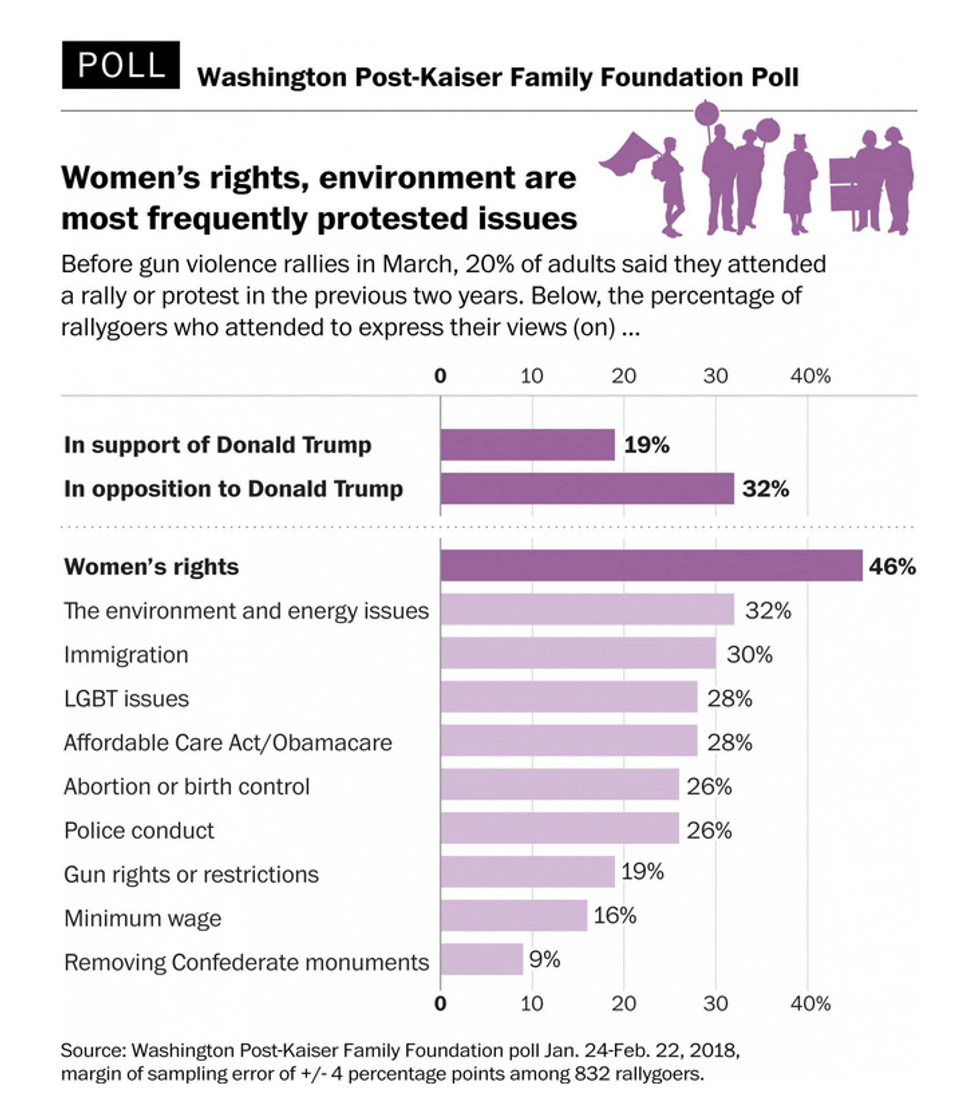
The survey took place this past January and February, just before widespread anti-gun violence mobilizations followed the shooting in February at Marjory Stoneman Douglas High School in Parkland, Fla. Teenage students led an estimated 800 "March for Our Lives" rallies across the nation on March 24, and thousands of students staged walkouts on March 14, demanding stricter gun control legislation.
In recent weeks, teachers and education supporters in Oklahoma, West Virginia, and Kentucky have also taken part in actions after years of corporate tax cuts have left teachers without raises and students struggling in underfunded and neglected schools.
On Thursday, hundreds of people voiced outrage after the latest fatal shooting of an unarmed black man, Saheed Vassell, by a police officer in Brooklyn, N.Y.--days after similar protests after the killing of Stephon Clark in Sacramento, Calif.
Other explosive issues in the past year have included the Republican Party's repeated attempts to repeal the Affordable Care Act last summer, which were stymied in large part thanks to protests led by the disability rights group ADAPT; and the Trump administration's attacks on women's rights as well as the president's admitted history of sexually assaulting women, which played a role in driving an estimated four million Americans to attend the Women's March on January 21, 2017--the largest protest in American history.
The momentum shows no sign of waning as the 2018 midterm elections draw near. Eighty-three percent of those surveyed said they intend to vote on election day, and a third said they plan to work or volunteer for a political campaign.
A movement without memory is adrift. And a movement that picks the wrong heroes is lost.
Two milestones should serve as reminders to self-styled members of the Resistance. One marks a turning point in the life of an ill-chosen hero. The other is a reminder that true heroism calls for self-awareness, self-confidence, and self-sacrifice.
We'll get to those milestones. But first there's the matter of torture.
Donald Trump has nominated Gina Haspel to run the Central Intelligence Agency. Haspel, a career intelligence operative, led torture operations and ran a CIA "black site" in Thailand which was used to interrogate suspected Al Quaeda members after 9/11. She also signed the order to destroy the videotaped evidence of the agency's illegal acts, which itself appears to have been illegal.
Haspel was apparently present for the torture of a detainee named Abd al-Rahim al-Nashiri, (It was incorrectly reported that she was also present for the torture of Abu Zubaydah, a more famous prisoner.) There have even been calls for Haspel's arrest.
As CIA whistleblower John Kiriakou wrote in a Washington Post op-ed:
"The message this sends to the CIA workforce is simple: Engage in war crimes, in crimes against humanity, and you'll get promoted. Don't worry about the law. Don't worry about ethics. Don't worry about morality or the fact that torture doesn't even work. Go ahead and do it anyway. We'll cover for you. And you can destroy the evidence, too."
Sen. Dianne Feinstein, a member of the Senate Select Committee on Intelligence, notes that Haspel "was involved in one of the darkest chapters in American history' and has called on the CIA to declassify documents regarding her role in overseeing torture.
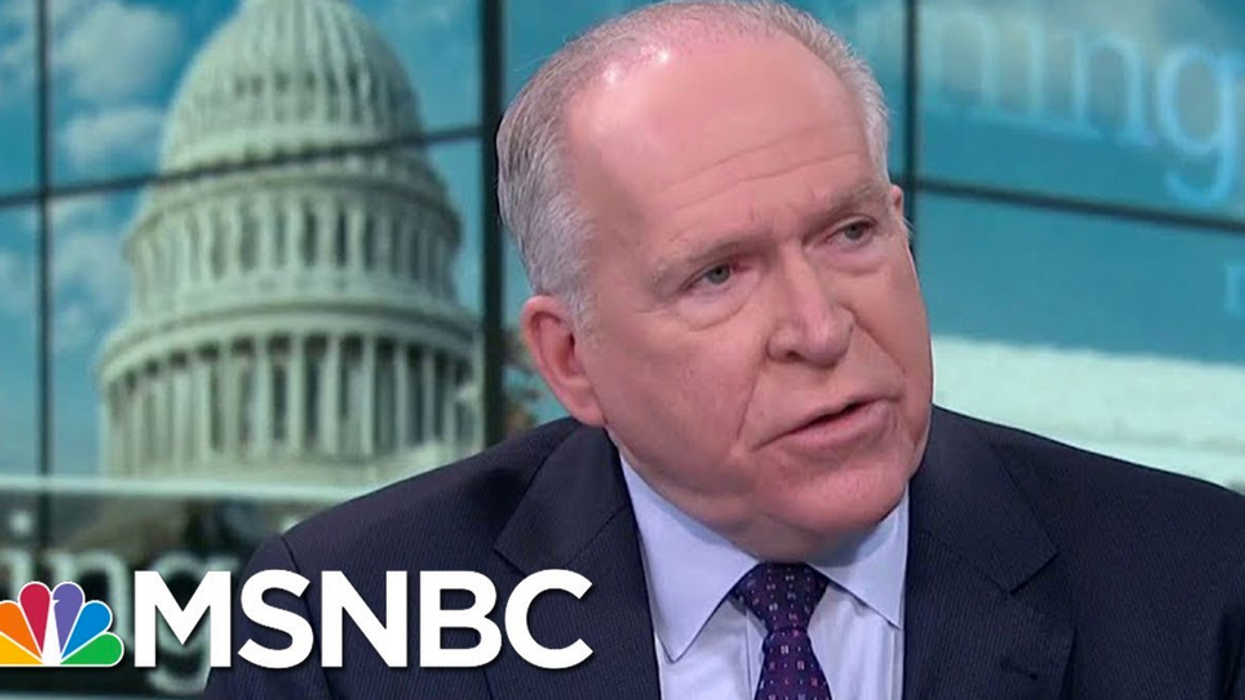
And yet, in their understandable zeal to remove Donald Trump from the presidency, some liberals and Democrats are treating Haspel's moral peers like heroes. Consider this tweet from Samantha Power, Barack Obama's U.N. Ambassador, which reads: "Not a good idea to piss off John Brennan."
Power was reacting to a tweet from Brennan, a former CIA Director, which addressed Trump after the brutal mistreatment and firing of FBI Associate Director Andrew McCabe, a day or two before he was due to retire with a pension. Brennan wrote:
When the full extent of your venality, moral turpitude, and political corruption becomes known, you will take your rightful place as a disgraced demagogue in the dustbin of history. You may scapegoat Andy McCabe, but you will not destroy America...America will triumph over you.
Brennan's anger toward Trump may be welcome, but it should also raise questions about the proper role of the intelligence community in political affairs. (On a more positive note, Rep. Mark Pocan has offered to hire McCabe so that he can collect his pension -- and it may work.)
Brennan's tweet was widely praised by some liberals, presumably including many who were appalled by Haspel's nomination. But Brennan, who replaced Haspel as head of the CIA's clandestine division, defended the CIA's use of torture in 2013. He agreed that some agents had gone too far, but disagreed with the Senate Intelligence Committee's conclusion, backed by other experts, that torture had not yielded "useful" information.
Brennan also attacked the democratic principle of transparency. "I think there's been more than enough transparency that's happened over the last couple days," he said of the Intelligence Committee's report. "I think it's over the top."
A year later, the CIA's inspector general confirmed that the agency had spied on the Senate Intelligence Committee itself. The CIA then attempted to elide its own guilt in the matter, drawing Feinstein's ire.
But even when taken at face value, the inspector general's report showed that the CIA acted in defiance of the principle that intelligence and law enforcement agencies should be subject to democratic, civilian oversight. And who was the CIA's director when it spied on that "over the top" Senate committee?
John Brennan.
Among Democrats, James Comey has gone from hero to villain and back so many times that it's hard to keep track. He was a hero to Democrats when Obama appointed him to lead the FBI in 2013, because he had blocked George W. Bush's attempt to get then-Attorney General James Ashcroft to reauthorize a domestic spying program while he was in a hospital intensive care unit.
The American Civil Liberties Union wasn't quite as fond of Comey. "As the second-highest ranked Justice Department official under John Ashcroft, Comey approved some of the worst abuses committed by the Bush administration," ACLU executive director Anthony Romero said at the time. "Specifically, the publicly available evidence indicates Comey signed off on enhanced interrogation techniques that constitute torture, including waterboarding."
Comey became a villain to Democrats when, as FBI Director, he spoke publicly about the FBI's investigation of Hillary Clinton's email servers shortly before the election. But he became a hero again when he defied Trump over the Russia investigation, an act that led to his firing.
Comey continues to be lionized by many Democrats, despite his decidedly mixed record. He's been playing to them, too, in social media and elsewhere. (After Comey quoted from Martin Luther King, Jr's "Letter From a Birmingham Jail," writer Ben Schwartz tweeted: "Oh look, FBI agents are still reading Dr. King's mail." Schwartz was referring to the FBI's infamous, years-long campaign of spying on and harassing Dr. King.)
Trump's attack on Comey's character have made his upcoming book a bestseller. That, too, is a sign of liberal enthusiasm.
Then there's Mueller himself. Fawning comments like this one, comparing Mueller to Thomas Jefferson, are commonplace on social media. That comment drew responses like this one:
"Amen: Father guide Mueller & his team in the (right) direction."
And this one:
"...the greatest number have begun their career by paying an obsequious court to the people; commencing demagogues, and ending tyrants." -A Hamilton
"Perimeter defense may not matter if the enemy is inside the gates." -R Mueller, III
Then there's this poem, which was accompanied by a video clip of Dr. King:
Mueller is coming Lady Justice is coming with him.
I Salute the Men and Women of the FBI! I Salute the Men and Women of Muellers Team.
I Salute all those People Defending America! IC, CIA, NSA, Police, Firemen, Teachers, Drs and Nurses.
I Salute You! For America!
These commenters may not know that Mueller was criticized for supporting the rush to war in Iraq by stating, incorrectly, that Iraq had weapons of mass destruction. He was challenged in 2003 by whistleblowing special agent Colleen Rowley for implying a link between Iraq and Al Qaeda, and for reportedly allowing the FBI to state incorrectly that there were 5,000 Al Qaeda terrorists in the US.
(Rowley, who has since left the FBI, wrote an essay in June 2017 entitled "No, Robert Mueller And James Comey Aren't Heroes.")
The FBI's moves against peaceful protestors did not die with Dr. King. After filing a Freedom of Information Act (FOIA) request, the ACLU revealed that the FBI spied on anti-Iraq war protestors, including Quakers and student groups, during George W. Bush's presidency.
Documents obtained by DBA Press and the Center for Media and Democracy showed that the FBI misused a counter-terrorism program known as "Operation Tripwire" to spy on peaceful Occupy protestors, in concert with private-sector informants.
The Partnership for Civil Justice Fund obtained documents showing that the FBI was coordinating nationwide efforts against the Occupy movement as early as August 2011, before the occupation of Zuccotti Park in New York City.
The FBI Director who oversaw all of these these covert programs was Robert Mueller.
Then there's James Clapper, the former Director of National Intelligence, who's also being celebrated for his attacks on Trump. Since retiring in January, Clapper has taken the lead in alleging that Russia aided Trump - a right-wing president - get elected. He has also used these allegations to stigmatize and demonize the Left.
But before he made his outlandish claims against progressive groups and publications, Clapper was known for something else. As law professor Jonathan Turley writes, Clapper lied to the Senate Intelligence Committee in 2013 when he denied that the government was collecting data on "millions, or hundreds of millions of Americans."
"Even in a city with a notoriously fluid notion of truth," writes Turley, "Clapper's false testimony was a standout."
And yet, Clapper's report on Russian spying - a report which inexplicably placed much of the blame for the election of a right-wing president on left-wing websites - was treated as gospel by many Democrats and liberals.
We promised two milestones. Here's the first. On March 12, the five-year statute of limitations ran out on Clapper's Senate lie. He can no longer be prosecuted for perjury. That's good news for Clapper, but bad news for the rule of law.
Donald Trump is both corrupt and unstable. I share the hope Mueller succeeds in bringing him to justice, although a President Pence could conceivably do more legislative damage than Trump has done thus far. Trump's escalating war of words against Mueller, even as his lawyer argues that Mueller's investigation should be shut down, is deeply worrisome.
"Choosing the wrong heroes only makes it easier to be misled into another war, or more torture, or another campaign of illegal spying."
But the Democrats who idealize figures like Mueller, Clapper, Brennan, and the others are sacrificing the long-term needs of justice - the "moral arc of the universe" that Dr. King talked about - for short-term expediency.
Some of the people currently being lionized, like Comey, probably acted according to their own moral lights. But theirs aren't necessarily the morals this country needs. It's possible to hope they succeed without turning them into heroes.
Choosing the wrong heroes only makes it easier to be misled into another war, or more torture, or another campaign of illegal spying.
In fact, it's already happening. Senate Minority Leader Chuck Schumer was asked if he was urging Senate Democrats to oppose Haspel's nomination or that of Secretary of State nominee Mike Pompeo. Pompeo signaled his openness to resuming torture operations and has described agents who conducted torture as "patriots."
"At this point, I am not," Schumer replied.
Sen. Feinstein also seems to be equivocating on the Haspel nomination. Meanwhile, the New York Times reports that the White House is using intelligence channels, rather than the State Department, to communicate with North Korea.
We tell the stories of heroes so that we can remember. But when we choose the wrong heroes, we forget.
Here's the other milestone we mentioned: March 16, 2018 marked the 50th anniversary of the massacre of Vietnamese civilians by US troops in the village of My Lai.
As America waged war in Vietnam, the FBI was engaged in a massive, covert program of spying on antiwar individuals and groups. A Senate panel led by Sen. Frank Church found that the FBI broke the law repeatedly while carrying out this program, which became known as COINTELPRO. From the panel's report:
"The (FBI's) techniques ... ranged from the trivial (mailing reprints of Reader's Digest articles to college administrators) to the degrading (sending anonymous poison-pen letters intended to break up marriages) and the dangerous ..."
In Vietnam, the CIA was leading the Phoenix program, which engaged in kidnapping, torture, and murder. CIA Director William Colby told a Congressional subcommittee that the program killed 20,587 people.
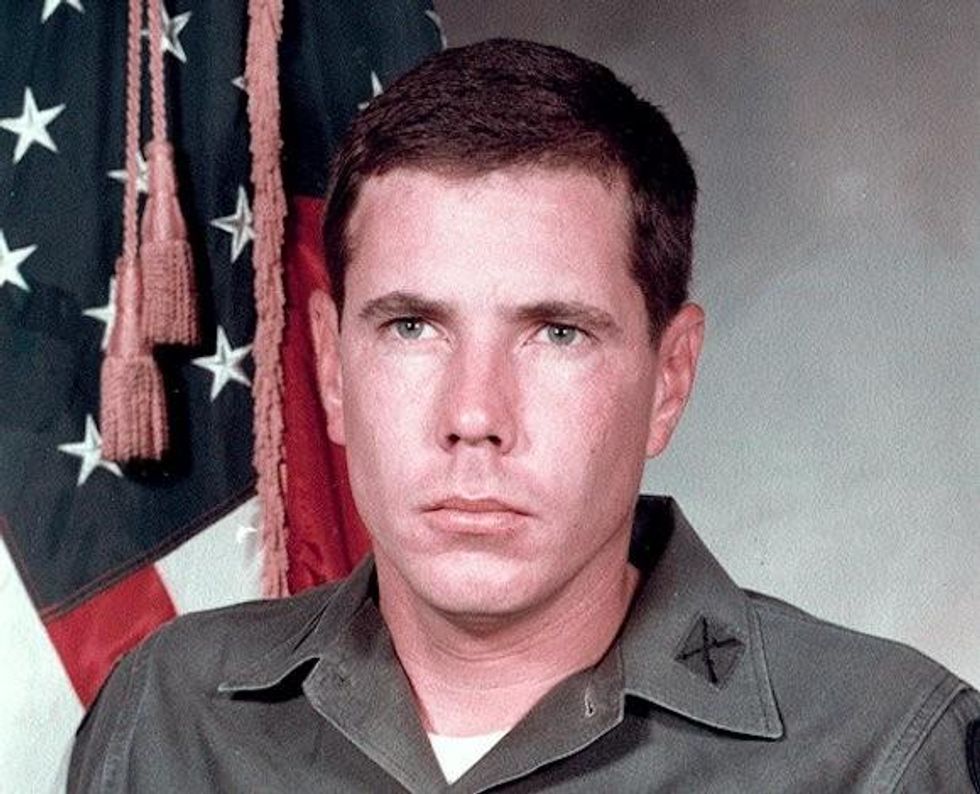
But when the My Lai massacre was underway, someone resisted. Hugh Thompson, Jr. was piloting an observation helicopter. He and his crew saw dead bodies around the village, but had encountered no hostile fire and had seen no sign of Viet Cong combatants.
To commemorate the anniversary of his actions, Jon Wiener wrote about Thompson for the Los Angeles Times. "They were not combatants," Thompson told Wiener years later. "They were old women, old men, children, kids, babies." So Thompson did something extraordinary. Wiener writes:
"Thompson told the American troops that, if they opened fire on the Vietnamese civilians in the bunker, he and his crew would open fire on them."
Thompson reported the massacre, and later testified about it on Capitol Hill.
According to the book "Four Hours in My Lai," Thompson was bitterly attacked by members of Congress like Rep. Mendel Rivers (D-SC). Thompson told 60 Minutes that he "received death threats over the phone...Dead animals on your porch, mutilated animals on your porch some mornings when you get up."
It took years for Thompson to be recognized for his actions, but he and his crew received the Soldier's Medal for bravery in 1998, thirty years after the massacre.
"Self-trust is the essence of heroism," said Ralph Waldo Emerson. Hugh Thompson, Jr. died in 2006. In My Lai and afterwards, he trusted his own sense of right and wrong. He faced down the entire military and political might of the US government because he knew it was the right thing to do.
A movement is defined by its heroes. The Resistance can find better heroes than the ones some of its members have chosen - and it should. It can start with Hugh Thompson, Jr.
Citing concerns about the impacts of the climate crisis on communities across the United States, mayors representing more than 51 million Americans have come out against efforts at the nation's top environmental agency to repeal the Clean Power Plan, an Obama administration rule that aimed to cut carbon emissions from power plants.
"No one is insulated from the impacts of climate change--people in cities of all sizes, along with suburban and rural communities are all at risk."
--Climate Mayors
Although many environmentalists have criticized the plan as "woefully inadequate," the Trump administration's attack on it has raised alarm among activists and policymakers alike.
Last March, in a move decried as "terribly irresponsible," President Donald Trump signed an executive order demanding a review of the plan--which has faced challenges in federal court--ahead of its possible repeal. In December, the Environmental Protection Agency (EPA) announced it was seeking public comment for how to replace it.
In a letter addressed to Scott Pruitt, the Trump-appointed EPA administrator, 236 mayors from 47 states wrote, "We strongly oppose the proposed repeal of the Clean Power Plan, which would put our citizens at risk and harm our efforts to address the urgent threat of climate change."
"Communities across the country are experiencing the effects of climate change today: sea level rise; hotter, longer, and more frequent heat waves; increased extreme weather; and many other harmful impacts," they noted. "Residents of our communities have experienced harmful impacts of climate change such as dirtier air, increased heat-related illnesses and deaths, damaged and disappearing coastlines, longer droughts and other strains on water quantity and quality, and increasingly frequent and severe storms and wildfires."
"No one is insulated from the impacts of climate change--people in cities of all sizes, along with suburban and rural communities are all at risk," they continued. "Reducing greenhouse gas emissions is essential to protect our citizens against the worst impacts of climate change."
"Cities are not going to sit on the sidelines while the Trump administration attempts to take away our country's best hope to cut carbon pollution and address climate change."
--Henry Henderson, NRDC
The mayors pointed to research (pdf) illustrating the incredible economic consequences of the climate crisis, and emphasized that while the financial and environmental impacts are felt locally--and mitigation and adaption efforts often occur on a community level--"the legal authority of cities and other municipalities generally extends only as far as their state governments and federal law allow, and as a result, our local efforts to address climate change are highly sensitive to national policies like the Clean Power Plan."
The letter was celebrated by environmentalists such as Henry Henderson at the National Resources Defense Council (NRDC), who wrote: "The mayors' letter reflects the voices of communities across the country that are bearing the worst effects of climate change and are eager for solutions. It shows that cities are not going to sit on the sidelines while the Trump administration attempts to take away our country's best hope to cut carbon pollution and address climate change."
Several of the local leaders who signed on to the letter, organized by the group Climate Mayors, took to Twitter to detail their concerns with the planned repeal: