
Senator Angus King, an independent from Maine, opened his questioning of the military officials before him by stating:
"Gentlemen, I've only been here five months, but this is the most astounding and most astoundingly disturbing hearing that I've been to since I've been here. You guys have essentially rewritten the Constitution here today."
King's statement followed the questioning by longtime South Carolina Republican Senator Lindsey Graham, who recently pushed to have the Boston bombing suspect - a U.S. citizen accused of a violent crime on U.S. soil - named an "enemy combatant," denying him his constitutional rights. Graham enjoyed unanimous agreement from the panelists to his series of questions:
Do you agree with me that when it comes to international terrorism, we're talking about a worldwide struggle?
Would you agree with me the battlefield is wherever the enemy chooses to make it?
And it could be anyplace on the planet, and we have to be aware and able to act.
The message was clear from the Pentagon: The world is a battlefield. The AUMF reads, in part,
"the president is authorized to use all necessary and appropriate force against those nations, organizations, or persons he determines planned, authorized, committed, or aided the terrorist attacks that occurred on September 11, 2001, or harbored such organizations or persons, in order to prevent any future acts of international terrorism against the United States by such nations, organizations or persons."
Only one member of Congress voted against that 2001 bill. Barbara Lee, a California Democrat, said from the floor of the House of Representatives: "I am convinced that military action will not prevent further acts of international terrorism against the United States. ... Some of us must urge the use of restraint ... and think through the implications of our actions today, so this does not spiral out of control."
Clearly, Senator Angus King thinks things have spiraled out of control. As does journalist Jeremy Scahill, whose new book, "Dirty Wars," is subtitled, "The World Is a Battlefield." Scahill told me: "The concept of 'The World Is a Battlefield' actually is ... a military doctrine called 'Operational Preparation of the Battlespace,' which views the world as a battlefield. [If] the military predicts that conflicts are likely or that war is a possibility, [they] can forward deploy troops to those countries to prepare the battlefield. And under both Bush and Obama, the world has been declared the battlefield." His film "Dirty Wars," based on the book and directed by Richard Rowley, opens in theaters nationally this June.
Close to 12 years later, the AUMF remains in force, giving the Obama administration and the Pentagon carte blanche to wage war, to occupy nations, to kill people with drone "signature strikes," based not on guilt but on a remote analysis of a suspect's "patterns of life". As these wars become increasingly hidden, it becomes even more important for journalists to go to where the silence is, to hold those in power accountable.
Which is why the Obama administration seems to be waging low-intensity warfare on journalists at home, with dragnet surveillance of reporters to uncover protected sources, and targeting of whistle-blowers with unprecedented use of the espionage act. More than 100 prisoners at the US base on Guantanamo are engaged in a life-threatening hunger strike. Most of them have never been charged and are cleared for release, but remain in that American gulag, with no hope, no change.
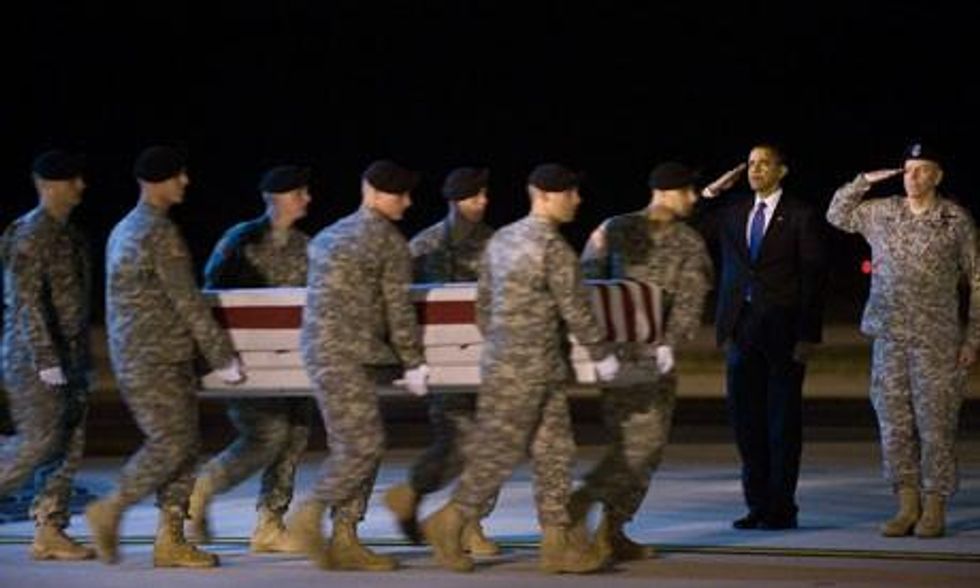
Memorial Day, while for many not much more than a three-day weekend, will be marked by many solemn ceremonies. At the time of this writing, the most recent US deaths in Afghanistan were two soldiers from the Pacific island of Guam, Sgt Eugene M Aguon, 23, and Spc Dwayne W Flores, 22, killed by a so-called improvised explosive device on 16 May.
Unreported by the Pentagon are the hundreds of soldier and veteran suicides, which now account for more deaths than combat. The backlog at Veterans Affairs, as of May 20, was more than 873,000 benefits claims pending, 584,000 of which were pending for more than 125 days.
Thomas Paine wrote in the March 21, 1778, edition of his pamphlet The Crisis, "If there is a sin superior to every other, it is that of willful and offensive war ... he who is the author of a war, lets loose the whole contagion of hell, and opens a vein that bleeds a nation to death."
Denis Moynihan contributed research to this column
Senator Angus King, an independent from Maine, opened his questioning of the military officials before him by stating:
"Gentlemen, I've only been here five months, but this is the most astounding and most astoundingly disturbing hearing that I've been to since I've been here. You guys have essentially rewritten the Constitution here today."
King's statement followed the questioning by longtime South Carolina Republican Senator Lindsey Graham, who recently pushed to have the Boston bombing suspect - a U.S. citizen accused of a violent crime on U.S. soil - named an "enemy combatant," denying him his constitutional rights. Graham enjoyed unanimous agreement from the panelists to his series of questions:
Do you agree with me that when it comes to international terrorism, we're talking about a worldwide struggle?
Would you agree with me the battlefield is wherever the enemy chooses to make it?
And it could be anyplace on the planet, and we have to be aware and able to act.
The message was clear from the Pentagon: The world is a battlefield. The AUMF reads, in part,
"the president is authorized to use all necessary and appropriate force against those nations, organizations, or persons he determines planned, authorized, committed, or aided the terrorist attacks that occurred on September 11, 2001, or harbored such organizations or persons, in order to prevent any future acts of international terrorism against the United States by such nations, organizations or persons."
Only one member of Congress voted against that 2001 bill. Barbara Lee, a California Democrat, said from the floor of the House of Representatives: "I am convinced that military action will not prevent further acts of international terrorism against the United States. ... Some of us must urge the use of restraint ... and think through the implications of our actions today, so this does not spiral out of control."
Clearly, Senator Angus King thinks things have spiraled out of control. As does journalist Jeremy Scahill, whose new book, "Dirty Wars," is subtitled, "The World Is a Battlefield." Scahill told me: "The concept of 'The World Is a Battlefield' actually is ... a military doctrine called 'Operational Preparation of the Battlespace,' which views the world as a battlefield. [If] the military predicts that conflicts are likely or that war is a possibility, [they] can forward deploy troops to those countries to prepare the battlefield. And under both Bush and Obama, the world has been declared the battlefield." His film "Dirty Wars," based on the book and directed by Richard Rowley, opens in theaters nationally this June.
Close to 12 years later, the AUMF remains in force, giving the Obama administration and the Pentagon carte blanche to wage war, to occupy nations, to kill people with drone "signature strikes," based not on guilt but on a remote analysis of a suspect's "patterns of life". As these wars become increasingly hidden, it becomes even more important for journalists to go to where the silence is, to hold those in power accountable.
Which is why the Obama administration seems to be waging low-intensity warfare on journalists at home, with dragnet surveillance of reporters to uncover protected sources, and targeting of whistle-blowers with unprecedented use of the espionage act. More than 100 prisoners at the US base on Guantanamo are engaged in a life-threatening hunger strike. Most of them have never been charged and are cleared for release, but remain in that American gulag, with no hope, no change.
Memorial Day, while for many not much more than a three-day weekend, will be marked by many solemn ceremonies. At the time of this writing, the most recent US deaths in Afghanistan were two soldiers from the Pacific island of Guam, Sgt Eugene M Aguon, 23, and Spc Dwayne W Flores, 22, killed by a so-called improvised explosive device on 16 May.
Unreported by the Pentagon are the hundreds of soldier and veteran suicides, which now account for more deaths than combat. The backlog at Veterans Affairs, as of May 20, was more than 873,000 benefits claims pending, 584,000 of which were pending for more than 125 days.
Thomas Paine wrote in the March 21, 1778, edition of his pamphlet The Crisis, "If there is a sin superior to every other, it is that of willful and offensive war ... he who is the author of a war, lets loose the whole contagion of hell, and opens a vein that bleeds a nation to death."
Denis Moynihan contributed research to this column
Senator Angus King, an independent from Maine, opened his questioning of the military officials before him by stating:
"Gentlemen, I've only been here five months, but this is the most astounding and most astoundingly disturbing hearing that I've been to since I've been here. You guys have essentially rewritten the Constitution here today."
King's statement followed the questioning by longtime South Carolina Republican Senator Lindsey Graham, who recently pushed to have the Boston bombing suspect - a U.S. citizen accused of a violent crime on U.S. soil - named an "enemy combatant," denying him his constitutional rights. Graham enjoyed unanimous agreement from the panelists to his series of questions:
Do you agree with me that when it comes to international terrorism, we're talking about a worldwide struggle?
Would you agree with me the battlefield is wherever the enemy chooses to make it?
And it could be anyplace on the planet, and we have to be aware and able to act.
The message was clear from the Pentagon: The world is a battlefield. The AUMF reads, in part,
"the president is authorized to use all necessary and appropriate force against those nations, organizations, or persons he determines planned, authorized, committed, or aided the terrorist attacks that occurred on September 11, 2001, or harbored such organizations or persons, in order to prevent any future acts of international terrorism against the United States by such nations, organizations or persons."
Only one member of Congress voted against that 2001 bill. Barbara Lee, a California Democrat, said from the floor of the House of Representatives: "I am convinced that military action will not prevent further acts of international terrorism against the United States. ... Some of us must urge the use of restraint ... and think through the implications of our actions today, so this does not spiral out of control."
Clearly, Senator Angus King thinks things have spiraled out of control. As does journalist Jeremy Scahill, whose new book, "Dirty Wars," is subtitled, "The World Is a Battlefield." Scahill told me: "The concept of 'The World Is a Battlefield' actually is ... a military doctrine called 'Operational Preparation of the Battlespace,' which views the world as a battlefield. [If] the military predicts that conflicts are likely or that war is a possibility, [they] can forward deploy troops to those countries to prepare the battlefield. And under both Bush and Obama, the world has been declared the battlefield." His film "Dirty Wars," based on the book and directed by Richard Rowley, opens in theaters nationally this June.
Close to 12 years later, the AUMF remains in force, giving the Obama administration and the Pentagon carte blanche to wage war, to occupy nations, to kill people with drone "signature strikes," based not on guilt but on a remote analysis of a suspect's "patterns of life". As these wars become increasingly hidden, it becomes even more important for journalists to go to where the silence is, to hold those in power accountable.
Which is why the Obama administration seems to be waging low-intensity warfare on journalists at home, with dragnet surveillance of reporters to uncover protected sources, and targeting of whistle-blowers with unprecedented use of the espionage act. More than 100 prisoners at the US base on Guantanamo are engaged in a life-threatening hunger strike. Most of them have never been charged and are cleared for release, but remain in that American gulag, with no hope, no change.
Memorial Day, while for many not much more than a three-day weekend, will be marked by many solemn ceremonies. At the time of this writing, the most recent US deaths in Afghanistan were two soldiers from the Pacific island of Guam, Sgt Eugene M Aguon, 23, and Spc Dwayne W Flores, 22, killed by a so-called improvised explosive device on 16 May.
Unreported by the Pentagon are the hundreds of soldier and veteran suicides, which now account for more deaths than combat. The backlog at Veterans Affairs, as of May 20, was more than 873,000 benefits claims pending, 584,000 of which were pending for more than 125 days.
Thomas Paine wrote in the March 21, 1778, edition of his pamphlet The Crisis, "If there is a sin superior to every other, it is that of willful and offensive war ... he who is the author of a war, lets loose the whole contagion of hell, and opens a vein that bleeds a nation to death."
Denis Moynihan contributed research to this column