SUBSCRIBE TO OUR FREE NEWSLETTER
Daily news & progressive opinion—funded by the people, not the corporations—delivered straight to your inbox.
5
#000000
#FFFFFF
To donate by check, phone, or other method, see our More Ways to Give page.
In early 2010, one of Washington DC's most prestigious think tanks was holding a seminar on the Middle East which included a discussion of Israel's December 2008-January 2009 assault on Gaza which killed about 1,300 Palestinians. When the death toll was mentioned, one expert on the panel smiled enigmatically and intoned: "It's unfortunate, but every once in a while you have to mow the lawn."
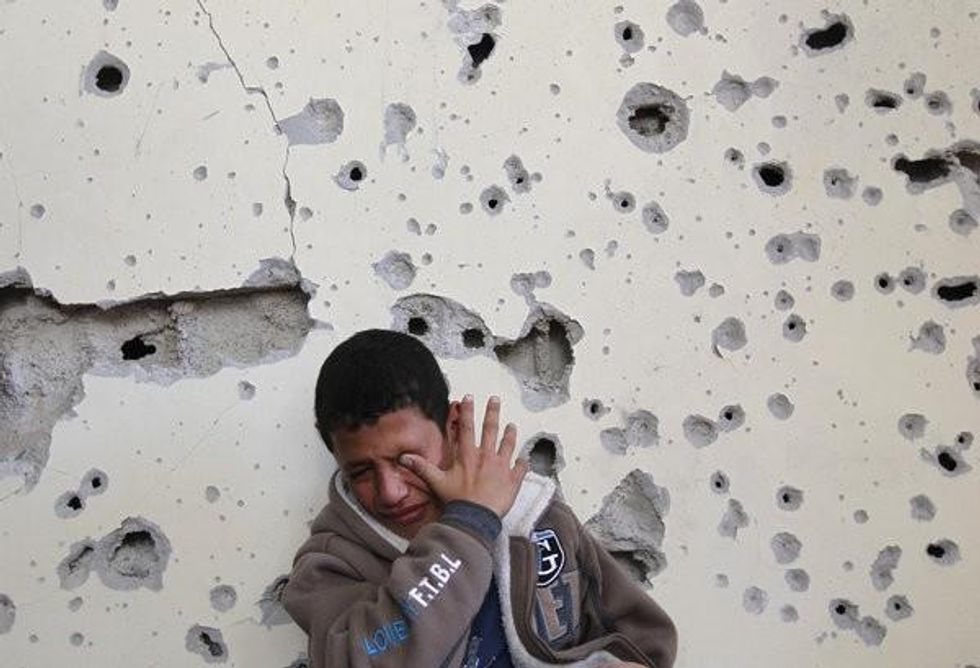
The remark, which likened killing hundreds of men, women and children - many of them noncombatants - with trimming the grass, was greeted with a light tittering around the room, which was filled with some of Washington's most elite, highly educated and well-paid Middle East experts. Not a single one objected to the panelist's black humor.
On the contrary, several analysts and experts were grinning at the reference to Israel's strategy of mounting periodic attacks on the Palestinians to cull each new generation of militants. Such is the nonchalance of Washington's policy-advising cognoscenti toward the ongoing and systematic genocide of Gaza's oppressed population.
The cavalier language is symptomatic of the policymaking community's increasingly pervasive tendency to disregard and disparage the humanity of Palestinian victims of Israeli attacks, which are often waged by Israel's high-tech drones and U.S.-supplied F-16's. There is also a tendency to ignore or downplay Israeli war crimes.
This dangerously sociopathic attitude is prevalent whether cloaked in a cheap joke or reflected in the failure by the State Department spokesman to condemn or even acknowledge the criminality of Israel's latest aerial and sea-based bombardment of Palestinian civilians, at least 18 of whom have been killed in the past 48 hours. Three Israelis also have died in retaliatory rocket fire.
After the latest attacks, the State Department's statement justified Israel's bombardment of Gaza as Israel's "right to defend itself" against the launching of relatively primitive rockets, mostly by radical groups, from inside Gaza. Yet, while the State Department urged both sides to avoid civilian casualties, nowhere was there mention of the Palestinians' right to defend themselves from various attacks by Israel. Apparently only one side is granted that privilege, according to the U.S. statement.
The relegation of Palestinians to a less-than-human status by Israel and the United States - especially the inhabitants of Gaza who are perpetually locked into an open-air prison and subject to an Israeli blockade - was noted by MIT professor Noam Chomsky after a visit to Gaza to attend an academic conference. In comments broadcast by "Democracy Now" on Nov. 14, Chomsky remarked:
"It's kind of amazing ... and inspiring to see people managing somehow to survive ... as essentially caged animals subject to constant, random, sadistic punishment - only to humiliate them - no pretext. They [the Palestinians] would like to have dignified lives, but the standard Israeli position is that they shouldn't raise their heads."
Instead of a serious effort to reach a peace acceptable to both sides, Israel seems to prefer a state of endless conflict with the Palestinians. After all, the prospect of peace might require the Israeli government to treat their neighbors as equals and withdraw from territory occupied since 1967.
So, rather than making meaningful concessions, some Israeli hardliners simply promote the idea of periodically "mowing the grass," i.e. killing the latest generation of Palestinian militants who sprout up from the injustice all around them. Perhaps that is why Israel broke an informal ceasefire on Wednesday by assassinating Hamas military commander Ahmed Jabari in an air strike.
Jabari was killed hours after he received the draft of a permanent truce agreement with Israel, which included mechanisms for maintaining the ceasefire, according to Israeli peace activist Gershon Baskin, who helped mediate talks between Israel and Hamas for the release of Israeli soldier Gilad Shalit.
Jabari was a key Palestinian interlocutor in the release of Shalit, and an important intermediary for truce negotiations with groups such as the PFLP and Islamic Jihad. Such a relatively moderate figure may have been perceived as a threat to Israeli leaders who prefer to portray Hamas as rejectionist toward any peace.
These developments and the U.S. response to them are a chilling omen for those who had hoped for a change in U.S. Middle East policy after the U.S. presidential election - namely, increased pressure on Israel to halt its cruel oppression of Palestinians and obey international law.
There is still a window of opportunity for the U.S. to shift its approach before the violence spirals out of control. One also can hope that President Barack Obama is working the phones to rein in Israeli Prime Minister Benjamin Netanyahu. But Obama's eerie and reprehensible silence during the Israeli assault on Gaza in December 2008-January 2009 must not be repeated.
In early 2010, one of Washington DC's most prestigious think tanks was holding a seminar on the Middle East which included a discussion of Israel's December 2008-January 2009 assault on Gaza which killed about 1,300 Palestinians. When the death toll was mentioned, one expert on the panel smiled enigmatically and intoned: "It's unfortunate, but every once in a while you have to mow the lawn."
The remark, which likened killing hundreds of men, women and children - many of them noncombatants - with trimming the grass, was greeted with a light tittering around the room, which was filled with some of Washington's most elite, highly educated and well-paid Middle East experts. Not a single one objected to the panelist's black humor.
On the contrary, several analysts and experts were grinning at the reference to Israel's strategy of mounting periodic attacks on the Palestinians to cull each new generation of militants. Such is the nonchalance of Washington's policy-advising cognoscenti toward the ongoing and systematic genocide of Gaza's oppressed population.
The cavalier language is symptomatic of the policymaking community's increasingly pervasive tendency to disregard and disparage the humanity of Palestinian victims of Israeli attacks, which are often waged by Israel's high-tech drones and U.S.-supplied F-16's. There is also a tendency to ignore or downplay Israeli war crimes.
This dangerously sociopathic attitude is prevalent whether cloaked in a cheap joke or reflected in the failure by the State Department spokesman to condemn or even acknowledge the criminality of Israel's latest aerial and sea-based bombardment of Palestinian civilians, at least 18 of whom have been killed in the past 48 hours. Three Israelis also have died in retaliatory rocket fire.
After the latest attacks, the State Department's statement justified Israel's bombardment of Gaza as Israel's "right to defend itself" against the launching of relatively primitive rockets, mostly by radical groups, from inside Gaza. Yet, while the State Department urged both sides to avoid civilian casualties, nowhere was there mention of the Palestinians' right to defend themselves from various attacks by Israel. Apparently only one side is granted that privilege, according to the U.S. statement.
The relegation of Palestinians to a less-than-human status by Israel and the United States - especially the inhabitants of Gaza who are perpetually locked into an open-air prison and subject to an Israeli blockade - was noted by MIT professor Noam Chomsky after a visit to Gaza to attend an academic conference. In comments broadcast by "Democracy Now" on Nov. 14, Chomsky remarked:
"It's kind of amazing ... and inspiring to see people managing somehow to survive ... as essentially caged animals subject to constant, random, sadistic punishment - only to humiliate them - no pretext. They [the Palestinians] would like to have dignified lives, but the standard Israeli position is that they shouldn't raise their heads."
Instead of a serious effort to reach a peace acceptable to both sides, Israel seems to prefer a state of endless conflict with the Palestinians. After all, the prospect of peace might require the Israeli government to treat their neighbors as equals and withdraw from territory occupied since 1967.
So, rather than making meaningful concessions, some Israeli hardliners simply promote the idea of periodically "mowing the grass," i.e. killing the latest generation of Palestinian militants who sprout up from the injustice all around them. Perhaps that is why Israel broke an informal ceasefire on Wednesday by assassinating Hamas military commander Ahmed Jabari in an air strike.
Jabari was killed hours after he received the draft of a permanent truce agreement with Israel, which included mechanisms for maintaining the ceasefire, according to Israeli peace activist Gershon Baskin, who helped mediate talks between Israel and Hamas for the release of Israeli soldier Gilad Shalit.
Jabari was a key Palestinian interlocutor in the release of Shalit, and an important intermediary for truce negotiations with groups such as the PFLP and Islamic Jihad. Such a relatively moderate figure may have been perceived as a threat to Israeli leaders who prefer to portray Hamas as rejectionist toward any peace.
These developments and the U.S. response to them are a chilling omen for those who had hoped for a change in U.S. Middle East policy after the U.S. presidential election - namely, increased pressure on Israel to halt its cruel oppression of Palestinians and obey international law.
There is still a window of opportunity for the U.S. to shift its approach before the violence spirals out of control. One also can hope that President Barack Obama is working the phones to rein in Israeli Prime Minister Benjamin Netanyahu. But Obama's eerie and reprehensible silence during the Israeli assault on Gaza in December 2008-January 2009 must not be repeated.
In early 2010, one of Washington DC's most prestigious think tanks was holding a seminar on the Middle East which included a discussion of Israel's December 2008-January 2009 assault on Gaza which killed about 1,300 Palestinians. When the death toll was mentioned, one expert on the panel smiled enigmatically and intoned: "It's unfortunate, but every once in a while you have to mow the lawn."
The remark, which likened killing hundreds of men, women and children - many of them noncombatants - with trimming the grass, was greeted with a light tittering around the room, which was filled with some of Washington's most elite, highly educated and well-paid Middle East experts. Not a single one objected to the panelist's black humor.
On the contrary, several analysts and experts were grinning at the reference to Israel's strategy of mounting periodic attacks on the Palestinians to cull each new generation of militants. Such is the nonchalance of Washington's policy-advising cognoscenti toward the ongoing and systematic genocide of Gaza's oppressed population.
The cavalier language is symptomatic of the policymaking community's increasingly pervasive tendency to disregard and disparage the humanity of Palestinian victims of Israeli attacks, which are often waged by Israel's high-tech drones and U.S.-supplied F-16's. There is also a tendency to ignore or downplay Israeli war crimes.
This dangerously sociopathic attitude is prevalent whether cloaked in a cheap joke or reflected in the failure by the State Department spokesman to condemn or even acknowledge the criminality of Israel's latest aerial and sea-based bombardment of Palestinian civilians, at least 18 of whom have been killed in the past 48 hours. Three Israelis also have died in retaliatory rocket fire.
After the latest attacks, the State Department's statement justified Israel's bombardment of Gaza as Israel's "right to defend itself" against the launching of relatively primitive rockets, mostly by radical groups, from inside Gaza. Yet, while the State Department urged both sides to avoid civilian casualties, nowhere was there mention of the Palestinians' right to defend themselves from various attacks by Israel. Apparently only one side is granted that privilege, according to the U.S. statement.
The relegation of Palestinians to a less-than-human status by Israel and the United States - especially the inhabitants of Gaza who are perpetually locked into an open-air prison and subject to an Israeli blockade - was noted by MIT professor Noam Chomsky after a visit to Gaza to attend an academic conference. In comments broadcast by "Democracy Now" on Nov. 14, Chomsky remarked:
"It's kind of amazing ... and inspiring to see people managing somehow to survive ... as essentially caged animals subject to constant, random, sadistic punishment - only to humiliate them - no pretext. They [the Palestinians] would like to have dignified lives, but the standard Israeli position is that they shouldn't raise their heads."
Instead of a serious effort to reach a peace acceptable to both sides, Israel seems to prefer a state of endless conflict with the Palestinians. After all, the prospect of peace might require the Israeli government to treat their neighbors as equals and withdraw from territory occupied since 1967.
So, rather than making meaningful concessions, some Israeli hardliners simply promote the idea of periodically "mowing the grass," i.e. killing the latest generation of Palestinian militants who sprout up from the injustice all around them. Perhaps that is why Israel broke an informal ceasefire on Wednesday by assassinating Hamas military commander Ahmed Jabari in an air strike.
Jabari was killed hours after he received the draft of a permanent truce agreement with Israel, which included mechanisms for maintaining the ceasefire, according to Israeli peace activist Gershon Baskin, who helped mediate talks between Israel and Hamas for the release of Israeli soldier Gilad Shalit.
Jabari was a key Palestinian interlocutor in the release of Shalit, and an important intermediary for truce negotiations with groups such as the PFLP and Islamic Jihad. Such a relatively moderate figure may have been perceived as a threat to Israeli leaders who prefer to portray Hamas as rejectionist toward any peace.
These developments and the U.S. response to them are a chilling omen for those who had hoped for a change in U.S. Middle East policy after the U.S. presidential election - namely, increased pressure on Israel to halt its cruel oppression of Palestinians and obey international law.
There is still a window of opportunity for the U.S. to shift its approach before the violence spirals out of control. One also can hope that President Barack Obama is working the phones to rein in Israeli Prime Minister Benjamin Netanyahu. But Obama's eerie and reprehensible silence during the Israeli assault on Gaza in December 2008-January 2009 must not be repeated.