The Anglo-American aggression addicts haven't kicked the habit. The team that brought you shock and awe and Operation Infinite Justice is gearing up for yet another crack at winning a senseless war in the Middle East.
This time the target is Iran, the pretence the regime's imminent possession of nuclear weapons. But some things will remain the same - it will lead to slaughter and end in disaster.
A brief recap of the Anglo-American "war on terror" in the Middle East, 2001 to date: Afghanistan was occupied to "eliminate terrorism" but, many thousands of dead later, terror has spread to Pakistan and beyond, leaving Kabul with the most corrupt government on earth.
Iraq was invaded to disarm Saddam of weapons he didn't have. US troops have finally withdrawn, leaving millions dead or displaced and the country broken in dysfunctional sectarian misery.
Libya, far from being the war that went well, was bombed to "protect civilians" with the result that 30,000 died and thousands more remain in prison reportedly being tortured by the regime Nato installed.
"They couldn't be so crazy" is therefore not an unreasonable response to the speculation about yet another Middle East war. But here we go again.
The US national intelligence director James Clapper's unsubstantiated claim that Iran is preparing attacks in the US itself - without even a 45-minute warning, apparently - is one sign among many that the familiar spook-media propaganda coalition is in overdrive again, selling another cock-eyed conflict.
An attack against Iran will not stop the regime acquiring nuclear weapons if it wishes to do so. It can only make it more likely that it will decide to acquire them, and will eventually surely succeed.
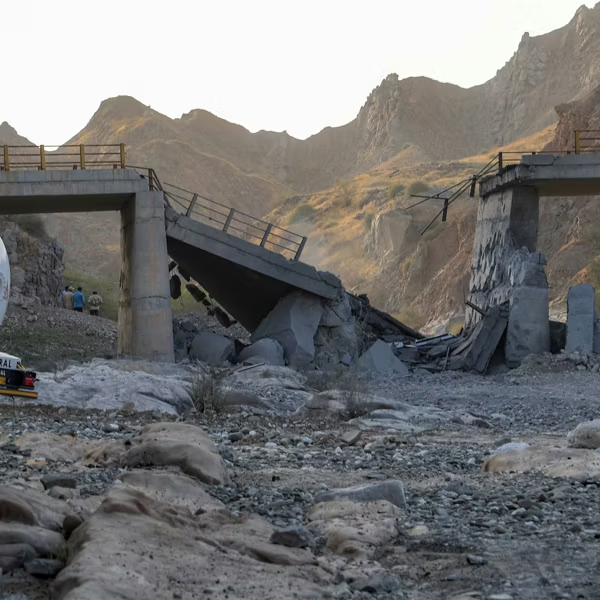
Along the way thousands more will die, conflict will extend across the region, oil supplies will be disrupted and the Iranian regime will be strengthened domestically.
Iran is not a liberal democracy. That is an issue which, as the Arab spring shows, is more likely to be addressed by the Iranian people themselves than by a foreign attack sponsored by Saudi Arabia, most recently the butchers of Bahraini democracy.
The central case for attacking Iran is animated by the determination that Washington and its allies have the right to dominate the Middle East come what may.
That is the argument offered by Matthew Kroenig, until six months ago the Pentagon's special adviser on Iran, in an article in Foreign Affairs baldly titled Time to Attack Iran: "A nuclear-armed Iran would immediately limit US freedom of action in the Middle East ... Iran could threaten any US political or military initiative in the Middle East with nuclear war, forcing Washington to think twice before acting in the region."
The pragmatic case against war is overwhelming. But the principled case is even stronger. Britain and the US have launched a series of wars across the Middle East for no better purpose than maintaining their control over a region whose peoples they dare not allow to be self-governing and independent.
Can an attack be stopped? If Britain can be detached that would help derail the war drive. Five British warships sail alongside the US navy in the Gulf, and we can be sure that Diego Garcia will be a base for the bombing onslaught - it was ethnically cleansed by the Wilson government for precisely this sort of purpose.
William Hague has made plain government support for US policy so far. The delight of the Commons exchanges on the issue was Jack Straw, whose only contribution to diplomacy was marketing the novel concept of the "unreasonable UN veto" at the time of the Iraq aggression, insisting that Britain should not act without clear UN authority now.
Millions of British people peacefully and democratically opposed the Iraq war and were ignored by Tony Blair. He got his war but lost his political momentum, reputation and job, in that order, as a result.
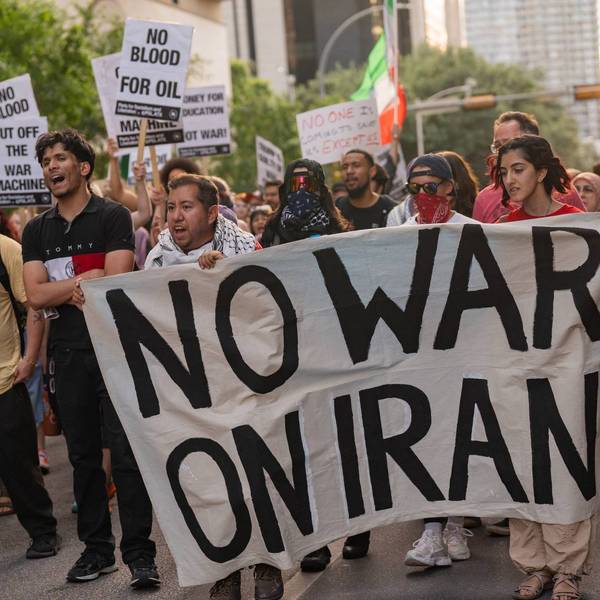
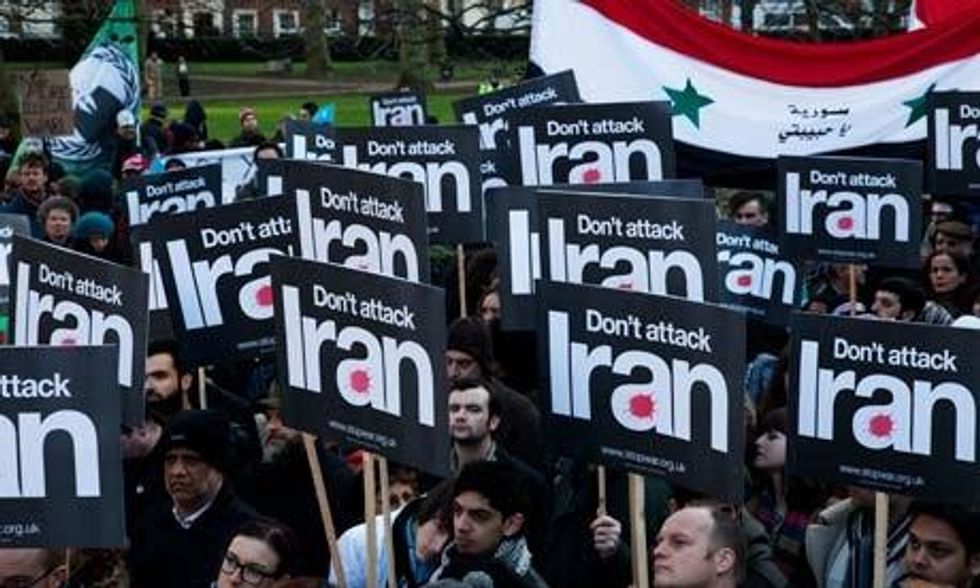
Today's anti-war campaign must learn from the Occupy movement and UK Uncut, as well as breaking that bipartisan parliamentary consensus for war which proved so calamitous in 2003, if the cycle of war is to end. A nationwide day of action on Saturday 11 February against attacking Iran is the start.
The Anglo-American aggression addicts haven't kicked the habit. The team that brought you shock and awe and Operation Infinite Justice is gearing up for yet another crack at winning a senseless war in the Middle East.
This time the target is Iran, the pretence the regime's imminent possession of nuclear weapons. But some things will remain the same - it will lead to slaughter and end in disaster.
A brief recap of the Anglo-American "war on terror" in the Middle East, 2001 to date: Afghanistan was occupied to "eliminate terrorism" but, many thousands of dead later, terror has spread to Pakistan and beyond, leaving Kabul with the most corrupt government on earth.
Iraq was invaded to disarm Saddam of weapons he didn't have. US troops have finally withdrawn, leaving millions dead or displaced and the country broken in dysfunctional sectarian misery.
Libya, far from being the war that went well, was bombed to "protect civilians" with the result that 30,000 died and thousands more remain in prison reportedly being tortured by the regime Nato installed.
"They couldn't be so crazy" is therefore not an unreasonable response to the speculation about yet another Middle East war. But here we go again.
The US national intelligence director James Clapper's unsubstantiated claim that Iran is preparing attacks in the US itself - without even a 45-minute warning, apparently - is one sign among many that the familiar spook-media propaganda coalition is in overdrive again, selling another cock-eyed conflict.
An attack against Iran will not stop the regime acquiring nuclear weapons if it wishes to do so. It can only make it more likely that it will decide to acquire them, and will eventually surely succeed.
Along the way thousands more will die, conflict will extend across the region, oil supplies will be disrupted and the Iranian regime will be strengthened domestically.
Iran is not a liberal democracy. That is an issue which, as the Arab spring shows, is more likely to be addressed by the Iranian people themselves than by a foreign attack sponsored by Saudi Arabia, most recently the butchers of Bahraini democracy.
The central case for attacking Iran is animated by the determination that Washington and its allies have the right to dominate the Middle East come what may.
That is the argument offered by Matthew Kroenig, until six months ago the Pentagon's special adviser on Iran, in an article in Foreign Affairs baldly titled Time to Attack Iran: "A nuclear-armed Iran would immediately limit US freedom of action in the Middle East ... Iran could threaten any US political or military initiative in the Middle East with nuclear war, forcing Washington to think twice before acting in the region."
The pragmatic case against war is overwhelming. But the principled case is even stronger. Britain and the US have launched a series of wars across the Middle East for no better purpose than maintaining their control over a region whose peoples they dare not allow to be self-governing and independent.
Can an attack be stopped? If Britain can be detached that would help derail the war drive. Five British warships sail alongside the US navy in the Gulf, and we can be sure that Diego Garcia will be a base for the bombing onslaught - it was ethnically cleansed by the Wilson government for precisely this sort of purpose.
William Hague has made plain government support for US policy so far. The delight of the Commons exchanges on the issue was Jack Straw, whose only contribution to diplomacy was marketing the novel concept of the "unreasonable UN veto" at the time of the Iraq aggression, insisting that Britain should not act without clear UN authority now.
Millions of British people peacefully and democratically opposed the Iraq war and were ignored by Tony Blair. He got his war but lost his political momentum, reputation and job, in that order, as a result.
Today's anti-war campaign must learn from the Occupy movement and UK Uncut, as well as breaking that bipartisan parliamentary consensus for war which proved so calamitous in 2003, if the cycle of war is to end. A nationwide day of action on Saturday 11 February against attacking Iran is the start.
The Anglo-American aggression addicts haven't kicked the habit. The team that brought you shock and awe and Operation Infinite Justice is gearing up for yet another crack at winning a senseless war in the Middle East.
This time the target is Iran, the pretence the regime's imminent possession of nuclear weapons. But some things will remain the same - it will lead to slaughter and end in disaster.
A brief recap of the Anglo-American "war on terror" in the Middle East, 2001 to date: Afghanistan was occupied to "eliminate terrorism" but, many thousands of dead later, terror has spread to Pakistan and beyond, leaving Kabul with the most corrupt government on earth.
Iraq was invaded to disarm Saddam of weapons he didn't have. US troops have finally withdrawn, leaving millions dead or displaced and the country broken in dysfunctional sectarian misery.
Libya, far from being the war that went well, was bombed to "protect civilians" with the result that 30,000 died and thousands more remain in prison reportedly being tortured by the regime Nato installed.
"They couldn't be so crazy" is therefore not an unreasonable response to the speculation about yet another Middle East war. But here we go again.
The US national intelligence director James Clapper's unsubstantiated claim that Iran is preparing attacks in the US itself - without even a 45-minute warning, apparently - is one sign among many that the familiar spook-media propaganda coalition is in overdrive again, selling another cock-eyed conflict.
An attack against Iran will not stop the regime acquiring nuclear weapons if it wishes to do so. It can only make it more likely that it will decide to acquire them, and will eventually surely succeed.
Along the way thousands more will die, conflict will extend across the region, oil supplies will be disrupted and the Iranian regime will be strengthened domestically.
Iran is not a liberal democracy. That is an issue which, as the Arab spring shows, is more likely to be addressed by the Iranian people themselves than by a foreign attack sponsored by Saudi Arabia, most recently the butchers of Bahraini democracy.
The central case for attacking Iran is animated by the determination that Washington and its allies have the right to dominate the Middle East come what may.
That is the argument offered by Matthew Kroenig, until six months ago the Pentagon's special adviser on Iran, in an article in Foreign Affairs baldly titled Time to Attack Iran: "A nuclear-armed Iran would immediately limit US freedom of action in the Middle East ... Iran could threaten any US political or military initiative in the Middle East with nuclear war, forcing Washington to think twice before acting in the region."
The pragmatic case against war is overwhelming. But the principled case is even stronger. Britain and the US have launched a series of wars across the Middle East for no better purpose than maintaining their control over a region whose peoples they dare not allow to be self-governing and independent.
Can an attack be stopped? If Britain can be detached that would help derail the war drive. Five British warships sail alongside the US navy in the Gulf, and we can be sure that Diego Garcia will be a base for the bombing onslaught - it was ethnically cleansed by the Wilson government for precisely this sort of purpose.
William Hague has made plain government support for US policy so far. The delight of the Commons exchanges on the issue was Jack Straw, whose only contribution to diplomacy was marketing the novel concept of the "unreasonable UN veto" at the time of the Iraq aggression, insisting that Britain should not act without clear UN authority now.
Millions of British people peacefully and democratically opposed the Iraq war and were ignored by Tony Blair. He got his war but lost his political momentum, reputation and job, in that order, as a result.
Today's anti-war campaign must learn from the Occupy movement and UK Uncut, as well as breaking that bipartisan parliamentary consensus for war which proved so calamitous in 2003, if the cycle of war is to end. A nationwide day of action on Saturday 11 February against attacking Iran is the start.