
What people would not want Presidential Debates in multiple cities all over America in September and October 2012? Why, the people at the Commission on Presidential Debates (CPD). CPD is a private corporation created in 1987. It is controlled by the Republican and Democratic Parties and acts as the iron gatekeeper regarding the number of debates, who is chosen to ask the questions and who is excluded from most important forums for reaching millions of people interested in the presidential elections.
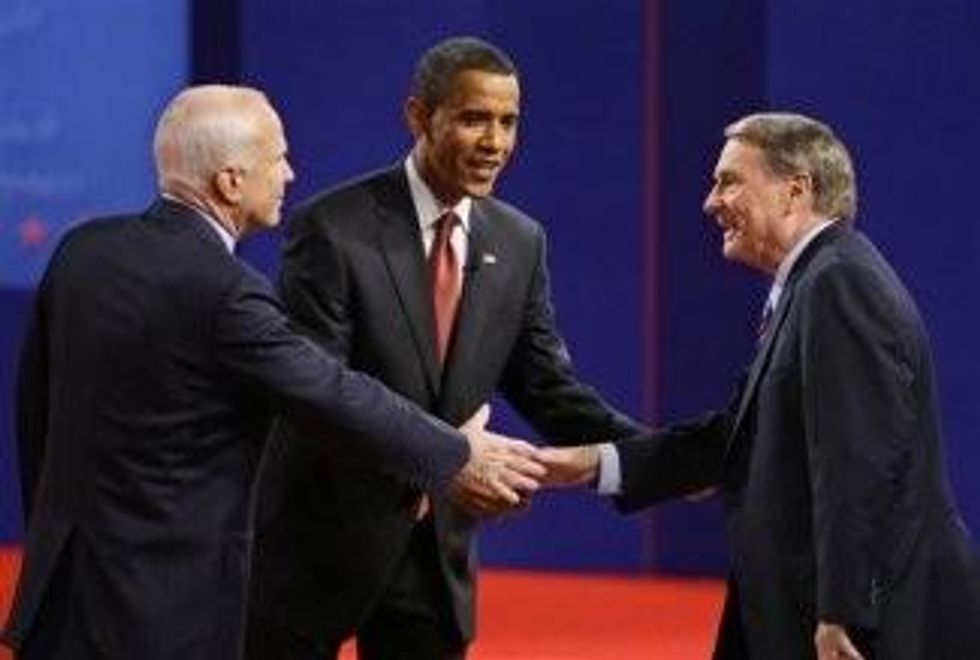
Powered by the television networks that transmit the debates to the public, the CPD is set in concrete when it comes to entrenching the status quo for the two party dictatorship's orchestrated bubble of exclusion and manipulation.
Citizen groups such as Open Debates have exposed the CPD's inner workings, picketed its Washington, D.C. headquarters and used federal courts to try to pry open the presidential debate process. Aside from a modest settlement and apology for one of its nasty transgressions, the Commission has emerged unchanged. After all it is a corporation that has mocked the Bill of Rights and side-stepped the Federal Election Commission and IRS rules.
Presidential campaigns are repetitious, tedious, often sterile and trivial. They narrow down to half a dozen issues many months before Election Day, ignore very important domestic and foreign subjects and public necessities by common implied consent. And they deliberately ignore local and regional matters.
Campaigns are so boring that the media jumps on silly comments and gaffes and focuses on the almost daily polling to add some spice to their monotonous campaign coverage of the "horse race".
True debates, rather than parallel interviews of the CPD model, would offer depth, variety, and unpredictability to counter the scripted nature of the candidates' political consultants.
So, why ration debates? We need twenty-one debate sites all over the country, ending this blue state-red state divide where over half of the voters never see a major Presidential campaign in their states. Republicans have not campaigned, for example, in Massachusetts, New York and California and Democrats don't bother with Texas, Alabama and Georgia.
From Maine to California and Alaska to Florida, citizens in cities and rural areas such as Appalachia and along the Rio Grande should band together to demand that the candidates crisscross the country participating in debate after debate.
In each community, mayors, labor unions, chambers of commerce, farm organizations, religious groups, non-profits, charities and advocacy organizations, neighborhood groups, good government associations and others should band together and sign letters saying: "We want you to come to Portland, Oregon or Dallas, Texas, or Los Angeles, California, Pittsburgh, Pa. Miami, Florida or Chicago, Illinois or Cleveland, Ohio or Salt Lake City, Utah or Minneapolis, Minnesota or Clairton, Pennsylvania, Worcester, Massachusetts or Mingo County, West Virginia, or New Orleans, Louisiana."
The Congressionally disenfranchised colony of the District of Columbia deserves a presidential debate for its being denied simple democracy.
Each community would select its debate format, subjects to be discussed, mode of interaction with the audience and other debate criteria to generate excitement and engagement by Americans of all ages.
Suddenly the people--where they live and work--will shift the dynamic of shaping the Presidential races and agenda to them where it belongs.
The celluloid slogans and sound bytes will be replaced by candidate preparedness for each region or else risk losing political ground.
The community brainpower behind these debates will raise the quality of these debate challenges to new heights.
Instead of the present, stifling, programmed three debates by the CPD, these twenty one debates would throw aside many of the taboos, bring the people into the process, address regional needs, excite larger voter turnout and compel the candidates to be better, more forthright candidates. Reporters will have real news to report instead of having to strain to make stories out of mind-numbing redundancies.
Fresh agendas and personas will be allowed in these debates including third-party candidates who meet reasonable criteria of ballot presence and public support. (See OpenDebates.org for the 2007 Appleseed Citizens' Task Force on Fair Debates.)
Imagine three real debates a week for seven weeks between Labor Day and mid-October. Determined coalitions in one community after another that stick together can make these candidates treat voters not as powerless spectators but in one of Thomas Jefferson's favorite words "participators."
Representing tens of millions of Americans from everywhere, these grand and historic invitations would be very hard to turn down. (For more information, see No Debate: How the Republican and Democratic Parties secretly Control the Presidential Debates by George Farah, Seven Stories Press 2004)
To get this grand series of nationwide debates realized, all we have to realize is that it is all in our hands. Here, the people have the power. Your comments are welcome at info@nader.org.
What people would not want Presidential Debates in multiple cities all over America in September and October 2012? Why, the people at the Commission on Presidential Debates (CPD). CPD is a private corporation created in 1987. It is controlled by the Republican and Democratic Parties and acts as the iron gatekeeper regarding the number of debates, who is chosen to ask the questions and who is excluded from most important forums for reaching millions of people interested in the presidential elections.
Powered by the television networks that transmit the debates to the public, the CPD is set in concrete when it comes to entrenching the status quo for the two party dictatorship's orchestrated bubble of exclusion and manipulation.
Citizen groups such as Open Debates have exposed the CPD's inner workings, picketed its Washington, D.C. headquarters and used federal courts to try to pry open the presidential debate process. Aside from a modest settlement and apology for one of its nasty transgressions, the Commission has emerged unchanged. After all it is a corporation that has mocked the Bill of Rights and side-stepped the Federal Election Commission and IRS rules.
Presidential campaigns are repetitious, tedious, often sterile and trivial. They narrow down to half a dozen issues many months before Election Day, ignore very important domestic and foreign subjects and public necessities by common implied consent. And they deliberately ignore local and regional matters.
Campaigns are so boring that the media jumps on silly comments and gaffes and focuses on the almost daily polling to add some spice to their monotonous campaign coverage of the "horse race".
True debates, rather than parallel interviews of the CPD model, would offer depth, variety, and unpredictability to counter the scripted nature of the candidates' political consultants.
So, why ration debates? We need twenty-one debate sites all over the country, ending this blue state-red state divide where over half of the voters never see a major Presidential campaign in their states. Republicans have not campaigned, for example, in Massachusetts, New York and California and Democrats don't bother with Texas, Alabama and Georgia.
From Maine to California and Alaska to Florida, citizens in cities and rural areas such as Appalachia and along the Rio Grande should band together to demand that the candidates crisscross the country participating in debate after debate.
In each community, mayors, labor unions, chambers of commerce, farm organizations, religious groups, non-profits, charities and advocacy organizations, neighborhood groups, good government associations and others should band together and sign letters saying: "We want you to come to Portland, Oregon or Dallas, Texas, or Los Angeles, California, Pittsburgh, Pa. Miami, Florida or Chicago, Illinois or Cleveland, Ohio or Salt Lake City, Utah or Minneapolis, Minnesota or Clairton, Pennsylvania, Worcester, Massachusetts or Mingo County, West Virginia, or New Orleans, Louisiana."
The Congressionally disenfranchised colony of the District of Columbia deserves a presidential debate for its being denied simple democracy.
Each community would select its debate format, subjects to be discussed, mode of interaction with the audience and other debate criteria to generate excitement and engagement by Americans of all ages.
Suddenly the people--where they live and work--will shift the dynamic of shaping the Presidential races and agenda to them where it belongs.
The celluloid slogans and sound bytes will be replaced by candidate preparedness for each region or else risk losing political ground.
The community brainpower behind these debates will raise the quality of these debate challenges to new heights.
Instead of the present, stifling, programmed three debates by the CPD, these twenty one debates would throw aside many of the taboos, bring the people into the process, address regional needs, excite larger voter turnout and compel the candidates to be better, more forthright candidates. Reporters will have real news to report instead of having to strain to make stories out of mind-numbing redundancies.
Fresh agendas and personas will be allowed in these debates including third-party candidates who meet reasonable criteria of ballot presence and public support. (See OpenDebates.org for the 2007 Appleseed Citizens' Task Force on Fair Debates.)
Imagine three real debates a week for seven weeks between Labor Day and mid-October. Determined coalitions in one community after another that stick together can make these candidates treat voters not as powerless spectators but in one of Thomas Jefferson's favorite words "participators."
Representing tens of millions of Americans from everywhere, these grand and historic invitations would be very hard to turn down. (For more information, see No Debate: How the Republican and Democratic Parties secretly Control the Presidential Debates by George Farah, Seven Stories Press 2004)
To get this grand series of nationwide debates realized, all we have to realize is that it is all in our hands. Here, the people have the power. Your comments are welcome at info@nader.org.
What people would not want Presidential Debates in multiple cities all over America in September and October 2012? Why, the people at the Commission on Presidential Debates (CPD). CPD is a private corporation created in 1987. It is controlled by the Republican and Democratic Parties and acts as the iron gatekeeper regarding the number of debates, who is chosen to ask the questions and who is excluded from most important forums for reaching millions of people interested in the presidential elections.
Powered by the television networks that transmit the debates to the public, the CPD is set in concrete when it comes to entrenching the status quo for the two party dictatorship's orchestrated bubble of exclusion and manipulation.
Citizen groups such as Open Debates have exposed the CPD's inner workings, picketed its Washington, D.C. headquarters and used federal courts to try to pry open the presidential debate process. Aside from a modest settlement and apology for one of its nasty transgressions, the Commission has emerged unchanged. After all it is a corporation that has mocked the Bill of Rights and side-stepped the Federal Election Commission and IRS rules.
Presidential campaigns are repetitious, tedious, often sterile and trivial. They narrow down to half a dozen issues many months before Election Day, ignore very important domestic and foreign subjects and public necessities by common implied consent. And they deliberately ignore local and regional matters.
Campaigns are so boring that the media jumps on silly comments and gaffes and focuses on the almost daily polling to add some spice to their monotonous campaign coverage of the "horse race".
True debates, rather than parallel interviews of the CPD model, would offer depth, variety, and unpredictability to counter the scripted nature of the candidates' political consultants.
So, why ration debates? We need twenty-one debate sites all over the country, ending this blue state-red state divide where over half of the voters never see a major Presidential campaign in their states. Republicans have not campaigned, for example, in Massachusetts, New York and California and Democrats don't bother with Texas, Alabama and Georgia.
From Maine to California and Alaska to Florida, citizens in cities and rural areas such as Appalachia and along the Rio Grande should band together to demand that the candidates crisscross the country participating in debate after debate.
In each community, mayors, labor unions, chambers of commerce, farm organizations, religious groups, non-profits, charities and advocacy organizations, neighborhood groups, good government associations and others should band together and sign letters saying: "We want you to come to Portland, Oregon or Dallas, Texas, or Los Angeles, California, Pittsburgh, Pa. Miami, Florida or Chicago, Illinois or Cleveland, Ohio or Salt Lake City, Utah or Minneapolis, Minnesota or Clairton, Pennsylvania, Worcester, Massachusetts or Mingo County, West Virginia, or New Orleans, Louisiana."
The Congressionally disenfranchised colony of the District of Columbia deserves a presidential debate for its being denied simple democracy.
Each community would select its debate format, subjects to be discussed, mode of interaction with the audience and other debate criteria to generate excitement and engagement by Americans of all ages.
Suddenly the people--where they live and work--will shift the dynamic of shaping the Presidential races and agenda to them where it belongs.
The celluloid slogans and sound bytes will be replaced by candidate preparedness for each region or else risk losing political ground.
The community brainpower behind these debates will raise the quality of these debate challenges to new heights.
Instead of the present, stifling, programmed three debates by the CPD, these twenty one debates would throw aside many of the taboos, bring the people into the process, address regional needs, excite larger voter turnout and compel the candidates to be better, more forthright candidates. Reporters will have real news to report instead of having to strain to make stories out of mind-numbing redundancies.
Fresh agendas and personas will be allowed in these debates including third-party candidates who meet reasonable criteria of ballot presence and public support. (See OpenDebates.org for the 2007 Appleseed Citizens' Task Force on Fair Debates.)
Imagine three real debates a week for seven weeks between Labor Day and mid-October. Determined coalitions in one community after another that stick together can make these candidates treat voters not as powerless spectators but in one of Thomas Jefferson's favorite words "participators."
Representing tens of millions of Americans from everywhere, these grand and historic invitations would be very hard to turn down. (For more information, see No Debate: How the Republican and Democratic Parties secretly Control the Presidential Debates by George Farah, Seven Stories Press 2004)
To get this grand series of nationwide debates realized, all we have to realize is that it is all in our hands. Here, the people have the power. Your comments are welcome at info@nader.org.