
Impeachment by the People
Courage is in short supply in Washington, D.C. The realities of the Iraq War cry out for the overthrow of a government that is criminally responsible for death, mutilation, torture, humiliation, chaos. But all we hear in the nation's capital, which is the source of those catastrophes, is a whimper from the Democratic Party, muttering and nattering about "unity" and "bipartisanship," in a situation that calls for bold action to immediately reverse the present course.
These are the Democrats who were brought to power in November by an electorate fed up with the war, furious at the Bush Administration, and counting on the new majority in Congress to represent the voters. But if sanity is to be restored in our national policies, it can only come about by a great popular upheaval, pushing both Republicans and Democrats into compliance with the national will.
The Declaration of Independence, revered as a document but ignored as a guide to action, needs to be read from pulpits and podiums, on street corners and community radio stations throughout the nation. Its words, forgotten for over two centuries, need to become a call to action for the first time since it was read aloud to crowds in the early excited days of the American Revolution: "Whenever any form of government becomes destructive of these ends, it is the right of the people to alter or abolish it and institute new government."
The "ends" referred to in the Declaration are the equal right of all to "life, liberty, and the pursuit of happiness." True, no government in the history of the nation has been faithful to those ends. Favors for the rich, neglect of the poor, massive violence in the interest of continental and world expansion--that is the persistent record of our government.
Still, there seems to be a special viciousness that accompanies the current assault on human rights, in this country and in the world. We have had repressive governments before, but none has legislated the end of habeas corpus, nor openly supported torture, nor declared the possibility of war without end. No government has so casually ignored the will of the people, affirmed the right of the President to ignore the Constitution, even to set aside laws passed by Congress.
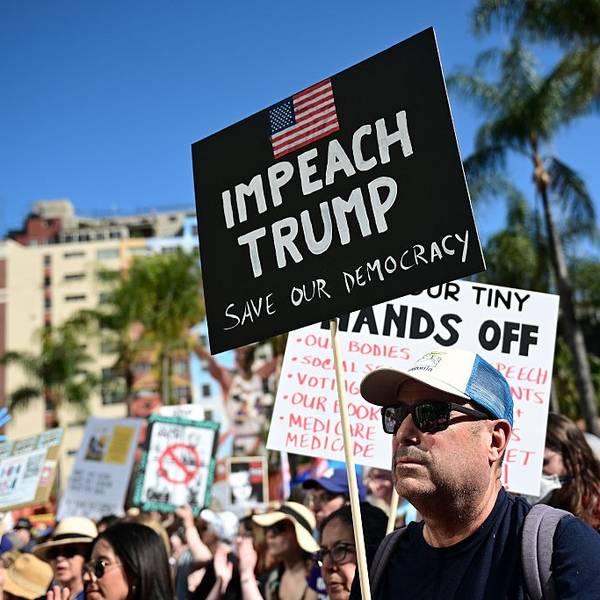
The time is right, then, for a national campaign calling for the impeachment of President Bush and Vice President Cheney. Representative John Conyers, who held extensive hearings and introduced an impeachment resolution when the Republicans controlled Congress, is now head of the House Judiciary Committee and in a position to fight for such a resolution. He has apparently been silenced by his Democratic colleagues who throw out as nuggets of wisdom the usual political palaver about "realism" (while ignoring the realities staring them in the face) and politics being "the art of the possible" (while setting limits on what is possible).
I know I'm not the first to talk about impeachment. Indeed, judging by the public opinion polls, there are millions of Americans, indeed a majority of those polled, who declare themselves in favor if it is shown that the President lied us into war (a fact that is not debatable). There are at least a half-dozen books out on impeachment, and it's been argued for eloquently by some of our finest journalists, John Nichols and Lewis Lapham among them. Indeed, an actual "indictment" has been drawn up by a former federal prosecutor, Elizabeth de la Vega, in a new book called United States v. George W. Bush et al, making a case, in devastating detail, to a fictional grand jury.
There is a logical next step in this development of an impeachment movement: the convening of "people's impeachment hearings" all over the country. This is especially important given the timidity of the Democratic Party. Such hearings would bypass Congress, which is not representing the will of the people, and would constitute an inspiring example of grassroots democracy.
These hearings would be the contemporary equivalents of the unofficial gatherings that marked the resistance to the British Crown in the years leading up to the American Revolution. The story of the American Revolution is usually built around Lexington and Concord, around the battles and the Founding Fathers. What is forgotten is that the American colonists, unable to count on redress of their grievances from the official bodies of government, took matters into their own hands, even before the first battles of the Revolutionary War.
In 1772, town meetings in Massachusetts began setting up Committees of Correspondence, and the following year, such a committee was set up in Virginia. The first Continental Congress, beginning to meet in 1774, was a recognition that an extralegal body was necessary to represent the interests of the people. In 1774 and 1775, all through the colonies, parallel institutions were set up outside the official governmental bodies.
Throughout the nation's history, the failure of government to deliver justice has led to the establishment of grassroots organizations, often ad hoc, dissolving after their purpose was fulfilled. For instance, after passage of the Fugitive Slave Act, knowing that the national government could not be counted on to repeal the act, black and white anti-slavery groups organized to nullify the law by acts of civil disobedience. They held meetings, made plans, and set about rescuing escaped slaves who were in danger of being returned to their masters.
In the desperate economic conditions of 1933 and 1934, before the Roosevelt Administration was doing anything to help people in distress, local groups were formed all over the country to demand government action. Unemployed Councils came into being, tenants' groups fought evictions, and hundreds of thousands of people in the country formed self-help organizations to exchange goods and services and enable people to survive.
More recently, we recall the peace groups of the 1980s, which sprang up in hundreds of communities all over the country, and provoked city councils and state legislatures to pass resolutions in favor of a freeze on nuclear weapons. And local organizations have succeeded in getting more than 400 city councils to take a stand against the Patriot Act.
Impeachment hearings all over the country could excite and energize the peace movement. They would make headlines, and could push reluctant members of Congress in both parties to do what the Constitution provides for and what the present circumstances demand: the impeachment and removal from office of George Bush and Dick Cheney. Simply raising the issue in hundreds of communities and Congressional districts would have a healthy effect, and would be a sign that democracy, despite all attempts to destroy it in this era of war, is still alive.
An Urgent Message From Our Co-Founder
Dear Common Dreams reader, It’s been nearly 30 years since I co-founded Common Dreams with my late wife, Lina Newhouser. We had the radical notion that journalism should serve the public good, not corporate profits. It was clear to us from the outset what it would take to build such a project. No paid advertisements. No corporate sponsors. No millionaire publisher telling us what to think or do. Many people said we wouldn't last a year, but we proved those doubters wrong. Together with a tremendous team of journalists and dedicated staff, we built an independent media outlet free from the constraints of profits and corporate control. Our mission has always been simple: To inform. To inspire. To ignite change for the common good. Building Common Dreams was not easy. Our survival was never guaranteed. When you take on the most powerful forces—Wall Street greed, fossil fuel industry destruction, Big Tech lobbyists, and uber-rich oligarchs who have spent billions upon billions rigging the economy and democracy in their favor—the only bulwark you have is supporters who believe in your work. But here’s the urgent message from me today. It's never been this bad out there. And it's never been this hard to keep us going. At the very moment Common Dreams is most needed, the threats we face are intensifying. We need your support now more than ever. We don't accept corporate advertising and never will. We don't have a paywall because we don't think people should be blocked from critical news based on their ability to pay. Everything we do is funded by the donations of readers like you. When everyone does the little they can afford, we are strong. But if that support retreats or dries up, so do we. Will you donate now to make sure Common Dreams not only survives but thrives? —Craig Brown, Co-founder |
Courage is in short supply in Washington, D.C. The realities of the Iraq War cry out for the overthrow of a government that is criminally responsible for death, mutilation, torture, humiliation, chaos. But all we hear in the nation's capital, which is the source of those catastrophes, is a whimper from the Democratic Party, muttering and nattering about "unity" and "bipartisanship," in a situation that calls for bold action to immediately reverse the present course.
These are the Democrats who were brought to power in November by an electorate fed up with the war, furious at the Bush Administration, and counting on the new majority in Congress to represent the voters. But if sanity is to be restored in our national policies, it can only come about by a great popular upheaval, pushing both Republicans and Democrats into compliance with the national will.
The Declaration of Independence, revered as a document but ignored as a guide to action, needs to be read from pulpits and podiums, on street corners and community radio stations throughout the nation. Its words, forgotten for over two centuries, need to become a call to action for the first time since it was read aloud to crowds in the early excited days of the American Revolution: "Whenever any form of government becomes destructive of these ends, it is the right of the people to alter or abolish it and institute new government."
The "ends" referred to in the Declaration are the equal right of all to "life, liberty, and the pursuit of happiness." True, no government in the history of the nation has been faithful to those ends. Favors for the rich, neglect of the poor, massive violence in the interest of continental and world expansion--that is the persistent record of our government.
Still, there seems to be a special viciousness that accompanies the current assault on human rights, in this country and in the world. We have had repressive governments before, but none has legislated the end of habeas corpus, nor openly supported torture, nor declared the possibility of war without end. No government has so casually ignored the will of the people, affirmed the right of the President to ignore the Constitution, even to set aside laws passed by Congress.
The time is right, then, for a national campaign calling for the impeachment of President Bush and Vice President Cheney. Representative John Conyers, who held extensive hearings and introduced an impeachment resolution when the Republicans controlled Congress, is now head of the House Judiciary Committee and in a position to fight for such a resolution. He has apparently been silenced by his Democratic colleagues who throw out as nuggets of wisdom the usual political palaver about "realism" (while ignoring the realities staring them in the face) and politics being "the art of the possible" (while setting limits on what is possible).
I know I'm not the first to talk about impeachment. Indeed, judging by the public opinion polls, there are millions of Americans, indeed a majority of those polled, who declare themselves in favor if it is shown that the President lied us into war (a fact that is not debatable). There are at least a half-dozen books out on impeachment, and it's been argued for eloquently by some of our finest journalists, John Nichols and Lewis Lapham among them. Indeed, an actual "indictment" has been drawn up by a former federal prosecutor, Elizabeth de la Vega, in a new book called United States v. George W. Bush et al, making a case, in devastating detail, to a fictional grand jury.
There is a logical next step in this development of an impeachment movement: the convening of "people's impeachment hearings" all over the country. This is especially important given the timidity of the Democratic Party. Such hearings would bypass Congress, which is not representing the will of the people, and would constitute an inspiring example of grassroots democracy.
These hearings would be the contemporary equivalents of the unofficial gatherings that marked the resistance to the British Crown in the years leading up to the American Revolution. The story of the American Revolution is usually built around Lexington and Concord, around the battles and the Founding Fathers. What is forgotten is that the American colonists, unable to count on redress of their grievances from the official bodies of government, took matters into their own hands, even before the first battles of the Revolutionary War.
In 1772, town meetings in Massachusetts began setting up Committees of Correspondence, and the following year, such a committee was set up in Virginia. The first Continental Congress, beginning to meet in 1774, was a recognition that an extralegal body was necessary to represent the interests of the people. In 1774 and 1775, all through the colonies, parallel institutions were set up outside the official governmental bodies.
Throughout the nation's history, the failure of government to deliver justice has led to the establishment of grassroots organizations, often ad hoc, dissolving after their purpose was fulfilled. For instance, after passage of the Fugitive Slave Act, knowing that the national government could not be counted on to repeal the act, black and white anti-slavery groups organized to nullify the law by acts of civil disobedience. They held meetings, made plans, and set about rescuing escaped slaves who were in danger of being returned to their masters.
In the desperate economic conditions of 1933 and 1934, before the Roosevelt Administration was doing anything to help people in distress, local groups were formed all over the country to demand government action. Unemployed Councils came into being, tenants' groups fought evictions, and hundreds of thousands of people in the country formed self-help organizations to exchange goods and services and enable people to survive.
More recently, we recall the peace groups of the 1980s, which sprang up in hundreds of communities all over the country, and provoked city councils and state legislatures to pass resolutions in favor of a freeze on nuclear weapons. And local organizations have succeeded in getting more than 400 city councils to take a stand against the Patriot Act.
Impeachment hearings all over the country could excite and energize the peace movement. They would make headlines, and could push reluctant members of Congress in both parties to do what the Constitution provides for and what the present circumstances demand: the impeachment and removal from office of George Bush and Dick Cheney. Simply raising the issue in hundreds of communities and Congressional districts would have a healthy effect, and would be a sign that democracy, despite all attempts to destroy it in this era of war, is still alive.
Courage is in short supply in Washington, D.C. The realities of the Iraq War cry out for the overthrow of a government that is criminally responsible for death, mutilation, torture, humiliation, chaos. But all we hear in the nation's capital, which is the source of those catastrophes, is a whimper from the Democratic Party, muttering and nattering about "unity" and "bipartisanship," in a situation that calls for bold action to immediately reverse the present course.
These are the Democrats who were brought to power in November by an electorate fed up with the war, furious at the Bush Administration, and counting on the new majority in Congress to represent the voters. But if sanity is to be restored in our national policies, it can only come about by a great popular upheaval, pushing both Republicans and Democrats into compliance with the national will.
The Declaration of Independence, revered as a document but ignored as a guide to action, needs to be read from pulpits and podiums, on street corners and community radio stations throughout the nation. Its words, forgotten for over two centuries, need to become a call to action for the first time since it was read aloud to crowds in the early excited days of the American Revolution: "Whenever any form of government becomes destructive of these ends, it is the right of the people to alter or abolish it and institute new government."
The "ends" referred to in the Declaration are the equal right of all to "life, liberty, and the pursuit of happiness." True, no government in the history of the nation has been faithful to those ends. Favors for the rich, neglect of the poor, massive violence in the interest of continental and world expansion--that is the persistent record of our government.
Still, there seems to be a special viciousness that accompanies the current assault on human rights, in this country and in the world. We have had repressive governments before, but none has legislated the end of habeas corpus, nor openly supported torture, nor declared the possibility of war without end. No government has so casually ignored the will of the people, affirmed the right of the President to ignore the Constitution, even to set aside laws passed by Congress.
The time is right, then, for a national campaign calling for the impeachment of President Bush and Vice President Cheney. Representative John Conyers, who held extensive hearings and introduced an impeachment resolution when the Republicans controlled Congress, is now head of the House Judiciary Committee and in a position to fight for such a resolution. He has apparently been silenced by his Democratic colleagues who throw out as nuggets of wisdom the usual political palaver about "realism" (while ignoring the realities staring them in the face) and politics being "the art of the possible" (while setting limits on what is possible).
I know I'm not the first to talk about impeachment. Indeed, judging by the public opinion polls, there are millions of Americans, indeed a majority of those polled, who declare themselves in favor if it is shown that the President lied us into war (a fact that is not debatable). There are at least a half-dozen books out on impeachment, and it's been argued for eloquently by some of our finest journalists, John Nichols and Lewis Lapham among them. Indeed, an actual "indictment" has been drawn up by a former federal prosecutor, Elizabeth de la Vega, in a new book called United States v. George W. Bush et al, making a case, in devastating detail, to a fictional grand jury.
There is a logical next step in this development of an impeachment movement: the convening of "people's impeachment hearings" all over the country. This is especially important given the timidity of the Democratic Party. Such hearings would bypass Congress, which is not representing the will of the people, and would constitute an inspiring example of grassroots democracy.
These hearings would be the contemporary equivalents of the unofficial gatherings that marked the resistance to the British Crown in the years leading up to the American Revolution. The story of the American Revolution is usually built around Lexington and Concord, around the battles and the Founding Fathers. What is forgotten is that the American colonists, unable to count on redress of their grievances from the official bodies of government, took matters into their own hands, even before the first battles of the Revolutionary War.
In 1772, town meetings in Massachusetts began setting up Committees of Correspondence, and the following year, such a committee was set up in Virginia. The first Continental Congress, beginning to meet in 1774, was a recognition that an extralegal body was necessary to represent the interests of the people. In 1774 and 1775, all through the colonies, parallel institutions were set up outside the official governmental bodies.
Throughout the nation's history, the failure of government to deliver justice has led to the establishment of grassroots organizations, often ad hoc, dissolving after their purpose was fulfilled. For instance, after passage of the Fugitive Slave Act, knowing that the national government could not be counted on to repeal the act, black and white anti-slavery groups organized to nullify the law by acts of civil disobedience. They held meetings, made plans, and set about rescuing escaped slaves who were in danger of being returned to their masters.
In the desperate economic conditions of 1933 and 1934, before the Roosevelt Administration was doing anything to help people in distress, local groups were formed all over the country to demand government action. Unemployed Councils came into being, tenants' groups fought evictions, and hundreds of thousands of people in the country formed self-help organizations to exchange goods and services and enable people to survive.
More recently, we recall the peace groups of the 1980s, which sprang up in hundreds of communities all over the country, and provoked city councils and state legislatures to pass resolutions in favor of a freeze on nuclear weapons. And local organizations have succeeded in getting more than 400 city councils to take a stand against the Patriot Act.
Impeachment hearings all over the country could excite and energize the peace movement. They would make headlines, and could push reluctant members of Congress in both parties to do what the Constitution provides for and what the present circumstances demand: the impeachment and removal from office of George Bush and Dick Cheney. Simply raising the issue in hundreds of communities and Congressional districts would have a healthy effect, and would be a sign that democracy, despite all attempts to destroy it in this era of war, is still alive.