

SUBSCRIBE TO OUR FREE NEWSLETTER
Daily news & progressive opinion—funded by the people, not the corporations—delivered straight to your inbox.
5
#000000
#FFFFFF
To donate by check, phone, or other method, see our More Ways to Give page.
Daily news & progressive opinion—funded by the people, not the corporations—delivered straight to your inbox.

"Being able to heat your home in the freezing cold is not a luxury."
A group of 20 US senators on Thursday demanded that the US Department of Health and Human Services boost winter heating assistance as President Donald Trump's illegal war with Iran fuels a surge in energy costs.
In a letter sent to HHS Secretary Robert F. Kennedy Jr., the senators—19 Democrats along with Sen. Bernie Sanders (I-Vt.)—urged an emergency appropriation request for "at least $3 billion for the Low Income Home Energy Assistance Program (LIHEAP)," which would supplement the $4 billion already allocated to the heating assistance initiative.
"Without immediate action, senior citizens on fixed incomes, working families with kids, and people with disabilities are at serious risk of going cold this winter," the senators wrote. "In the richest country in the history of the world, we cannot let that happen."
The senators then pointed fingers at Trump, arguing that the president's "war in Iran and his opposition to renewable energy is sending home heating costs through the roof."
The price of heating oil, along with the price of gasoline and diesel fuel, has been skyrocketing in the months since Trump attacked Iran without congressional authorization in February.
Barron's reported on Wednesday that heating oil prices have now hit record highs, and an analysis published Monday by the National Energy Assistance Directors Association estimates that houses will pay an extra $900 for heating oil this winter, a 50% increase from the year before.
The senators concluded their letter by reiterating the urgency of passing emergency increases in LIHEAP funding.
"Emergency LIHEAP assistance is needed now more than ever," they wrote. "Without this vital funding, states will be forced to turn away families, reduce benefits, or exhaust heating assistance funds well before winter is over."
"Being able to heat your home in the freezing cold is not a luxury," they emphasized. "It is a matter of life and death."

A federal judge opted not to rule on a lawsuit seeking to overturn FDA approval of mifepristone until the FDA completes a review that has been described as a political pretext to restrict abortion.
Access to the abortion drug mifepristone will remain unchanged in the US for now after a federal district judge on Sunday paused a lawsuit aimed at overturning the Food and Drug Administration's approval of the medication. But he left the door open for the Trump administration to restrict access to the drug.
US District Judge Reed O'Connor of the Northern District of Texas refused the manufacturer's motion to dismiss a lawsuit brought by Texas and Florida seeking to overturn FDA approval of mifepristone altogether. But the judge accepted the US Department of Justice's (DOJ) motion to stay the case until December 1, or until the FDA completes a "review" of the drug that it will use to determine whether access to it should be tightened.
That FDA review, spearheaded by Health and Human Services Secretary Robert F. Kennedy Jr., has been criticized as a politicized effort to create a pretext for the anti-abortion Trump administration to restrict abortion pill access, including in states where the procedure is legal.
Nearly 700,000 people use mifepristone per year, according to the Guttmacher Institute, which has found it to be the method for the majority of US abortions in recent years.
Receiving it through the mail via out-of-state telehealth providers has become a go-to method for those in states with bans on terminating a pregnancy. The drug has been used by around 7.5 million people since it was first approved in 2000.
The FDA's own current webpage states that its periodic reviews of mifepristone have “not identified any new safety concerns” and that the drug is safe when used as directed. Prior FDA reviews have found that hospitalization occurs in only 0.04-0.6% of all medication abortions.
Despite the lack of any clearly identified risk, the Trump FDA has said that the ongoing review could lead to “substantive changes" to the Risk Evaluation and Mitigation Strategy for the drug, leading some to argue that it is a "sham" meant to create a scientific justification for the administration's goal of restricting abortion.
"Ensuring legal access to mifepristone in the long term is vital to women’s healthcare and reproductive freedom," said Evan Masingill, the CEO of GenBioPro, which manufactures generic mifepristone and sued to defend the FDA's approval of its product.
"We expect the FDA’s review of mifepristone to not contradict the decision they made in 2023 that reaffirmed our product is safe and effective," Masingill said.
The US Supreme Court ruled earlier this year that lower courts could not block the FDA's 2023 decision, under the Biden administration, to lift in-person dispensing requirements for mifepristone following the overturning of Roe v. Wade the previous year. The in-person requirement was lifted following a 2021 FDA review that deemed the rules unnecessary.
The Supreme Court has previously blocked individual anti-abortion doctors from bringing lawsuits against the FDA, ruling that they did not have standing to claim personal injury.
But Texas and Florida have sought to get around this by suing as states, and so far, courts have allowed them to do so. The conservative 5th Circuit accepted a similar argument from Louisiana earlier this year.
However, O'Connor—an appointee of former President George W. Bush—did not rule on the merits of whether the states' claims against the FDA were correct.
But even if that lawsuit fails, the Trump administration could dramatically curtail access to mifepristone by reinstating in-person dispensing requirements, placing new limits on which pharmacies can dispense the drug, and adding new requirements for prescribers and patients.
“The FDA has affirmed time and again that mifepristone is safe and effective,” said Skye Perryman, President and CEO of Democracy Forward, which is representing the drugmaker. “Far-right, anti-science extremists may be pressuring the Trump-Vance administration to reach a different, ideologically-driven outcome, but we will continue to represent our clients to hold the FDA to the same science-based standards it has long applied to protect people’s ability to access effective, evidence-based healthcare, including protecting access to medication abortion.”
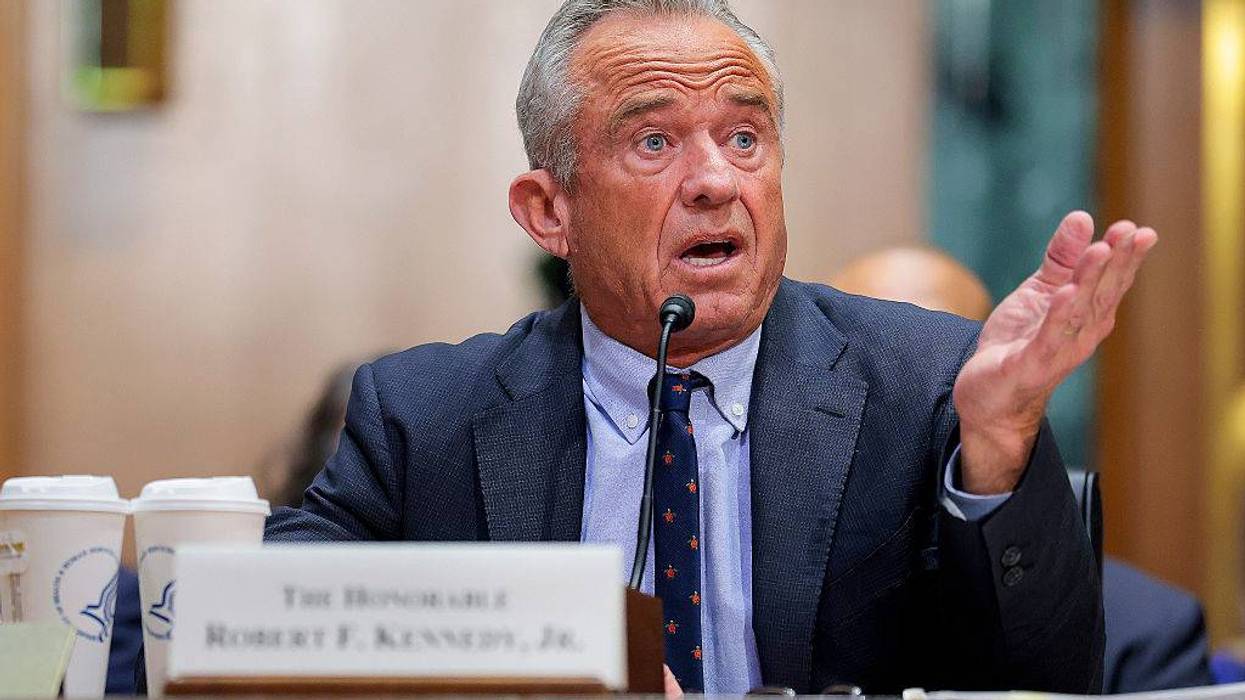
Robert F. Kennedy Jr., the head of the US Health and Human Services Department, said he doesn't think the Republican Party's unprecedented cuts to food aid would have "that much effect."
US Health and Human Services Secretary Robert F. Kennedy Jr. on Wednesday dismissed the impact of massive food aid cuts signed into law last summer by President Donald Trump, saying he doesn't believe the cuts will have "that much effect" as new data showed at least 5 million people have lost assistance so far—including roughly 1.5 million children.
Speaking at a news conference on children's nutrition in Florida, Kennedy falsely claimed that "the only people kicked off of" the Supplemental Nutrition Assistance Program (SNAP) under the GOP budget law signed by Trump "were people who were not eligible for it," either "because their income is too high or because they were illegal aliens."
Kennedy's remarks came as a new analysis by the Center on Budget and Policy Priorities (CBPP) found that SNAP enrollment nationwide has fallen to a 17-year low following enactment of the Trump-GOP budget law, which will cut the program by around $190 billion over the next decade, enact stricter work reporting mandates, and require states to contribute a portion of benefit costs for the first time.
"'Not much effect?' Based on available data from 25 states, we estimate that well over 1.5 million kids nationwide have lost SNAP in the wake of the unprecedented cuts in the Republican reconciliation law," Katie Bergh, a policy analyst at CBPP, wrote in response to Kennedy's remarks. "Many of those kids and their families lost SNAP despite still being eligible."
Watch Kennedy's comments:
Q: “Are either of you concerned that the reduction in funding for SNAP and the reduction in eligibility for SNAP will reduce access to food for children and families?”
Sec. Kennedy: “I don't think it's gonna have that much effect.” pic.twitter.com/1h97NP6rcN
— BulwarkClips (@BulwarkClips) August 26, 2026
News reports, anecdotal accounts from impacted families, and expert assessments contradict Kennedy's insistence that only those who were no longer eligible for SNAP due to income or immigration status have lost benefits. An explosion of red tape due to the new work reporting requirements imposed by the Trump-GOP budget law has made it more difficult for eligible beneficiaries to continue receiving SNAP, forcing many to seek aid from food banks and take desperate measures—such as skipping meals and doses of medication—to make ends meet.
CBPP warned that the impacts of the cuts are likely to intensify once the budget law's provision shifting benefit costs to states takes full effect next year.
"The magnitude of the cost shift and the urgency surrounding error rates may incentivize states to take drastic measures to reduce their payment error rates quickly and cut program costs, even if it means delaying or improperly denying benefits to eligible people," the think tank said on Wednesday. "We’re likely seeing some of those initial effects in SNAP participation data."
A report published last month by a pair of food policy experts argued that the unprecedented assault on SNAP undercuts Kennedy's so-called "Make America Healthy Again" initiative, which purports to place nutrition "at the center of health."
“If we are serious about improving Americans’ health, we need policies that make healthy food more accessible, not less,” said Priya Fielding-Singh of George Washington University’s Global Food Institute. “Cutting off food assistance for millions of families undermines MAHA’s stated goals of improving diet quality and preventing chronic disease. Food security and public health go hand in hand.”
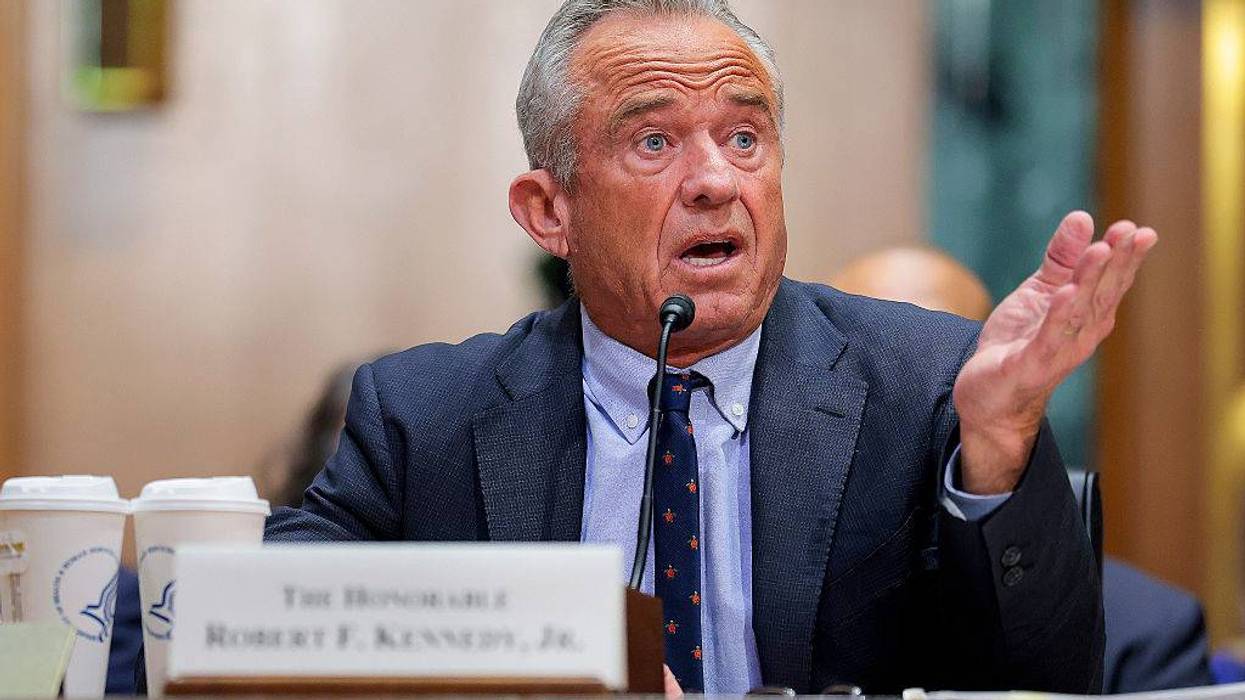
"RFK Jr. must resign or be fired. Vaccines are safe and effective. Listen to your pediatrician," said US Sen. Angela Alsobrooks.
The Pennsylvania Department of Health on Tuesday announced that the state recently suffered its first two measles-related deaths in 35 years.
The two individuals who died were unvaccinated residents of Lancaster County, according to Pennsylvania DOH. The department has confirmed nearly 400 measles cases across the state so far in 2026.
Remarking on the two deaths, Pennsylvania Secretary of Health Dr. Debra Bogen noted that "measles was largely eliminated... for more than three decades," which is why many residents "are not familiar with this disease and don’t fully understand the potential severity of the illness."
"We want to ensure every Pennsylvanian has the information they need to protect themselves, their loved ones and their communities," Bogen added. "As a physician, I want to make sure that people understand that the MMR vaccine is safe and provides the best protection we have against measles."
Measles has made a major resurgence in the US in 2026, and in July the total number of documented cases of the virus surpassed the number recorded throughout all over 2025.
News of the measles-related deaths—the first recorded in the country this year—prompted some critics to point the finger at US Health and Human Services Secretary Robert F. Kennedy Jr., a longtime vaccine conspiracy theorist who was appointed by President Donald Trump to be America's top public health official.
Shaughnessy Naughton, president of 314 Action, declared that "measles is officially out of control," while demanding that Kennedy step down from leading HHS.
"How many more people need to die before there is a nationwide call for RFK Jr. to resign?" Naughton asked. "His anti-science, anti-vaccine policies are killing people and infecting a generation of Americans with dangerous vaccine skepticism that will take years to recover from... It’s time for RFK Jr. to step aside before he inflicts more harm."
Naughton's call for Kennedy's resignation was echoed by Sen. Angela Alsobrooks (D-Md.), whose own state is experiencing a measles outbreak.
"RFK Jr.'s lies and conspiracy theories are making Marylanders sick," Alsobrooks wrote in a Tuesday social media post. "RFK Jr. must resign or be fired. Vaccines are safe and effective. Listen to your pediatrician."
Tara C. Smith, professor of epidemiology at the Kent State University College of Public Health, pointed out that the US has already experienced more measles deaths during Kennedy's two years running HHS than it experienced throughout the prior 24 years combined.
"And outbreaks are still growing here in Ohio and in Pennsylvania," Smith added. "Utter madness that our government is encouraging this."
Biologist Lucky Tran, director of science communications and media relations at Columbia University, similarly observed that measles had been all but eliminated in the two decades before Kennedy took control of HHS.
"Measles was declared eliminated in the US in 2000, but will lose that status this year," wrote Tran. "This is an abject failure of public health leadership."
Kennedy has long used his influence to sow distrust of vaccines, including in Lancaster County, the location of the two most recent measles-related fatalities.
As The New York Times reported earlier this month, Kennedy in 2021 delivered a speech to an estimated 1,500 people in the county urging them to resist any government vaccine mandates.
"Those agencies are going to do everything in their power to make the Amish vaccinate," Kennedy said. "Because they cannot stand the fact that you are healthy."
The future HHS secretary also dismissed concerns about the danger of measles during the speech, recommending a mixture of "chicken soup and vitamin A" as a "cure" for the disease.
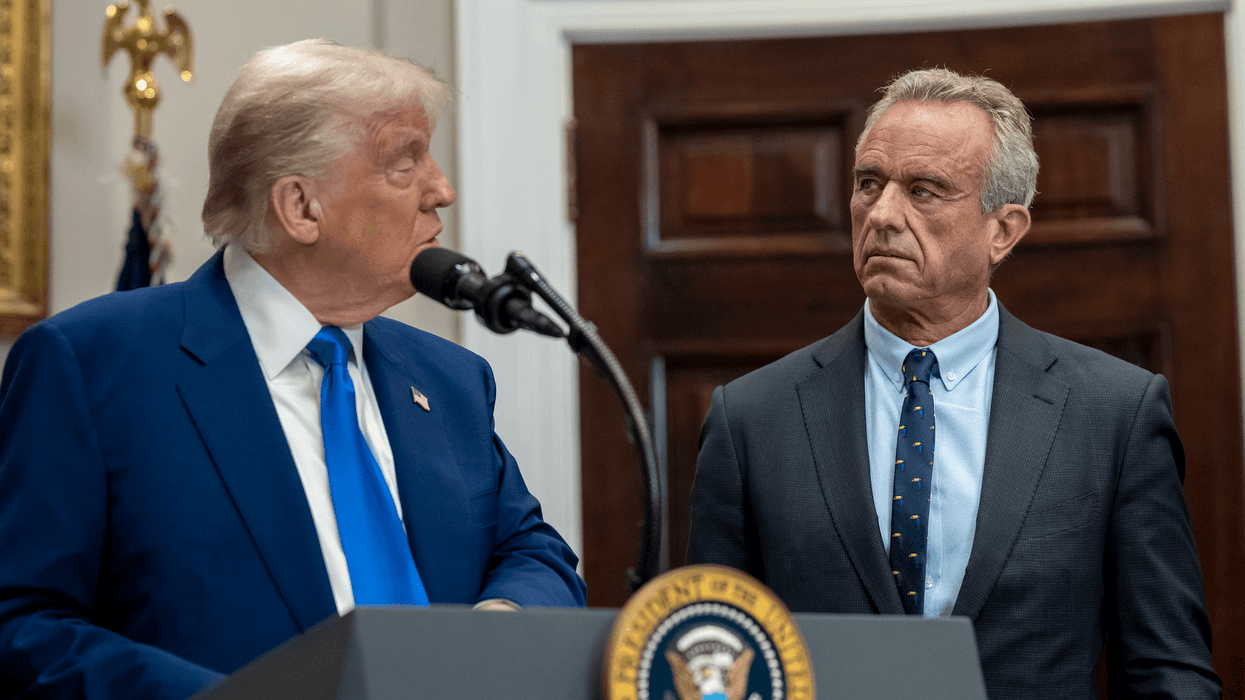
The ruling, said the government watchdog Public Citizen, is "a win for young Americans' well-being."
The Teen Pregnancy Prevention program, first authorized through bipartisan legislation in 2009, has been credited with helping to dramatically reduce the number of American teenagers who have experienced unwanted pregnancies in the past decade and a half, dropping by more than 65% over 16 years, according to one congressional report.
Despite the best efforts of President Donald Trump and Health and Human Services Secretary Robert F. Kennedy Jr., a federal judge's ruling on Wednesday sent the message that the push to reduce teen pregnancy in the US will continue, with the administration's limits on the program's federal grants paused.
Judge Christopher Cooper of the US District Court for the District of Columbia granted a preliminary injunction in the case of Hennepin County, Minnesota v. US Department of Health and Human Services, in which officials joined King County in Washingtin state, Planned Parenthood of the Heartland, and the Sexuality Information and Education Council of the United States (SIECUS) in challenging HHS's changes to the program's grant policy. The plaintiffs were represented by Public Citizen and Democracy Forward.
The changes, said Cooper, were “likely arbitrary and capricious.”
The new policy, announced in June, canceled 53 of 66 active grants that had gone to public universities, health departments, and nonprofits for programming related to sex education, including information that was given to teens on contraception and communication with sexual partners.
In Trump's 2027 budget, the grants are described as promoting "radical leftist ideology," and officials claim there is no evidence that teen pregnancy prevention programs that go beyond educating young people about abstinence have "contributed to the historic decline in teen pregnancy, which is now at an all-time low."
Under new guidance issued in June, Teen Pregnancy Prevention (TPP) program grantees are required to focus lessons on abstinence, deemphasize contraception, and teach teens about fertility and "body literacy."
“HHS is perfectly entitled to formulate its own views about how to stem teen pregnancy—or even whether it is worth preventing at all—and to pursue policy initiatives consistent with its viewpoint. But it is not at liberty, under the Administrative Procedure Act (APA), to impose conditions on grant recipients that Congress did not intend or that are unreasonable or unexplained. The preliminary record suggests that HHS has done just that,” wrote Cooper in the ruling.
"Through the TPP, Congress sought to fund a range of evidence-based teen pregnancy prevention strategies, not just abstinence. According to unrebutted record evidence, programs that teach abstinence to the exclusion of all other approaches are ineffective in delaying sexual initiation and reducing adolescent pregnancy, at least as a general matter," Cooper continued.
The judge took aim at the administration's promotion of "body literacy," which he called “a nebulous concept that appears to elevate fertility and marital procreation over well-tested forms of contraception and pregnancy prevention.”
Cooper also suggested that HHS had not bothered to find genuine evidence of its claims about "body literacy," instead "remarkably" referencing "public health studies that appear either not to exist or not to support the propositions for which they are cited—a hallmark of AI-generated citations.”
The judge stopped short of reinstating the dozens of grants, amounting to about $67 million, that have been terminated, saying it was unclear whether he had the authority to do so.
The plaintiffs and other advocates of comprehensive sex education have called for a permanent injunction; Cooper called on both parties in the case to propose a schedule for next steps by September 1.
Callie Simon, executive director of SIECUS, said the group was "encouraged that the court has halted implementation of the new harmful policy" but emphasized that "the impacts of terminating existing grants remain."
“Today’s decision sends a clear message that the Trump-Vance administration cannot replace the proven, bipartisan Teen Pregnancy Prevention program with an ideologically driven alternative that harms young people,” said Simon. "Communities across the country are still without the evidence-based programs they relied on, and we will continue fighting to ensure young people have access to the sex education they deserve.”
Sandra J. Valenciano, director and health officer for public health in Seattle and King counties, said local communities were facing a measurable loss due to HHS' stripping of TPP grants
“This federal action threatened our ability to complete a study on a new science-based, community-informed sex education curriculum specifically for young men and boys,” said Valenciano. “This ruling gives us hope that we may still be able to get to the finish line with this study and ultimately empower more young people to build healthy families if, when, and how they choose.”
Ruth Richardson, president and CEO of Planned Parenthood North Central States, said the ruling "reaffirms the value of trusted, evidence-based education programs that help youth make informed choices and plan for their futures."
"Attacks on the Teen Pregnancy Prevention program not only put young people at risk, they also risk increasing costs for taxpayers," said Richardson. "No one benefits from these politically motivated attacks. It’s time for them to end.”
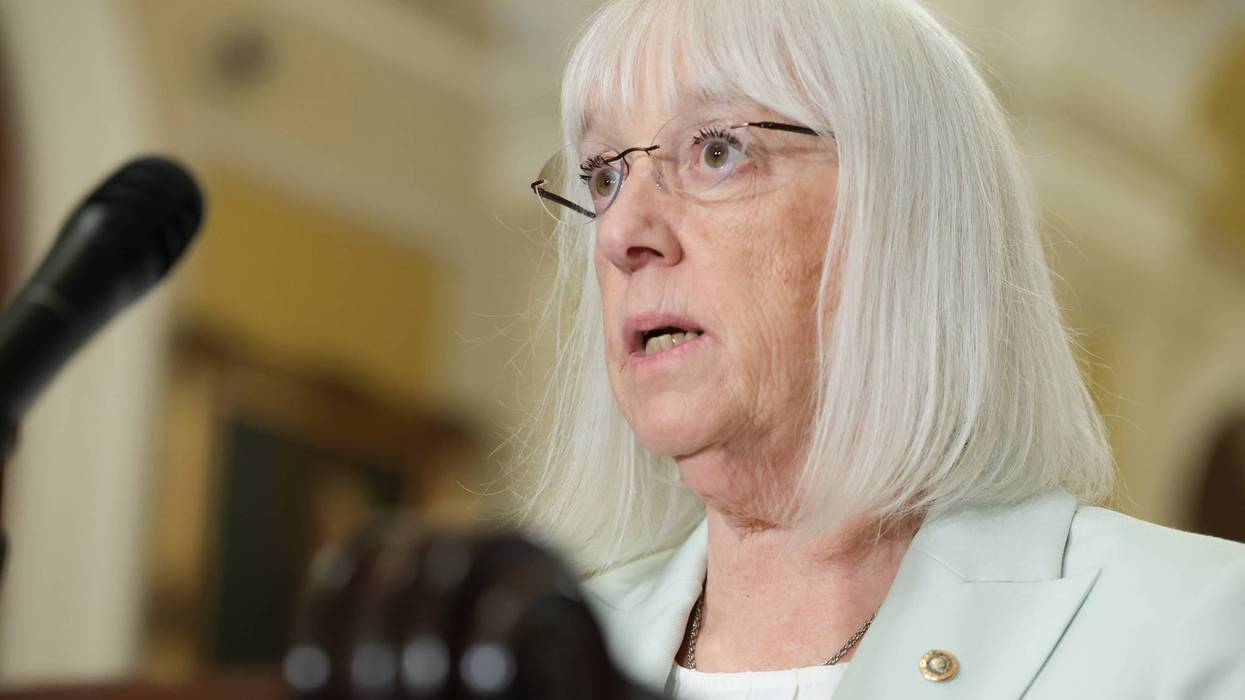
"If Trump had simply done nothing... some of these families would have ended up saving as much as $15,000 a year," said Sen. Patty Murray.
In what Democratic Sen. Patty Murray described as a “slap in the face to moms and dads,” Republicans have blocked her proposed resolution to restore a rule that could have saved low-income parents thousands of dollars per year on childcare before the Trump administration axed it.
Under a rule that went into effect earlier this month, the Department of Health and Human Services (HHS) rescinded a Biden-era rule that capped families’ copayments at 7% of their household income for the Child Care and Development Fund (CCDF), which helps about 994,000 low-income families pay for childcare so parents can work, attend school, or participate in job training.
The program is administered at the state level, and under the abandoned rule that was enacted in 2024, all states were required to begin phasing in the 7% cap, which is considered a federal affordability benchmark.
Under the Trump policy change, states will not be required to cap parents' copayments as long as they continue to use a sliding scale based on income level and don't present a "barrier” to receiving assistance, though it's not specified what that means.
As of March 2026, 19 states had not lowered their maximum copayment to 7%.
An April analysis by the Center for American Progress found that, by eliminating the federal cap, families in 10 states that have not enacted it would lose between $450 and more than $15,000 in potential annual savings, depending on how high their state sets the threshold.
In Ohio, which caps copayments at 27% of household income, families could lose up to $15,482 in annual savings under the maximum copayment. In Vermont, which caps copayments at 14.9% of household income, families could lose up to $11,712.
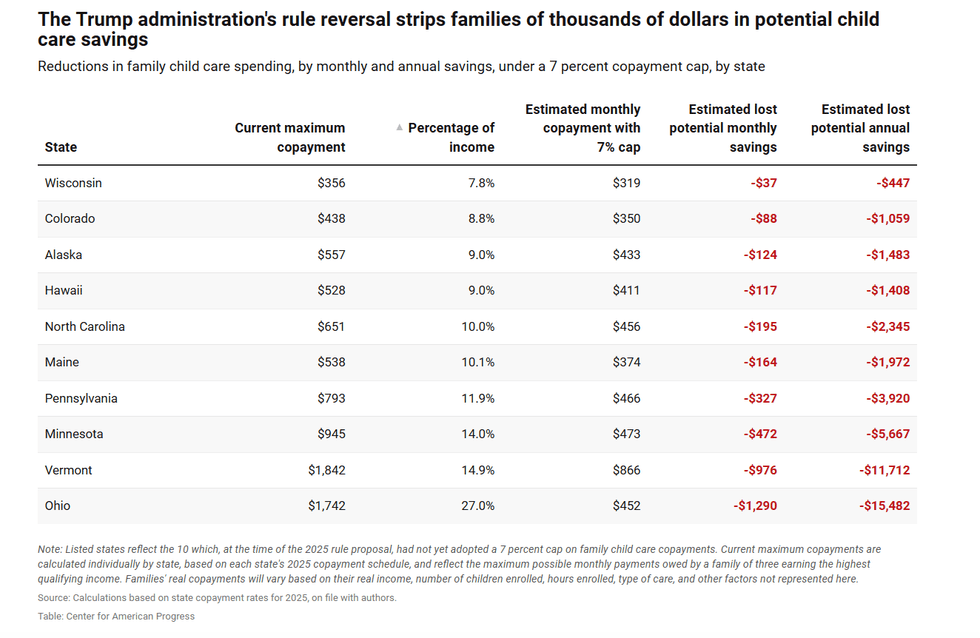 (Graphic from the Center for American Progress)
Murray (D-Wash), the former chair of the Senate Committee on Health, Education, Labor, and Pensions (HELP), introduced a resolution last month under the Congressional Review Act, which would have nullified the administration's elimination of the 7% cap.
It also would have restored other Biden-era requirements that were reversed under the same rule, including requirements that states pay childcare providers based on enrollment rather than attendance, pay them in advance, and use grants and contracts to fund childcare for infants, children with disabilities, and those in underserved communities.
In a speech on the Senate floor before the resolution came to a procedural vote on Thursday, she told her colleagues bluntly, “You are either voting to lower childcare costs or to increase them.”
She challenged the senators who planned to vote against the resolution to “go home and tell the parents in your state you voted to raise their childcare bill,” adding that “you cannot call yourself pro-family while voting to make it more expensive to raise one.”
In a party-line vote on Friday, the bill was blocked from advancing by a margin of 52-47, with every Republican voting against it except for Sen. Mitch McConnell (R-Ky.), who is absent after being hospitalized in June.
After the vote failed, Murray described it as an example of Republicans taking money away from American families struggling to afford the basics of life while pushing for lavish spending on war and tax cuts for corporations and the wealthy.
“How about instead of a $1.5 trillion war budget, we make sure every working family in America can afford childcare?” Murray said. “If Trump had simply done nothing, and left the 7% cap in place, some of these families would have ended up saving as much as $15,000 a year for their family.”
According to a Century Foundation analysis of Bureau of Labor Statistics data, childcare costs increased by 5% from August 2024 to August 2025 and now average more than $13,000 per child per year across age groups.
Trump has been surprisingly open about the fact that, under his control, and in direct contrast with his campaign promises, the federal government is prioritizing spending on his war in Iran instead of providing government subsidies for Americans’ basic needs, including daycare.
"We’re fighting wars. We can’t take care of daycare," he said during a speech in April. "You gotta let a state take care of daycare, and they should pay for it too. It’s not possible for us to take care of daycare, Medicaid, Medicare, all these individual things.”
“Trump says we can’t afford childcare. But he is wrong,” said Murray, who has co-introduced legislation to expand federal childcare subsidies and cover nearly all costs for low-income families. “The truth is we can’t afford to ignore childcare.”

"Abandoning children to meet deportation targets is immoral. This must stop. These children deserve legal representation."
Thousands of unaccompanied immigrant children could lose their lawyers beginning Friday as federally funded contracts supporting them are set to expire, prompting advocates to warn that the move will leave vulnerable minors to face deportation proceedings frightened and alone.
Since 2003, the US Department of Health and Human Services (HHS) has funded a nationwide network of around 100 advocacy groups that have offered legal services to unaccompanied minors who arrived in the United States without their parents or legal guardians, as well as children already in immigration custody.
The Trump administration's move to withhold over $65 million in congressionally appropriated funding starting late last year forced dozens of nonprofit advocacy groups to trim operations, refuse new clients, or end vital programs altogether. There is no apparent plan for continuing representation for roughly 20,000 children currently receiving legal assistance as they navigate the US immigration courts and deportation process.
"This is a five-alarm fire," Sen. Jeff Merkley said Thursday on social media. "It’s wrong under every moral code."
Shaina Aber, executive director of Acacia Center for Justice—one of the nonprofits that received funding through the program—told El País' Patricia Clarembaux on Thursday, "We don’t know what’s going to happen on August 1 because the government has not informed us of the transition plan for the 20,000 children who have representation under this contract."
“It will really depend on whether the attorneys have alternative funding that allows them to continue," she added.
A child cannot be expected to navigate immigration court alone, yet that is exactly what will happen starting this Saturday if the Trump administration succeeds in dismantling these legal services.Tell Congress to honor its promise to protect unaccompanied children: tinyurl.com/protect-kids
[image or embed]
— Acacia Center for Justice (@acaciajustice.org) July 29, 2026 at 2:51 PM
HHS told El País that its Office of Refugee Resettlement—which is responsible for looking after immigrant minors—“remains fully compliant with legal and regulatory obligations and does not act in any way that could dissuade a child from seeking appropriate legal relief.”
However, as Acacia Center noted, "without legal representation, fewer than 1% of immigrant children are granted immigration relief. Without access to counsel, tens of thousands of vulnerable children could be forced to navigate life-changing legal proceedings with fewer protections, fewer advocates, and less time."
"HHS must honor its commitment and fulfill its obligation to pay for legal services already provided to prevent unaccompanied children from being stripped of their lawyers and deported without due process," the group argued.
Critics also point to President Donald Trump's record of mistreating unauthorized immigrants, especially children, over the course of his two terms. During his first term (2017–21), "zero tolerance" policies, including family separation and expanded use of what many observers call concentration camps, left thousands of children traumatized. Detention in overcrowded and often squalid facilities reportedly plagued by abuse has harmed many children since Trump's return to the White House last year.
Katie, a member of the group Women of Welcome and sponsor of immigrant children, responded to the imminent HHS funding cutoff last week, saying, “I have worked with immigrants in my professional life and have a lot of immigrant friends, but seeing the journey through the eyes of these kids was very new."
"The little girl I am adopting has been through a lot of trauma, and I may never know what she has gone through," Katie added. "She is resilient and funny, but she is 6, and she shouldn’t have to fight this system alone. This experience has not only deepened my faith, but I have learned more and more about how important the work of advocacy and loving people is. For these children, it is difficult to fight a system that isn’t built to protect them.”
Anna Devereaux, senior managing attorney at the Michigan Immigrant Rights Center, said that “children are children, regardless of their nationality, and our law and our values require us to act in their best interest."
"But the government’s failure to provide long-term funding has made it challenging to sustain a legal program for children," she added. "If this funding ends now, the future for these children is uncertain.”
Aber said: “These children are not leverage in a political negotiation. They are human beings—many of whom fled violence, trafficking, and abuse—who have a legally and morally recognized right to have their cases heard with a lawyer by their side."
"Abandoning children to meet deportation targets is immoral," she asserted. "This must stop. These children deserve legal representation."

The organization has "provided affordable sexual and reproductive healthcare, including birth control, STI testing and treatment, cancer screenings, and wellness exams to millions of people through Title X."
Planned Parenthood Federation of America on Wednesday sued over the Trump administration's attempt to abuse a federal program "for an overtly political and ideological agenda that is at odds with Title X's statutory purpose of funding comprehensive family planning care for those who cannot afford it."
"Title X of the Public Health Service Act is the only domestic federal program devoted solely to family planning for uninsured, underinsured, and low-income people," notes the complaint, filed in federal court in Washington, DC by lawyers at PPFA, Democracy Forward, and Wilmer Cutler Pickering Hale and Dorr.
After the US Department of Health and Human Services' Office of Population Affairs in April announced changes to how it chooses Title X grantees for the 2027-32 cycle, the National Family Planning and Reproductive Health Association and the Family Health Council of Central Pennsylvania sued last month, backed by the ACLU.
The office then updated the policy earlier this month. However, as Wednesday's complaint explains, the updated version still says that "in evaluating and awarding Title X grants," the office "will consider the extent to which applicants 'advance' and 'align with' a series of political priorities."
PPFA's attorneys argued that the administration's approach is unlawful and puts the group's members "at a competitive disadvantage," which could ultimately impact people seeking care, from contraception to testing for sexually transmitted infections (STIs).
Democracy Forward president and CEO Skye Perryman—whose organization has repeatedly sued over Trump policies—said in a statement that "people should be able to receive the healthcare that is right for them, their lives, and their values, and that requires support for providing critically needed family planning services for people who cannot afford it."
Accusing the administration of "once again putting politics over people," she said that "the unlawful, ideologically driven changes to Title X threaten devastating consequences for lower income Americans nationwide who rely on the program for essential healthcare, including birth control, cancer screenings, and STI testing."
"Title X was created so a person's income would never determine whether they could access the medically appropriate family planning care that is right for them," Perryman emphasized. "We will aggressively pursue legal action on behalf of our clients until the administration stops undermining that promise and follows the law."
Highlighting the potential impact of the administration's policy for people throughout the United States, PPFA pointed out that from October 2024 through September 2025, its health centers provided over 1.3 million Title X visits across 33 states.
"Planned Parenthood health centers have provided affordable sexual and reproductive healthcare, including birth control, STI testing and treatment, cancer screenings, and wellness exams to millions of people through Title X," said PPFA president and CEO Alexis McGill Johnson. "We are suing the Trump administration because, yet again, it is trying to make it harder for people to get the vital care they need at Planned Parenthood."
The new lawsuit comes after Planned Parenthood and other reproductive health clinics regained access to Medicaid funding earlier this month, following the expiration of a provision in the One Big Beautiful Bill Act, which President Donald Trump signed last July.
The passage of that provision was a victory for forced pregnancy advocates, who have long targeted Planned Parenthood for providing abortion care. An analysis from the organization found that the "defunding" effort led to the closure of nearly 30 health centers, all of which were located in "contraceptive deserts" and two-thirds of which were in areas defined as rural, medically underserved, or experiencing health professional shortages.
The group also called the Medicaid provision a "backdoor abortion ban," noting that 64% of Planned Parenthood health center closures were in states where such care is legal, and the shuttered facilities had previously served over 10,000 abortion patients annually.
"By deliberately targeting Planned Parenthood, President Trump and his allies in Congress worsened a public health crisis, making it harder for people to get the essential and lifesaving care they needed at their trusted provider," McGill Johnson said in early July.
"Still, anti-abortion lawmakers are trying to make 'defund' permanent because Planned Parenthood health centers provide abortion care where it's legal," she stressed. "They are willing to sacrifice the lives and health of people across the country if it gets them closer to their goal of banning abortion everywhere and shutting down Planned Parenthood."
"We're in a fight for survival—not just for Planned Parenthood health centers, but for everyone to get high-quality, affordable healthcare from their trusted provider," she added. "And know this: Planned Parenthood will never stop fighting to ensure everyone can get the care they need."
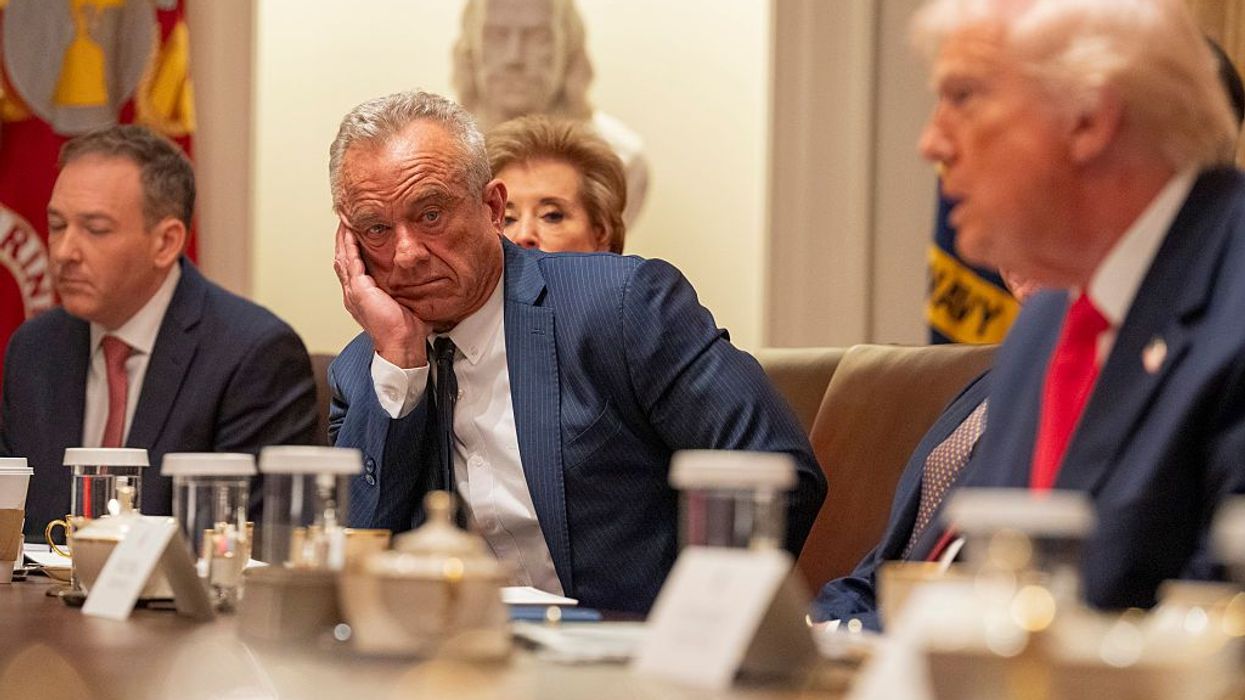
"If Trump gets his way and waters down the child vaccine schedule over the debunked autism myth, more American kids will suffer and die of preventable disease."
With the US already experiencing public health crises involving measles and explosive diarrhea, President Donald Trump reportedly believes it's time to further undermine Americans' faith in the safety of vaccines.
The Wall Street Journal reported on Monday that Trump in May asked US Health and Human Services (HHS) Secretary Robert F. Kennedy Jr. why he wasn't doing more to research disproven claims linking childhood vaccination with increased incidence of autism.
Trump specifically said he'd like to see Kennedy cut the number of shots the CDC recommends for children on the idea that doing so would make "autism rates drop, even if any such effect could take years."
Kennedy, despite being best known as an anti-vaccine conspiracy theorist before being appointed as the nation's top health official, was reportedly "taken aback" by Trump's demands, as White House political advisers had asked him to tone down his rhetoric about vaccinations.
During a White House meeting roughly a month later, the Journal reported, Trump complained that Kennedy "wasn't doing enough" to reduce the number of childhood vaccinations.
Multiple high-quality medical studies have found no link between vaccines and autism.
Brad Woodhouse, president of Protect Our Care, expressed horror at the president leading the charge against childhood vaccinations, which are estimated by the US Centers for Disease Control and Prevention (CDC) to prevent 4 million deaths per year worldwide.
"The reality is ugly," said Woodhouse. "If Trump gets his way and waters down the child vaccine schedule over the debunked autism myth, more American kids will suffer and die of preventable disease. We’re already in the middle of a record-breaking measles crisis thanks to vaccine lies amplified loudly by this administration, yet Trump is determined to do more damage."
Gavin Yamey, director of the Center for Policy Impact in Global Health at Duke University, declared himself "livid" at Trump's latest efforts to undermine confidence in vaccines.
"Ahead of the midterms, RFK Jr. and Trump... are ALL IN on their dangerous anti-vaxx activism and conspiracy theories," Yamey wrote in a social media post. "There is a wealth of high quality evidence that vaccines do not cause autism."
Claremont McKenna College political scientist Jack Pitney noted that Trump's false belief in a link between vaccines and autism stretches back years.
"For decades, Trump has pushed the lie that vaccines cause autism," Pitney wrote. "Now he reportedly wants RFK Jr. to push it even harder. The result? More US measles cases in the past 18 months than in the previous 20 years combined."
"This coverage collapse was a choice that Congress made. As a result, millions more will end up uninsured, living sicker, dying younger, and being one emergency away from financial ruin."
The Trump administration quietly released data last week showing a sharp decline in the number of Americans enrolled in health insurance on the Affordable Care Act exchanges, a widely predicted outcome caused by congressional Republicans' refusal to extend subsidies that helped people buy coverage.
The new data, published Friday on the Department of Health and Human Services' website, shows that 19.2 million people were enrolled in ACA marketplace plans as of February—a decline of more than 5 million since the start of President Donald Trump's second term.
Last year, Republicans repeatedly blocked Democratic efforts to enact a temporary extension of the enhanced ACA tax credits, whose expiration at the start of 2026 led insurers to jack up premiums, pricing many out of coverage entirely. In focus groups, some Americans facing premium spikes said they would be forced to cut back on groceries or ration their medications to afford coverage.
“This dramatic decrease of millions of Americans losing health insurance is the result of deliberate decisions by the president and congressional leaders—it is what we feared but expected, given the end of the enhanced tax credit and other policies that make it harder to get on and stay on coverage," said Anthony Wright, executive director of the advocacy group Families USA. "As a result, millions more will end up uninsured, living sicker, dying younger, and being one emergency away from financial ruin."
Wright dismissed the Trump administration's attempt to explain away the coverage losses by claiming the numbers show a decline in "phantom" enrollment and fraud, calling that narrative "an insult to every person who became uninsured or underinsured."
"These results are real for the millions who faced premiums doubling, paying hundreds of thousands of dollars for coverage. The resulting price spikes and coverage losses are real for all who buy coverage as individuals, including gig workers, small business owners, young adults, seniors not quite of Medicare age, and many others," said Wright. "The consequences are now undeniable: millions dropped from the rolls, and yet another year of double-digit premium increases."
The lapse of enhanced ACA subsidies—which were established in 2021 during the Biden administration—alongside the roughly $900 billion in Medicaid cuts included in the Republican budget package that Trump signed into law last summer amounts to what analysts, advocates, and Democratic lawmakers say is the largest assault on federal healthcare programs in US history.
"We weren’t being hysterical. We knew this would happen," said Rep. Sara Jacobs (D-Calif.) in response to the new enrollment figures. "When Republicans passed the Big Ugly Bill and cut funding for healthcare, they literally signed away millions of Americans’ ability to afford health insurance. And now it’s happening."
According to the Congressional Budget Office, around 16 million people across the US could lose health coverage by 2034 due to the Trump-GOP law, and millions of children have lost coverage since last year.
“Trump and Republicans are engineering the most devastating assault on healthcare in history, and today’s numbers prove it," Leslie Dach, chair of the advocacy group Protect Our Care, said on Friday. "They ripped away the tax credits that helped millions afford coverage, gutted funding to help people enroll, and sabotaged the ACA at every turn. They knew exactly what would happen, they chose to do it anyway, and it’s going to get worse."
“Among the three million who have lost coverage are parents skipping cancer screenings, patients rationing insulin, and families who are now one medical emergency away from financial ruin," said Dach. "Republicans created this crisis on purpose, and while Americans pay for it with their health and their lives, billionaires are cashing their tax cut checks."