

5
#000000
#FFFFFF
To donate by check, phone, or other method, see our More Ways to Give page.

The blast is expected to send a plume of toxic lead dust into the air, which could travel at least 100 miles depending on the weather.
In a post on Truth Social, Trump said he believed detonating the material was “the proper course” of action to prevent an uncontrolled explosion. He said he would order the Army to wait until the US Court of Appeals for the Eighth Circuit allows the operation to proceed. The court blocked a US Environmental Protection Agency (EPA) permit for the planned detonation last week.
Trump also said he would wait for approval from Iowa’s Democratic governor-elect, Rob Sand. Sand said the Army had known for months that its plan was a public health hazard and that its delay in dealing with the deteriorating material made the situation “more dangerous and unpredictable than it ever should have been.” He called for postponing the operation until the public better understood the risks.
Trump said that Sand, who takes office in January, would be responsible for “any and all death or destruction” resulting from the delay.
The president's order comes a day after the Army announced that it planned to detonate the chemicals on Wednesday, November 25, the day before Thanksgiving, citing what it said were optimal weather conditions to mitigate harm from the toxic cloud. The Army said it planned to carry out the detonation despite the Eighth Circuit's order from last week, citing what it claimed were emergency authorities.
While the Army has insisted the controlled detonation is the safest path to avoid an even more dangerous accidental explosion, environmental groups have argued that the crisis was one “of the Army’s own making.”
In a court filing defending the Army’s claim of emergency authority, the US Department of Justice (DOJ) revealed that the Army had removed protective blast doors, leaving the explosives more vulnerable to temperature fluctuations. The filing also revealed that the Army had failed to replenish the stabilizing solution for more than a year and had found dangerous crystallization in 58 of the 68 barrels.
"The new information from the DOJ indicates that the problem is significantly worse than the Army originally shared," said Michael Schmidt, general counsel for the Iowa Environmental Council—one of the groups that sued last week in an effort to halt the detonation. "It appears that detonation may be, at this point, the only feasible option due to how long this problem was allowed to persist."
The groups have criticized the Army for failing to keep residents informed as it planned the operation over several months. Outgoing Iowa Gov. Kim Reynolds’ office said the Republican governor’s staff learned of the plans only a week ago.
Earthjustice attorney Thien Chau has described the potential fallout as a “public health catastrophe for people in at least two states,” Iowa and Illinois.
The Army’s own modeling indicated that the blast could send large amounts of lead dust into the air. The particles could then settle on homes, playgrounds, and farmland or enter waterways, where contamination could persist long after the explosion.
According to the EPA, there is no safe level of lead exposure for humans. Even low levels of exposure can permanently harm children’s developing brains. Lead exposure can also cause kidney damage, cardiovascular problems, and developmental disorders.
A 2024 study published in the International Journal of Epidemiology estimated that lead exposure contributed to approximately 67,000 deaths a year in the United States from 2017-19, largely through its association with cardiovascular disease and other chronic health problems.
Wally Taylor, attorney and legal chair for the Sierra Club’s Iowa Chapter, said the Army had yet to provide documents showing it had explored safer alternatives.
“The Army has clearly mishandled this situation, and Iowans and residents in our neighboring states deserve a full review of all of the missteps that led us to this point," he said. "However, if detonation is now the only option, it is imperative that everyone impacted has access to the full range of testing, mitigation, and remediation resources."
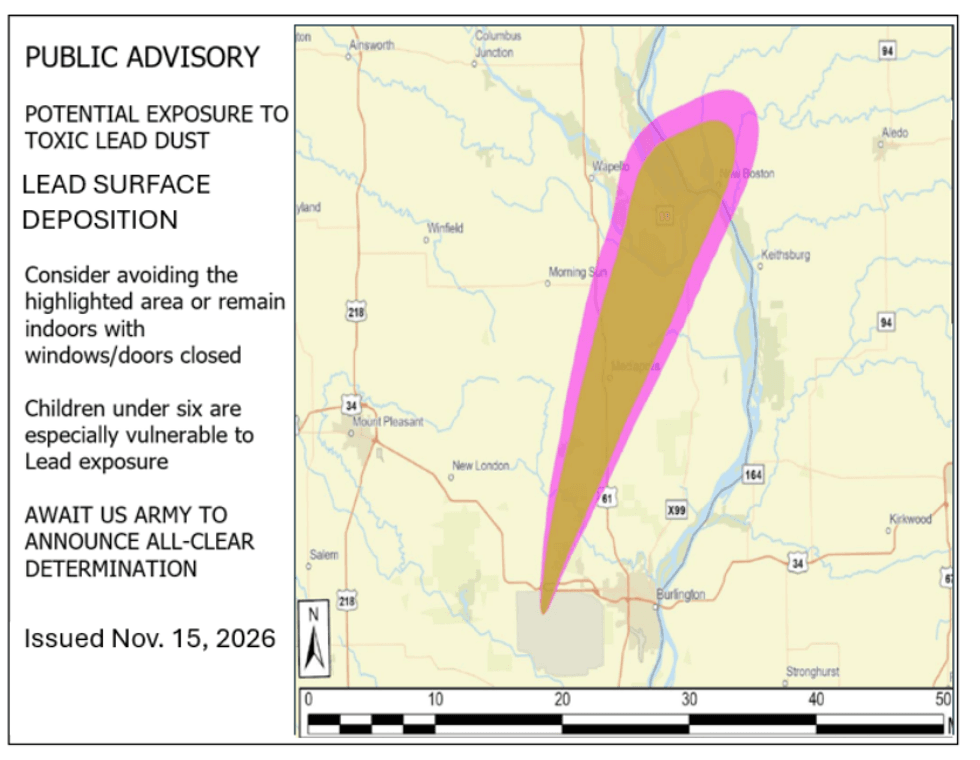 A US Army map issued on November 15, 2026, shows areas the Army advised Iowa residents to avoid following the planned detonation of nearly 10,000 pounds of degraded lead azide at the Iowa Army Ammunition Plant near Middletown, Iowa. (Image: US Army)
Trump saddled Sand with responsibility for the delay even as officials in both parties called on the Army to postpone the blast.
On Thursday, Sens. Dick Durbin (D-Ill.) and Tammy Duckworth (D-Ill.), Reps. Darin LaHood (R-Ill.), Mary Miller (R-Ill.), and Eric Sorensen (D-Ill.), Democratic Illinois Gov. JB Pritzker, and Sens.-elect Juliana Stratton (D-Ill.) and Josh Turek (D-Iowa) sent a letter relaying their concerns to EPA Administrator Lee Zeldin and Acting Army Secretary Adam Telle.
“Families in the area deserve better than being left with unanswered questions about a decision that could affect their health and safety. They deserve timely information, transparent safety plans, and a meaningful opportunity to understand the risks before the Army moves forward. I’m urging them to delay this and seek out safer alternatives,” their letter reads.
Duckworth reiterated in another statement on Sunday that "the Army still has failed to explain to the public why this detonation needs to happen this way—and too many people fear for their family’s health and safety."
"This is an extreme failure of communication, planning, and leadership," she said. "And they must be held accountable for the harm done."