

SUBSCRIBE TO OUR FREE NEWSLETTER
Daily news & progressive opinion—funded by the people, not the corporations—delivered straight to your inbox.
5
#000000
#FFFFFF
To donate by check, phone, or other method, see our More Ways to Give page.
Daily news & progressive opinion—funded by the people, not the corporations—delivered straight to your inbox.
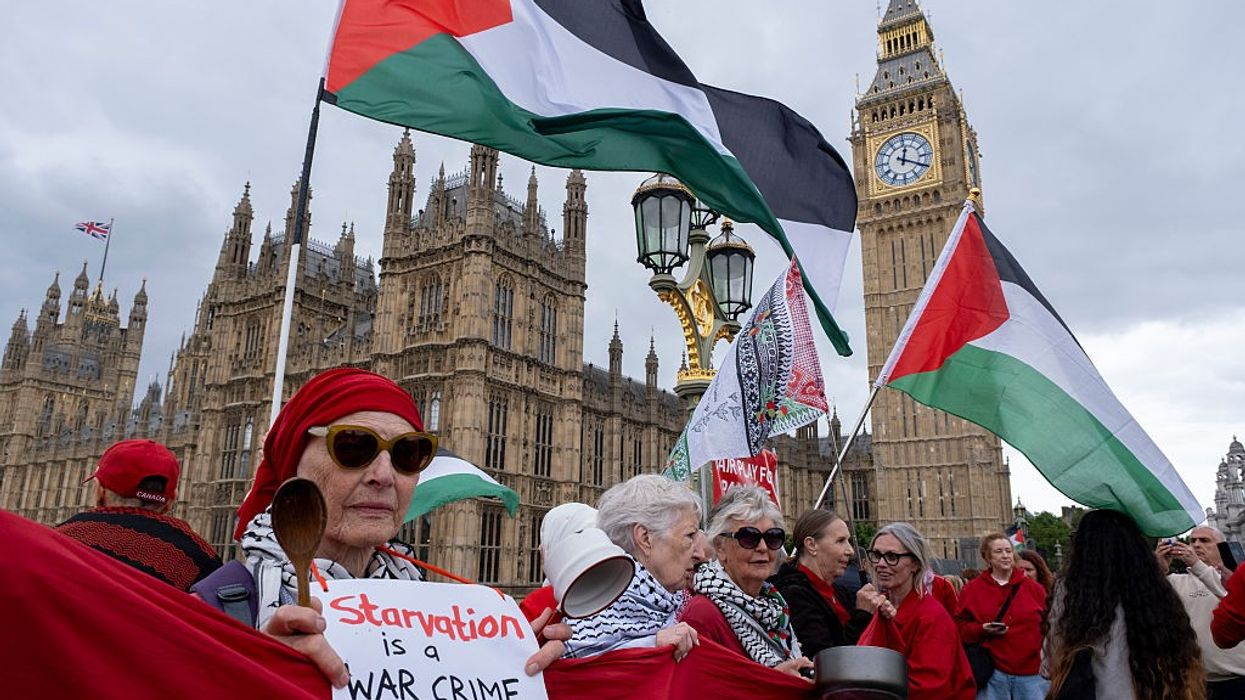
"U.K. Prime Minister Keir Starmer admitted this week that the situation in Gaza is 'getting worse by the day' but has yet to match these words with concrete actions."
Thousands of people formed a "Red Line for Palestine" encircling the U.K. Parliament in Westminster on Wednesday to demand an arms embargo and sanctions on Israel for its ongoing genocidal violence against Palestinians in the Gaza Strip.
The protesters are also calling for the reinstatement of U.K. aid to the United Nations Relief and Works Agency for Palestine Refugees in the Near East (UNRWA), the government's support for International Criminal Court investigations, and an immediate and permanent cease-fire in Gaza, according to a statement from organizers.
The red line protest during Parliament's "question time" was organized by the Campaign for Nuclear Disarmament, Friends of Al-Aqsa, Muslim Association of Britain, Palestinian Forum in Britain, Palestine Solidarity Campaign, and Stop the War Coalition.
"The U.S.-backed aid distribution in Gaza has shut down operations today, citing 'security risks,'" organizers noted. "This follows widespread criticism over its ties to Israel and alleged downplaying of civilian casualties. Meanwhile, U.K. Prime Minister Keir Starmer admitted this week that the situation in Gaza is 'getting worse by the day' but has yet to match these words with concrete actions."
While people in the streets took aim at Starmer and U.K. Foreign Secretary David Lammy, who are both part of the Labour Party, some members of Parliament joined the protest.
Scottish MP Brian Leishman, a member of Labour's Socialist Campaign Group, said on social media that he was "proud to stand with fellow MPs and the thousands of people that joined the Red Line for Palestine protest outside Parliament today calling for an end to genocide and for countries to stop arming Israel."
MP Colum Eastwood, former leader of Northern Ireland's Social Democratic and Labour Party, similarly said that he was "proud" to join the protest, while MP Zack Polansky, a candidate to lead the Green Party, said he was "proud to stand with so many fellow Jewish people against the genocide."
Party MP Ellie Chowns described her experience participating in the demonstration as "incredibly moving and powerful," while Independent MP Shockat Adam declared: "Starving children is a red line. Genocide is a red line. When humanity is on the line, silence cannot be the response."
Independent MP Adnan Hussain said he was "honored to have joined" the action and shared footage in which he appeared with MP Jeremy Corbyn, a fellow Independent who used to be Labour's leader. In the Sky News clip, Corbyn talked about the bill he's introducing to demand an independent public inquiry into the U.K.'s "complicity with active genocide" in Gaza.
"Many of us remain disgusted by the continued supply of components for the F-35 fighter jet program," Corbyn told The New Arab. "I am shocked the government openly admits to making 'exceptions' to its partial suspension. Does this breach its legal obligations to prevent genocide? One thing is clear: This government still supplies weapons to a state whose leader is wanted by the International Criminal Court for crimes against humanity."
The Hague-based tribunal in November issued arrest warrants for Israeli Prime Minister Benjamin Netanyahu, former Israeli Defense Minister Yoav Gallant, and a Hamas leader who has since been declared dead. Israel also faces a genocide case at the International Court of Justice over its annihilation of Gaza.
Polling shows Israel's destruction of Gaza is unpopular with the British public. The Palestine Solidarity Campaign not only was an organizer of Wednesday's protest but also commissioned a poll from Opinium Research and released the results on Wednesday. The survey, conducted from May 30 to June 2, found that 57% of Brits believe the U.K. should impose a full arms embargo.
The survey also found that 54% support sanctioning Israeli Finance Minister Bezalel Smotrich, 53% think Israel should be expelled from the U.N., and 50% support boycotting Israeli products in supermarkets. Middle East Eye reported that "the new poll comes after a similar survey showed public support for Israel in European countries had fallen to its lowest recorded level."
The polling also comes as the official casualty counts in Gaza—which experts warn are likely significant underestimates—climbed to 54,607 Palestinians killed and 125,341 wounded, with most of the enclave's more than 2 million struggling to access food, water, shelter, and healthcare in the face of Israel's bombings and blockade of humanitarian aid.
U.K. organizers plan to follow Wednesday's red line action with a National March for Palestine on Saturday, June 21.
"Israel's attacks on Gaza and the West Bank are intensifying. Their starvation policy continues," says the march's webpage. "The U.K. government has at last accepted that Israel's actions are unconscionable. Now they must act—words are not enough."
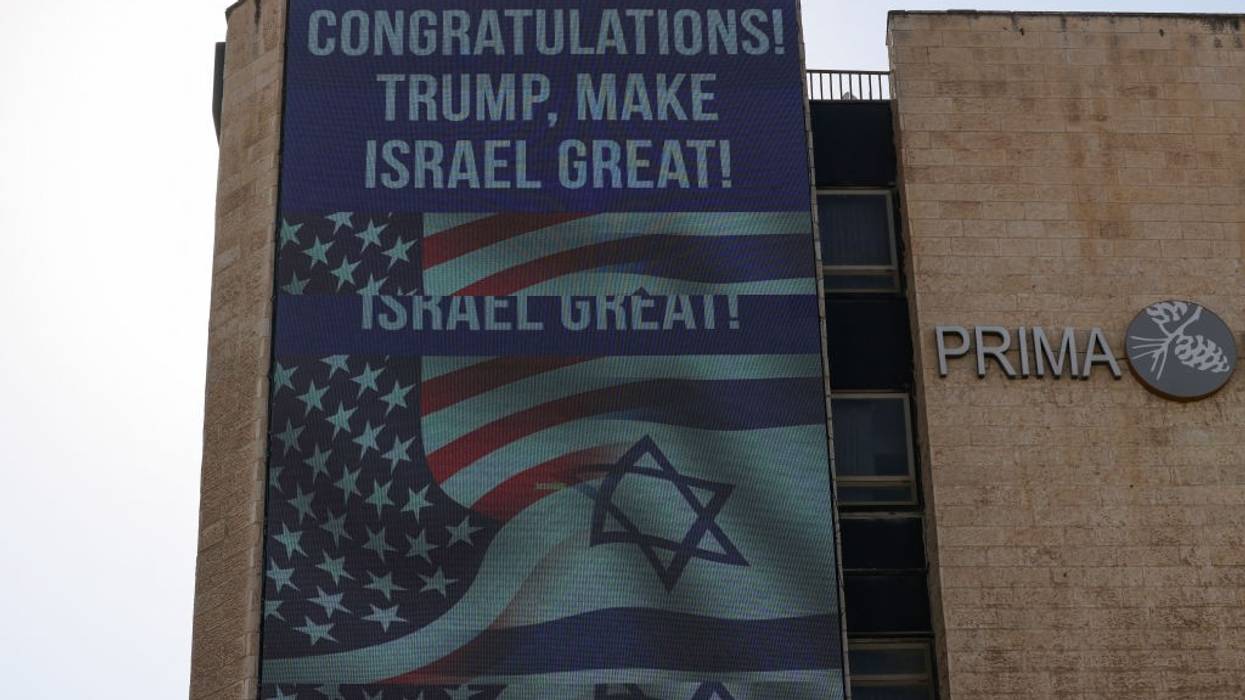
"We in the anti-war movement must redouble our efforts to end the genocide and wars in the Middle East," said one campaigner.
While many critics of U.S. Vice President Kamala Harris opposed the Democratic presidential nominee due to the Biden-Harris administration's nearly unconditional support for Israel's annihilation of Gaza, peace advocates on Wednesday warned that Republican President-elect Donald Trump could lift the few guardrails the Democrats had placed on Israel and unleash the key ally to seize all of Palestine.
"A Harris victory would not have stopped Israel's genocide in Gaza or drive to war across the Middle East, but Trump's racism, Islamophobia, and bigotry, and his close relationship with [Israeli Prime Minister Benjamin] Netanyahu, could well enable Israel to pursue its desire for full control of Gaza and the West Bank," Lindsey German of the London-based Stop the War Coalition said in a statement.
"We face an extremely dangerous situation worldwide."
Israel has gradually and systematically seized more and more Palestinian lands since illegally occupying the Gaza Strip and West Bank, including East Jerusalem, in 1967. The goal of Israel's far right is expansion of Israeli territory to include what proponents call "Greater Israel," which is based on biblical boundaries that stretched from Africa to Turkey to Mesopotamia. Netanyahu has repeatedly displayed maps showing the Middle East without Palestine, all of whose territory is shown as part of Israel.
On Wednesday, far-right Israelis including senior government officials like National Security Minister Itamar Ben-Gvir and Finance Minister Bezalel Smotrich celebrated Trump's win. They are openly plotting ways to steal more land, including by ethnically cleansing Palestinians during the current war on Gaza, through home demolitions and forced expulsions in the West Bank and East Jerusalem, and by expanding Jewish-only apartheid settlements that are illegal under international law.
David Friedman, who served as U.S. ambassador to Israel during Trump's first term, recently released a book advocating Israel's annexation of all of Palestine, a policy "based first and foremost on biblical prophecies and values," according to the author. Friedman envisions a situation in Palestine akin to the U.S. conquest and rule of Puerto Rico, in which Palestinians don't have voting rights but are granted limited autonomy so long as they act in accordance with Israeli law.
Powerful Trump backers also support annexation. Republican megadonor Miriam Adelson's wish list for the president-elect's second term includes Israeli annexation of the West Bank and U.S. recognition of the move.
During Trump's first term, then-Secretary of State Mike Pompeo ended a 30-year State Department policy under which Israeli settler colonies in the occupied West Bank were viewed as inconsistent with international law. Pompeo later explained that as an evangelical Christian, his position was based on the biblical belief that Israel is God's "promised land" for his "chosen people," the Jews.
In February, U.S. Secretary of State Antony Blinken reversed the so-called Pompeo Doctrine, declaring Israeli settlements to be "inconsistent with international law"—even as he provided diplomatic cover for the war on Gaza for which Israel is on trial at the International Court of Justice for alleged genocide.
According to Israeli media reports, Trump has pushed Netanyahu to wrap up the Gaza war before he takes office next January. Many observers fear that could mean Israeli forces ramp up already devastating attacks that have killed more than 43,000 Palestinians, mostly women and children, while wounding more than 102,000 others and displacing, starving, and sickening most of Gaza's population.
United Nations human rights officials said last week that Israeli forces are creating an "apocalyptic" situation in northern Gaza, where the invaders are being accused of carrying out the so-called General's Plan to starve and then ethnically cleanse Palestinians from parts of the coastal enclave in order to make way for Israeli recolonization.
"We face an extremely dangerous situation worldwide, with a growing arms race," warned German. "We in the anti-war movement must redouble our efforts to end the genocide and wars in the Middle East. We also need peace in Ukraine, for the West to stop arming Ukraine, and for an end to the escalation of militarism and conflict aimed at China in the Pacific."
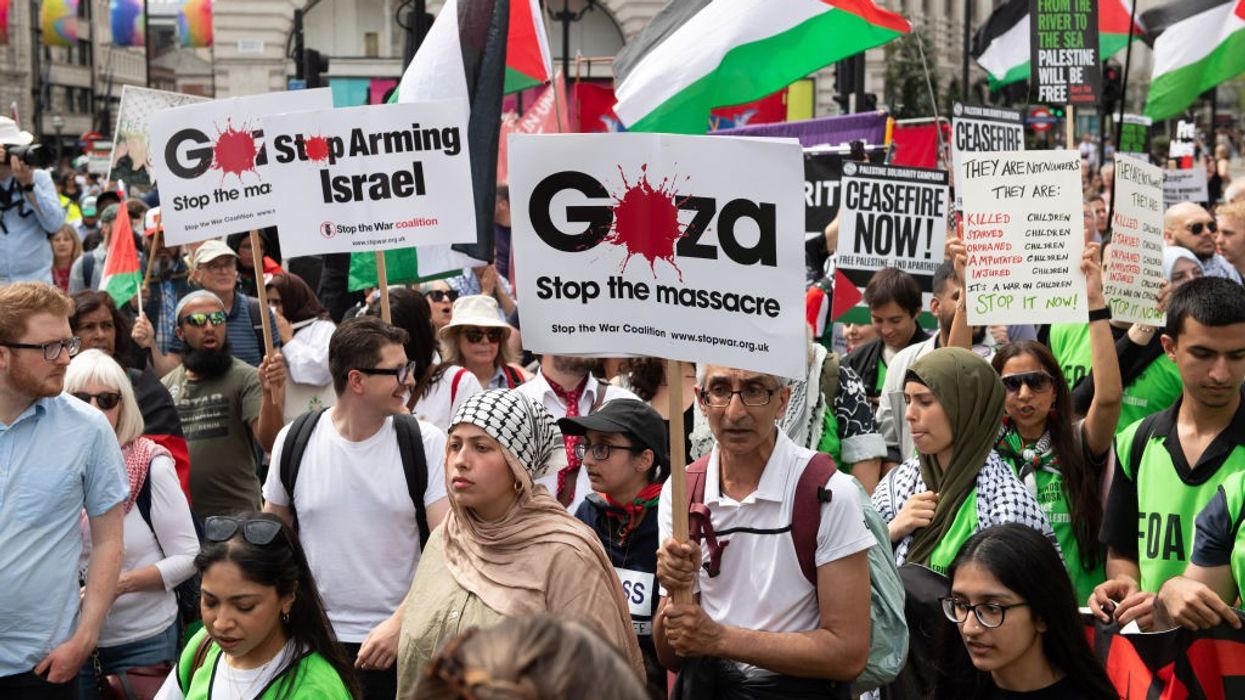
"Finally—but this is both too little and too late," said the International Center of Justice for Palestinians.
As governments enabling Israel's devastating war on the Gaza Strip face growing global demands to impose arms embargoes, a U.K. minister on Monday announced the suspension of approximately 30 of 350 weapons export licenses.
"This is not a blanket ban. This is not an arms embargo," stressed U.K. Foreign Secretary David Lammy, part of Prime Minister Keir Starmer's Labour Party, which took control of the government after voters ended 14 years of Conservative rule in July.
While describing himself as a "friend of Israel" and "a liberal, progressive Zionist," Lammy said that "it is this government's legal duty to review export licenses" and "the assessment I have received leaves me unable to conclude anything other than that for certain U.K. arms exports to Israel, there does exist a clear risk that they might be used to commit or facilitate a serious violation of international humanitarian law."
The targeted licenses are for "equipment that we assess is for use in the current conflict in Gaza, such as important components which go into military aircraft, including fighter aircraft, helicopters, and drones, as well as items which facilitate ground targeting," Lammy told the U.K. Parliament. The remaining exports "will continue" and "the government will keep our position under review."
According to the Financial Times:
The move will not affect components for the multinational F-35 joint striker fighter program, except regarding parts sent directly to Israel.
U.K. officials determined that suspending critical components within a global pool of spare parts could harm the maintenance and operations of F-35s in other nations.
"When Israel is carrying out a genocidal assault in Gaza, we shouldn't just ban a small fraction of arms licenses to Israel,"
said Zarah Sultana, a Labour Party member who represents Coventry South in Parliament. "This ban still allows the U.K. to sell parts for F-35 fighter jets, known as 'the most lethal' in the world. The government needs to ban ALL arms sales."
Stop the War Coalition
called the suspension "an admission of guilt" and similarly stressed that "we need a full, comprehensive ban on arms sales to apartheid Israel—not this half-hearted approach."
Lammy's announcement came as the Danish news outlet
Information and NGO Danwatch connected Israel's use of an F-35 stealth fighter to a July 13 attack on an Israeli-designated "safe zone" in southern Gaza, which killed scores of Palestinians and injured hundreds more.
In a statement responding to both developments, Sam Perlo-Freeman, research coordinator for the Campaign Against Arms Trade,
said:
The government's statement today that it is suspending 30 arms export licenses to Israel is a belated, but welcome move, finally acting upon the overwhelming evidence of Israeli war crimes in Gaza. But exempting parts for Israel's F-35 is utterly outrageous and unjustifiable.
These are by far the U.K.'s most significant arms supplies to the Israeli military, and just today we have confirmation that they have been used in one of the most egregious attacks in recent months. The government has admitted that there is a 'clear risk' that Israel is using fighter aircraft among other weapons to violate international humanitarian law. How can this 'clear risk' not apply to the F-35s? The only right and legal course of action is to end the supply of F-35 parts to Israel, along with the rest of U.K. arms sales.
Although the suspension is not as bold as critics of Israel's bombardment have called for, it was still seen as another positive step under Starmer, whose government has also recently resumed funding to the United Nations Relief and Works Agency for Palestine Refugees in the Near East and dropped a challenge to the International Criminal Court prosecutor's request for arrest warrants for Israeli Prime Minister Benjamin Netanyahu and Defense Minister Yoav Gallant as well as Hamas leaders.
While Gallant said he was "deeply disheartened" by the U.K.'s latest move, Dearbhla Minogue, senior lawyer for the Global Legal Action Network (GLAN), declared that "this momentous decision vindicates everything Palestinians have been saying for months."
GLAN and Al-Haq on Saturday had threatened the U.K. government with new legal action if it failed to engage the suspension mechanism following revelations in The Guardian and The Telegraph regarding communications between Attorney General Richard Hermer and the Foreign Office about weapons sales to Israel.
"The U.K. government was backed into a corner," Minogue said Monday. "Our most recent letter showed that a suspension was the only right and legal thing to do. This is a truly historic victory for Al-Haq and for Palestinians. The exhaustive evidence we filed in mid-August showed that there was only one legally sound decision available to the government—that it is against the law to supply Israel with weapons for use against Palestinians in Gaza."
Both groups are now considering their next actions. Fellow GLAN lawyer Charlotte Andrews-Briscoe emphasized, "Now that the government has taken this important step, it must do much, much more, and abide by its obligations under international law to do everything in its power to prevent the commission of genocide."
Israel faces an ongoing South Africa-led genocide case at the International Court of Justice for its nearly 11-month assault on Gaza, which has killed at least 40,786 Palestinians, injured another 94,224, and forcibly displaced most of the enclave's 2.3 million residents, who are struggling to find food, water, shelter, and adequate medical care.
The Associated Press reported that "British firms sell a relatively small amount of weapons and components to Israel compared to major suppliers such as the U.S. and Germany. Earlier this year, the government said military exports to Israel amounted to £42 million ($53 million) in 2022."
Still, the suspension could increase pressure on other allies of Israel to take similar action and
strain relations with the U.S. government—which, under President Joe Biden, has showered Israel with weapons and diplomatic support since the current escalation of the decadeslong conflict began in October.
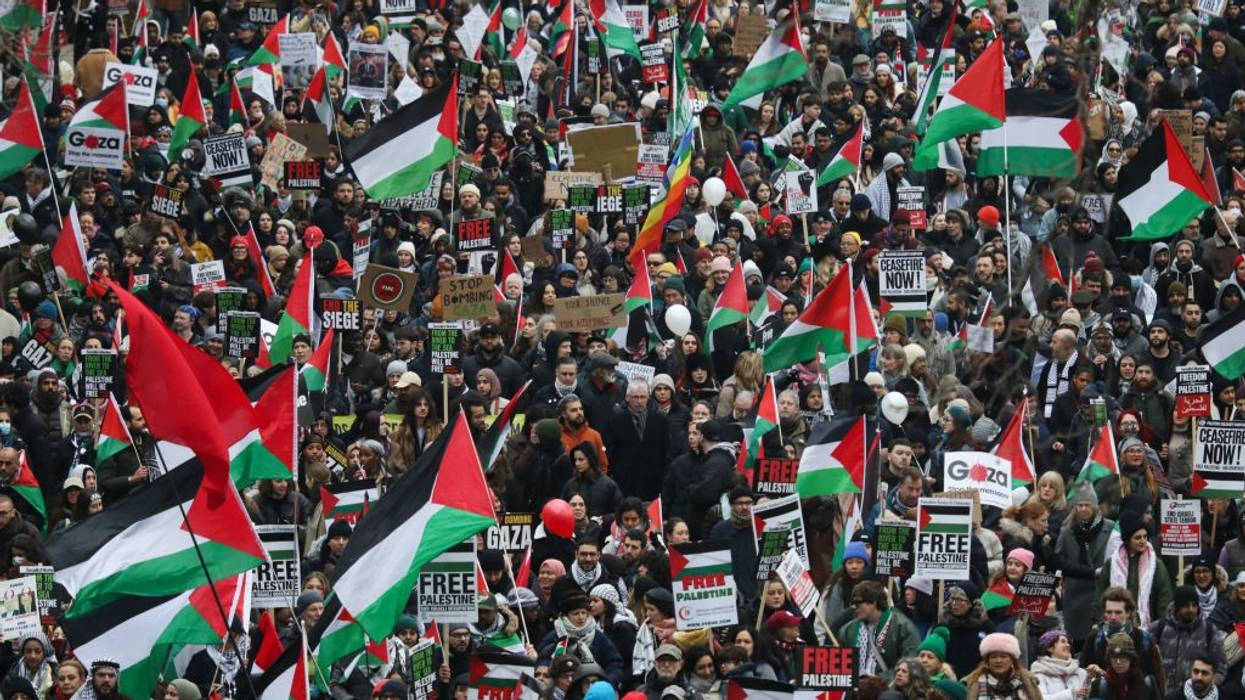
Coordinated actions from DC to London to Jakarta designed to "send a powerful message not just to the Israelis but to the Western powers who are backing them that the public say 'not in our name.'"
Major coordinated demonstrations took place across the world on Saturday to mark the 100th day of Israel's bombardment and military assault on the people of the Gaza Strip that have now claimed the lives of nearly 24,000 Palestinians, a large majority of them innocent men, women, and children who had nothing to do with the attacks orchestrated by Hamas on October 7 of last year.
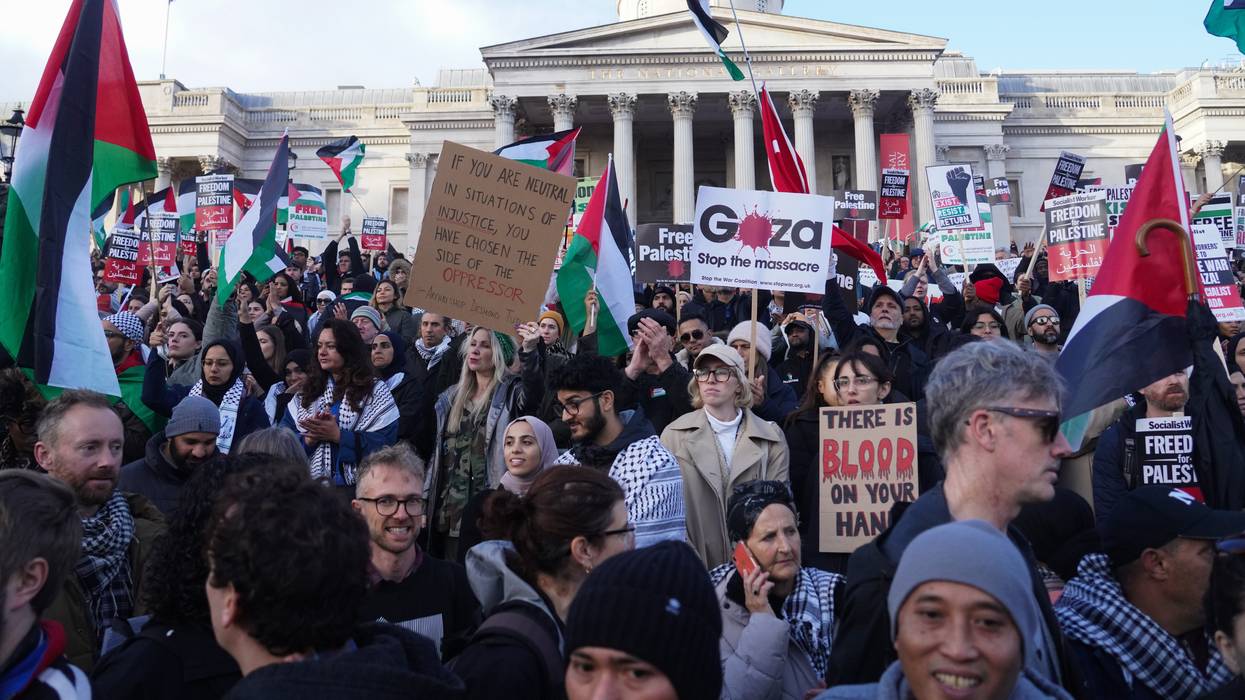
In London, as many as 500,000 people marched on Parliament Square to demand an immediate cease-fire Gaza, condemn their own U.K. government's support of Israel's disproportionate and "genocidal" onslaught, and warn against a wider regional war that experts warn is creeping closer by the day.
'Justice is lacking': pro-Palestine demonstrators gather in Londonwww.youtube.com
"This Global Day of Action, from Australia through to Asia, Europe and the Americas, is the first coordinated, international movement against the war being waged by Israel on the Palestinian people," said Gaza Global Day of Action organizers ahead of the demonstration. "It will send a powerful message not just to the Israelis but to the Western powers who are backing them that the public say 'not in our name.'"
In Dublin, organizers of a march that saw more than 100,000 march through city streets called it the largest rally for Palestinian rights in Irish history.
As the Irish Times reports:
The crowd was filled with Palestinian flags, posters calling for an "End to the Gaza genocide" as well as makeshift washing lines, with baby clothes hanging from it, representing the many young lives lost in the conflict.
At the front of the march, four people held mock corpses in bloody body bags to represent the growing number of civilian casualties.
In the United States, an estimated 400,000 people marched in Washington, D.C. to denounce the Israeli onslaught—which has claimed over 23,000 lives, including more than 10,000 children—as well as their own government's complicity in the carnage. President Joe Biden was on the tip of many demonstrators' tongues and polls in the U.S. have shown very little support across the political spectrum for how he is handling the situation.
Jake and Ida Braford, a young couple from Richmond, Virginia, who brought their two small children to the protest, told the Associated Press the situation in Gaza has made them unsure of their support for Biden come this year's election.
"We're pretty disheartened," Ida told the news agency. "Seeing what is happening in Gaza, and the government's actions makes me wonder what is our vote worth?"
Lexia Reyher and Eli Hausman explained to the Washington Post how they drove through the night from Indiana to attend the demonstration. "There's strength in numbers," Hausman told the newspaper. "When we all show up, people know we care. When we have an opportunity to come together, we're going to take it."
Following the march, demonstrators left a pile of bloodied baby dolls, including severe parts, in a pile outside the White House as a message to Biden. "The blood of the over 10,000 murdered children in Gaza is on his hands," said CodePink co-founder Jodie Evans.
Meanwhile, in Indonesia, thousands gathered outside the U.S. embassy in Jakarta to condemn the ongoing "genocide" in Gaza perpetrated by Israel with the backing of the U.S. government and other Western allies.
Global day of action: Demonstration at US embassy in Jakarta urges ceasefire in Gazawww.youtube.com
Large protests were also held in Kuala Lumpur, Malaysia as well as in the South African cities of Cape Town and Johannesburg. On Thursday, a delegation from South Africa presented its case charging Israel with genocide before the International Court of Justice (ICJ) in The Hague.
"We are here today to be part of the global day of action that will see demonstrations planned in more than 66 cities and at least 36 countries," said a statement released by the organizers in Cape Town. "Today's rally will be part of a united front of global voices, calling unconditionally for an immediate and permanent ceasefire."
Cities in Israel were not among those holding large-scale demonstrations against the government's ongoing military campaign in Gaza. One application by Israelis for a rally in Haifa to denounce the onslaught was rejected.
As Haaretz reported: "The commander of the police's Coastal District, Maj. Gen. Daniel Levy, explained that the refusal to grant the permit was over "real concerns about a serious disruption to public order," adding that there was a high likelihood that violence would break out between demonstrators and people opposing the demonstration."
Update: This piece has updated to reflect the estimated attendance at the demonstration in Washington, D.C. and to include other voices from that event.
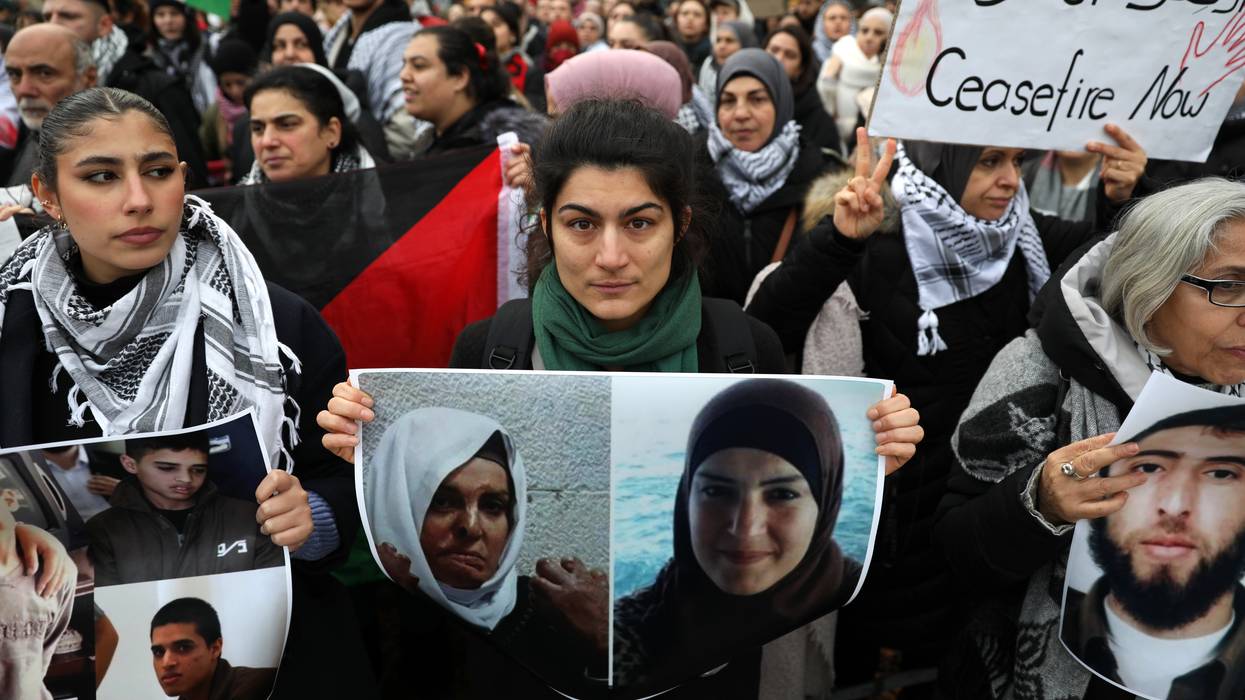
"It will send a powerful message not just to the Israelis but to the Western powers who are backing them that the public say, 'Not in our name.'"
Millions of people are expected to take to the streets worldwide on Saturday to demand a permanent cease-fire in the Gaza Strip and denounce the U.S.-led bombing of Yemen, which pushed the Middle East even closer to a full-scale regional war.
Organizers said people in over 120 cities across 45 countries are planning to join the Gaza Global Day of Action, a mass demonstration that will begin days after South Africa presented evidence before the International Court of Justice that Israel is committing genocide in the Palestinian enclave.
"This global day of action, from Australia through to Asia, Europe, and the Americas, is the first coordinated, international movement against the war being waged by Israel on the Palestinian people," said Kate Hudson, general secretary of the U.K.-based Campaign for Nuclear Disarmament. "It will send a powerful message not just to the Israelis but to the Western powers who are backing them that the public say, 'Not in our name.'"
Major protests are expected in New York City, Washington, D.C., London, Paris, Cairo, Istanbul, Tokyo, and scores of other cities and towns.
Israeli forces have killed more than 23,000 people—including over 10,000 children—in Gaza in just over three months, devastated the territory's infrastructure, and sparked a horrifying humanitarian crisis. Much of Gaza's population is displaced, starving, and at growing risk of disease.
Hudson said Friday that in the face of such a catastrophe, "everyone with a conscience" should "join the millions of voices from around the world in demanding an end to endless war."
"Your participation will amplify the call for justice for innocent Palestinians and every citizen of every country targeted by the missiles of Israel and the West," said Hudson. "It will make it clear to those countries that they do not have their citizens' support for their actions."
"Saturday is going to be a very important day for the anti-war movement," she added. "So let's unite, make a difference, and show that together, we can create waves of change that echo globally. Let's paint a picture of hope, unity, and lasting change."
The Biden administration has insisted it hopes to prevent Israel's assault on Gaza—which the U.S. has backed from the start with weaponry and diplomatic support—from spreading across the region, but it has launched airstrikes in Iraq, Syria, and Yemen since October 7, targeting Iran-aligned militia groups and heightening the risk of a broader war.
The growing number of Biden administration and congressional staffers who support a cease-fire are expected to speak at a rally in Washington, D.C. on Saturday.
In a statement late Thursday announcing the Yemen airstrikes—which many U.S. lawmakers slammed as unconstitutional—President Joe Biden said he "will not hesitate to direct further measures to protect our people and the free flow of international commerce as necessary," signaling that additional attacks on Yemen are on the table.
"Instead of working to end Israel's massacre of Palestinians, the Biden administration is choosing war and further destruction," IfNotNow, a Jewish American advocacy group, said Friday in response to the U.S. strikes in Yemen. "There is no military solution. We need a lasting cease-fire NOW."
Ismail Patel, visiting research fellow at the University of Leeds, wrote in an op-ed for Middle East Eye last week that plans for Saturday's global demonstrations were inspired in part by the inability of international institutions such as the United Nations to act as Israel and its Western allies operate with impunity on the world stage.
"A global day of protest thus serves as a powerful tool for exposing this unfair and ineffective order," Patel argued. "It further sheds light on how the U.S. and U.K. governments hold justice hostage and the world at ransom as they continuously shield Israel from accountability."
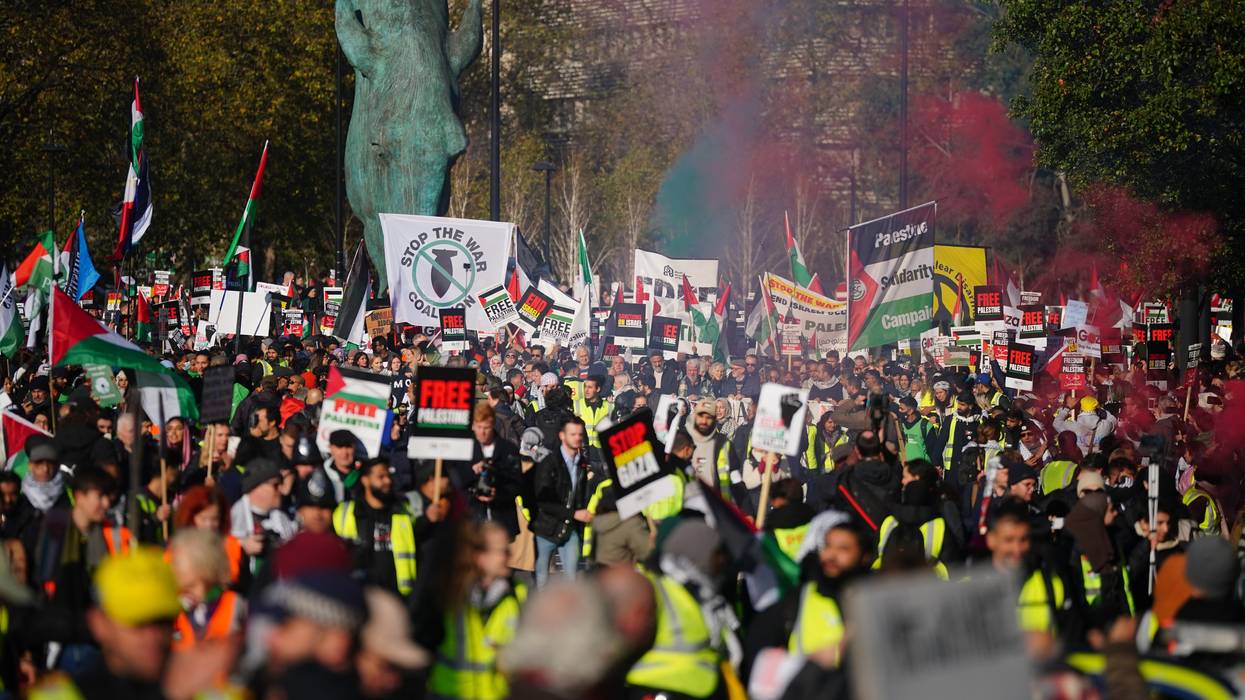
"In our thousands, in our millions, we are all Palestinians," demonstrators chanted at Saturday's march, described as one of the largest political protests in U.K. history.
Hundreds of thousands of people took to the streets of London on Saturday to demand an immediate cease-fire in Gaza as Israeli forces ramped up their aerial and ground assault on the Palestinian enclave's hospitals and other civilian infrastructure, intensifying the territory's humanitarian crisis.
Described as one of the largest political demonstrations in U.K. history, the march moved ahead despite criticism from British Home Secretary Suella Braverman and Tory Prime Minister Rishi Sunak, who suggested earlier in the week that the protest should have been banned by London police given that it coincided with Armistice Day. Braverman accused the police of giving favorable treatment to "pro-Palestinian mobs."
"I am horrified by the tone, language, and incitement our own government is using to whip up hatred against its own citizens—citizens who are standing up in solidarity with the besieged and bombed citizens of Gaza," British Army veteran and march participant Nadia Mitchell wrote for OpenDemocracy. "Personally, I cannot think of a more appropriate day to demand a cease-fire than on the day we remember the mother of all cease-fires, to remember and honor those who sacrificed their lives in pursuit of peace and an end to war."
Some U.K. lawmakers, including former Labour leader Jeremy Corbyn and Labour MP John McDonnell, joined Saturday's march alongside hundreds of thousands of peace activists, union members, and people of all faiths.
"In our thousands, in our millions, we are all Palestinians," demonstrators chanted.
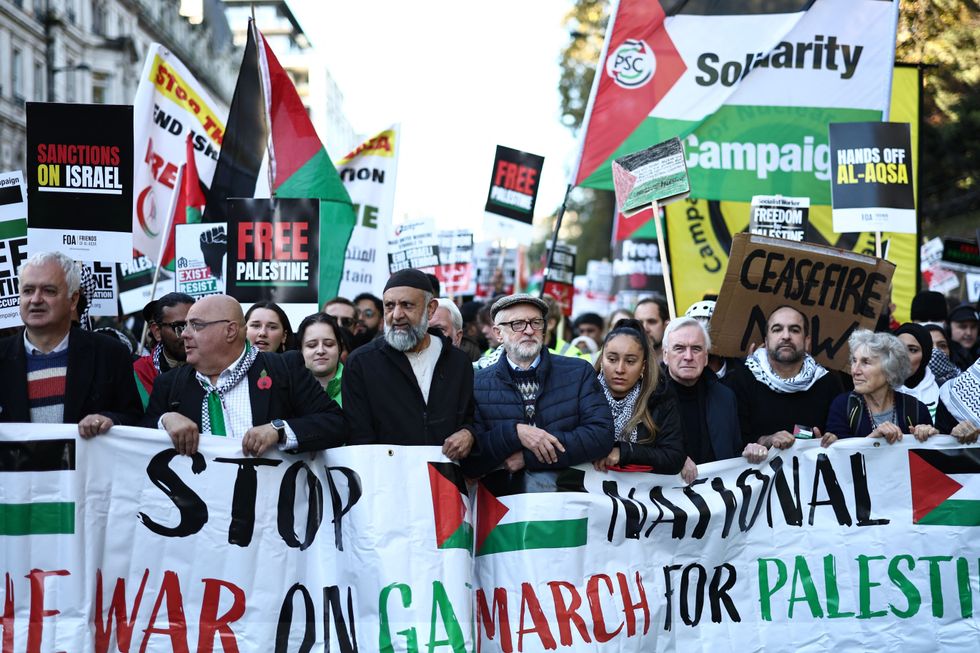 (Photo: Henry Nicholls/AFP via Getty Images)
Reuters reported that "police said far-right groups opposing the march were present in central London in 'significant numbers,' leading to skirmishes with officers near the Cenotaph war memorial, close to the Houses of Parliament and in Westminster."
"Officers in riot gear sought to contain the far-right protesters, some of whom threw bottles at them, and police vehicles sped around the city to respond to reports of tensions in the streets," the outlet added.
Participants in the mass demonstration, meanwhile, marched from London's Hyde Park to the U.S. Embassy to protest the Biden administration's unwavering military and political support for the Israeli government as the death toll in Gaza continues to climb.
The head of the World Health Organizationtold the United Nations Security Council on Friday that Israel's bombing and siege are killing one child on average every 10 minutes in Gaza.
"Nowhere and no one is safe," said WHO Director-General Tedros Adhanom Ghebreyesus.
Mohammed Abu Mughaisib, deputy medical coordinator for Doctors Without Borders in Gaza, told The Washington Post on Saturday that hospitals in northern Gaza have become "a graveyard" due to mounting Israeli attacks.
Medical workers at al-Nasr pediatric hospital were forced to leave babies in incubators behind as they evacuated south, Abu Mughaisib said.
"The medical staff evacuated because of the shelling on the pediatric hospital, and they couldn't save the babies to take them out, so they left five babies alone in the intensive care on the machines and the ventilators," he told the newspaper. "That's the situation: leaving babies now alone on the ventilators."
 (Photo: Victoria Jones/PA Images via Getty Images)
Saturday's march was organized by the Palestine Solidarity Campaign (PSC), Stop the War Coalition, Campaign for Nuclear Disarmament, and other advocacy groups.
"We march to call for an end to the indiscriminate bombing of civilians and a #CeasefireNOW," PSC director Ben Jamal wrote on social media. "We march in respect of the rights of all to live in freedom and with dignity."
The demonstration is part of a growing international movement supporting a cease-fire in the Gaza Strip as Western leaders, including Sunak and U.S. President Joe Biden, refuse to demand an end to Israel's siege and relentless bombing campaign.
Earlier this week, as Israeli forces encircled northern Gaza, Biden told reporters that there is "no possibility" of a cease-fire. Israeli Prime Minister Benjamin Netanyahu reportedly rejected a proposed five-day cease-fire in exchange for the release of some of the hostages held by Hamas.
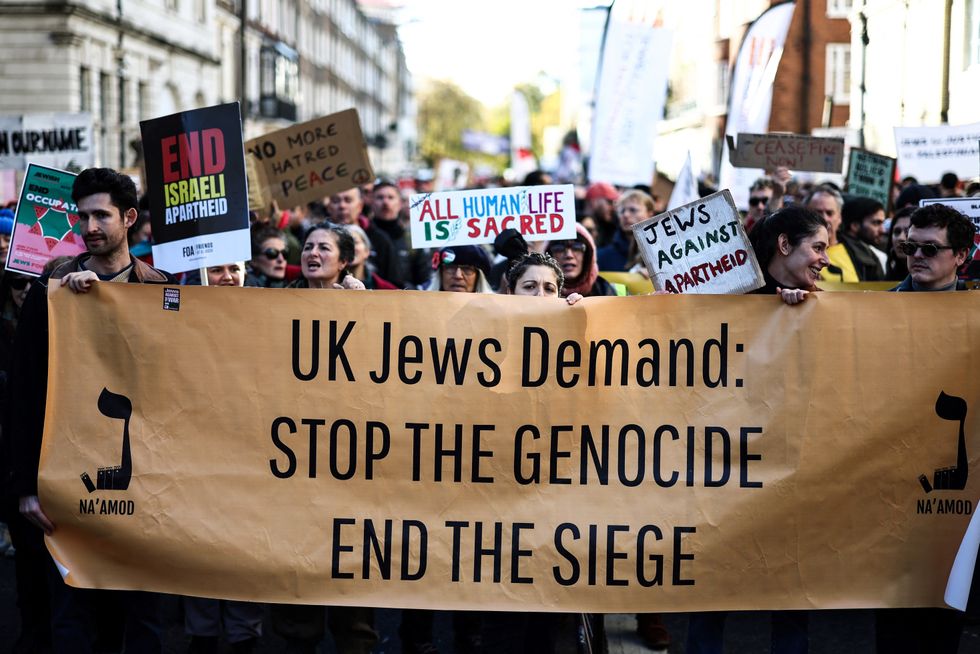 (Photo: Henry Nicholls/AFP via Getty Images)
Video footage of Saturday's march shows the streets of central London packed with demonstrators expressing solidarity with the people of Gaza and demanding an end to Israel's assault, which began after a deadly Hamas-led attack in southern Israel last month.
London authorities estimated that around 300,000 people took part in Saturday's march. Organizers said turnout was as high as 1 million.
"This footage shows the true will of the British people," wrote Ahmed Alnaouq, a London-based Palestinian journalist and co-founder of the nonprofit We Are Not Numbers. "Hundreds of thousands are protesting peacefully despite rounds of vicious smear campaigns and intimidation. "All say in one word: CEASE-FIRE NOW!"
"We want to send a clear message from the march that we represent the majority of the population in our calls for a cease-fire and that the movement in support of the Palestinians is growing in strength."
Organizers are expecting hundreds of thousands of people from across the United Kingdom to join an "inspiring, peaceful, and united show of solidarity" with Palestinians enduring the Israeli war on Gaza by marching from London's Hyde Park to the U.S. Embassy on Saturday.
"More than 500,000 people are expected to converge in London, making it one of the largest political marches in British history," the Palestine Solidarity Campaign (PSC), one of the organizers, said in a Friday statement reported by The Guardian.
Stop the War Coalition (STWC) convenor Lindsey German said Thursday that "our local groups in towns and cities across the U.K., along with coach companies, are telling us that every one of their coaches have been booked to bring people to London. This is comparable only to the 2 million strong protest against the Iraq War in 2003."
The other organizations behind the National March for Palestine on November 11—which is Armistice Day—are the Campaign for Nuclear Disarmament, Friends of Al-Aqsa, Muslim Association of Britain, and Palestinian Forum in Britain.
"We want to send a clear message from the march that we represent the majority of the population in our calls for a cease-fire and that the movement in support of the Palestinians is growing in strength," says STWC's event webpage.
The Israel Defense Forces' (IDF) air and ground assault of Gaza—launched last month in response to a Hamas-led attack—has killed over 11,000 people, according to the Palestinian Health Ministry. Israeli troops on Friday attacked multiple hospitals in the besieged enclave, including the largest, where tens of thousands of civilians have sought shelter.
Throughout the bloodshed and Israel's destruction of civilian infrastructure including homes, schools, and places of worship, people around the world have taken to the streets to call for a cease-fire, with some also demanding International Criminal Court action on "escalating Israeli war crimes and genocide of the Palestinian people" in Gaza.
"Our call for a cease-fire is rooted in a sincere wish to see an end to all violence, especially that which targets civilians, while recognizing that this cannot be achieved unless the root causes of that violence, the 75 years of ongoing Nakba against the Palestinian people, are adequately addressed," the STWC webpage explains.
Nakba, or "catastrophe," is a term Palestinians use to describe the ethnic cleansing of over 750,000 people from Palestine during the creation of the modern state of Israel in 1947-48. During this latest monthlong war, at least two plans from Israeli officials to permanently expel Palestinians from Gaza have been circulated.
Right-wing Israeli Prime Minister Benjamin Netanyahu said during a Monday interview with an American reporter that after the current assault ends, Israel plans to control Gaza for an "indefinite period," adding that his nation will "have the overall security responsibility because we've seen what happens when we don't have it."
U.K. Prime Minister Rishi Sunak has refused to support a cease-fire in Gaza, leaving some British Muslims feeling "disappointed and disheartened." The Conservative leader has also fired a government aide who called for cease-fire and condemned related demonstrations, saying this week that "my view is that these marches are disrespectful."
Faced with pressure to stop Saturday's march, Metropolitan Police Commissioner Sir Mark Rowley said Wednesday that "the laws created by Parliament are clear. There is no absolute power to ban protest." Noting Armistice Day events, he added that marchers had shown a "complete willingness to stay away from the Cenotaph and Whitehall and have no intention of disrupting the nation's remembrance events."
Sunak, who met with Rowley this week, said of the commissioner: "He has said that he can ensure that we safeguard remembrance for the country this weekend as well as keep the public safe. Now, my job is to hold him accountable for that."
Meanwhile, STWC welcomed the Met leader's acknowledgement that police lack the power to ban the upcoming demonstration, and declared that "any other decision would have represented a capitulation to political pressure by the government and would not have been accepted by the movement of solidarity with the Palestinian people."
"Saturday's march too will be peaceful and will restore the focus to where it should be—the suffering in Gaza and the urgent need for the British government to support a cease-fire," the coalition added. "We urge the largest possible turnout for Gaza on Saturday."
The UK's long-awaited, much-delayed Chilcot Inquiry into the Iraq War, examining Britain's role in the 2003 invasion of Iraq, is finally set to be published next summer--and it's "shaping up to be a whitewash," warns one anti-war coalition.
Then-Prime Minister Gordon Brown commissioned the report in 2009; the panel heard from its last witness in February 2011. The endeavor is estimated to have cost approximately PS10 million ($15 million USD) and has been repeatedly delayed over the past six years.
According to the latest update from lead investigator Sir John Chilcot, the report is now expected to be ready for publication in June or July.
"My colleagues and I estimate that we will be able to complete the text of our report in the week commencing 18 April 2016," Chilcot wrote in a letter on Wednesday (pdf) to Prime Minister David Cameron. "At that point, National Security checking of its contents by a team of officials, who will be given confidential access to the report on your behalf, can begin."
Chilcot explained that the "considerable size" of the report, which reportedly runs over two million words, means it will take time to prepare the report for printing.
Rose Gentle, whose son Gordon, 19, was killed in a bomb attack in Basra in 2004, said she was "disappointed" by the news. "We thought it should be out a lot sooner than this," she told Sky News. "I thought it would be out by the end of the year because they have everything there."
Saying the delays were keeping grieving families of slain veterans from getting "closure," a group of 29 families threatened earlier this year to sue Chilcot if he did not set a date of publication for the report. They blamed the logjam largely on the government's "Maxwellisation" procedure, which gives individuals criticized in official reports time to respond to allegations.
"It's another let-down," Gentle declared on Thursday. "It's another few months to wait and suffer again."
Even Cameron himself, citing "the families of those who served in Iraq," said in his official response to Chilcot that he was "disappointed...that you do not believe it will be possible logistically to publish your report until early summer." The Prime Minister said he would "welcome any further steps you can take to expedite the final stages of the Inquiry."
The office of former Prime Minister Tony Blair, meanwhile--whose role in the conflict is at the center of the Inquiry and who on Sunday admitted that the invasion of Iraq helped the rise of ISIS--issued a defensive response to Chilcot's announcement.
"The reason for his delay has been the excessive care taken to allow those who are criticized in the report to respond to those criticisms before it is published, a process which has not only held up its findings but has given them an advantage in trying to get their justifications in first."
--Stop the War Coalition
"Mr. Blair...wants to make it clear that the timetable of the Inquiry and the length of time it will have taken to report is not the result either of issues over the correspondence between him as Prime Minister and President Bush; or due to the Maxwellisation process," the statement read.
Even when it is finally published, there is no guarantee that the Chilcot report will answer critical questions.
As anti-war Labour Party leader Jeremy Corbyn said in a speech earlier this year, "I think I shall be disappointed when it is published. I suspect that it will be full of redactions and that we will have to read a million words before we discover which bits have been redacted."
The Stop the War Coalition added Thursday in a press statement: "The reason for his delay has been the excessive care taken to allow those who are criticized in the report to respond to those criticisms before it is published, a process which has not only held up its findings but has given them an advantage in trying to get their justifications in first."
An additional eight or nine months before publication "will mean more spin and obfuscation," the coalition added. "Chilcot is the third British report into the Iraq war. Like its predecessors, Butler and Hutton, it is shaping up to be a whitewash. The long delay in publishing it is unlikely to hide that fact."
To that end, journalist and author Peter Oborne on Wednesday published his own, independent inquiry into the war.
Oborne's report, conducted in concert with the BBC, charges that Blair "misrepresented the evidence" on the existence, possession, and condition of weapons of mass destruction; "used vital testimony selectively to build the case for war;" stayed silent on pre-war assessments that showed invading Iraq would make the UK more vulnerable to terrorism; and blamed France "for the US/UK failure to persuade more than two other members of the UN Security Council (Spain and Bulgaria) to vote for war."
Oborne's evidence, based on publicly available testimony and "background narratives" by UK scholar David Morrison, shows plainly that "there is little reason to doubt that the Blair government misrepresented the intelligence to parliament and to the British public in order to make the case for an illegal war in which 179 British soldiers and hundreds of thousands of Iraqi civilians died," Oborne writes.
"The invasion of Iraq was intended to deal with international terrorism. It is plain that the terrorist threat to Britain has increased beyond measure as a result of the decision to go into Iraq," he continued. "Let's see if John Chilcot agrees."