

SUBSCRIBE TO OUR FREE NEWSLETTER
Daily news & progressive opinion—funded by the people, not the corporations—delivered straight to your inbox.
5
#000000
#FFFFFF
To donate by check, phone, or other method, see our More Ways to Give page.
Daily news & progressive opinion—funded by the people, not the corporations—delivered straight to your inbox.
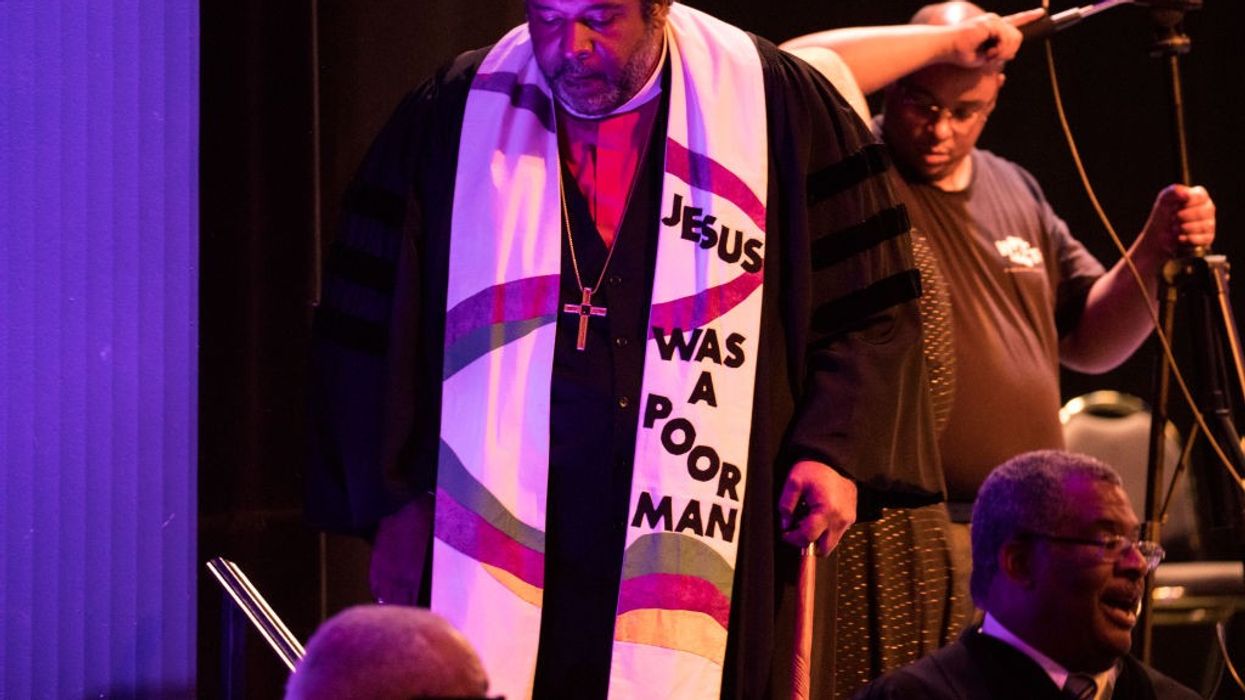
"We should really be talking about how to abolish the majority of poverty, because we know what would happen if we did have serious living minimum wage and healthcare," Barber said.
William Barber, a bishop and co-chair of the Poor People's Campaign, said in an interview published Thursday that U.S. presidential debates, and the race more broadly, was "failing" the poor, whose needs and concerns he said aren't being addressed.
About 38 million people in the U.S. live in poverty, roughly 11.5% of the population, as determined by the federal government. PPC says that one-third of the electorate, or 85 million people, are poor or low-income.
"We're talking about poverty that is not an anomaly among one group of people. But in fact, is across the country, in every community, in every city," Barber told USA Today. "We should really be talking about how to abolish the majority of poverty, because we know what would happen if we did have serious living minimum wage and healthcare."
Both @KamalaHarris & @realDonaldTrump say they want to represent working people. Why not accept @RevDrBarber’s challenge to debate the causes of America’s exceptional poverty & the policies that could end it. https://t.co/TIjUvOof0O
— Jonathan Wilson-Hartgrove (@wilsonhartgrove) October 3, 2024
PPC was inspired by a 1968 movement of the same name organized by Martin Luther King Jr. and led by allies after his assassination. They set up a 3,000-person protest camp on Washington Mall in the spring of that year, staying for six weeks.
Barber, a Black pastor and political organizer from North Carolina, was among those who led the relaunch in 2018—Poor People's Campaign: A National Call for a Moral Revival—which started with demonstrations in Washington, D.C., and at statehouses across the country.
Barber, who recently wrote a book about white poverty, has said that there's a "deafening silence" on the part of the media with regard to economic justice in the U.S.
Barber told USA Today that the debate moderators, as well as the presidential and vice presidential candidates, have failed to address it. He said Tuesday's vice presidential debate should have featured a question on a living minimum wage.
"To not have that as a major question and drill it down and make these candidates answer the question is a failing, we believe of the debate system," Barber said.
The current federal minimum wage is $7.25, set in 2009. Barber has frequently expressed outrage that Congress hasn't acted to raise it in the last 15 years.
In 2021, Sen. Bernie Sanders (I-Vt.) moved to raise the minimum wage to $15, via an amendment to the Covid-19 stimulus package, but all 50 Republican senators and eight members of the Democratic caucus voted it down.
Barber noted that Minnesota Gov. Tim Walz, the Democratic vice presidential nominee, raised the need to expand the child tax credit and for affordable housing in the debate, but said the moderators should have explicitly asked about the needs of poor people.
"I think there's a great failure of the press, of those who planned the debate, and even the politicians themselves, for not putting millions of people at the center of the political debate," Barber said.
Barber in fact recommended a reform to the debate format in which nonpartisan experts lay out facts on an issue before candidates speak—and people who are affected by an issue, rather than professional moderators, ask the questions.
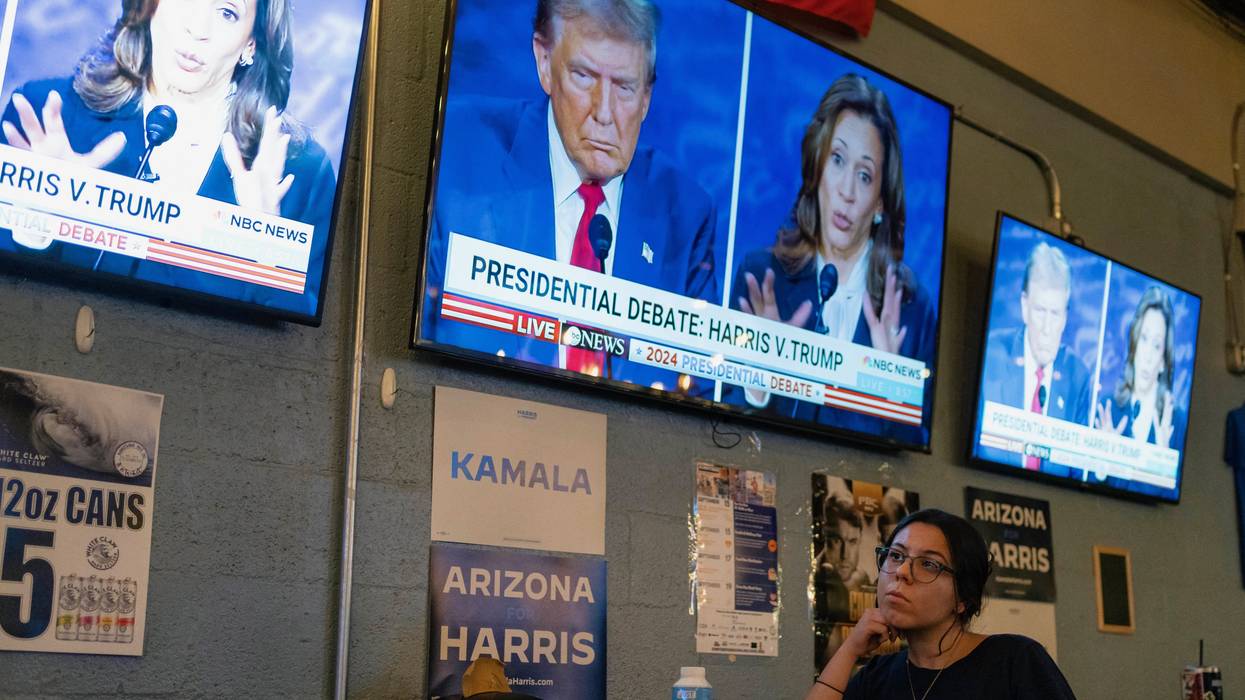
"This election is going to be incredibly close," said one Sunrise Movement organizer. "To win, Harris needs to show young people she will fight for us."
Up until the very last question of the debate between U.S. Vice President Kamala Harris and former President Donald Trump Tuesday night, American voters heard little about fossil fuels and the climate, other than arguing over which presidential candidate is more committed to continuing fracking and its high rate of planet-heating methane emissions.
"One hour in. Still no climate questions," said journalist Emily Atkin at 10:00 pm.
But campaigners said that the brief coverage of energy and the climate emergency in the debate—which took place days after scientists reported the summer of 2024 was the hottest on record—made clearer than ever that if given a second term in office, Trump would fulfill the promise he made to oil executives earlier this year to slash the Biden-Harris' administration's climate regulations and clean energy development in favor of expanding oil and gas drilling.
Trump attacked the Biden-Harris administration for rescinding a key permit for the Keystone XL pipeline and bragged about getting "the oil business going like nobody has ever done before."
But JL Andrepont, a campaigner and analyst at 350 Action, said Harris' promises to continue fracking and statement boasting that she has helped oversee "the largest increase in domestic oil production in history" left much to be desired for U.S. voters, a majority of whom believe policymakers must do more to address the climate emergency.
"The climate crisis worsens daily, and yet Trump and VP Harris debated for 90 minutes and climate change was only mentioned at the end," said Andrepont. "We'll be upfront—the only way to ensure a safe and affordable future for Americans and beyond is to transition swiftly and justly from all fossil fuels, including fracked gas, and to renewable energy."
But while "Trump is singing 'drill baby drill' and Big Oil is holding up the mic," added Andrepont, Harris "knows that the climate crisis is real and already affecting far too many communities."
They suggested that choosing between Trump and Harris is a matter of choosing which president climate campaigners would rather push and negotiate with in order to expand renewable energy in the U.S., protect people from pollution and its threats to public health, and cut the country's greenhouse gas emissions.
"VP Harris is the only candidate who believes in climate change or even claims to represent the people, and we will hold her accountable to what that means. But we must fight for that chance," they said.
Allie Rosenbluth, campaign manager at Oil Change U.S., added that Harris must fulfill her promise to debate viewers that as president, she would "chart a course for the future and not go backwards to the past."
"That means taking decisive action to end fossil fuels and ensuring a just transition to renewable energy," said Rosenbluth. "We need a climate president—one who will invest in clean energy, end fossil fuel subsidies, and phase out fossil fuels to protect the communities most exposed to oil and gas pollution and the climate crisis. It's time for Harris to show she can be that president.”
Rosenbluth was among those who noted that Harris' comments on fracking, which she said she would allow to continue in Pennsylvania, where the debate took place, showed her willingness to take a "dangerous [position] that will keep us on the path towards catastrophic climate impacts and continue exposing frontline communities to deadly levels of fossil fuel pollution."
As Harris reminded voters that the Inflation Reduction Act, one of President Joe Biden's signature laws, expanded leases for fracking, the cancer-causing chemicals used in the oil and gas extraction method and its release of planet-heating methane went unmentioned.
Also ignored was the fact that polls in 2020 and 2021 showed majorities of Pennsylvanians opposed fracking.
What Harris could have said, Elizabeth Sawin of the Multisolving Institute wrote, was: "We are going to ban fracking because it is bad for air, water, people, and climate. Then we are going to take care of the people who are employed in that sector, helping them re-skill for jobs in the clean economy with good healthcare, childcare, and pay."
In a move that one climate leader said summed up "the American mainstream media's approach to the issue," co-moderator Linsey Davis of ABC News asked the candidates in the debate's final moments what they would each do to fight climate change.
Trump said nothing about the climate emergency in response to the question—instead accusing Biden of sending manufacturing jobs overseas and alluding to a debunked claim about money the president's son received from the wife of a Russian official.
Harris noted that Trump has previously called the climate crisis "a hoax" and acknowledged people who have faced the destruction of extreme weather in the U.S., and pointed to the investments the Biden administration has made in "a clean energy economy."
While Trump made clear that he would "give oil and gas CEOs exactly what they want," said Stevie O'Hanlon, communications director for the Sunrise Movement, Harris overall "missed a critical opportunity to lay out a stark contrast with Trump and show young voters that she will stand up to Big Oil and stop the climate crisis."
The Sunrise Movement has not endorsed Harris but has launched a voter outreach campaign supporting Harris, with a plan to knock on 1.5 million doors in swing states, and O'Hanlon reported that "we hear people asking every day, 'What are Democrats going to do for us?'"
"Young voters want more from Harris. We want to see a real plan that meets the scale and urgency of this crisis. Seventy-eight percent of young voters in key swing states say climate change is a major issue shaping their vote," said O'Hanlon. "This election is going to be incredibly close... To win, Harris needs to show young people she will fight for us."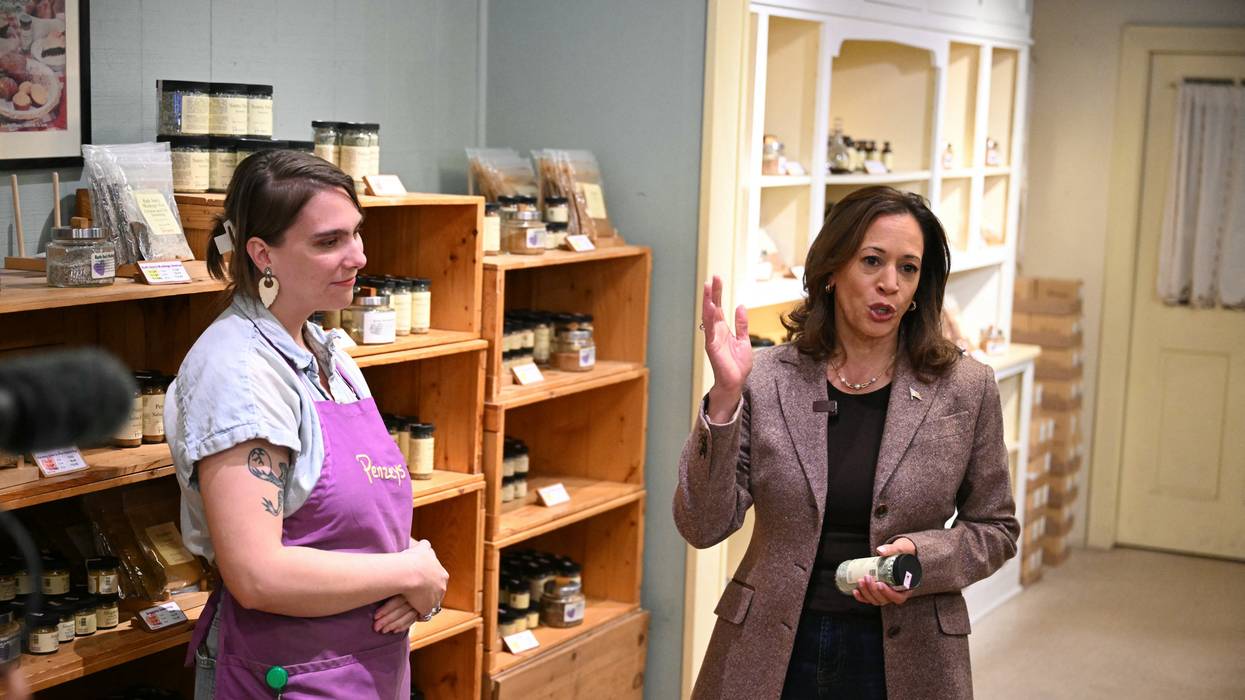
"This would make a major difference for the affordability crisis so many face," said Rep. Ro Khanna.
Congressman Ro Khanna expressed hope on Tuesday that Vice President Kamala Harris' pledge to "fight to raise the minimum wage" on her newly released list of policy proposals would not be her last word on the matter, and urged her to speak out more specifically by backing a $17 minimum wage at the first presidential debate between her and Republican nominee Donald Trump.
Khanna (D-Calif.) said the Democratic nominee must send a clear message to many "voters who are living paycheck to paycheck in swing states," by showing that she is committed to improving their day-to-day lives with concrete economic policies.
Attaching a dollar amount to her promise to raise the minimum wage would show voters that she aims to "make a major difference for the affordability crisis so many face," said Khanna.
Several battleground states, including Pennsylvania, Wisconsin, and North Carolina, have minimum wages that match the federal minimum pay—$7.25 per hour—which hasn't been updated in 15 years.
Harris backed a $15 federal minimum wage when she ran for president in 2020, eight years after fast food workers launched the Fight for $15 national campaign.
But last year, Sen. Bernie Sanders (I-Vt.) and Rep. Bobby Scott (D-Va.) proposed raising the federal floor for wages to $17 per hour within five years, with Sanders saying, "A job should lift you out of poverty, not keep you in it."
According to the Massachusetts Institute of Technology's Living Wage Calculator, even people in states with relatively low costs of living would need to earn significantly more than $15 per hour to enjoy a decent standard of living.
In both Mississippi and Alabama, for example, one adult with no children would need to earn more than $19 per hour to make a living wage. Two working adults raising one child would need to make $17.89 each, but they would need to make more than $21 each per hour if they had a second child.
"Raising our federal minimum wage from $7.25 to $17 is not radical," said Liz Shuler, president of the American Federation of Labor and Congress of Industrial Organizations (AFL-CIO), last year.
At HuffPost on Tuesday, Dave Jamieson noted that providing specifics about her plans to raise the wage floor would further clarify for swing state voters how Harris differs from her GOP opponent on this issue, as Trump has "never had a coherent vision for the minimum wage" and "has contradicted himself so often on the issue that The Washington Post's fact-checking operation once created a 'guide to all of Donald Trump's flip-flops on the minimum wage.'"
While campaigning for president in 2016, Trump said at various points that he did not support any federal minimum wage, that raising it would be a "big, big problem," and that that he was "looking at" raising it.
One Fair Wage (OFW), which has campaigned on ending the subminimum wage of just $2.13 for tipped workers, applauded Harris for her support for that policy, saying it offers a clear contrast to Trump and could appeal to 14 million service workers, including millions in swing states, who could sway the election.
"While both campaigns have called for the elimination of taxes on tips, this policy alone would only benefit about one-third of tipped workers," said the group. "Most workers wouldn't see any real relief, as their earnings are too low for them to benefit from a tax cut. That's why the Harris-Walz campaign's commitment to ending the subminimum wage stands out—it acknowledges that eliminating taxes on tips is not enough, and that workers need a true wage increase by ending the $2.13/hr subminimum wage for tipped workers, allowing them to earn a full minimum wage with tips on top."
"By taking this bold stance, the Harris-Walz campaign is aligning itself with a growing movement of workers and advocates fighting to create an economy where everyone can thrive," said OFW.
Saru Jayaraman, president of the organization, added that the policy would "lift millions of people out of poverty, close racial and gender pay gaps, and provide a foundation for economic security that all working people deserve."
"Raising wages resonates with millions of Americans who have been left behind by the current system, and the Harris-Walz campaign's commitment to this issue will not only energize voters but set the stage for a fairer, more equitable economy," she added.
Last week, Sanders told Rolling Stone that in the last eight weeks of the campaign, he hopes Harris will "expose Trump for the fraud that he is" and "develop an agenda for working-class people and trade unionists that will be very much in contrast with Trump."
"Raising the minimum wage to a living wage," said Sanders, "will improve wages for many millions of lower-income Americans."
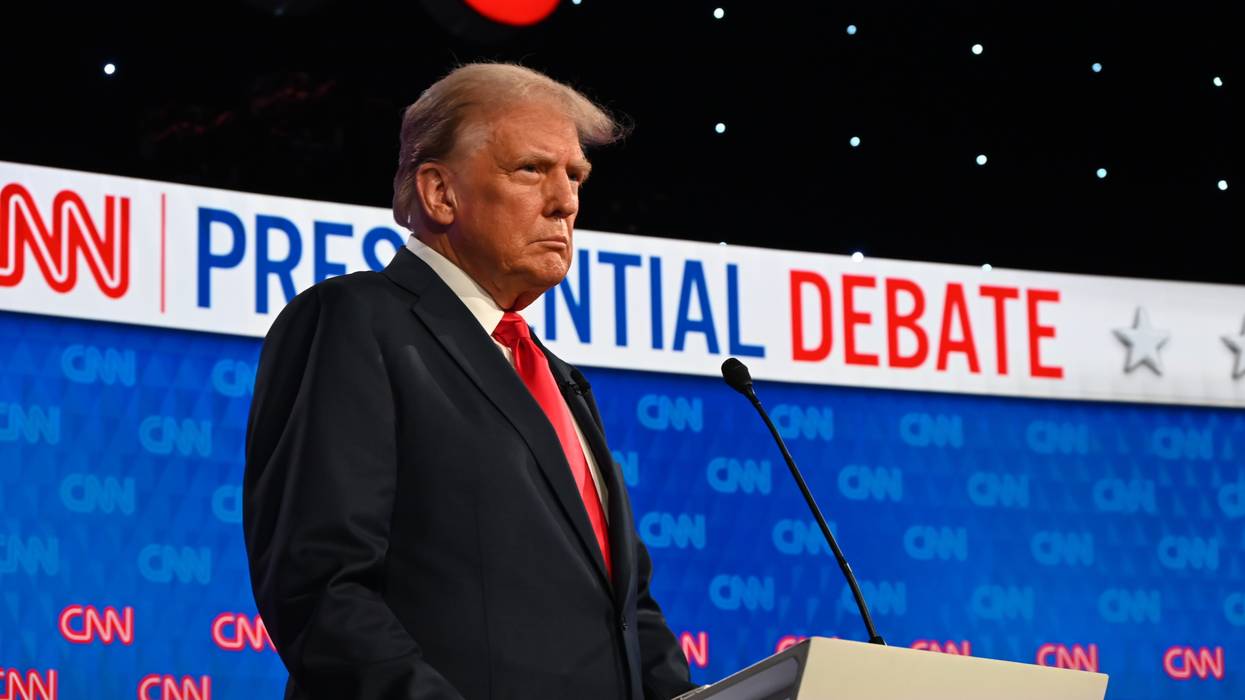
We should not underestimate the power of debate questions to shape the political landscape.
In November 2020, Common Dreams published my op-ed “Three Questions That Didn’t Get Asked During the Presidential Debates (and Probably Never Will).” The article offered several probing policy questions that (I surmised) would never make it through the corporate media’s screening process. Sure enough, none of those issues were addressed in the widely televised debates in advance of the 2020 election.
But here we are again. As we approach the November election, I find myself once again reflecting on some of the urgent policy issues that always seem to get buried in the corporate media’s constant supply of irrelevant distractions. This includes but is not limited to endless and often relatively inconsequential and inconclusive polls, the character assassinations of the day, gratuitous speculation from talking heads supplying what one of my old college professors used to call “graceful monuments to the obvious,” and whole buckets of information overload that lack perspective and thoughtful analysis. The now nearly universal proclivity of large news organizations to emphasize horse-race politics combined with infotainment and political theatrics has produced conventions and debates that sometimes seem to have more in common with rock concerts or sporting events than venues offering the kind of thoughtful analysis of issues that are supposed to be the core of democracy.
In what is undoubtedly one of the oddest and most convoluted elections in U.S. history, we seem to be in the position of choosing not only two presidential candidates but two alternate realities.
Back in the day, all this character assassination used to be called muckraking journalism and it was primarily bottom-feeder publications that engaged in it. Now, we have supposedly well-regarded mainstream media outlets digging up as much dirt and negative trivia as they can find on candidates who are now expected to pass impossible purity tests. While, on the one hand, our reigning cultural amnesia almost guarantees that the lessons of the past will get memory holed, paradoxically, the unforgiving permanence of the digital realm and the internet also guarantees that no act or mistake on the part of any public figure is either forgotten or forgiven. It seems to go without saying that all of this turmoil generates far more heat than light. Given this sorry state of affairs and offered as a simple thought experiment, here are some questions that the corporate media should be asking candidates, not only in the presidential debates but also as a matter of course given the dizzying events of this most unusual presidential campaign.
Although there’s a widespread public perception that AI was only developed by Big Tech, for many years the federal government has sponsored a huge AI development program working closely with and even funding the private sector. In 2024, Big Tech unleashed powerful but still poorly understood AI capabilities into the economy before their implications and impact on labor markets could be fully assessed. The federal government lagged even further behind industry in trying to come up with sound regulatory policies so that AI would not severely disrupt an already tenuous and unstable economic picture. It now seems abundantly clear that AI is indeed displacing all sorts of jobs ranging from customer service to professional positions in marketing, accounting, entertainment, and many other fields of endeavor.
Rather than facing and managing a problem that government itself helped create, Congress and the executive branch seem content to allow unelected technocrats such as Sam Altman, the CEO of OpenAI, to formulate policy proposals and other much needed guardrails. In addition, it’s troubling that rogue AI is already acting as a chaos agent, can undermine the foundations of democracy by empowering hackers, and is further aggravating the crisis of information quality and validity that haunts our political landscape. In the larger picture, both robots and AI—with the apparent blessing of both corporations and government—are beginning to intrusively inject themselves into society, culture, and politics. Given all of these trends, what is your position on how AI and robotics will impact the economy and the quality of life in the U.S.?
The mass closings of Steward hospitals nationwide has dramatically highlighted state and federal governments’ failure in allowing for-profit and private equity companies to take over many aspects of the healthcare system. This company, which operated 31 hospitals in eight states, has now filed for bankruptcy and has been selling its hospitals to pay off creditors after years of mismanagement and profiteering by its executive team. Private equity firms have been making acquisitions in healthcare for years including ambulances, hospitals, and, more recently, primary care practices.
The corporate greed of these companies is appalling. They see the decline in healthcare offering opportunities for monetary gain even as they themselves contribute to that decline and government regulators do little to ameliorate the situation. Many citizens, through no fault of their own, are mired in medical debt. Reportedly, the largest use of gofundme in the U.S. is now for paying medical bills. In addition, the way that the Covid-19 crisis was handled—a topic now seemingly memory holed during the campaign—has also been a major factor in the downward spiral of healthcare quality. Given these realities, what is your plan for restoring reliable and affordable healthcare in the U.S. and getting for-profit companies out of the healthcare system?
The longstanding ripple effects from the Citizens United Supreme Court decision have dramatically altered the political landscape. Not only has it opened the door to outsized influence from dark money and billionaire donors but it has also allowed corporations to wield wildly disproportionate influence on government policies and legislation. This is a problem that threatens the very core of our democratic processes. Over the last few decades, corporate power has increased many times over and the takeover of U.S. politics has opened the door to corrupt practices and allowed corporations to place their interests over and above the collective interests and well-being of the public. Public opinion polls show this is one major reason why Americans now have such little faith in all three branches of government.
Because the most powerful and influential companies tend to be in the Big Tech sector, equally concerning is how technological control is being used to advance and consolidate this new “behind the scenes” power structure. We might view it as technologically-enhanced “back door” politics. The overall privatization of the public commons and the sweetheart deals that take place behind the scenes are now deceptively coded as “public-private partnerships.”
Many current and challenging societal problems can be traced to this corporate takeover. Further, a huge part of this scenario is the information control wielded by Big Tech and Big Media which have become our primary sources of political news and information. Given this situation, what is your position on the disproportionate control that corporations now exercise over our political system? What will your administration do to eliminate pay-for-play politics, and restore the kind of democratic governance that Americans deeply long for and deserve?
In what is undoubtedly one of the oddest and most convoluted elections in U.S. history, we seem to be in the position of choosing not only two presidential candidates but two alternate realities. It’s all the more important therefore that responsible and responsive probing of the top-of-mind existential issues faced by the American public be thoughtfully and proactively addressed by the media. Many Americans are already asking these hard questions in their minds and hearts. If this process can be broadened to embrace the public commons of debate and vigorous discourse, then perhaps we’ll see a glimmer of hope for real transformative change at this unprecedented crossroads in our nation’s history.

A quality debate requires incisive questions that speak to people’s real needs and concerns as well as real-time factchecking to counter lies and deception. With CNN, we're almost guaranteed to get neither.
On Thursday, U.S. President Joe Biden and former President Donald Trump will face each other on CNN for the first scheduled debate of the 2024 presidential election. This year, things will be run differently; CNN will be entirely in charge. If history is any guide, things will not go well for democracy.
Once upon a time, presidential debates were hosted by the nonpartisan League of Women Voters, which set the terms and chose the moderators. But the national chairs of the two dominant parties formed the bipartisan Commission on Presidential Debates (CPD) and wrested control from the League in 1988. The LWV responded by accusing the parties of
perpetrat[ing] a fraud on the American voter. It has become clear to us that the candidates’ organizations aim to add debates to their list of campaign-trail charades devoid of substance, spontaneity, and answers to tough questions. The league has no intention of becoming an accessory to the hoodwinking of the American public.
The result was, as FAIR repeatedly documented (e.g., 10/26/12, 8/26/16, 8/2/19, 2/29/20), largely what the league predicted: few tough questions, most with a right-wing corporate framing, rarely reflecting the issues of most concern to voters. But even the CPD has lost its grip on the debates now, starting in 2022, when the RNC announced its distancing from the organization. Earlier this year, Biden signaled his own interest in working out a debate outside the normal CPD process.
Which brings us to the current situation, featuring two scheduled debates—on June 27 on CNN, and on September 10 on ABC—following rules agreed upon by the host network and the two candidates. CNN anchors Jake Tapper and Dana Bash will moderate the first contest.
As we’ve said before (7/19/23), the public needs to fully understand the stakes of the 2024 election, and that can’t mean a blackout on Trump. But it does require incisive questions that speak to people’s real needs and concerns, and some way of offering real-time factchecking to viewers. CNN viewers are unlikely to get the former, and CNN has already promised not to supply the latter.
Of the major nonpartisan news networks (i.e., excluding Fox), CNN is perhaps the least fit to host a presidential debate. In recent elections and primaries, it has repeatedly proved that it’s not an enlightened public the network is after, but ratings (e.g., FAIR.org, 8/2/19, 8/25/22, 7/19/23).
In the most recent example, the network infamously hosted a town hall with Trump during the 2023 Republican primaries. That choice appeared to be entirely self-serving. After working to move the network rightward, then-chair Chris Licht had led CNN to what The Atlantic (6/2/23) described as “its historic nadir,” in terms of ratings as well as newsroom morale. The Trump town hall was the big plan to turn the ship around.
Instead, it quickly proved to be an embarrassment that ultimately cost Licht his job (FAIR.org, 6/8/23). Trump turned the event into what came across as a campaign rally sponsored by CNN, spouting falsehood after falsehood and running roughshod over CNN host Kaitlan Collins in front of cheering fans. (The CNN floor manager instructed the audience that while applause was permitted, booing was not.)
Even in its town halls with Trump’s slightly less truth-challenged primary challengers, the network’s own post-event factchecks showed that CNN hosts—including Tapper and Bash—failed to counter major falsehoods in real time (FAIR.org, 7/19/23).
Though Trump (who agreed to the ground rules and choice of host) has been pre-emptively complaining he won’t get a fair shake from such a “biased” outlet—biased to the left, he means—Tapper and Bash hardly have a record of asking left-leaning questions.
CNN didn’t host a presidential debate in 2020, but it did host Democratic primary debates. Beyond its ESPN-like introductions to the candidates and questioning style that seemed designed to foment conflict more than to inform, the network relied heavily on right-wing talking points and assumptions to frame its questions (FAIR.org, 8/2/19).
In just one example, Tapper started off a 2019 Democratic primary debate night by asking Sen. Bernie Sanders (I-Vt.) whether “tak[ing] private health insurance away from more than 150 million Americans, in exchange for government-sponsored healthcare for everyone,” was “political suicide” (FAIR.org, 8/2/19).
CNN, like its fellow corporate media outlets, is allergic to questions about many issues of critical importance to large numbers of viewers.
In a 2016 Democratic debate, Bash questioned Hillary Clinton on her proposal for paid maternity leave—something every other industrialized nation in the world provides—with a decidedly antagonistic framing (FAIR.org, 7/16/19): “There are so many people who say, ‘Really? Another government program?’ Is that what you’re proposing? And at the expense of taxpayer money?”
After CNN‘s 2023 Trump town hall, Tapper (On With Kara Swisher, 7/10/23) argued that the event was “in the public’s interest.” But there’s no world in which offering a serial liar a town hall stuffed full of people instructed to cheer but not boo serves the public interest. Tapper’s take on the “public interest” doesn’t bode well for his performance this week.
On the central foreign policy issue of the year—Israel’s months-long assault on Gaza—Tapper and Bash both have exhibited a strong pro-Israel bias (FAIR.org, 5/3/24). It’s not a promising setup for a debate between a strongly pro-Israel candidate occasionally critical of the country’s right-wing government (Biden) and a strongly pro-Israel candidate aligned with that right wing (Trump).
And CNN, like its fellow corporate media outlets, is allergic to questions about many issues of critical importance to large numbers of viewers. In its first 2019 Democratic primary debate (FAIR.org, 8/2/19), CNN asked more non-policy questions—primarily about whether some candidates were “moving too far to the left to win the White House”—than questions about the climate crisis. Across two nights of debates, the network’s 31 non-policy questions overwhelmed those on key issues like gun control (11) and women’s rights (7).
The debate and its terms have been agreed to by both Biden and Trump. There will be no audience on Thursday. The candidates’ microphones will be muted when it’s not their turn to speak. In a first for a presidential debate, there will be two commercial breaks during the debate. (It remains to be seen which giant corporations will be sponsoring this supposed exercise in democracy.)
What will this format offer viewers—and, more broadly, democracy? The microphone rule should help avoid the 2020 debate debacle, in which Trump’s incessant interruptions rendered the event virtually unwatchable (FAIR.org, 10/2/20). But Trump doesn’t just interrupt incessantly; he lies incessantly as well. Will Tapper and Bash factcheck every lie, even if it means doing so more often to Trump than to Biden?
It’s hard to imagine how the public will be served by a “debate” featuring a notorious fabulist in which the moderators don’t even try to point out blatant lies.
Shockingly, CNN isn’t even going to pretend to try. Political director David Chalian (New York Times, 6/24/24) said that a live debate “is not the ideal arena for live factchecking,” so instead the moderators would be “facilitating the debate between these candidates, not being a participant in that debate.” Factchecking will be reserved for post-show analysis. Meanwhile, moderators “will use all tools at their disposal to enforce timing and ensure a civilized discussion” (CNN, 6/15/24).
On the one hand, Trump has made real-time factchecking essentially impossible, because the rate at which he puts forth falsehoods would require constant interruption. Of the 74 Trump debate claims checked by Politifact (2/2/24), only two were judged “true,” and seven “mostly true.” Across time and setting, 58% of Biden’s claims were judged at least “half true,” compared to 24% for Trump.
On the other hand, it’s hard to imagine how the public will be served by a “debate” featuring a notorious fabulist in which the moderators don’t even try to point out blatant lies. Saving factchecking for after the debate won’t help the millions who tune out when the debate ends. And you can hardly expect an opponent to be responsible for countering every lie Trump tells.
CNN has never been particularly good at factchecking (e.g., FAIR.org, 10/4/11, 10/5/12). Now with a candidate and party that aggressively disdain facts and honesty, the network is virtually guaranteed to fail the public even more miserably—and with potentially graver consequences.

CNN anchors will ask all the questions, and I hope that they rise to the moment.
U.S. President Joe Biden and former U.S. President Donald Trump will debate on CNN at 9:00 pm ET on Thursday. As an alumnus of “debate camp” and a presidential historian, I’m eager to watch.
Richard Nixon and John F. Kennedy held the first televised presidential debate in 1960. Those who watched on TV favored bronzed Kennedy over sweaty Nixon; those who listened on radio thought Nixon won. (Some scholars have debunked that. I say it’s too good to check.) The next debates were in 1976, and they have occurred every four years since then.
We remember them for gaffes and drama. But when you watch them on C-SPAN, what is most interesting is the earnest discussion of issues and strategies.
The overarching issue—one that rarely has come up before—is the health of American democracy.
Gerald Ford probably lost the election in 1976 when he bafflingly declared, “There is no Soviet domination of Eastern Europe.” That reinforced Lyndon Johnson’s unfair jibe that there was nothing wrong with Ford “except he played football too long without his helmet.” In 1980, Ronald Reagan defused his greatest weakness, chuckling at Jimmy Carter’s charges of extremism (“there you go again”). Reagan made himself an acceptable alternative and won by a landslide.
This time, both candidates face perils.
For Biden, paradoxically, it is that he is the president. Ford, Carter, Reagan, George H.W. Bush, George W. Bush, Barack Obama, and Trump all lost their first debate. Incumbents are rusty, cocooned. A military band plays “Hail to the Chief” when they walk into a room. Rarely are they challenged to their face. Biden has held few press conferences and given few interviews. He will have to fight hard against seeming peeved at criticism of his record.
Four years ago, Donald Trump was frantic, bombastic, and, it turned out, feverish from Covid-19. It is a big part of why he lost. These days, at his rallies he rails against his foes and promises retribution. But CNN’s format—with strict time limits and microphone cutoffs—perversely could help Trump, just as he was helped by being thrown off Twitter.
I was very involved in debate prep for Bill Clinton in 1996 when I was his chief speechwriter. Clinton knew well the incumbent jinx and worked hard to beat it. For the first debate, he prepped for most of a week at the leafy Chautauqua Institution in upstate New York. Sen. George Mitchell (D-Maine) played Bob Dole. He clobbered Clinton, who, like the other incumbents, was not used to being denounced to his face. At one point, Clinton slammed down his papers. “He’s cheating! He has notes!” Each day we would confide to lurking reporters that Mitchell had bested the president, and they all thought we were just spinning to lower expectations. With Clinton, we wrote and researched and practiced answers. Clinton grew more assured each day. The prep paid off: He was the only incumbent to prevail in the first debate, according to polls.
So as a political aficionado, I will watch for signs of a confident candidate.
But I will also want to see if the debate serves the public. CNN anchors will ask all the questions, and I hope that they rise to the moment.
The overarching issue—one that rarely has come up before—is the health of American democracy. “We are not bystanders in this ongoing attack on democracy,” Biden declared at Philadelphia’s Independence Hall. No doubt he will pound Trump for his attempt to block the peaceful transfer of power four years ago.
Trump, in turn, has made his claim that millions of noncitizens will vote a central campaign argument. (That’s nonsense, by the way.) Just as we saw in 2020, the Big Lie is being pre-deployed.
I hope the candidates will talk concretely about American democracy and how to fix it. For Biden, being pro-democracy cannot merely be a euphemism for supporting him. He should talk about his future agenda, such as the Freedom to Vote Act and John R. Lewis Voting Rights Advancement Act. I hope the anchors will not hurry the candidates along if they want to discuss these things—voting rights and January 6 and the like—in their eagerness to get to other issues such as inflation or immigration.
We will likely hear about the Supreme Court. Trump has been eager to describe the kinds of justices he wants to appoint (judges like Clarence Thomas, he said). Biden, on the other hand, has long hesitated to discuss the court itself. At his State of the Union, he did tell the justices that “with all due respect, justices, women are not without... electoral or political power.” Two weeks ago, at last, he said that the next president might appoint two justices, and Trump would “appoint two more flying flags upside down.”
We can expect to hear about crime as well. Trump used to brag about signing the First Step Act, a bipartisan sentencing reform law. More recently, he has turned to angry rhetoric about supposedly soaring crime. Yes, violence spiked during the pandemic, but it has dropped sharply since then. And there is no evidence at all that criminal justice reform led to more crime.
The job for the Brennan Center in this moment: Fight fear with facts. Not a bad goal for all of us as viewers.

"There is simply no substitute for the candidates debating with each other, and before the American people, their visions for the future of our nation."
After Tuesday previews by CNN and The New York Times, a dozen major U.S. news outlets on Sunday called on Democratic President Joe Biden, who is seeking reelection, and former President Donald Trump, the presumptive Republican nominee, to agree now to debate each other.
Although the presidential primary season is ongoing, the two historically unpopular candidates have already secured enough delegates to receive their parties' nominations at the conventions this summer. The nonpartisan Commission on Presidential Debates (CPD) last year announced the date, time, and location of three debates scheduled for September and October.
"With the contours of the 2024 general election now coming into clear focus, we—the undersigned national news organizations—urge the presumptive presidential nominees to publicly commit to participating in general election debates before November's election," says the joint letter signed by ABC News, The Associated Press, CBS News, CNN, C-SPAN, Fox News, NewsNation, NBC News, Noticias Univision, NPR, PBS NewsHour, and USA Today.
"General election debates have a rich tradition in our American democracy, having played a vital role in every presidential election of the past 50 years."
"General election debates have a rich tradition in our American democracy, having played a vital role in every presidential election of the past 50 years, dating to 1976," they wrote. "In each of those elections, tens of millions have tuned in to watch the candidates debating side by side, in a competition of ideas for the votes of American citizens."
The news organizations noted that "though it is too early for invitations to be extended to any candidates, it is not too early for candidates who expect to meet the eligibility criteria to publicly state their support for—and their intention to participate in—the commission's debates planned for this fall."
"If there is one thing Americans can agree on during this polarized time, it is that the stakes of this election are exceptionally high," the letter concludes. "Amidst that backdrop, there is simply no substitute for the candidates debating with each other, and before the American people, their visions for the future of our nation."
In a Thursday letter to CPD leaders acknowledging the media organizations' call, Trump's campaign wrote that "the commission must move up the timetable of its proposed 2024 debates to ensure more Americans have a full chance to see the candidates before they start voting, and we would argue for adding more debates in addition to those on the currently proposed schedule."
"We have already indicated President Trump is willing to debate anytime, anyplace, anywhere—and the time to start these debates is now," the campaign letter adds. This, despite the Republican National Committee's 2022 withdrawal from the CPD.
At a Saturday rally in Schnecksville, Pennsylvania, Trump stood next to a podium with a sign that said "anytime, anywhere, anyplace" and renewed his call for Biden to debate him. The twice-impeached former president—who faces four ongoing criminal cases—has a track record of defying debate rules.
As ABC News detailed Sunday:
Biden has mostly avoided commenting publicly on engaging in debate with Trump. Asked following his State of the Union address in March if he would commit to one, Biden remarked to ABC News: "It depends on his behavior."
"Well, if I were him, I'd want to debate me too," Biden said earlier in March, after Trump challenged him to debate "anytime, anywhere, anyplace."
"He's got nothing else to do," Biden added.
The Times reported earlier this week that "the Biden campaign has not ruled out agreeing to the debates, according to a person with direct knowledge of the discussions, who requested anonymity to share details intended to be private. But the campaign does not see an advantage to publicly committing to participate this early in the year, the person said."
Trump declined to participate in the Republican primary debates this cycle and Democrats didn't hold any, despite protests from longshot candidates. In 2020, there were only two presidential debates; a third was canceled after Trump tested positive for Covid-19 and refused to shift to a remote format.
In February, Ralph Nader, who has run for president as an Independent, suggested holding presidential debates in major cities and swing states, writing in a Common Dreams opinion piece that "unlike the one-shoe-fits-all model of the CPD, this proposal would provide a greater variety of debate formats and reflect national issues by the moderators but also regional issues."
"The proverbial named 'empty seat' for no-show candidates would be visible to millions of TV viewers if an invited candidate declined to participate," he argued. "All that is needed to make these debates happen is for the mayor and city council in each city to establish a representative host committee to organize the details of when, where, and how these debates are to be planned."

Here's how citizens in six key U.S. cities could jumpstart democracy by organizing debates themselves and daring the candidates not show up.
In 2004 author George Farah exposed the Commission on Presidential Debates (CPD) as a creation in 1987 of the Republican and Democratic Parties to take control away from the “uppity” League of Women Voters (LWV). The League had been the sponsor of presidential debates every four years.
Farah’s book was titled No Debate: How the Republican and Democratic Parties Secretly Control the Presidential Debates. Unless voters organize their own debates (about which more later), there may be no presidential debates this year. There won’t be 50 to 100 million viewers watching the debates, as there were in prior presidential election contests.
This year of no debate started last April when the Republican National Committee (RNC) unanimously voted to leave the CPD. Under pressure from Donald J. Trump, who thinks all debates involving him are stacked against him, the RNC explained that they are quitting by alleging that the CPD is biased.
It is about time that presidential candidates be confronted with some grassroots initiatives instead of having their two or three debate locations and topics chosen by the major political party operatives in Washington, DC.
Sure, the CPD is very biased against Third Party candidates, which it has managed to exclude since 1988, despite national polls that show voters want more voices and choices on the debate stage. For example, in 2000, over 60% in a Fox Poll wanted Pat Buchanan and me in the Debates.
Ronna McDaniel, chairwoman of the RNC, declared on the day of withdrawal that the RNC is “…going to find newer, better debate platforms to ensure that future nominees are not forced to go through the biased CPD in order to make their case to the American people.” Because Trump doesn’t want debates, she has done nothing since April.
Across the aisle, the Democratic National Committee (DNC) endorsed Joe Biden last April and, according to the Washington Post, “has no plans to sponsor primary debates.” Presently, there are only two competing Democratic candidates Marianne Williamson, a well-known self-help author/lecturer, and Dean Phillips, a three-term Democratic Congressman from Minnesota. The DNC wants no debates with these two challengers during the primary season and neither does President Joe Biden.
“It’s just against democratic principle. Those of us who are running should be heard, …it’s what the people deserve,” Ms. Williamson told the Washington Post.
So, what are the voters to do? The answer is clear. There are major cities in the half-dozen swing states that will probably decide the 2024 November election. Just about every organized group in these cities – Atlanta, Philadelphia, Detroit, Milwaukee, Phoenix and Las Vegas – would want a Presidential debate in their city. This is true for both red and blue states.
Bringing a presidential debate to one’s city brings national media coverage, with reporters, visitors and an outpouring of spending. There would be excited support from chambers of commerce, unions, citizen groups, schools, religious associations, good government organizations like the Urban Leagues, service clubs, City Hall and yes, the League of Women Voters.
Invitations sent to the nominees after their conventions would be very difficult to reject. It would be an insult to the people’s pride in each state.
Unlike the one-shoe-fits-all model of the CPD, this proposal would provide a greater variety of debate formats and reflect national issues by the moderators but also regional issues which were never discussed when the RNC and DNC were in charge. Different ideas on how to involve the public would be put into practice as well.
The proverbial named “empty seat” for no-show candidates would be visible to millions of TV viewers if an invited candidate declined to participate. All that is needed to make these debates happen is for the Mayor and City Council in each city to establish a representative host Committee to organize the details of when, where and how these debates are to be planned.
Presidential debates with huge watching and listening audiences boost voter turnout, affording many voters their only observation of the candidates interacting with one another in a non-scripted manner.
I’m sending this very realizable proposal to the mayors of the aforementioned cities and suggest that local radio and TV talk shows and newspapers interview local officials and the candidates about this idea. Readers of this column can choose to weigh in with their special enthusiasms.
It is about time that presidential candidates be confronted with some grassroots initiatives instead of having their two or three debate locations and topics chosen by the major political party operatives in Washington, DC.
The 2024 presidential election is not generating excitement. There are reports of more voters staying home than usual. The RNC and DNC, with their stubborn no debates policy, are assuring a lower turnout.
Presidential debates with huge watching and listening audiences boost voter turnout, affording many voters their only observation of the candidates interacting with one another in a non-scripted manner.
Go for it, Mayors and city councils! Crank up the engines for these local initiatives. The debate discussions and local engagement have beneficial ripple effects for our democracy.
Secret emails and candidates' wives have been among the recent headlines about the 2016 presidential race. While entertaining, these stories are an insult to our democracy. Whether the media realizes it or not, what matters to voters are policies, ideas, and solutions.
Where is climate change in this equation? According to Media Matters, just nine questions were asked about climate change in the first eight presidential primary debates as of mid-January.
Climate change is a unifier. It's a unique issue in its ability to exacerbate countless other social issues. Social justice issues like public health, education, criminal justice, poverty, and economic opportunity all intersect with climate change. To put the magnitude into perspective, researchers from the University College of London have concluded that climate change is the biggest public health crisis of the 21st century. The New York Times reported on a study concluding that by the end of the century, the act of simply being outside for several hours could be deadly in some parts of the world. All of the consequences of climate change are not yet fully understood, but they are ever more near.
With all this being said, there has been little to no discussion of climate change in the race for the presidency. Even while Republicans still play down the consequences - and even the reality - of climate change, debate moderators and reporters have done little to push them on these stances.
Back in the real world, 97% of climate scientists have determined that climate change is happening and caused by human activity. And, it's already affecting people and places all over the world. Climate change should be the issue of the 2016 election, but the only way for this to happen is if the media partners with the people to put actual issues ahead of circus-like entertainment value. This is also where young people must come in.
As powerful as the media may be, at a certain point it becomes impossible for any entity to ignore the voices of a multitude of vocal activists. This is why I'm excited that the Get Loud Challenge exists. The Get Loud Challenge, designed and launched by Alliance for Climate Education (ACE), is a climate action competition to engage young people in the climate movement. It provides a platform to unite the voices of young people along with specific actions they can take, including petitions, scripts for phone calls, and social media posts that can be used and shared to pressure the media to cover climate change responsibly.
The Get Loud Challenge provides a platform like no other for youth to establish their voice in the national dialogue on the climate crisis. Youth are the most direct stakeholders when it comes to climate change, as its catastrophic implications become more and more obvious by the day. Young people will be the generation most affected by the climate crisis if we do nothing. Youth have a unique perspective and moral authority, and when it comes to fighting for the attention that our future depends on, we have an obligation to make our voices heard. Will you join the Get Loud Challenge today?
I watched the GOP presidential debate last night and found it very depressing.
The main event was the effort by Marco Rubio and Ted Cruz to pierce Trump's armor and rattle him. The more they poked at him, the more belligerent he became.
Given the wide lead Trump has, he is likely to be the candidate of the Republican party. This is horrifying. To watch him makes me feel frightened for the future of our country. I also listened to him speaking (I think in Maine) i the morning.
He is crude, egotistical, bullying, self-centered, and vulgar. He boasts nonstop about his wealth and power and success. When he spoke to a crowd, he was egomaniacal. His subject is Donald Trump. He is an expert on himself.
In both venues, he made a crude sexual reference. In the morning, he said that Mitt Romney begged for his endorsement in 2012 and would have gone on his knees had Trump asked. The audience roared. During the debate, he made a reference to his male anatomy.
I have been wondering whether Trump is the epitome of the worst of our culture. Is he the product of a culture that worships money, admires avarice, and glories in porn and "the real housewives of..."
I think so. He is the quintessence of a degraded popular culture. Washington, Jefferson, Addams, Lincoln and so many others would be appalled.
I can't imagine him as president. We would be the laughingstock of the world. I imagine him insulting other nations, isolating us in the world. I can't imagine him with his touchiness and temperament in charge of the nuclear codes.
His behavior is revolting. His braggadocio is appalling. His egomania is disgusting. The idea of Trump as president is too horrible to imagine.