SUBSCRIBE TO OUR FREE NEWSLETTER
Daily news & progressive opinion—funded by the people, not the corporations—delivered straight to your inbox.
5
#000000
#FFFFFF
To donate by check, phone, or other method, see our More Ways to Give page.
Daily news & progressive opinion—funded by the people, not the corporations—delivered straight to your inbox.
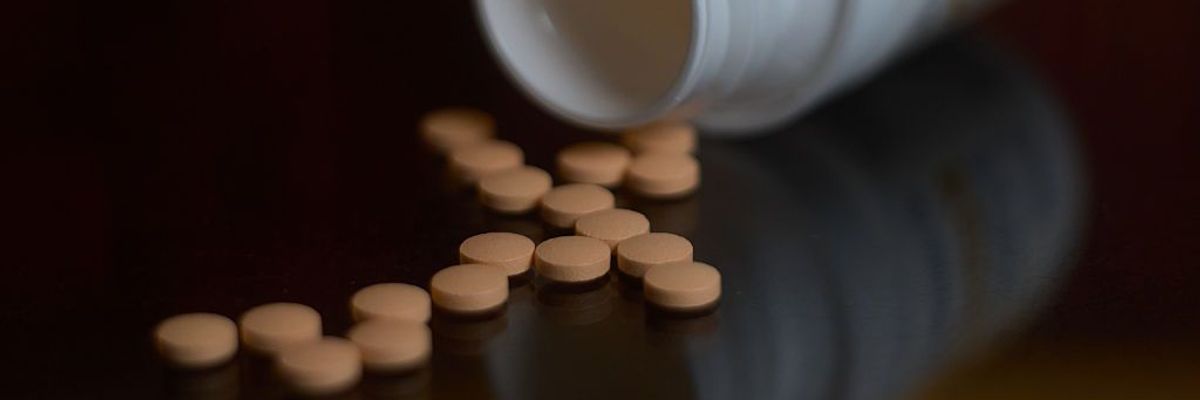
Packaging and pills of different types of psychotropic medications are seen in this illustration photo taken in Warsaw, Poland on April 22, 2025.
One critic charged that Trump's earlier deals with pharmaceutical companies "just nibble around the margins in terms of what is really driving high prices for prescription drugs in the US."
President Donald Trump in recent months has made ludicrously false claims about his administration slashing prescription drug prices in the US by as much as 600%, which would entail pharmaceutical companies paying people to use their products.
In reality, reported Reuters on Wednesday, drugmakers are planning to raise prices on hundreds of drugs in 2026.
Citing data from healthcare research firm 3 Axis Advisors, Reuters wrote that at least 350 branded medications are set for price hikes next year, including "vaccines against COVID, RSV, and shingles," as well as the "blockbuster cancer treatment Ibrance."
The total projected number of drugs seeing price increases next year is significantly higher than in 2025, when 3 Axis Advisors estimated that pharmaceutical companies raised prices on 250 medications.
The median price increase for drugs next year is projected at 4%, roughly the same as in 2025.
Reuters also found that some of the companies raising prices on their drugs are the same ones who struck deals with Trump to lower the costs of a limited number of prescriptions earlier this year, including Novartis, Pfizer, Boehringer Ingelheim, and GSK.
In announcing the deals with the pharmaceutical companies, Trump declared that "starting next year, American drug prices will come down fast and furious and will soon be the lowest in the developed world."
But Dr. Benjamin Rome, a health policy researcher at Brigham and Women's Hospital in Boston, told Reuters that the projected savings for Americans under the Trump deals are a drop in the bucket compared with the continued price hikes on other drugs.
"These deals are being announced as transformative when, in fact, they really just nibble around the margins in terms of what is really driving high prices for prescription drugs in the US," Rome explained.
Merith Basey, CEO of Patients For Affordable Drugs Now, a patient advocacy organization focused exclusively on lowering the cost of medications, also said she was unimpressed by Trump's deals with drugmakers.
"Voluntary agreements with drug companies—especially when key details remain undisclosed—are no substitute for durable, system-wide reforms," she said earlier this month. "Patients are overwhelmingly calling on Congress to do more to lower prescription drug prices by holding Big Pharma accountable and addressing the root causes of high drug prices, because drugs don’t work if people can’t afford them."
Dear Common Dreams reader, It’s been nearly 30 years since I co-founded Common Dreams with my late wife, Lina Newhouser. We had the radical notion that journalism should serve the public good, not corporate profits. It was clear to us from the outset what it would take to build such a project. No paid advertisements. No corporate sponsors. No millionaire publisher telling us what to think or do. Many people said we wouldn't last a year, but we proved those doubters wrong. Together with a tremendous team of journalists and dedicated staff, we built an independent media outlet free from the constraints of profits and corporate control. Our mission has always been simple: To inform. To inspire. To ignite change for the common good. Building Common Dreams was not easy. Our survival was never guaranteed. When you take on the most powerful forces—Wall Street greed, fossil fuel industry destruction, Big Tech lobbyists, and uber-rich oligarchs who have spent billions upon billions rigging the economy and democracy in their favor—the only bulwark you have is supporters who believe in your work. But here’s the urgent message from me today. It's never been this bad out there. And it's never been this hard to keep us going. At the very moment Common Dreams is most needed, the threats we face are intensifying. We need your support now more than ever. We don't accept corporate advertising and never will. We don't have a paywall because we don't think people should be blocked from critical news based on their ability to pay. Everything we do is funded by the donations of readers like you. When everyone does the little they can afford, we are strong. But if that support retreats or dries up, so do we. Will you donate now to make sure Common Dreams not only survives but thrives? —Craig Brown, Co-founder |
President Donald Trump in recent months has made ludicrously false claims about his administration slashing prescription drug prices in the US by as much as 600%, which would entail pharmaceutical companies paying people to use their products.
In reality, reported Reuters on Wednesday, drugmakers are planning to raise prices on hundreds of drugs in 2026.
Citing data from healthcare research firm 3 Axis Advisors, Reuters wrote that at least 350 branded medications are set for price hikes next year, including "vaccines against COVID, RSV, and shingles," as well as the "blockbuster cancer treatment Ibrance."
The total projected number of drugs seeing price increases next year is significantly higher than in 2025, when 3 Axis Advisors estimated that pharmaceutical companies raised prices on 250 medications.
The median price increase for drugs next year is projected at 4%, roughly the same as in 2025.
Reuters also found that some of the companies raising prices on their drugs are the same ones who struck deals with Trump to lower the costs of a limited number of prescriptions earlier this year, including Novartis, Pfizer, Boehringer Ingelheim, and GSK.
In announcing the deals with the pharmaceutical companies, Trump declared that "starting next year, American drug prices will come down fast and furious and will soon be the lowest in the developed world."
But Dr. Benjamin Rome, a health policy researcher at Brigham and Women's Hospital in Boston, told Reuters that the projected savings for Americans under the Trump deals are a drop in the bucket compared with the continued price hikes on other drugs.
"These deals are being announced as transformative when, in fact, they really just nibble around the margins in terms of what is really driving high prices for prescription drugs in the US," Rome explained.
Merith Basey, CEO of Patients For Affordable Drugs Now, a patient advocacy organization focused exclusively on lowering the cost of medications, also said she was unimpressed by Trump's deals with drugmakers.
"Voluntary agreements with drug companies—especially when key details remain undisclosed—are no substitute for durable, system-wide reforms," she said earlier this month. "Patients are overwhelmingly calling on Congress to do more to lower prescription drug prices by holding Big Pharma accountable and addressing the root causes of high drug prices, because drugs don’t work if people can’t afford them."
President Donald Trump in recent months has made ludicrously false claims about his administration slashing prescription drug prices in the US by as much as 600%, which would entail pharmaceutical companies paying people to use their products.
In reality, reported Reuters on Wednesday, drugmakers are planning to raise prices on hundreds of drugs in 2026.
Citing data from healthcare research firm 3 Axis Advisors, Reuters wrote that at least 350 branded medications are set for price hikes next year, including "vaccines against COVID, RSV, and shingles," as well as the "blockbuster cancer treatment Ibrance."
The total projected number of drugs seeing price increases next year is significantly higher than in 2025, when 3 Axis Advisors estimated that pharmaceutical companies raised prices on 250 medications.
The median price increase for drugs next year is projected at 4%, roughly the same as in 2025.
Reuters also found that some of the companies raising prices on their drugs are the same ones who struck deals with Trump to lower the costs of a limited number of prescriptions earlier this year, including Novartis, Pfizer, Boehringer Ingelheim, and GSK.
In announcing the deals with the pharmaceutical companies, Trump declared that "starting next year, American drug prices will come down fast and furious and will soon be the lowest in the developed world."
But Dr. Benjamin Rome, a health policy researcher at Brigham and Women's Hospital in Boston, told Reuters that the projected savings for Americans under the Trump deals are a drop in the bucket compared with the continued price hikes on other drugs.
"These deals are being announced as transformative when, in fact, they really just nibble around the margins in terms of what is really driving high prices for prescription drugs in the US," Rome explained.
Merith Basey, CEO of Patients For Affordable Drugs Now, a patient advocacy organization focused exclusively on lowering the cost of medications, also said she was unimpressed by Trump's deals with drugmakers.
"Voluntary agreements with drug companies—especially when key details remain undisclosed—are no substitute for durable, system-wide reforms," she said earlier this month. "Patients are overwhelmingly calling on Congress to do more to lower prescription drug prices by holding Big Pharma accountable and addressing the root causes of high drug prices, because drugs don’t work if people can’t afford them."