SUBSCRIBE TO OUR FREE NEWSLETTER
Daily news & progressive opinion—funded by the people, not the corporations—delivered straight to your inbox.
5
#000000
#FFFFFF
To donate by check, phone, or other method, see our More Ways to Give page.
Daily news & progressive opinion—funded by the people, not the corporations—delivered straight to your inbox.
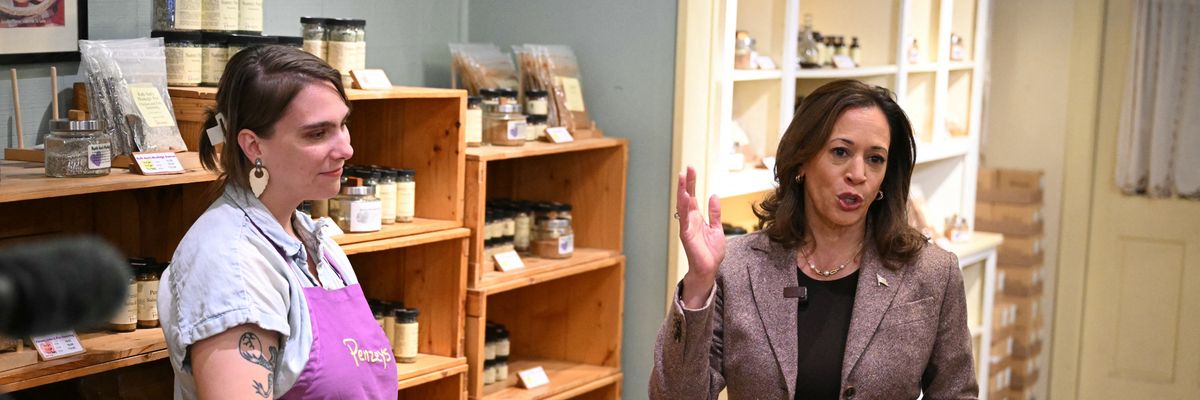
U.S. Vice President Kamala Harris, the Democratic presidential nominee, answers questions from reporters during a campaign stop at Penzeys Spices in Pittsburgh, Pennsylvania, on September 7, 2024.
"This would make a major difference for the affordability crisis so many face," said Rep. Ro Khanna.
Congressman Ro Khanna expressed hope on Tuesday that Vice President Kamala Harris' pledge to "fight to raise the minimum wage" on her newly released list of policy proposals would not be her last word on the matter, and urged her to speak out more specifically by backing a $17 minimum wage at the first presidential debate between her and Republican nominee Donald Trump.
Khanna (D-Calif.) said the Democratic nominee must send a clear message to many "voters who are living paycheck to paycheck in swing states," by showing that she is committed to improving their day-to-day lives with concrete economic policies.
Attaching a dollar amount to her promise to raise the minimum wage would show voters that she aims to "make a major difference for the affordability crisis so many face," said Khanna.
Several battleground states, including Pennsylvania, Wisconsin, and North Carolina, have minimum wages that match the federal minimum pay—$7.25 per hour—which hasn't been updated in 15 years.
Harris backed a $15 federal minimum wage when she ran for president in 2020, eight years after fast food workers launched the Fight for $15 national campaign.
But last year, Sen. Bernie Sanders (I-Vt.) and Rep. Bobby Scott (D-Va.) proposed raising the federal floor for wages to $17 per hour within five years, with Sanders saying, "A job should lift you out of poverty, not keep you in it."
According to the Massachusetts Institute of Technology's Living Wage Calculator, even people in states with relatively low costs of living would need to earn significantly more than $15 per hour to enjoy a decent standard of living.
In both Mississippi and Alabama, for example, one adult with no children would need to earn more than $19 per hour to make a living wage. Two working adults raising one child would need to make $17.89 each, but they would need to make more than $21 each per hour if they had a second child.
"Raising our federal minimum wage from $7.25 to $17 is not radical," said Liz Shuler, president of the American Federation of Labor and Congress of Industrial Organizations (AFL-CIO), last year.
At HuffPost on Tuesday, Dave Jamieson noted that providing specifics about her plans to raise the wage floor would further clarify for swing state voters how Harris differs from her GOP opponent on this issue, as Trump has "never had a coherent vision for the minimum wage" and "has contradicted himself so often on the issue that The Washington Post's fact-checking operation once created a 'guide to all of Donald Trump's flip-flops on the minimum wage.'"
While campaigning for president in 2016, Trump said at various points that he did not support any federal minimum wage, that raising it would be a "big, big problem," and that that he was "looking at" raising it.
One Fair Wage (OFW), which has campaigned on ending the subminimum wage of just $2.13 for tipped workers, applauded Harris for her support for that policy, saying it offers a clear contrast to Trump and could appeal to 14 million service workers, including millions in swing states, who could sway the election.
"While both campaigns have called for the elimination of taxes on tips, this policy alone would only benefit about one-third of tipped workers," said the group. "Most workers wouldn't see any real relief, as their earnings are too low for them to benefit from a tax cut. That's why the Harris-Walz campaign's commitment to ending the subminimum wage stands out—it acknowledges that eliminating taxes on tips is not enough, and that workers need a true wage increase by ending the $2.13/hr subminimum wage for tipped workers, allowing them to earn a full minimum wage with tips on top."
"By taking this bold stance, the Harris-Walz campaign is aligning itself with a growing movement of workers and advocates fighting to create an economy where everyone can thrive," said OFW.
Saru Jayaraman, president of the organization, added that the policy would "lift millions of people out of poverty, close racial and gender pay gaps, and provide a foundation for economic security that all working people deserve."
"Raising wages resonates with millions of Americans who have been left behind by the current system, and the Harris-Walz campaign's commitment to this issue will not only energize voters but set the stage for a fairer, more equitable economy," she added.
Last week, Sanders told Rolling Stone that in the last eight weeks of the campaign, he hopes Harris will "expose Trump for the fraud that he is" and "develop an agenda for working-class people and trade unionists that will be very much in contrast with Trump."
"Raising the minimum wage to a living wage," said Sanders, "will improve wages for many millions of lower-income Americans."
Dear Common Dreams reader, It’s been nearly 30 years since I co-founded Common Dreams with my late wife, Lina Newhouser. We had the radical notion that journalism should serve the public good, not corporate profits. It was clear to us from the outset what it would take to build such a project. No paid advertisements. No corporate sponsors. No millionaire publisher telling us what to think or do. Many people said we wouldn't last a year, but we proved those doubters wrong. Together with a tremendous team of journalists and dedicated staff, we built an independent media outlet free from the constraints of profits and corporate control. Our mission has always been simple: To inform. To inspire. To ignite change for the common good. Building Common Dreams was not easy. Our survival was never guaranteed. When you take on the most powerful forces—Wall Street greed, fossil fuel industry destruction, Big Tech lobbyists, and uber-rich oligarchs who have spent billions upon billions rigging the economy and democracy in their favor—the only bulwark you have is supporters who believe in your work. But here’s the urgent message from me today. It's never been this bad out there. And it's never been this hard to keep us going. At the very moment Common Dreams is most needed, the threats we face are intensifying. We need your support now more than ever. We don't accept corporate advertising and never will. We don't have a paywall because we don't think people should be blocked from critical news based on their ability to pay. Everything we do is funded by the donations of readers like you. When everyone does the little they can afford, we are strong. But if that support retreats or dries up, so do we. Will you donate now to make sure Common Dreams not only survives but thrives? —Craig Brown, Co-founder |
Congressman Ro Khanna expressed hope on Tuesday that Vice President Kamala Harris' pledge to "fight to raise the minimum wage" on her newly released list of policy proposals would not be her last word on the matter, and urged her to speak out more specifically by backing a $17 minimum wage at the first presidential debate between her and Republican nominee Donald Trump.
Khanna (D-Calif.) said the Democratic nominee must send a clear message to many "voters who are living paycheck to paycheck in swing states," by showing that she is committed to improving their day-to-day lives with concrete economic policies.
Attaching a dollar amount to her promise to raise the minimum wage would show voters that she aims to "make a major difference for the affordability crisis so many face," said Khanna.
Several battleground states, including Pennsylvania, Wisconsin, and North Carolina, have minimum wages that match the federal minimum pay—$7.25 per hour—which hasn't been updated in 15 years.
Harris backed a $15 federal minimum wage when she ran for president in 2020, eight years after fast food workers launched the Fight for $15 national campaign.
But last year, Sen. Bernie Sanders (I-Vt.) and Rep. Bobby Scott (D-Va.) proposed raising the federal floor for wages to $17 per hour within five years, with Sanders saying, "A job should lift you out of poverty, not keep you in it."
According to the Massachusetts Institute of Technology's Living Wage Calculator, even people in states with relatively low costs of living would need to earn significantly more than $15 per hour to enjoy a decent standard of living.
In both Mississippi and Alabama, for example, one adult with no children would need to earn more than $19 per hour to make a living wage. Two working adults raising one child would need to make $17.89 each, but they would need to make more than $21 each per hour if they had a second child.
"Raising our federal minimum wage from $7.25 to $17 is not radical," said Liz Shuler, president of the American Federation of Labor and Congress of Industrial Organizations (AFL-CIO), last year.
At HuffPost on Tuesday, Dave Jamieson noted that providing specifics about her plans to raise the wage floor would further clarify for swing state voters how Harris differs from her GOP opponent on this issue, as Trump has "never had a coherent vision for the minimum wage" and "has contradicted himself so often on the issue that The Washington Post's fact-checking operation once created a 'guide to all of Donald Trump's flip-flops on the minimum wage.'"
While campaigning for president in 2016, Trump said at various points that he did not support any federal minimum wage, that raising it would be a "big, big problem," and that that he was "looking at" raising it.
One Fair Wage (OFW), which has campaigned on ending the subminimum wage of just $2.13 for tipped workers, applauded Harris for her support for that policy, saying it offers a clear contrast to Trump and could appeal to 14 million service workers, including millions in swing states, who could sway the election.
"While both campaigns have called for the elimination of taxes on tips, this policy alone would only benefit about one-third of tipped workers," said the group. "Most workers wouldn't see any real relief, as their earnings are too low for them to benefit from a tax cut. That's why the Harris-Walz campaign's commitment to ending the subminimum wage stands out—it acknowledges that eliminating taxes on tips is not enough, and that workers need a true wage increase by ending the $2.13/hr subminimum wage for tipped workers, allowing them to earn a full minimum wage with tips on top."
"By taking this bold stance, the Harris-Walz campaign is aligning itself with a growing movement of workers and advocates fighting to create an economy where everyone can thrive," said OFW.
Saru Jayaraman, president of the organization, added that the policy would "lift millions of people out of poverty, close racial and gender pay gaps, and provide a foundation for economic security that all working people deserve."
"Raising wages resonates with millions of Americans who have been left behind by the current system, and the Harris-Walz campaign's commitment to this issue will not only energize voters but set the stage for a fairer, more equitable economy," she added.
Last week, Sanders told Rolling Stone that in the last eight weeks of the campaign, he hopes Harris will "expose Trump for the fraud that he is" and "develop an agenda for working-class people and trade unionists that will be very much in contrast with Trump."
"Raising the minimum wage to a living wage," said Sanders, "will improve wages for many millions of lower-income Americans."
Congressman Ro Khanna expressed hope on Tuesday that Vice President Kamala Harris' pledge to "fight to raise the minimum wage" on her newly released list of policy proposals would not be her last word on the matter, and urged her to speak out more specifically by backing a $17 minimum wage at the first presidential debate between her and Republican nominee Donald Trump.
Khanna (D-Calif.) said the Democratic nominee must send a clear message to many "voters who are living paycheck to paycheck in swing states," by showing that she is committed to improving their day-to-day lives with concrete economic policies.
Attaching a dollar amount to her promise to raise the minimum wage would show voters that she aims to "make a major difference for the affordability crisis so many face," said Khanna.
Several battleground states, including Pennsylvania, Wisconsin, and North Carolina, have minimum wages that match the federal minimum pay—$7.25 per hour—which hasn't been updated in 15 years.
Harris backed a $15 federal minimum wage when she ran for president in 2020, eight years after fast food workers launched the Fight for $15 national campaign.
But last year, Sen. Bernie Sanders (I-Vt.) and Rep. Bobby Scott (D-Va.) proposed raising the federal floor for wages to $17 per hour within five years, with Sanders saying, "A job should lift you out of poverty, not keep you in it."
According to the Massachusetts Institute of Technology's Living Wage Calculator, even people in states with relatively low costs of living would need to earn significantly more than $15 per hour to enjoy a decent standard of living.
In both Mississippi and Alabama, for example, one adult with no children would need to earn more than $19 per hour to make a living wage. Two working adults raising one child would need to make $17.89 each, but they would need to make more than $21 each per hour if they had a second child.
"Raising our federal minimum wage from $7.25 to $17 is not radical," said Liz Shuler, president of the American Federation of Labor and Congress of Industrial Organizations (AFL-CIO), last year.
At HuffPost on Tuesday, Dave Jamieson noted that providing specifics about her plans to raise the wage floor would further clarify for swing state voters how Harris differs from her GOP opponent on this issue, as Trump has "never had a coherent vision for the minimum wage" and "has contradicted himself so often on the issue that The Washington Post's fact-checking operation once created a 'guide to all of Donald Trump's flip-flops on the minimum wage.'"
While campaigning for president in 2016, Trump said at various points that he did not support any federal minimum wage, that raising it would be a "big, big problem," and that that he was "looking at" raising it.
One Fair Wage (OFW), which has campaigned on ending the subminimum wage of just $2.13 for tipped workers, applauded Harris for her support for that policy, saying it offers a clear contrast to Trump and could appeal to 14 million service workers, including millions in swing states, who could sway the election.
"While both campaigns have called for the elimination of taxes on tips, this policy alone would only benefit about one-third of tipped workers," said the group. "Most workers wouldn't see any real relief, as their earnings are too low for them to benefit from a tax cut. That's why the Harris-Walz campaign's commitment to ending the subminimum wage stands out—it acknowledges that eliminating taxes on tips is not enough, and that workers need a true wage increase by ending the $2.13/hr subminimum wage for tipped workers, allowing them to earn a full minimum wage with tips on top."
"By taking this bold stance, the Harris-Walz campaign is aligning itself with a growing movement of workers and advocates fighting to create an economy where everyone can thrive," said OFW.
Saru Jayaraman, president of the organization, added that the policy would "lift millions of people out of poverty, close racial and gender pay gaps, and provide a foundation for economic security that all working people deserve."
"Raising wages resonates with millions of Americans who have been left behind by the current system, and the Harris-Walz campaign's commitment to this issue will not only energize voters but set the stage for a fairer, more equitable economy," she added.
Last week, Sanders told Rolling Stone that in the last eight weeks of the campaign, he hopes Harris will "expose Trump for the fraud that he is" and "develop an agenda for working-class people and trade unionists that will be very much in contrast with Trump."
"Raising the minimum wage to a living wage," said Sanders, "will improve wages for many millions of lower-income Americans."