

SUBSCRIBE TO OUR FREE NEWSLETTER
Daily news & progressive opinion—funded by the people, not the corporations—delivered straight to your inbox.
5
#000000
#FFFFFF
To donate by check, phone, or other method, see our More Ways to Give page.
Daily news & progressive opinion—funded by the people, not the corporations—delivered straight to your inbox.
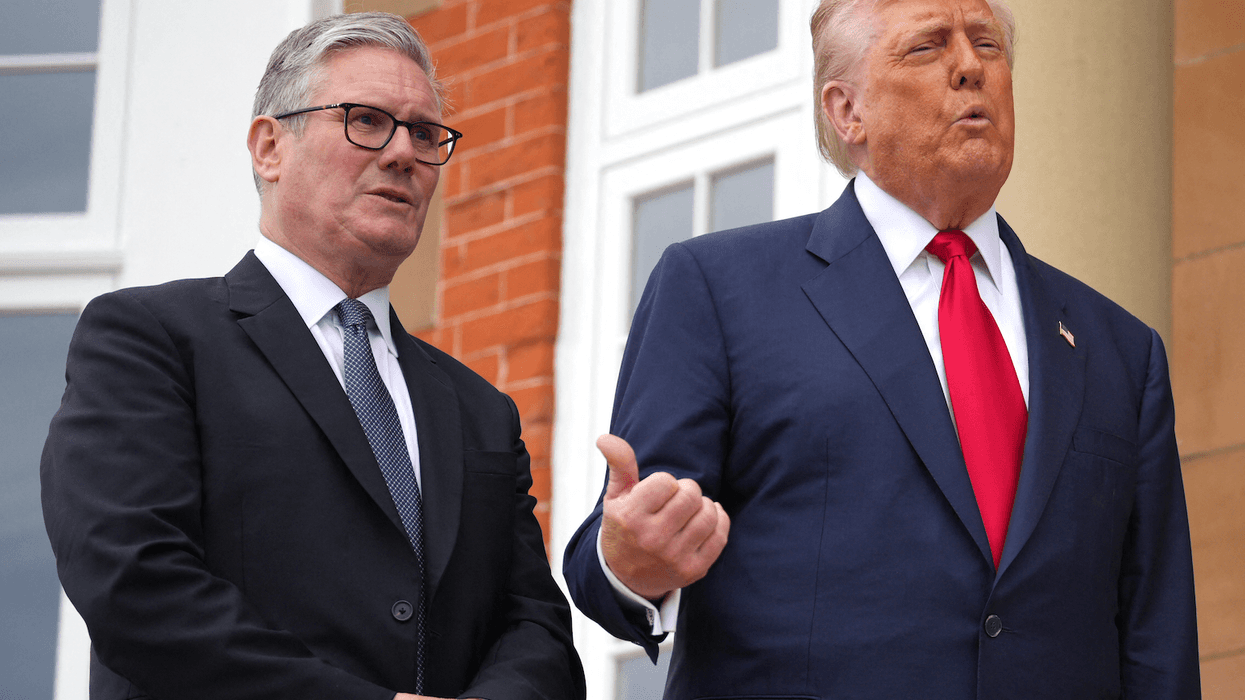
When Labour won, they were supposed to be an alternative to right-wing crazy, but now are losing the whole country to their own MAGA because a real alternative takes work.
The consensus is that this is the year for the Democrats. They have the political winds at their backs. Even with the gerrymandering and the voter suppression and everything Republicans have thrown at the wall, smart money says Democrats take the House and maybe the Senate. And anything that limits the power of this president is good. I’ll grant all of it. Net positive.
But what happens after a good cycle or two, if the winners don’t understand what they won? If they don’t see the pain that powered their victories?
We don’t have to guess because it already happened in Britain.
A year and a half ago, Labour won in a landslide. Imagine our centrist Democrats, the Newsom and Buttigieg wing, sweeping into power with the biggest majority in a generation. The Tories were finished, the same way a lot of folks think Republicans are about to be finished. But Labour walked in and decided the mission was better management. Be the adults in the room. Trim the spending. Talk tough on the border. The ship was fine, just needed a steady hand.
If Democrats get to Washington, take the gavels, and decide the job is just to clean up after Donald Trump and keep the machine humming, we know how this ends. We just watched it play out in Britain.
Now look at them. Reform is Nigel Farage’s party, which is their MAGA more or less. Reform is leading the polls, and Labour’s a distant second. Their MAGA has led just about every poll since late last year. Keir Starmer, the head of Labour, is one of the least popular leaders in the Western world. A year and a half ago centrists won everything. Now they’re watching the British version of Trumpism walk toward power.
When a party wins on the promise of change and then delivers management, the people who abandon ship don’t all come back. The ones who move, move right. The angry ones, the ones who feel lied to, don’t drift off to some nicer party on the left. They turn to the man burning it all down, which is always how the right takes power. Afterward, centrists throws up their hands, convinced the country is turning right, when in reality they’re turning desperate. If you promise change and deliver the status quo, things don’t get better; for a lot of people, they get worse.
Britain at least has a buffer. They build coalitions, so no single party runs the whole thing alone usually. The damage is scattered and slower. But the US doesn’t have that. We’ve got winner-takes-all, with gerrymandering stacked on top. Here, a centrist party that wins big and then governs scared doesn’t lose gracefully. It delivers the whole country to MAGA. The House, the Senate, the gavels, all of it.
Our centrists, the Newsoms, the Buttigiegs, the Slotkins, are on the rise right now. They aren’t leaders. They aren’t fierce advocates for structural change. In fact this is exactly the kind of compromise-driven, go-along-to-get-along Democratic Party that abandoned the working class and helped usher in MAGA. Hell, California Gov. Gavin Newsom can’t even bring himself to tax billionaires. These are folks who don’t get the depth of pain across our the country. And they certainly don’t get the ferocity behind the criminal administration wrecking our democracy. The Democratic Party and its faux leaders don’t see what’s coming, or they see it and don’t care. In the end it won’t matter which.
The cost of living is so far out of reach for young people that you can’t fix it with a tweak. There’s no tax credit, no rebate, no clever little program that closes that gap. It will take transformation. It will take building things again. The same is true for jobs. AI and robotics are about to come for human labor in a way this country has never seen, and Democrats have no plan for it. None. They’re not ready for the losses. They’re not ready for what happens to a person, to a town, to a whole generation, when the work goes away.
And they’re sure as hell not ready for what’s happening at the very top. Last week, Elon Musk became the world’s first trillionaire. I wrote on Thursday about how we built him, how public money and public research and public contracts carried him up the hill while we kept no ownership. Our tax dollars built SpaceX and then we handed over the deed. The pretenders in the Democratic Party, the ones about to take the reins, have no answer for that. They have no intention of stopping the next massive giveaway. Why? Because they don’t want to upset the interests who fund their campaigns.
Lack of accountability for guys at the top is the clearest indicator that we need systemic change. Forget for a second the question of genocide in Gaza. Forget the West Bank. You don’t have to know the answer for those to agree we should honestly investigate war crimes. The International Criminal Court already issued arrest warrants for Israel’s prime minister and defense minister for using starvation as a weapon of war. Our government’s response? To go after the court. To sanction its officials, and defend the war criminals.
Here at home, we’ve got a Justice Department unit whose entire job is crimes against humanity. Did it ever investigate Joe Biden’s cabinet, the men who signed off on the bombs? It didn’t. It won’t. They go after small men in faraway places, and give a pass to the policy masterminds here. The impunity of the powerful doesn’t start with Jeffrey Epstein or end with him. It runs straight through the war machine, the financial machine, the whole arrangement. A justice system that can’t prosecute its most powerful people for their most serious crimes is broken. You don’t fix broken with better management. You rebuild it.
We’ve got from now until the end of primary season to pick the right people. The candidates who understand our fight is structural. The ones who are ready for what’s actually coming. The ones not owned, willing to take a real risk.
If Democrats get to Washington, take the gavels, and decide the job is just to clean up after Donald Trump and keep the machine humming, we know how this ends. We just watched it play out in Britain. The winners were supposed to be an alternative to right-wing crazy, but now are losing the whole country to their own MAGA because a real alternative takes work.
That’s the thing about the so-called adults in the room. The centrists, the moderates, the corporatists, they won’t do the hard work. In part because they’re bankrolled by entrenched interests who will use every weapon in the arsenal to maintain status quo. And in part because of fear. They’re terrified of blame, so they’d rather keep walking toward disaster than take a chance on something better. Real reform means changing the whole structure, the democracy, the social fabric, the economy itself, and that’s going to take fight.
People are desperate for a life that works, but it’s easier for Dems to keep their heads down, push gently for incremental change, and hope things will get better on their own.
They won’t.
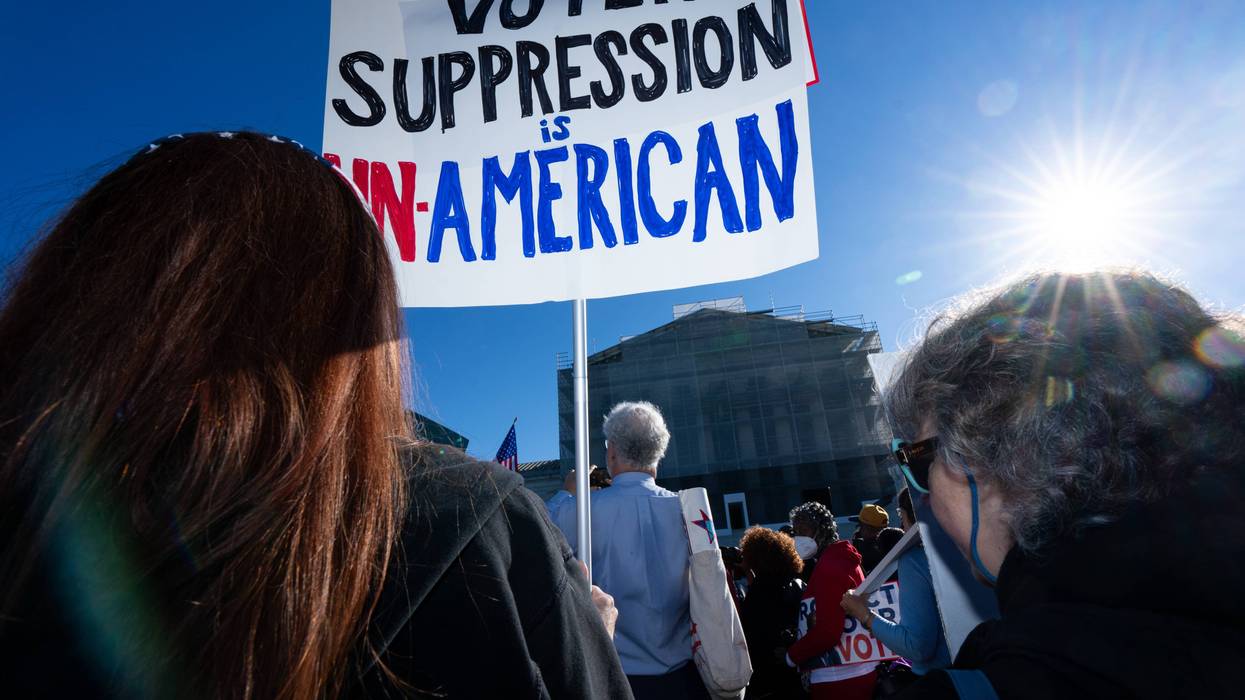
Disenfranching 40% of a state’s citizens cannot be reconciled with representative democracy.
Last week the Supreme Court gave a “two-fer” to white supremacists and proponents of Republican autocracy: First, six right-wing justices completed the erasure of the crowning achievement of the 1960s Civil Rights Movement, the Voting Rights Act. Second, in the same case, Louisiana v. Callais, the right-winger judges approved of states shaping legislative districts that deny the opposing party any role in government.
In essence, the Supreme Court OK'd the destruction of Congress as an instrument of American democracy.
The 15th Amendment to the Constitution was enacted and ratified five years after the Civil War. The amendment confirmed—in principle—that African-American citizens have the right to vote and to have their votes count.
So said the Constitution. But for almost a century the former Confederate states negated African Americans’ right to vote.
The GOP can achieve its desired result by calling their gerrymandering by another name. Racial gerrymandering, not okay. Partisan gerrymandering (which just happens to negate Black voting power), just fine.
The 15th Amendment also gave Congress the power to enforce its mandate. After years of struggle over civil rights—after peaceful demonstrators in Birmingham confronted snarling police dogs, mass arrests, and lethal bombing; after hundreds of nonviolent students worked for freedom in Mississippi in the face of murder, assaults, and the burning of Black churches; after peaceful marchers for voting rights returned to Selma after being clubbed by state troopers and ridden down by racist possemen—Congress tackled the white supremacist obstacles to African-American voting.
The Voting Rights Act of 1965 put an end to the myriad legal schemes that Southern white politicians had used to disenfranchise Black Americans and terminated the ploys used to deny African Americans a fair opportunity to elect representatives of their choice.
The outcome: Even as the segregationist white South moved to the Republican Party, African Americans gained substantial voting power and Black legislators were elected to Congress, state legislatures, and local government offices in meaningful numbers. The promise of the 15th Amendment, that all groups are entitled to a meaningful voting opportunity in a multiracial democracy, was mightily advanced.
But white supremacists and MAGA Republicans never accepted the new reality, so their right-wing agents on the Supreme Court finally throttled the Voting Rights Act for them. When the conservative justices threw out a congressional map that upheld Black voters’ right to have their votes count, they unleashed a new wave of state gerrymandering laws, enacted with extraordinary speed, and designed to make African-American voting futile.
To make things worse, the court justified its decision by affirming the power of states to deny meaningful representation to opposing party voters through gerrymandering.
As the right-wing justices explained, carving congressional districts for the purpose of denying representation to Black people may be forbidden (and good luck proving intent to discriminate, when Republican legislators don’t say so out loud). But doing precisely the same thing is fine when the stated purpose is denying representation to an opposing party’s voters.
Get that? The right-wingers of the United States Supreme Court say that judges must stand by and look, powerless to take action, if a state dominated by Republicans decides to manipulate congressional district maps to weaken or destroy the voting power of Democrats.
In practice it amounts to the same thing. The GOP can achieve its desired result by calling their gerrymandering by another name. Racial gerrymandering, not okay. Partisan gerrymandering (which just happens to negate Black voting power), just fine.
The GOP’s ultimate goal is the same either way: a Congress under MAGA Republican control regardless of voters. A nation in which African-American political influence is crushed.
What does this look like?
After the Supreme Court’s Callais decision, Tennessee’s Republican-controlled legislature promptly redrew its congressional maps. They sliced up the one district held by a Black Democrat, with the intended outcome that all nine of Tennessee’s representatives will be Republican.
One-third of Tennessee citizens voted for Democrats in 2024. This year that one-third of the population—including the Black voters of Memphis—are to have zero representation in Congress.
South Carolina has begun the same process and anticipates a similar result. Republicans now hold 6 of 7 House seats, and intend to eliminate the one Democrat.
Forty percent of South Carolinians voted Democratic in 2024, and will have zero representation in Congress following redistricting. The one-quarter of South Carolina’s population that are Black will have no district in which their political voice will be heard.
US President Donald Trump has pressed for a similar outcome wherever Republicans control state government. In bright red Indiana (but 38% Democratic), Trump seeks to zero out Democratic representation in Congress.
GOP redistricting is only marginally less extreme elsewhere. In Missouri, for example, 38% of “Show me” state voters are blue, and their representation will be reduced from two to one of the state’s eight congressional seats (12%).
We have separate district elections for Congress so that the range of local communities, with their different racial and ethnic populations, different beliefs, interests, and occupations can have a fair opportunity for representatives of their choosing. Disenfranchisement by gerrymandering thwarts that purpose.
Even more disturbing, Trump’s gerrymandering offensive seeks to flout majority rule by creating a voter-proof Republican Congress.
American voters are increasingly seeing through the failures and the fakery of Donald Trump’s presidency, the broken promises, the corruption, the incompetence, the cruelty. And voters see the price they are paying for Trump’s senseless grandiosity, from inflation to healthcare costs to measles, war, and climate change.
But through it all, congressional Republicans have remained Trump’s loyal, submissive toadies.
Voters will certainly make Republicans pay the price this fall. But Trump—with a big assist from MAGA Justices John Roberts, Samuel Alito, Clarence Thomas, Neil Gorsuch, Brett Kavanaugh, and Amy Coney Barrett—hopes to keep his hold on Congress, voters be damned. If a solid majority of voters cannot shake a would-be totalitarian’s hold on power, what will be left of our constitutional democracy?
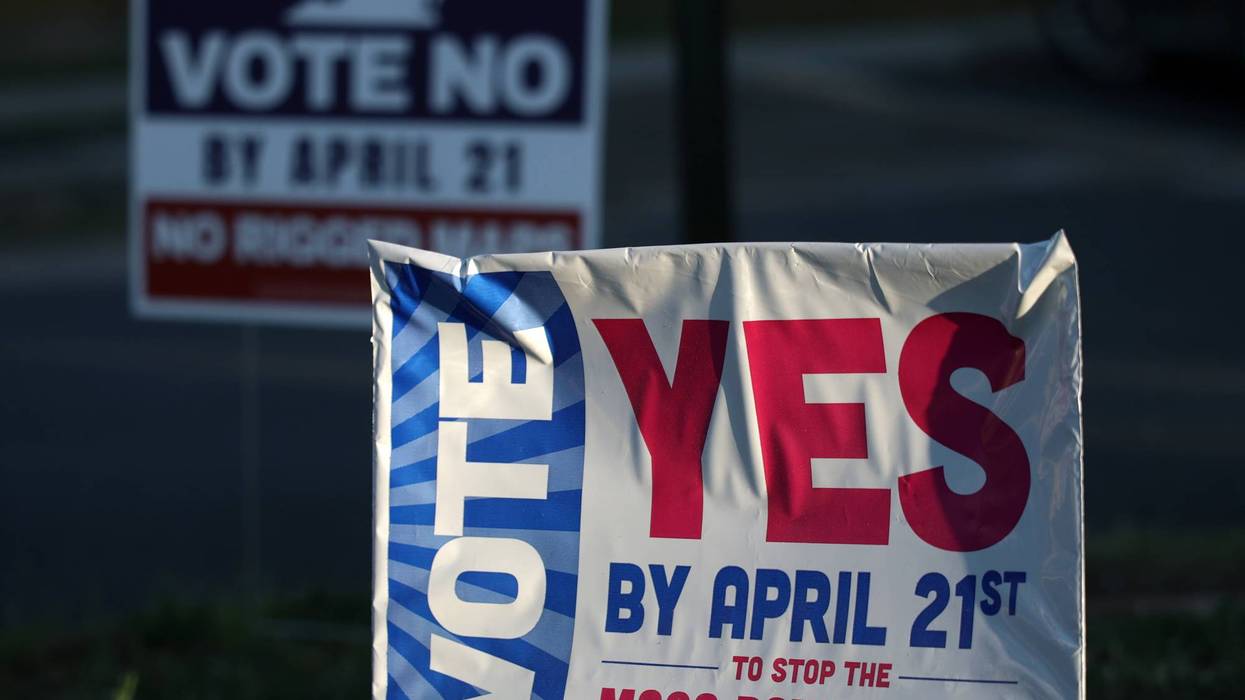
There is an important lesson to be learned here and that is that there is no advantage for Democrats in not being fully anti-Trump.
By roughly three percentage points, voters in Virginia voted for a redistricting plan that will heavily tilt the congressional playing field toward the Democrats. With some votes still to be counted, yes took 51.5% of the vote to 48.5% for the no campaign. The new map will give the Democrats a good chance at winning 10 out of 11 Virginia congressional districts—a big shift from the current 6 Democrats, 5 Republicans in the delegation. The measure still faces legal challenges before it can go into effect.
Turnout for the referendum was roughly 89% of those who voted in the 2025 gubernatorial election. So, the overall turnout rate for the referendum was around 49%. While this is disappointing in that less than half of eligible voters went to the polls, it is a high turnout rate for a special election.
Unfortunately, there are no exit polls for the Virginia referendum, so the best we can do is look at the voting data and see what conclusions we can draw. Among the very Hispanic-Asian election districts in Northern Virginia (Fairfax, Loudoun, and Manassas Park) the pro-referendum forces did about 16 percentage points better than Kamala Harris in 2024. A strong performance among Black voters in Richmond and Hampton Roads helped put the referendum over the top. According to The Washington Post, counties that were at least 25% Black supported the measure by a 14-point margin, after backing Gov. Abigail Spanberger last November by 24 points.
The pro-referendum forces also fared well in high-income parts of the commonwealth. Opposition to the referendum was concentrated in southwestern Virginia. In many of these counties, the no campaign was able to improve on President Donald Trump’s 2024 performance.
Tuesday’s vote in Virginia will mean more Democratic representatives in Congress.
Are there lessons that the Democrats can take away from the Virginia redistricting campaign? First of all, it is important to note that a win is a win. However, there is an important lesson to be learned here and that is that there is no advantage for Democrats in not being fully anti-Trump.
When the referendum campaign began, the yes forces were portraying the vote as part of a broad effort to level the congressional playing field. The New York Times reports that:
In the first six weeks of the campaign, the “Yes” side spent $13.5 million on advertising compared with the “No” campaign’s $640,000, according to data from AdImpact, a media tracking firm. But over that time period, “Yes” did not gain ground in private polling, according to multiple people briefed on the data.
Based on the media that I saw, in the closing days of the campaign, the yes forces retooled their messaging and presented the campaign as a way to stop Trump and the MAGA forces.
Why did the pro-redistricting forces not immediately embrace a full-on anti-Trump message? We can only make educated guesses. The first is newly elected Spanberger, who had run as a middle-of-the-road Democratic centrist. Her role in the redistricting is ambiguous. Unlike Gov. Gavin Newsom in California, Spanberger did not get out in front of the campaign. This is understandable. After all, Virginia, unlike California, is a purple state. Spanberger also needs to get her legislative agenda through in Richmond.
The best symbol of Spanberger’s attitude toward the referendum is the fact that she made an ad in support of a yes vote but the ad never showed. In her statements about the referendum, the governor was uncomfortable.
Democrats also seemed to have been unprepared for the no forces’ very clever use of statements by President Barack Obama opposing gerrymandering, which created confusion in the electorate. In response, the Democrats responded with ads featuring President Obama. In an interesting twist, Obama not Trump was the president most featured in the media outreach on the referendum.
So, in the end the redistricting referendum passed by less than Spanberger won last November. While the Republicans may be able to claim some sort of a moral victory, a win is still a win. Tuesday’s vote in Virginia will mean more Democratic representatives in Congress.
Democrats have reasons to celebrate. However, they should learn the lesson from the referendum: There is nothing to gain politically by soft-pedaling their opposition to Trump.

The administration’s domestic policies, coupled with aggressive foreign postures, are accelerating disillusionment among Trump’s core supporters.
As President Donald Trump’s second term unfolds, the contradictions at the heart of his “America First” agenda are increasingly apparent. What began as a populist revolt against elite globalism appears to have morphed into policies that alienate the very rural and small-town constituencies that backed him in 2016, 2020, and 2024.
These rust-belt and rural counties were drawn to his promises of economic revival, border security, and non-interventionism. Yet, emerging signs of fracture in this MAGA base suggest a potential backlash in the upcoming midterms.
The administration’s domestic policies, coupled with aggressive foreign postures, are accelerating disillusionment among Trump’s core supporters.
Domestically, Trump’s intensified immigration enforcement has backfired. Ramped-up Immigration and Customs Enforcement raids were sold as fulfilling pledges of mass deportations targeting “criminals”. But these operations have swept up undocumented workers essential to rural economies. Small family farms and businesses in states including California, Idaho, and Pennsylvania are reliant on immigrant labor for harvesting crops, dairy operations, and meatpacking. They now face acute shortages.
Trump, meanwhile, is perceived as profiting personally. His properties and branding deals benefit from economic nationalism, even as family farms teeter on the verge of bankruptcy.
Agricultural employment dropped by 155,000 workers between March and July 2025, reversing prior growth trends. Farmers in Ventura County, California, for example, denounced raids that targeted routes frequented by agricultural workers. Fields lie unharvested signalling financial ruin for some operations. Family-run farms struggle to find replacements. Low wages and grueling conditions simply fail to attract American-born laborers.
This labor crisis exacerbates a broader sense of betrayal. Rural voters supported Trump for his anti-elite rhetoric, expecting protection for their livelihoods. Instead, the administration’s actions have hollowed out local workforces without viable alternatives.
The H-2A visa program, meant to provide temporary foreign workers, has been streamlined—but remains insufficient amid ongoing raids, which deter even legal migrants. These disruptions ripple through small-town economies, where agriculture underpins community stability. Democrats, sensing opportunity, are investing in rural outreach, emphasizing economic populism to woo disillusioned voters who feel abandoned by Trump’s enforcement zeal.
Compounding these woes are the ongoing tariff disruptions. Trump touts his tariffs as tools to “make America great,” but in fact they have driven up costs for the same rural groups. Between January and September 2025, tariffs on imports from China, Canada, Mexico, and others have surged, collecting US$125 billion. However, the figure may be even higher according to experts.
But while the administration claims these taxes punish foreign adversaries, the burden falls squarely on American importers and consumers. Small businesses, which account for around 30% of imports, faced an average of US$151,000 in extra costs from April to September 2025, translating to $25,000 monthly hikes. Farmers, already squeezed by low grain prices, pay more for necessities, such as fertilizers (hit by 44% effective tariffs on Indian imports) and machinery parts.
Midwest producers of soybeans, corn, and pork—key US exports—suffer doubly from retaliatory tariffs abroad, which reduce demand and depress revenues. In Tennessee and Pennsylvania, builders report 2.5% rises in material costs, while food prices climb due to duties on beef, tomatoes, and coffee.
Trump, meanwhile, is perceived as profiting personally. His properties and branding deals benefit from economic nationalism, even as family farms teeter on the verge of bankruptcy. This disparity fuels resentment. Polls show Trump’s approval slipping in swing counties, with economic anxiety eroding the loyalty that once overlooked his character flaws.
These domestic fractures are mirrored in foreign policy, where Trump’s interventionism starkly contradicts his campaign pledge of “America First” restraint. Having promised no new wars, he has instead pursued aggressive postures that many Republicans view as unnecessary. The most emblematic is his renewed bid to acquire Greenland, apparently by negotiation or force, which has swiftly followed the US raid on Venezuela in the first week of January, accompanied by threats against other Latin American countries including Cuba and Colombia.
The US president has justified demands for control over the Arctic island—citing threats from Russia and China—as a strategic necessity. But NATO allies such as Denmark—of which Greenland is a constituent part—have rebuked it as an potentially alliance-shattering move. Congressional Republicans, including Sens. Mitch McConnell (R-Ky.) and Thom Tillis (R-NC), have broken ranks, warning that force would obliterate NATO and tarnish US influence.
Such dissent highlights broader paradoxes. Trump’s populist realism prioritizes tough rhetoric for domestic consumption but yields aggressive, even reckless actions abroad. His administration is effectively dismantling post-1945 institutions while embracing 19th-century spheres-of-influence and outright colonialist thinking, including invoking an updated version of the 1823 Monroe doctrine.
The fractures signal that Trump’s “America First” policies may ultimately leave its rural and rust belt champions behind.
Rural voters, weary of endless wars, supported his non-interventionist promises. Now they see echoes of past entanglements in Trump’s suggestion that the US could intervene in Iran. This cognitive dissonance is accelerating disillusionment with his presidency.
These self-inflicted but inherent contradictions are hastening a pivotal reckoning for Trumpism. In many counties that have thrice backed him—and especially in swing counties—economic hardship and policy betrayals erode the cultural ties binding rural America to the Republican party. Democrats, through programs such as the Rural Urban Bridge Initiative, are betting on this “betrayal” narrative, spotlighting farmers’ plights to flip seats in November 2026.
Polls show Latinos and independents souring on Trump, with the US president’s base turnout potentially waning as the midterm elections approach in November. If Republicans suffer larger-than-expected losses in those elections, it could mark the decline of Trumpism’s grip by exposing its elite-serving underbelly beneath populist veneer.
Yet, without a compelling alternative vision, Democrats risk squandering this opening. For now, the fractures signal that Trump’s “America First” policies may ultimately leave its rural and rust belt champions behind. Whether Trumpism proves resilient or begins a long decline may well be decided not in Washington and Mar-a-Lago, but in the county seats and small towns that once formed its unbreakable base.

Elon Musk and Donald Trump may want to foster the belief that there are large numbers of dead people getting Social Security benefit so that they can justify a purge of the rolls.
Good followers of U.S. President Donald Trump have to believe an increasingly large collection of ridiculous lies. First and foremost, they have to believe that the 2020 election was stolen. Then they have the corollary, that January 6 was an inside job pulled off for some reason by the FBI. Of course, they have to believe global warming isn’t happening and apparently now that that Ukraine started its war with Russia.
However, this week Elon Musk and Donald Trump added another big lie to the list: There are tens of millions of dead people getting Social Security. As with all Trump lies it is hard to know what the guy really believes and what is being thrown out to advance a larger goal, but this lie definitely ranks alongside the others for both its craziness and potential importance.
It seems the origins of the Social Security zombie story is Elon Musk’s misunderstanding of a Social Security file on the ages of people getting Social Security. He immediately began tweeting to his hundreds of millions of followers that tens of millions of dead people are getting Social Security. This line was quickly picked up by various right-wing influencers as yet another example of government incompetence and corruption.
It might have been helpful to Elon Musk’s “super-high IQ” DOGE boys if they had taken a few minutes to review some of these audits to understand how Social Security works and the problems it faces.
Then Donald Trump made the claim about millions of dead people getting Social Security himself. And under MAGA rules, once the “king” makes a pronouncement, everyone has to say it’s true no matter how utterly absurd it might be. This means all good Republicans have to insist that tens of millions of dead people are getting Social Security, or at least millions.
This claim is absurd on its face. Social Security actually keeps very good track of who is getting benefits, as numerous audits over the years have found. Yes, Social Security is in fact regularly audited by its inspector general and also the Government Accountability Office. It might have been helpful to Elon Musk’s “super-high IQ” DOGE boys if they had taken a few minutes to review some of these audits to understand how Social Security works and the problems it faces.
And the system does have problems, most of which are widely known to those familiar with the program. The two most obvious ones are the country’s method of tracking deaths and the age of the Social Security computer system.
The first problem is that there is no national death registry. We could compile this nationally, but this has been a big states’ rights issue, with many people, mostly Republicans, complaining that a national system of registering deaths would be a dangerous step toward totalitarianism. Therefore, the Social Security Administration (SSA) has to rely on getting data on deaths from states.
The other problem is that SSA is relying on an antiquated computer system that is using a computer language from the sixties. Musk and the DOGE boys may well want to ridicule SSA for using a computer system that is 50 or even 60 years old, but an analysis of the problem would again require looking in the mirror.
It would cost billions of dollars to put in place a new system, while maintaining the operation of the current system and ensuring that the privacy of workers’ earnings and benefit records are not compromised. Cost-conscious Republicans in Congress, along with many Democrats, have not wanted to fork over the money. If Elon Musk and the DOGE boys can arrange for the funding for modernizing the system, they would be widely applauded by supporters of Social Security, but that doesn’t seem the direction they are taking.
In fact, SSA has been pretty ingenuous in working around these obstacles to ensure that the overwhelming majority of its payments are accurate. And when overpayments are made, such as when benefits go to a dead person for a couple of months after death, they often are able to get the money back.
Anyhow, when it comes to the claim that the zombie hordes are getting Social Security, a quick visit with Mr. Arithmetic should put this nonsense to rest. Social Security gives us very good data (it’s even available to Elon Musk and the DOGE boys) on payments to beneficiaries by age.
We can add this up and calculate the total amount of payments that SSA can identify. That came to $1,227 billion at the end of 2024. We can also go to the Social Security Trustees Report and find out the total amount the program paid out in retiree benefits last year. Interestingly, that also came out to $1,227 billion. So where is the money that is going to the millions of Musk-Trump Social Security beneficiary zombies?
Okay, but maybe these are fake numbers that the geniuses at SSA have put together to trick real tax-paying Americans. But which numbers would be fake?
It could be paranoid to imagine that Trump will take away the Social Security benefits that people worked for over many decades, but those who think the worst about Donald Trump are rarely wrong.
We know the total amount Social Security pays out in benefits each year. There are dozens of records kept on this that are regularly published. Even Elon Musk and the “super-high IQ” DOGE boys can find this out.
Furthermore, if we want to venture into the Twilight Zone and imagine that there are actually hundreds of billions of dollars secretly being paid out to the Musk-Trump zombies every year, we wouldn’t have to worry about this money contributing to the deficit. If the zombie payments are never recorded anywhere, they can’t be a factor in the official deficit that we all know and love.
Maybe the SSA tricksters did it on the other side. They are hugely exaggerating what we are paying as benefits to real working people. All those numbers on people in their 60s, 70s, and 80s are hugely inflated so that they have extra money to pay to the Musk-Trump zombies.
While that would be a very clever trick by the SSA fraudsters, it would also be pretty hard to pull off. We do have very good data on births. We know how many people were born in 1940, 1950, 1960, and every other year. We also know roughly how many of these people are dying. Anyone interested could examine whether, for example, the number of 90-year-olds SSA says are getting benefits makes sense.
The same applies on the benefit side. Social Security has a very well-defined benefit formula, which is readily available to anyone who wants to look. We have good data from a wide variety of sources on the wages people earned during their working years, so we can know roughly what they should be getting in Social Security benefits. We also have data from both public and private sources on what Social Security beneficiaries are actually getting from the program.
If the SSA bureaucrats are able to find ways to exaggerate their proper payments to living people, to hide hundreds of billions of dollars being paid out to dead people each year, they are way more clever than anyone gives them credit for. I’m not sure that fits the story that Elon Musk and the DOGE boys want to tell.
It is always dangerous to try to get into the head of someone who is not making any sense, but it is worth asking if there can be any purpose served by Musk-Trump spewing nonsense about tens of millions of dead people getting Social Security benefits. This could just be another absurd Trump power play where he forces his MAGA followers to accept an absurd lie just to show he can. He did this when he released a huge volume of water in California, ostensibly to help contain the Los Angeles fires, even though the areas getting the water were nowhere near LA.
There is another more pernicious possibility. Musk-Trump may want to foster the belief that there are large numbers of dead people getting Social Security benefit so that they can justify a purge of the rolls. The purge will not be directed at the dead people who are not there, but at their political opponents. This is obviously completely illegal, but if Trump gets decide the law, as he insists, it’s all fine.
It could be paranoid to imagine that Trump will take away the Social Security benefits that people worked for over many decades, but those who think the worst about Donald Trump are rarely wrong. I guess we will eventually find out his intentions with this idiocy. We have to hope that it’s just Trump’s dementia.
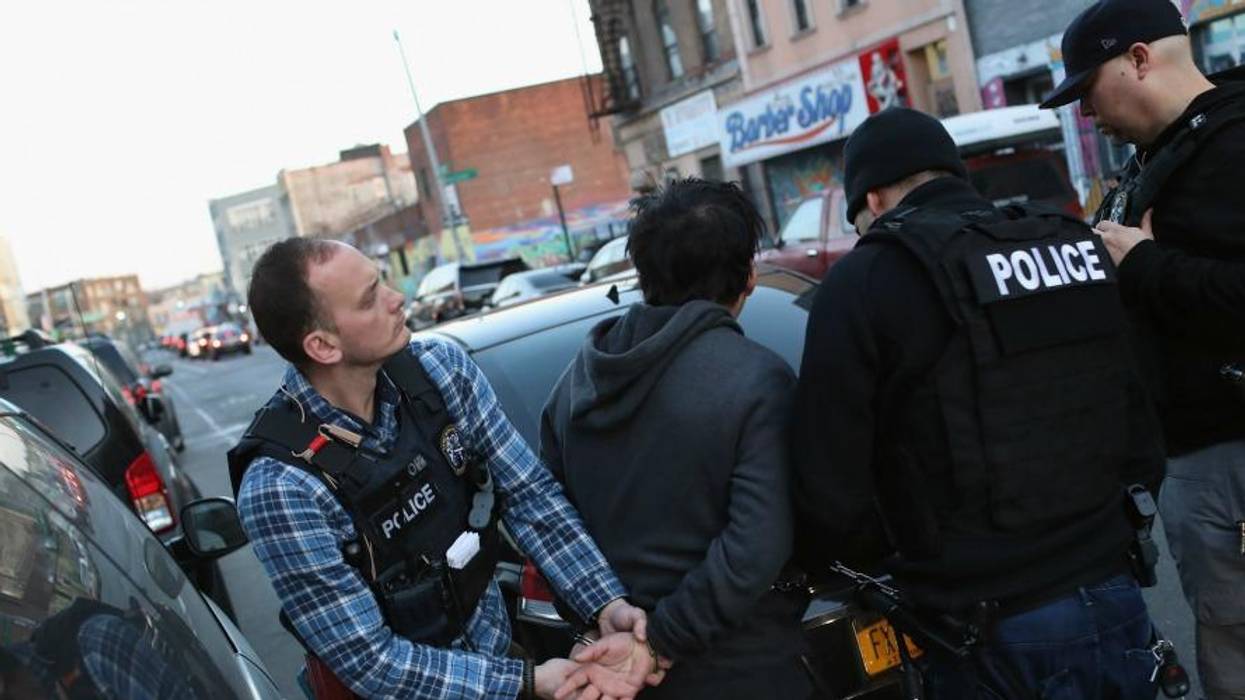
One Texas bishop said the new policy "strikes fear into the heart of our community... when they are worshipping God, seeking healthcare, and dropping off and picking up children at school."
School districts, healthcare professionals, and religious institutions across the United States are in fight-back mode Wednesday after Republican President Donald Trump revoked a rule prohibiting Immigration and Customs Enforcement agents from arresting undocumented immigrants in or around "sensitive" locations like schools, places of worship, hospitals, and shelters.
"Criminals will no longer be able to hide in America's schools and churches to avoid arrest," acting Homeland Security Secretary Benjamine Huffman said in a statement issued Tuesday. "The Trump administration will not tie the hands of our brave law enforcement, and instead trusts them to use common sense."
The unleashing of ICE agents for raids on previously protected spaces—which are refuges for children,
domestic violence victims, and other vulnerable people—is part of Trump's anti-immigrant agenda that includes "the largest mass deportation operation" in U.S. history, according to one administration official.
Religious leaders were among those condemning the move, with Mark Seitz, the Roman Catholic bishop of El Paso, Texas and chair of the U.S. Conference of Catholic Bishops' Committee on Migration, lamenting that the new policy "strikes fear into the heart of our community, cynically layering a blanket of anxiety on families when they are worshipping God, seeking healthcare, and dropping off and picking up children at school."
BREAKING: Trump has revoked a rule prohibiting ICE from arresting undocumented immigrants at or near "sensitive locations," like schools, places of worship, hospitals, & shelters." We need to act I list 7 tangible actions you can take to help protect immigrants: www.qasimrashid.com/p/trumps-mas...
[image or embed]
— Qasim Rashid, Esq. (@qasimrashid.com) January 21, 2025 at 12:43 PM
However, communities across the nation also met Trump's escalation with renewed determination to protect their immigrant neighbors.
Dr. Katherine Peeler, medical adviser at Physicians for Human Rights, said in a statement Tuesday that "no one should have to hesitate to seek lifesaving treatment because they fear detention, deportation, or being torn from their families."
"Eliminating protections for sensitive locations like hospitals will deter people from seeking essential medical care, putting their individual health at risk and jeopardizing public health," Peeler added. "This is part and parcel of the Trump administration's strategy to create a climate of fear that promotes discrimination and unnecessary suffering."
Some school districts in cities including Los Angeles, Chicago, Phoenix, Palm Springs and many others had already established policies to preemptively protect undocumented students by declaring safe spaces or refusing to cooperate with federal agencies. Others are now acting in the wake of Tuesday's policy shift.
School officials in Bridgeport, Connecticut said Tuesday that they are reaffirming their "commitment to protecting the safety and privacy of all students and families," partly by blocking ICE agents from entering buildings without permission from Superintendent Royce Avery.
"We will not tolerate any threats to the safety or dignity of our students," Avery said. "Every student in Bridgeport, regardless of their immigration status, has the right to feel secure and supported in our schools. I became an educator to advocate for all students, and I will ensure their rights and privacy are upheld. Our schools will remain a safe space where all students can learn, grow, and succeed without fear or discrimination."
The Saint Paul Federation of Educators (SPFE) in Minnesota's capital city is calling on its members to resist what it called Trump's efforts to establish an "authoritarian dictatorship."
"It is our turn to face down the authoritarian Republicans ruling our government," SPFE president Leah VanDassor said in a statement Tuesday. "Joining together, we can resist authoritarian efforts to divide us, refuse to comply with their agenda, and reclaim our birthright: making America live up to its promise of liberty and justice for all—no exceptions."
"There will be those in the U.S. House, U.S. Senate, and the Minnesota Legislature that will support [Trump's] orders, because they support replacing our democracy with an authoritarian dictatorship," VanDassor continued. "There will be temptation to ignore the role that white supremacy, sexism, transphobia, and xenophobia play in these actions."
"Some may have that option," VanDassor added. "But we don't."
Denver Public Schools (DPS) was among the districts that offered community guidance on what to do if government officials show up. School employees are advised to deny federal agents entry to buildings, alert occupants to impending raids, demand warrants from ICE officers, and seek legal counsel.

DPS Superintendent Alex Marrero explained in a statement last week that the district "is committed to providing equitable and inclusive environments where all our students feel safe and socially and emotionally supported" as "students, families, and staff who are undocumented are experiencing unease and uncertainty regarding potential mass deportation."
Even some MAGA Republicans are opposed to allowing federal agents to raid schools.
"If they do that, less kids will come to school," Arizona Superintendent of Public Instruction Tom Horne told Phoenix New Times on Tuesday, adding that it's not a child's fault if "their parents came here illegally."
Among those offering advice to her community on what to do if faced with an ICE raid was Detroit City Councilwoman Gabriela Santiago-Romero, who said in a video posted on Instagram: "If you are a resident and ICE comes to your property, you do not have to open the door. The only way you have to open the door to ICE is if they have a warrant signed by a judge."
Others noted that Trump's new policy only applies to public spaces and that ICE agents need both a judicial search warrant and arrest warrant to enter private spaces and arrest people.
While some U.S. clergy have expressed trepidation about offering sanctuary to migrants in light of the new Department of Homeland Security policy, other said they will protect community members in need.
"It is really important to be present to let people know, we will be there wherever we can to support them," Father Larry Dowling, a Catholic priest in Chicago, told ABC 7 on Sunday.
Trump
lashed out against Rev. Mariann Edgar Budde on his Truth Social platform early Wednesday, calling the spiritual leader of the Episcopal Diocese of Washington, D.C. "nasty" after she implored him during Tuesday's inaugural interfaith service to "have mercy" on "those in our communities whose children fear that their parents will be taken away" and who may not "have the proper documentation"—saying the vast majority of them are "good neighbors" and "not criminals."
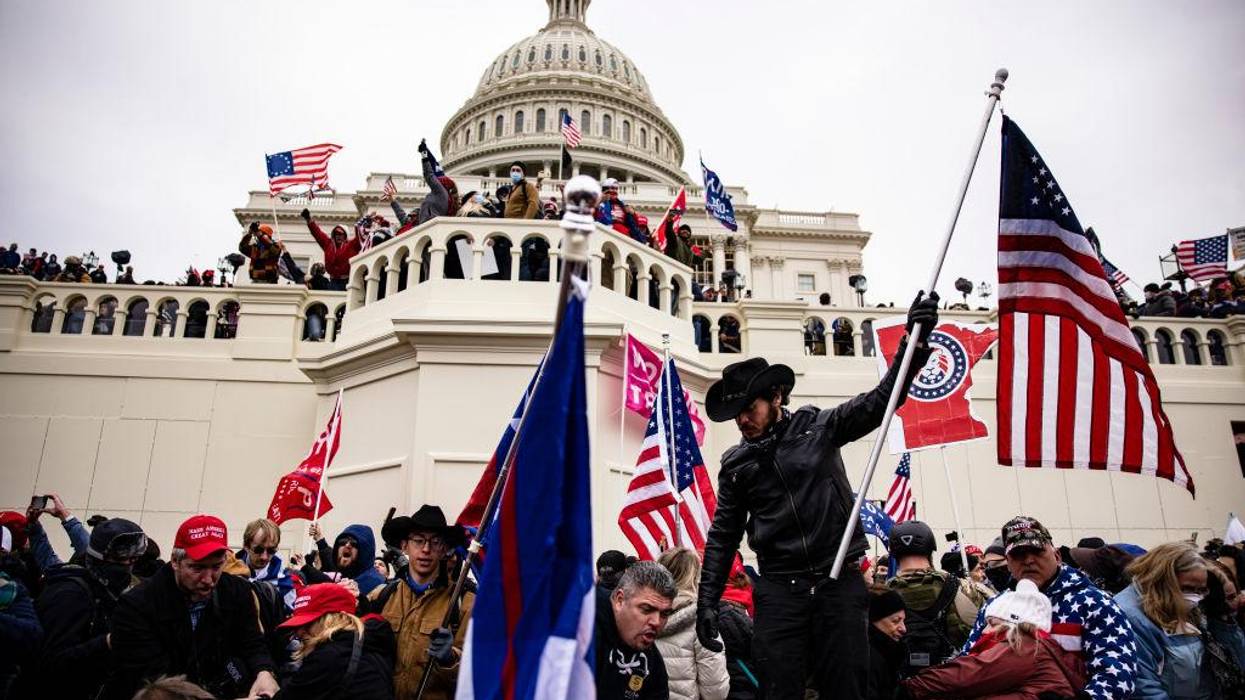
Before January 6, 2025, we need Americans across the country to demand that their lawmakers have the courage to certify the 2024 election results and reject the extreme Project 2025 agenda.
On January 6, 2021, we risked our lives to protect the American people’s duly-elected representatives from a violent mob that sought to overturn the results of a free and fair election. In doing so, we fought to defend American democracy itself. We could have never predicted the violence we would face that cold, January morning, but it was the mission we faced, and we rose to the occasion. We wish that we could say the same about the election deniers in Congress.
Despite the fact that thousands of MAGA rioters stormed the Capitol, assaulted over 140 police officers, and threatened the lives of congress members, 147 extreme MAGA Republicans still voted to overturn the 2020 election, including the Speaker of House Mike Johnson (R-La.). Today, we are 147 days away from January 6, 2025, when Congress will be tasked with certifying this year’s election results. Between now and then, we need Americans across the country to demand that their lawmakers have the courage to certify the 2024 election results and reject the extreme Project 2025 agenda so that the horrific tragedy of January 6, 2021 never happens again.
We have spent the last three years calling out those who voted to overturn the election because we know that another insurrection is possible. January 6 only happened because the former president and his lap dogs in Congress stoked insidious election lies among their followers. Elected officials like Speaker Johson were not merely responding to election deniers’ “concerns,” they were manufacturing them. By entertaining the Big Lie and developing fraudulent legal strategies to overturn the election, they gave permission to their supporters to attack American democracy. As a result, seven people, including several of our law enforcement colleagues, lost their lives.
On January 6, 2025, members of Congress will have to ask themselves: will they fulfill their duty to the American voters, protect the peaceful transfer of power, and disavow the Project 2025 agenda, or will they put their own political ambitions ahead of public service?
Two-thirds of Americans fear another January 6 because MAGA extremists haven’t changed their tune about the Big Lie. In fact, they’ve doubled down. Former U.S. President Donald Trump’s remarks at the National Association of Black Journalists convention, where he said he “absolutely” would pardon the convicted January 6 rioters, demonstrates this. Unfortunately, they aren’t stopping there. House Republicans are laying the groundwork for another insurrection and pushing their extreme Project 2025 agenda forward.
Project 2025 moves us from the physical violence we faced on January 6 into a bureaucratic assault on the rule of law. It is nothing short of a takeover of the federal government that would threaten our freedom to vote and undermine the ability of federal agencies to protect much-needed election infrastructure. Project 2025 would fundamentally alter our government and weaken guardrails around presidential power—all for the benefit of corporations, wealthy donors, and the far-right fringe—to the detriment of everyday Americans like us. MAGA Republicans’ support for this extreme agenda clearly shows that their mission remains the same as it did four years ago.
Even though these extremists’ anti-democratic actions are no longer surprising, it is still hard for us to fathom that Republicans in Congress are still committed to the Big Lie and Project 2025 even after running away in fear from a violent mob that was targeting them and their colleagues while wielding bear mace, zip ties, and firearms. Clearly, they prioritize power and party politics over duty and service—values that the 140 police officers showed when defending the Capitol. But we don’t need to understand it, we need to stop it from happening again. We are calling out MAGA extremists’ election lies because we want to ensure that no one has to risk their life to ensure a free and fair election.
Several congressional leaders have already committed to defending and certifying this year’s election results regardless of the outcome. For the next 147 days we are calling on Congress to courageously stand up for our democracy. On January 6, 2025, members of Congress will have to ask themselves: will they fulfill their duty to the American voters, protect the peaceful transfer of power, and disavow the Project 2025 agenda, or will they put their own political ambitions ahead of public service?
The 140 police officers who saved their lives that day will be watching to see how they answer.
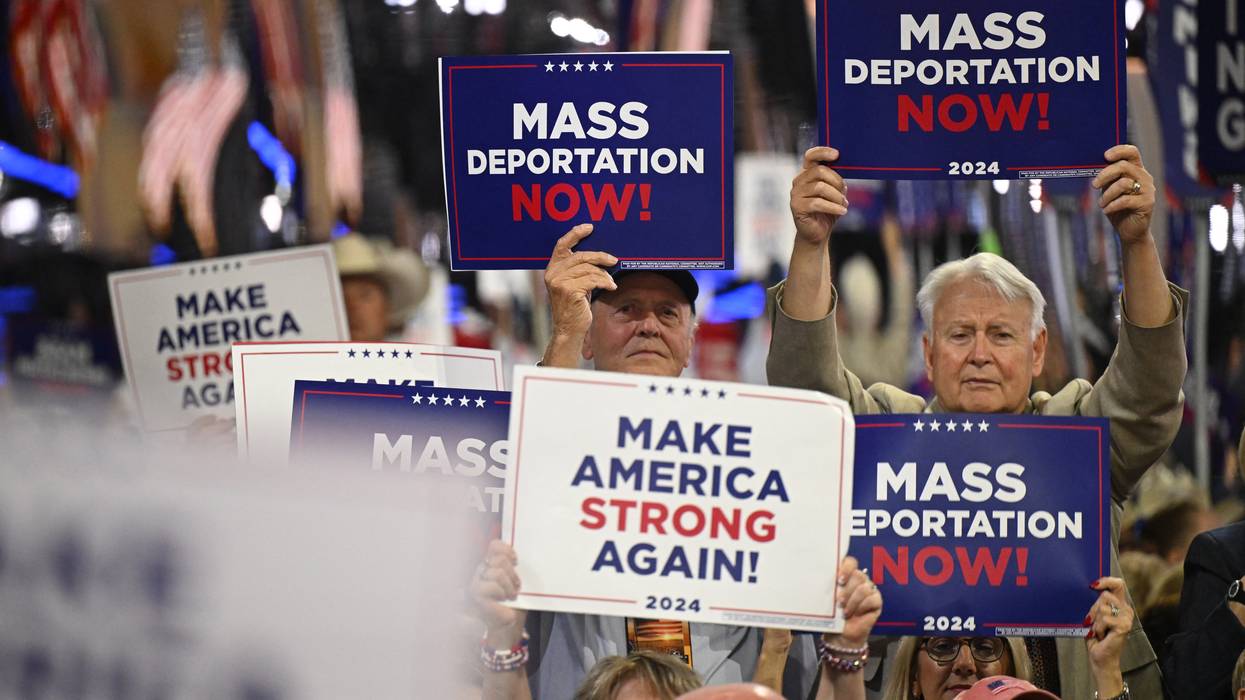
Are we poised to witness the greatest domestic act of genocide since the expulsion of Indigenous people?
I visited Annunciation House in November of 2019. This is a Catholic-run haven for homeless migrants, a drop of water to combat a limitless thirst. Most people, fleeing climate catastrophe and the political violence orchestrated by decades of U.S. efforts to destroy progressive regimes in Latin America, find no such respite. Nonetheless, people flee starvation, political instability, and death squads, even if the trek across the searing desert kills a great many of them. Families, children, pregnant women, the elderly—people with absolutely nothing—have been trapped between the proverbial rock and a hard place. During my 2019 visit to El Paso, Annunciation House was nearly empty due to then-U.S. President Donald Trump's "remain in Mexico" policy.
Refugees flee from deadly conditions no matter how slight their chances for asylum. These migrants are chess pieces for U.S. politicians. North of the Rio Grande, refugees seeking asylum encounter the myths and biases of political theater. Immigrants—suffering, dreaming, striving, and dying—have only symbolic worth to politicians. They are the commodities that can be driven with the sledge hammer of propaganda, deep into our reptilian brains.
Many Americans have always hated immigrants, and U.S. leaders have used that hatred to pump up frothing voters. We have drawn a peculiar line of delineation between those whose ancestors arrived long ago, and those who belatedly attempt to make the same transition. The collective sport of reviling the foreign born has grown in direct proportion to the ruin of forests and fields. As the climate slashes bloody fissures in the agricultural systems of the Global South, politicians in wealthy countries gather the spoils and trade cruelty for votes.
Do Trump's reprehensible promises inevitably become policy? Likely, yes. Trump has staked his legacy to his vow to punish undocumented residents mercilessly.
On the walls of Annunciation House residents display their works of art—a random jumble of shoes lie haphazardly within a glass display case. These shoes represent those who died in the desert. Thousands of people succumb to heat stroke, hypothermia, falls in rough terrain, and dehydration. Border patrol agents have famously spilled water from containers left by good Samaritans. The Chihuahuan Desert heat acts in tandem with the merciless border agents. One staff person at Annunciation House told me about a man and a small child on their knees in prayer. They gave thanks for having survived a 10 day ordeal in the desert, she told me.
One recalls that a much larger pile of shoes represent the gassed victims of Auschwitz. We associate shoes with mobility, opportunity, life—"pull yourself up by your bootstraps." When an assassin's bullet flicked off a piece of Trump's ear, he dropped and his shoes fell off to be photographed on the stage. Even the near death of a tyrant can be reduced to shoes.
Our media pundits seldom focus on refugees with discipline and depth. We rarely reflect on why people come to seek asylum—it is our government that has assisted in the installation of right-wing military juntas, and thus intervened in the political systems of Brazil, Nicaragua, Venezuela, the Dominican Republic, Haiti, Honduras, Guatemala, and El Salvador. The U.S. has instituted embargos upon Cuba and Venezuela in the effort to inflict suffering on citizens of these countries and spread instability. Our relentless burning of fossil fuels and our corporate plunder of Amazonian rain forest have caused climate collapse in the Global South.
We don't usually have an election that has been as perfectly choreographed as this one in 2024. Every brick, every bolt, wire, and ornament has been lovingly placed by predetermined forces. President Joe Biden's descent into slobbering senility, a bullet that precisely pinpricked Trump's ear (drawing just enough blood for dramatic effect and not a drop more), a cascading series of events in Israel and Gaza to frame the Democratic Party's suicidal connection to the genocidal IDF, the rise of the Supreme Court in its newly mutated enormity—everything has been handcrafted to give us fair warning. Every nuance of random chance has fallen exactly in the direction of Republican favor.
It may seem that Biden's withdrawal and the abrupt emergence of Kamala Harris from the crypt of vice-presidential anonymity now changes Republican good fortunes, but it does not. Harris is unlikely to significantly distance herself from the travesty of Gaza, or crawl out from Biden's shadow (though I anxiously hope that she surprises skeptical progressives and becomes an advocate for peace). Democrats continue on the treadmill of hasty choices. So long as the Democrats fail to produce a movement of working class passion in favor of pulling centrists out of the emergency supply closet, the groundswell of fascism will continue. This will not be an election like 2016, where people wake up in shock the next morning.
In 2016 comedian Jim Jefferies quipped that he might vote for Trump to see "just how crazy shit gets." We more or less know now, but not exactly. Trump has no policy, no platform, no values. He is absolutely not Hitler with an orange wig. Hitler was young and riveted upon the fine details of a society driven by the principles of eugenics. Trump is ancient, scattered, barely intelligent, and trivial to the core.
His bigotry is less deeply felt than transactional. Still, like a rat that understands which lever releases a pellet of food, Trump has figured out that cruelty toward immigrants inspires the love of his acolytes. His chaotic, stupid, disorganized blather gains coherence and meaning only by returning again and again to the fantasy that millions of snarling migrants have been marauding throughout the nation, murdering, raping, selling fentanyl, living in luxurious hotels, and sucking the life blood out of the American people.
Are we to watch passively as up to 20 million innocent souls are dragged from their homes to be interned, deported, or butchered? The only line of defense against genocide is the American public.
Without this preposterous, delusional tale, Trump could not get enough votes to become the animal control officer of the town of Bumfuck. Immigration, or rather, the racist fairy tale about dark-skinned, barbarian invaders raping and pillaging at the urging of the Biden administration—which allegedly aspires to bludgeon white political power with an unlimited roster of illegal voters—is pretty much the solitary plank in the MAGA platform.
There are a few so-called cultural issues that add flavor to the MAGA gruel—stuff like eliminating transgender access to bathrooms of choice and tossing books willy-nilly out of schools and public libraries. The Republicans also cling to their free market/neocon policies—welfare for billionaires, charity for fossil fuel megaliths, private prisons, increased funding for military and police—but these are honorable, bipartisan policies near and dear to the heart of America. No one gets excited about erasing Darren Woods' tax bill. The crown jewel, indeed the only jewel, in the MAGA world view is the imminent public display of vicious and violent military force enacted upon unarmed, dark-skinned civilians. Immigration narratives provides cover for an old-fashioned, Tulsa-styled race riot.
That is what energizes voters, and that is why Trump rambles distractedly about windmills and flushed toilets, but always returns to the horror story of a nation being ravaged by criminals and insane asylum escapees from the Global South. The true target of MAGA rage is not even immigrants or illegals, but rather, poor people. This passage from Ken Cuccinelli, writing for the Heritage Foundation's Project 2025—the reimagining of the Department of Homeland Security as The Waffen-SS—displays the MAGA passion for a eugenics informed policy of immigration:
The incoming administration should spearhead an immigration legislative agenda focused on creating a merit-based immigration system that rewards high-skilled aliens instead of the current system that favors extended family-based and luck-of-the-draw immigration. To that end, the diversity visa lottery should be repealed, chain migration should be ended while focusing on the nuclear family, and the existing employment visa program should be replaced with a system to award visas only to the "best and brightest."
Cuccinelli's vision involves military deployment on the southern border and Coast Guard intervention on the high seas. Cuccinelli's MAGA utopia features internment camps and strong-armed threats of sanctions against countries that balk at receiving the millions and millions of rounded up unfortunates. Police forces across the nation will be preoccupied with this anti-Latino pogram.
How will this be implemented? We all have the German WW II template in our brains—we picture door to door roundups, a bureaucratized system of collaborators and para-military forces, and a parallel deployment of Jewish police. But the U.S. is not WW II Germany or occupied Eastern Europe. Jews were well under 1% of the German population, whereas undocumented people comprise 3% of U.S. residents, and many of these have blood or marriage connections to people with U.S. citizenship. Those with Hispanic heritage comprise nearly a fifth of the U.S. population.
We have been warned well before the fact that the Trump administration, upon its inauguration in January of 2025, will launch a protracted genocidal action upon a large segment of our residents. This policy will be costly—potentially ruinous to our economy with lost labor and tax money in the trillions. But political theater defines life in the U.S. Trump is a mirage. We never quite understand the connection between his lies and his behavior. Do Trump's reprehensible promises inevitably become policy? Likely, yes. Trump has staked his legacy to his vow to punish undocumented residents mercilessly.
Depend on the Democratic Party to do jack shit. The Dems are already neck deep in MAGA immigration mimicry. What about the rest of us? Are we to watch passively as up to 20 million innocent souls are dragged from their homes to be interned, deported, or butchered? The only line of defense against genocide is the American public.
We should not be caught ruminating about our plan of action as the deed unfolds. We have about six months to prepare. And, please, no one should be believed in the future when they claim, "We had no idea."

In the aftermath of the apparent attempted assassination, the mainstream media have exhorted us to embrace a form of collective amnesia, and to forget the dangers of Trumpism, MAGA, and Project 2025.
Following the attempt on former U.S. President Donald Trump’s life on July 13, it’s worth keeping in mind the old maxim that two things can be true at the same time.
One truth is that political violence has no place in a democracy. Even in a faltering and deeply flawed one such as ours, violence is wrong and must be condemned. At the same time, Donald Trump remains an existential threat to democracy. Trump, the MAGA movement, and the program for right-wing governance proposed by the Heritage Foundation’s Project 2025 are all intertwined, and they have not changed. They remain as threatening as ever, and we must not shrink from saying so.
And yet, in the aftermath of the apparent attempted assassination, the mainstream media have exhorted us to embrace a form of collective amnesia, and to forget the dangers of Trumpism, MAGA, and Project 2025. We are told that what’s needed in this hour of peril is national unity, and to achieve unity we must accept a bogus narrative of moral equivalency that asserts that Democrats and Republicans, liberals, progressives, and conservatives, are equally guilty of using hyperbolic and divisive rhetoric for partisan gain.
Whether out of fear of reprisals from Trump should he be reelected or simply because of their fundamental corporate orientation, the mainstream media have attempted to steer the conversation away from the dangers of Project 2025 and MAGA extremism to a one-dimensional discussion of the need for unity. We cannot afford to go along.
Lester Holt’s July 15 interview with President Joe Biden is a prime example of this trend. The 20-minute session began with the NBC anchor pressing Biden to engage in “soul-searching” about a call he had with donors a week earlier, in which he reportedly said it was time to stop talking about his poor performance in the first debate and time to start putting Trump in a “bullseye.”
Holt brushed aside Biden’s weak attempt to defend the comment as a metaphor for focusing on Trump’s election denialism and history of using violent rhetoric to scapegoat immigrants and his political opponents. “This doesn’t sound like you’re turning down the heat,” Holt insisted, before segueing to the issues of Biden’s age and the persistent calls for him to drop out of the race.
Holt also dismissed Biden’s weak attempt to discuss Trump’s policy positions on abortion and climate change, and his selection of the crackpot JD Vance as his running mate. But most lamentable of all, neither Biden nor Holt brought up Trump’s longstanding ties to Project 2025, also known as the Presidential Transition Project, and the inchoate violence the project holds in store for all those who oppose it.
Although Trump has recently sought to distance himself from Project 2025, and has even gone so far as to claim he knows nothing about it, the former president is nothing if not a polished liar. In fact, Trump served as the keynote speaker at the Heritage Foundation event in April 2022 where the project was launched by the foundation’s president, Kevin Roberts.
“Our country is going to hell,” Trump declared in familiar fashion at the event, reprising the theme of American carnage that propelled him to presidency in 2016. From there, he went on to praise Heritage as a “great group… that will lay the groundwork and detail plans for exactly what our movement will do and what your movement will do when the American people give us a colossal mandate to save America and that’s coming. That’s coming.”
As Roberts explained in an appearance on Steve Bannon’s “War Room” podcast on July 2, what’s coming with Project 2025 is nothing less than a “second American Revolution” that will be “bloodless if the left allows it to be.”
The details of the “revolution” are set forth in the Project’s 920-page manifesto called the “Mandate for Leadership: The Conservative Promise.” Produced by Heritage with input, support, and advice from over 100 conservative groups, the mandate consists of 30 chapters written by leading figures on the American right, who demand sweeping overhauls of virtually every federal agency, from the Department of Defense to the Department of Homeland Security, the Justice Department, and the Federal Reserve. Although drafted by different authors and directed at disparate agencies, each chapter promotes the common goal of centralizing all federal power in the hands of the president, advancing the so-called “unitary executive theory” long championed by the radical right.
The chapter on the Justice Department—written by Gene Hamilton, the vice president and general counsel of the America First Legal Foundation, a group founded by Trump adviser Stephen Miller—calls for the DOJ to be placed under direct presidential supervision. It also calls on the attorney general to pursue an aggressively “anti-woke” legal agenda, using “the full force of federal prosecutorial resources to investigate and prosecute all state and local governments, institutions of higher education, corporations, and any other private employers who are engaged in discrimination” against white people under the guise of “diversity, equity, and inclusion” programs.
The chapter on the Office of Personnel Management, written by a trio of authors, including Paul Dans, the director of Project 2025 who served as and Trump’s OPM chief of staff, calls for reinstituting “Schedule F,” a job classification program implemented by Trump in October 2020 but subsequently repealed by President Biden. Under a renewed Schedule F, tens of thousands of federal workers would be stripped of civil service protections, and transformed into “at-will” employees who could be hired and fired solely on the basis of their loyalty to the president.
The chapter on the Department of Homeland Security, written by former Trump cabinet member Ken Cuccinelli, calls for the department to be dismantled and combined with other immigration agencies to create a more powerful force of border security and facilitate Trump’s goal of conducting the largest deportation program in American history.
And the parade of horrors does not end there. Other chapters advise the next Republican president to “stop the war on oil and natural gas” and replace carbon-reduction goals with initiatives to increase fossil-fuel production; “dismantle the administrative state;” eliminate the Department of Education and the National Weather Service (considered an agent of climate-change propaganda); and prohibit the mailing of the abortion pill mifepristone.
Whether out of fear of reprisals from Trump should he be reelected or simply because of their fundamental corporate orientation, the mainstream media have attempted to steer the conversation away from the dangers of Project 2025 and MAGA extremism to a one-dimensional discussion of the need for unity. We cannot afford to go along. As November approaches, remember the old maxim that two things can be true at the same time: Violence is wrong, and so is Trump and all that he stands for.
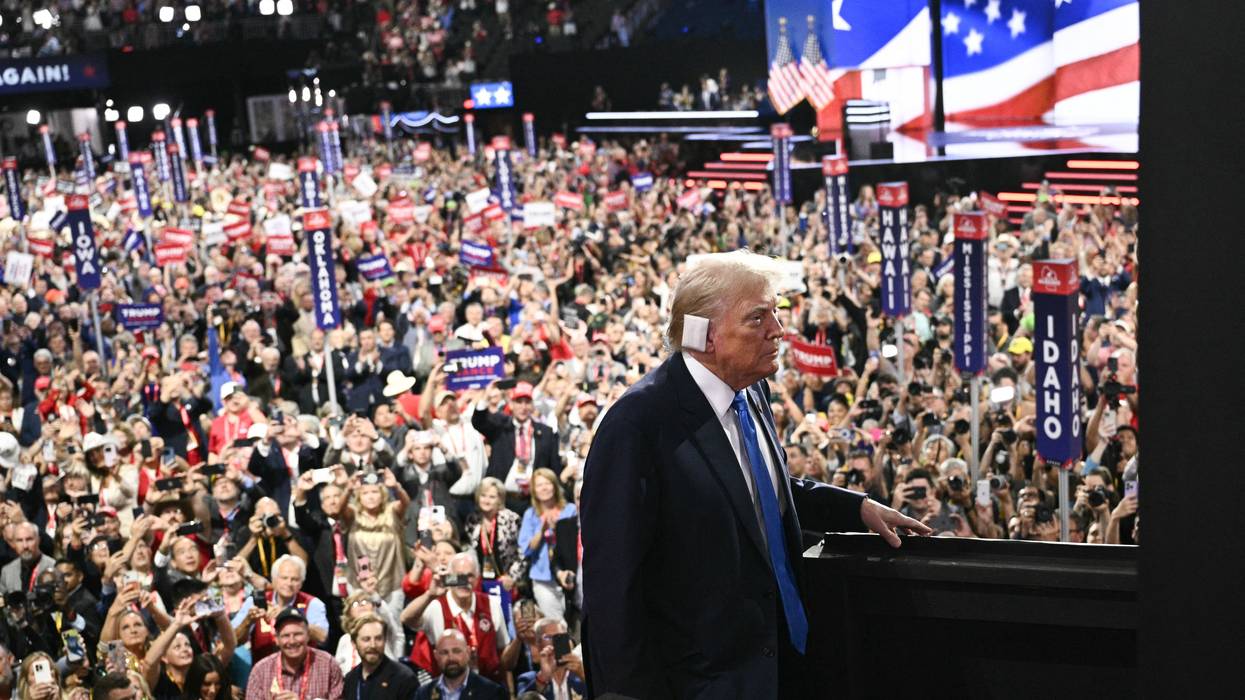
We should be worried about the far right’s Project 2025, but we should be horrified by what we’re seeing right now in 2024, right here in the all-American city of Milwaukee.
I came to the American Heartland to cover a political convention, but all I found was a tent revival, Brother Trump’s Traveling Salvation Show.
The Republican National Convention took just minutes after Monday’s opening gavel to officially nominate its Dear Leader for the third and probably not the last time. The roll call, once the highlight of past conventions, is now an empty ritual. A party platform that was probably written on a Mar-a-Lago cocktail napkin was rammed though with no dissent. RNC schedulers quickly liberated all four nights for the only real purpose they had here in Wisconsin.
The deification of Donald J. Trump.
I never thought I’d see a four-day national celebration of a presidential candidate who just 45 days earlier had been convicted on 34 felony charges.
The undulating white hats that staked a claim for Texas; the buttoned-down accountants under their ill-fitting, newly purchased red MAGA hats; and the tightly-wound blonde women in their adult cheerleading outfits—all of them populated the crowded floor of the Fiserv Forum wearing a badge that read “Delegate,” but they were only extras in the ultimate reality show. They mildly whooped for the transphobic jokes and Second Amendment bravado of faceless GOP congressional candidates but by 8 pm Central most were sucked by a cosmic force toward the back corner of the floor, iPhones aloft to capture a moment of political transubstantiation.
It reaches fever pitch as the Village People’s gay disco anthem “Y.M.C.A.” floods the massive basketball arena, with images of the Leader’s goofball dancing on a big screen. A house band segues into The Romantics’ “What I Like About You” as he finally enters the long tunnel and climbs to his seat, white bandage covering the stigmata of his right ear, which bled from Butler, Pennsylvania, to Milwaukee for the salvation of America and this delirious throng.
In the minutes that follow, vanquished rivals like Nikki Haley or Florida Gov. Ron DeSantis plead for mercy by pledging their undying fealty. The faithful thank their God for intervening Saturday to save Trump and save America. Eventually, the speeches all start sounding like a riff on The Manchurian Candidate: “Donald J. Trump is the kindest, bravest, warmest, most wonderful human being I’ve ever known in my life.”
But the camera is drawn, like a moth to flame, to Trump—head-cocked, absorbing the adulation, probably hoping the TV talking heads are speculating wildly about this obviously changed man. Here in Milwaukee, the political pundits finally saw the thing they’ve been pleading for—unity—and what that really looks like. It looks a lot like Jonestown.
“It seems that our party is really getting unified quite well,” Daniel Bobay, an ex-Californian who retired near Sulphur Springs, Texas, and was attending his first RNC as an alternate delegate, told me inside the Fiserv Forum. It was a variation of a quote I heard again and again and again. Bobay said he hopes the Trump shooting will reduce overheated rhetoric—but only from the media, and not especially from Republicans. “That’s always been the message,” he said with a slight chuckle, referring to tough talk on immigration. “You can’t only build half the wall, or deport only half the people.”
Like any cult, the real mysticism in Milwaukee was the things that went unsaid. I never thought I’d see a four-day national celebration of a presidential candidate who just 45 days earlier had been convicted on 34 felony charges, stemming from his efforts to win the 2016 election by paying off the porn star who would later testify she had sex with him.
But I’m much, much more flabbergasted by how quickly those convictions just vanished from your TV screen and the national conversation—just like the massive financial fraud, just like the E. Jean Carroll rape case, just like the taking of our top secret documents, just like the role he played in trying to tamper with his 2020 election defeat, and his summoning of a violent mob to the U.S. Capitol.
Any need to “tone it down” or “lower the national temperature” after Saturday’s shooting in Butler doesn’t undo the fact that all of those disqualifying things have happened. But here’s the other thing: Nobody at the RNC was really toning it down or lowering the temperature. Instead, it was like a weeklong heat dome of baseless accusation settled over eastern Wisconsin.
What’s more outrageous—that Republicans only want the rhetoric cooled off toward them? Or that the elite media is letting them get away with it?
The harsh tone was set early on Monday, when Wisconsin GOP Sen. Ron Johnson welcomed the faithful to his home state by declaring “the Democrat agenda, their policies, are a clear and present danger to America, to our institutions, our values, and our people.” Johnson then claimed that “the wrong speech” had been stuck into the teleprompter.
Really? In that case, the teleprompter guy must have brought all the wrong speeches. Because if there was some kind of memo about a new GOP message of peace, love, and understanding, it was not widely circulated. As I looked on from the upper deck Tuesday night, I heard a string of “everyday Americans” present a nonstop saga of murder, rape, and drug-related deaths. I wasn’t sure at times if I was watching the RNC or if Comcast had reactivated FEARnet. While some of the crimes were committed by undocumented migrants and others they sought to blame on liberal prosecutors, these truly awful, heartbreaking incidents were always tied back to President Joe Biden.
“I hold Joe Biden and Kamala Harris—the border czar, what a joke—and every Democrat who supports open borders, responsible for the death of my son,” a Southern California mom named Anne Fundner, who lost her 15-year-old son to a fentanyl overdose, told the delegates. Fundner burst into tears while the crowd erupted in chants of “Joe must go!” It was a moment which, like so many at the RNC, turned only emotional dials, without context about any link between Biden’s actual policies—or Trump’s, for that matter—and the calamity that befell Fundner’s son.
And look, no one expects convention goers to mount the RNC podium and admit that Biden’s border policies—which refugee advocates say are too strict and too similar to what Trump did—and his recent curbs on asylum have brought southern border crossings to their lowest levels of the 2020s, But did anyone expect that emotional dog-whistle speeches like Fundner’s would be greeted with delegates waving pre-made placards, “Stop Biden’s Border Bloodbath”?
Did they bring “the wrong signs,” just like Johnson brought “the wrong speech”? Or is this how the Republican Party lowers the temperature, even as it commits a type of stochastic terrorism by describing the most awful rapes and murders and telling America: Biden did this? Their version of “tone it down” is...”bloodbath”? Seriously? And yet when I walked around the inner bowels of the Fiserv Forum, RNC delegates swore that only Democrats are responsible for violent rhetoric.
“The level of violent rhetoric on the left has been escalating for years—they’re awful,” Bob Witsenhausen, the GOP county chair of Santa Fe, New Mexico, an alternate delegate wearing a red MAGA hat autographed by Laura Loomer, told me. He insisted that the “bloodbath” signs were OK because they address undocumented migrants—but he claimed Biden is “trying to label every MAGA Republican as a domestic terrorist.” He slammed Black Lives Matter, but when I asked about the violence on January 6, 2021, he replied with debunked tales about undercover FBI and “antifa” infiltrators. “Jan. 6 was a set up. Anybody who has their eyes open can see that.”
The mostly desolate city blocks here—with cops on bicycles and helicopters and in large gaggles of officers on street corners—feel like a sneak peek at what Trump has in store for Democratic-run cities if he wins in November.
But paranoia strikes deep. Big-time Republicans here in Milwaukee like Donald Trump Jr. and the veep pick, Ohio Sen. JD Vance, both said in interviews that “they” had tried to kill the GOP nominee in Butler County. Wait, I thought the GOP absolutely hates “preferred pronouns.” Why are they calling a 20-year-old registered Republican male “they”? What’s more outrageous—that Republicans only want the rhetoric cooled off toward them? Or that the elite media is letting them get away with it?
The bubble of disinformation walled off in downtown Milwaukee from the rest of America by a maze of concrete barriers could be suffocating at times. I kept wondering one thing: What would the great gonzo journalist Hunter S. Thompson have made of all of this? How long before he started seeing hideous green lizards crawling from underneath the MAGA hats of these rhinestone cowboys, before the numbing conformity revealed the psychedelic terror of the grim American future that crawls just underneath the surface?
But even if everything they said here about Biden and his porous border were actually true, there still wouldn’t be enough illicit pharmaceuticals to satisfy the Hunter S. Thompson of 1972, or to make sense of this Republican Kool-Aid acid test. Besides, America needs less hallucination and more clarity.
The 2024 RNC is indeed all about unity, but only the creepiest and most cultist kinds. I saw unity of fear, in a party of ritual humiliation where dissenters like Mitt Romney or Liz Cheney are tossed down the memory hole. I saw the unity of people professing their love of community and a so-called “real America” that looks like the floor of the Fiserv Forum, overwhelmingly white, with any “different” folks pushed down the escalators.
We should be worried about the far right’s Project 2025, but we should be horrified by what we’re seeing right now in 2024, right here in the all-American city of Milwaukee. The cult of personality around Donald Trump is already creating its own reality, starting with his campaign’s refusal to release any medical information about his treatment or prognosis after Saturday’s shooting.
Monday’s shock cancellation of MSNBC’s “Morning Joe” proved that Big Media can be cowed from asking any tough questions that might pierce this bubble. The mostly desolate city blocks here—with cops on bicycles and helicopters and in large gaggles of officers on street corners—feel like a sneak peek at what Trump has in store for Democratic-run cities if he wins in November.
On Tuesday afternoon, five members of the RNC’s massive security force—imported from Columbus, Ohio, patrolling in a unfamiliar neighborhood one mile away from the Fiserv Forum—confronted a 43-year-old homeless man wielding a knife in an apparent altercation and killed him. The incident is still under investigation, but it felt like an opening volley of a Trump presidency that promises to send law enforcement and even troops into cities like Milwaukee, to round up the homeless or knock on the doors of undocumented migrants.
“Had that been Milwaukee PD, that man would be alive right now,” a neighborhood resident, David Porter, told HuffPost. “I know that because they know him.” You could argue that the homeless man, Samuel Sharpe, from the wrong side of the concrete barriers, is the first victim of a Trump restoration. And as the cult of Donald Trump swoons and sways toward November with little resistance, you can probably guarantee he won’t be the last.