SUBSCRIBE TO OUR FREE NEWSLETTER
Daily news & progressive opinion—funded by the people, not the corporations—delivered straight to your inbox.
5
#000000
#FFFFFF
To donate by check, phone, or other method, see our More Ways to Give page.


Daily news & progressive opinion—funded by the people, not the corporations—delivered straight to your inbox.
Turkey's foreign ministry condemned the plan as "a new stage in Israel's goal of expanding its borders through occupation."
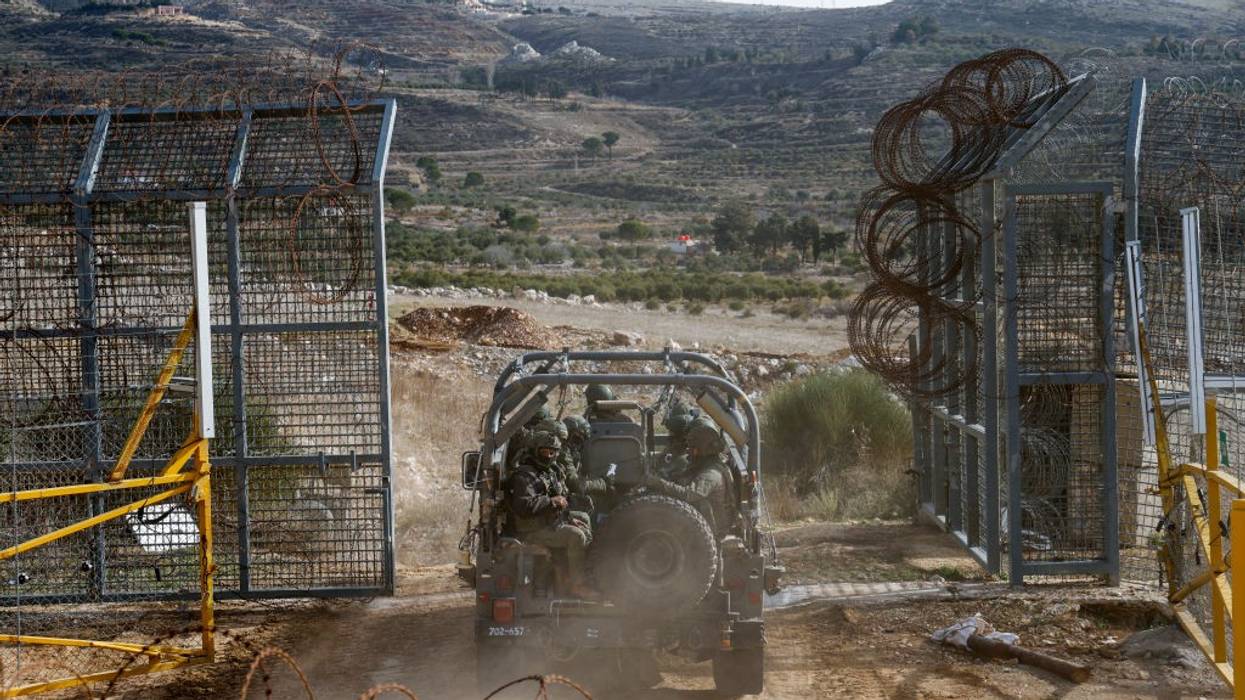
Prime Minister Benjamin Netanyahu said Sunday that Israel would move to expand settlements in the occupied and illegally annexed Golan Heights, exploiting the collapse of the Assad government to further entrench its control of Syrian land.
Netanyahu said in a statement Sunday that "strengthening" the Golan Heights is synonymous with "strengthening the state of Israel" and declared that "we will continue to hold onto it, make it flourish, and settle in it."
According to Netanyahu's office, the Israeli government "unanimously approved" the prime minister's push to double the settler population in the Golan Heights.
There are currently dozens of Israeli settlements housing roughly 20,000 people in the territory, the bulk of which Israel unlawfully annexed in 1981 after occupying it during the 1967 war.
Israel's settlement expansion plan sparked outrage from countries in the region, with Turkey's foreign ministry condemning the decision Sunday as "a new stage in Israel's goal of expanding its borders through occupation."
The foreign ministry of Saudi Arabia accused Israel of "sabotaging" Syria's "prospects for restoring its security and stability."
"The kingdom reaffirms that the occupied Golan is Syrian, Arab land," the ministry added.
Israel's military has wasted no time advancing on Syrian territory in the wake of Assad's fall. As Drop Site noted over the weekend, "Israeli tanks have advanced into villages and towns in Syria's Quneitra governorate, across from the Israeli-occupied Golan Heights, damaging streets, cutting down trees, and destroying electricity poles."
"Israel ordered residents to evacuate their homes. When many refused, Israeli forces destroyed water supply networks and power lines in an attempt to force them out," the outlet added.
On Saturday, as The Guardian reported, "Israel struck dozens of sites in Syria overnight with airstrikes" after the Israeli defense minister announced the country's forces "would remain for the winter on Mount Hermon—known to Syrians as Jabel Sheikh—in positions they occupied last week."
Abu Mohammed al-Jolani, the leader of the rebel group that helped drive Assad from power, denounced Israel's "uncalculated military adventures" but said that "the priority at this stage is reconstruction and stability, not being drawn into disputes that could lead to further destruction."
"Syria's war-weary condition, after years of conflict and war, does not allow for new confrontations," he said.
Israel's push for settlement expansion in the Golan Heights comes amid the country's large-scale, catastrophic assault on the Gaza Strip, which Israeli forces are preparing to occupy indefinitely.
President-elect Donald Trump's return to power in the United States is expected to embolden the far-right forces in Netanyahu's government that are seeking to return settlements to Gaza and annex the West Bank.
Netanyahu said in a video statement that he had "a very friendly, warm, and important discussion" with Trump late Saturday about the future of the Middle East.
"I said we would change the Middle East and we are doing so," the prime minister said. "I discussed with President-elect Trump the need to complete the victory."
American interference, at the behest of Netanyahu’s far-right Israel, has left the Middle East in ruins, with over a million dead and open wars raging in Libya, Sudan, Somalia, Lebanon, Syria, and Palestine, and with Iran on the brink of a nuclear arsenal.
In the famous lines of Tacitus, Roman historian, “To ravage, to slaughter, to usurp under false titles, they call empire; and where they make a desert, they call it peace.”
In our age, it is Israel and the U.S. that make a desert and call it peace.
The story is simple. In stark violation of international law, Israeli Prime Minister Benjamin Netanyahu and his ministers claim the right to rule over seven million Palestinian Arabs. When Israel’s occupation of Palestinian lands leads to militant resistance, Israel labels the resistance “terrorism” and calls on the U.S. to overthrow the Middle East governments that back the “terrorists.” The U.S., under the sway of the Israel Lobby, goes to war on Israel’s behalf.
The fall of Syria this week is the culmination of the Israel-U.S. campaign against Syria that goes back to 1996 with Netanyahu’s arrival to office as Prime Minister. The Israel-U.S. war on Syria escalated in 2011 and 2012, when Barack Obama covertly tasked the CIA with the overthrow of the Syrian Government in Operation Timber Sycamore. That effort finally came to “fruition” this week, after more than 300,000 deaths in the Syrian war since 2011.
Syria’s fall came swiftly because of more than a decade of crushing economic sanctions, the burdens of war, the U.S. seizure of Syria’s oil, Russia’s priorities regarding the conflict in Ukraine, and most immediately, Israel’s attacks on Hezbollah, which was the key military backstop to the Syrian Government. No doubt Assad often misplayed his own hand and faced severe internal discontent, but his regime was targeted for collapse for decades by the U.S. and Israel.
Since 2011, the Israel-U.S. perpetual war on Syria, including bombing, jihadists, economic sanctions, U.S. seizure of Syria’s oil fields, and more, has sunk the Syrian people into misery.
Before the U.S.-Israel campaign to overthrow Assad began in earnest in 2011, Syria was a functioning, growing middle-income country. In January 2009, the IMF Executive Board had this to say:
Executive Directors welcomed Syria’s strong macroeconomic performance in recent years, as manifested in the rapid non-oil GDP growth, comfortable level of foreign reserves, and low and declining government debt. This performance reflected both robust regional demand and the authorities’ reform efforts to shift toward a more market- based economy.
Since 2011, the Israel-U.S. perpetual war on Syria, including bombing, jihadists, economic sanctions, U.S. seizure of Syria’s oil fields, and more, has sunk the Syrian people into misery.
In the immediate two days following the collapse of the government, Israel conducted about 480 strikes across Syria, and completely destroyed the Syrian fleet in Latakia. Pursuing his expansionist agenda, Prime Minister Netanyahu illegally claimed control over the demilitarized buffer zone in the Golan Heights and declared that the Golan Heights will be a part of the State of Israel “for eternity.”
Netanyahu’s ambition to transform the region through war, which dates back almost three decades, is playing out in front of our eyes. In a press conference on December 9th, the Israeli prime minister boasted of an “absolute victory,” justifying the on-going genocide in Gaza and escalating violence throughout the region:
I ask you, just think, if we had acceded to those who told us time and again: '"The war must be stopped"– we would not have entered Rafah, we would not have seized the Philadelphia Corridor, we would not have eliminated Sinwar, we would not have surprised our enemies in Lebanon and the entire world in a daring operation-stratagem, we would not have eliminated Nasrallah, we would not have destroyed Hezbollah's underground network, and we would not have exposed Iran's weakness. The operations that we have carried out since the beginning of the war are dismantling the axis brick by brick.
The long history of Israel’s campaign to overthrow the Syrian Government is not widely understood, yet the documentary record is clear. Israel’s war on Syria began with U.S. and Israeli neoconservatives in 1996, who fashioned a “Clean Break” strategy for the Middle East for Netanyahu as he came to office. The core of the “clean break” strategy called for the Israel (and the US) to reject “land for peace,” the idea that Israel would withdraw from the occupied Palestinian lands in return for peace. Instead, Israel would retain the occupied Palestinian lands, rule over the Palestinian people in an Apartheid state, step-by-step ethnically cleanse the state, and enforce so-called “peace for peace” by overthrowing neighboring governments that resisted Israel’s land claims.
The long history of Israel’s campaign to overthrow the Syrian Government is not widely understood, yet the documentary record is clear.
The Clean Break strategy asserts, “Our claim to the land—to which we have clung for hope for 2000 years—is legitimate and noble,” and goes on to state, “Syria challenges Israel on Lebanese soil. An effective approach, and one with which American can sympathize, would be if Israel seized the strategic initiative along its northern borders by engaging Hizballah, Syria, and Iran, as the principal agents of aggression in Lebanon…”
In his 1996 book Fighting Terrorism, Netanyahu set out the new strategy. Israel would not fight the terrorists; it would fight the states that support the terrorists. More accurately, it would get the US to do Israel’s fighting for it. As he elaborated in 2001:
The first and most crucial thing to understand is this: There is no international terrorism without the support of sovereign states.… Take away all this state support, and the entire scaffolding of international terrorism will collapse into dust.
Netanyahu’s strategy was integrated into U.S. foreign policy. Taking out Syria was always a key part of the plan. This was confirmed to General Wesley Clark after 9/11. He was told, during a visit at the Pentagon, that “we’re going to attack and destroy the governments in seven countries in five years—we’re going to start with Iraq, and then we’re going to move to Syria, Lebanon, Libya, Somalia, Sudan and Iran.” Iraq would be first, then Syria, and the rest. (Netanyahu’s campaign for the Iraq War is spelled out in detail in Dennis Fritz’s new book, Deadly Betrayal. The role of the Israel Lobby is spelled out in Ilan Pappé’s new book, Lobbying for Zionism on Both Sides of the Atlantic). The insurgency that hit U.S. troops in Iraq set back the five-year timeline, but did not change the basic strategy.
The U.S. has by now led or sponsored wars against Iraq (invasion in 2003), Lebanon (U.S. funding and arming Israel), Libya (NATO bombing in 2011), Syria (CIA operation during 2010’s), Sudan (supporting rebels to break Sudan apart in 2011), and Somalia (backing Ethiopia’s invasion in 2006). A prospective U.S. war with Iran, ardently sought by Israel, is still pending.
Strange as it might seem, the CIA has repeatedly backed Islamist Jihadists to fight these wars, and jihadists have just toppled the Syrian regime. The CIA, after all, helped to create al-Qaeda in the first place by training, arming, and financing the Mujahideen in Afghanistan from the late 1970s onward. Yes, Osama bin Laden later turned on the U.S., but his movement was a U.S. creation all the same. Ironically, as Seymour Hersh confirms, it was Assad’s intelligence that “tipped off the U.S. to an impending Al Qaeda bombing attack on the headquarters of the U.S. Navy’s Fifth Fleet.”
Operation Timber Sycamore was a billion-dollar CIA covert program launched by Obama to overthrow Bashar al-Assad. The CIA funded, trained, and provided intelligence to radical and extreme Islamist groups. The CIA effort also involved a “rat line” to run weapons from Libya (attacked by NATO in 2011) to the jihadists in Syria. In 2014, Seymour Hersh described the operation in his piece “The Red Line and the Rat Line”:
“A highly classified annex to the report, not made public, described a secret agreement reached in early 2012 between the Obama and Erdoğan administrations. It pertained to the rat line. By the terms of the agreement, funding came from Turkey, as well as Saudi Arabia and Qatar; the CIA, with the support of MI6, was responsible for getting arms from Gaddafi’s arsenals into Syria.”
Soon after the launch of Timber Sycamore, in March 2013, at a joint conference by President Obama and Prime Minister Netanyahu at the White House, Obama said: “With respect to Syria, the United States continues to work with allies and friends and the Syrian opposition to hasten the end of Assad’s rule.”
To the U.S.-Israeli Zionist mentality, a call for negotiation by an adversary is taken as a sign of weakness of the adversary. Those who call for negotiations on the other side typically end up dead—murdered by Israel or U.S. assets. We’ve seen this play out recently in Lebanon. The Lebanese Foreign Minister confirmed that Hassan Nasrallah, Former Secretary-General of Hezbollah had agreed to a ceasefire with Israel days before his assassination. Hezbollah’s willingness to accept a peace agreement according to the Arab-Islamic world’s wishes of a two-state solution is long-standing. Similarly, instead of negotiating to end the war in Gaza, Israel assassinated Hamas’ political chief, Ismail Haniyeh, in Tehran.
To the U.S.-Israeli Zionist mentality, a call for negotiation by an adversary is taken as a sign of weakness of the adversary.
Similarly in Syria, instead of allowing for a political solution to emerge, the U.S. opposed the peace process multiple times. In 2012, the UN had negotiated a peace agreement in Syria that was blocked by the Americans, who demanded that Assad must go on the first day of the peace agreement. The U.S. wanted regime change, not peace. In September 2024, Netanyahu addressed the General Assembly with a map of the Middle East divided between “Blessing” and “Curse,” with Lebanon, Syria, Iraq, and Iran as part of Netanyahu’s curse. The real curse is Israel’s path of mayhem and war, which has now engulfed Lebanon and Syria, with Netayahu’s fervent hope to draw the U.S. into war with Iran as well.
The U.S. and Israel are high-fiving that they have successfully wrecked yet another adversary of Israel and defender of the Palestinian cause, with Netanyahu claiming “credit for starting the historic process.” Most likely Syria will now succumb to continued war among the many armed protagonists, as has happened in the previous U.S.-Israeli regime-change operations.
In short, American interference, at the behest of Netanyahu’s Israel, has left the Middle East in ruins, with over a million dead and open wars raging in Libya, Sudan, Somalia, Lebanon, Syria, and Palestine, and with Iran on the brink of a nuclear arsenal, being pushed against its own inclinations to this eventuality.
All this is in the service of a profoundly unjust cause: to deny Palestinians their political rights in the service of Zionist extremism based on the 7th century BCE Book of Joshua. Remarkably, according to that text—one relied on by Israel’s own religious zealots—the Israelites were not even the original inhabitants of the land. Rather, according the text, God instructs Joshua and his warriors to commit multiple genocides to conquer the land.
Against this backdrop, the Arab-Islamic nations and indeed almost all of the world have repeatedly united in the call for a two-state solution and peace between Israel and Palestine.
Instead of the two-state solution, Israel and the U.S. have made a desert and called it peace.
"What we are seeing is a violation of the disengagement agreement from 1974," said Geir Pedersen, the United Nations' special envoy to Syria.
The United Nations' special envoy to Syria said Tuesday that the Israeli military's rapid move to seize Syrian territory following the Assad government's collapse is a grave violation of a decades-old agreement that Prime Minister Benjamin Netanyahu claims is now dead.
"What we are seeing is a violation of the disengagement agreement from 1974, so we will obviously, with our colleagues in New York, follow this extremely closely in the hours and days ahead," Geir Pedersen said at a media briefing in Geneva.
Hours earlier, Pedersen told Zeteo's Mehdi Hasan that "this needs to stop," referring to Israel's further encroachment on the occupied and illegally annexed Golan Heights.
"This is a very serious issue," Pedersen said, rejecting Netanyahu's assertion that the 1974 agreement is null. "Let's not start playing with an extremely important part of the peace structure that has been in place."
"The message to Israel is that this needs to stop, What we are seeing in the Golan is a violation of the 1974 agreement. This is a very serious issue."
The UN's Syria Special Envoy tells me on 'Mehdi Unfiltered' that Israel's unlawful actions in Syria need to stop. pic.twitter.com/G7jSWJ8oP0
— Mehdi Hasan (@mehdirhasan) December 9, 2024
Netanyahu, who took the stand for the first time Tuesday in his long-running corruption trial, made clear in the wake of Assad's fall that he views developments in Syria as advantageous for Israel, writing on social media that "the collapse of the Syrian regime is a direct result of the severe blows with which we have struck Hamas, Hezbollah, and Iran."
The prime minister also thanked U.S. President-elect Donald Trump for "acceding to my request to recognize Israel's sovereignty over the Golan Heights, in 2019," adding that the occupied territory "will be an inseparable part of the state of Israel forever."
The Washington Post reported late Monday that "within hours of rebels taking control of Syria's capital, Israel moved to seize military posts in that country’s south, sending its troops across the border for the first time since the official end of the Yom Kippur War in 1974."
"Israeli officials defended the move as limited in scope, aimed at preventing rebels or other local militias from using abandoned Syrian military equipment to target Israel or the Golan Heights, an area occupied by Israel after the 1967 Arab-Israeli war," the Post added. "On Monday, more troops could be seen outside this Druze village adjacent to the border, preparing to cross."
The United States, Israel's main ally and arms supplier, also defended the Israeli military's actions, with a State Department spokesman telling reporters Monday that "every country, I think, would be worried about a possible vacuum that could be filled by terrorist organizations on its border, especially in volatile times, as we obviously are in right now in Syria."
Watch StateSpox justify Israel’s invasion of Syria based on hypotheticals.@shauntandon: Israel has gone across the Golan Heights, the UN said it’s a violation, does the US agree
Miller: Every country would be worried about a possible vacuum that could be filled by terrorist… pic.twitter.com/AA7lNhfSt1
— Assal Rad (@AssalRad) December 9, 2024
On Tuesday, Israel denied reports that its tanks reached a point roughly 16 miles from the Syrian capital as it continued to bomb Syrian army bases.
"Regional security sources and officers within the now fallen Syrian army described Tuesday morning's airstrikes as the heaviest yet, hitting military installations and airbases across Syria, destroying dozens of helicopters and jets, as well as Republican Guard assets in and around Damascus," Reuters reported. The U.S. also bombed dozens of targets in Syria in the aftermath of Assad's fall.
The governments of Iraq, Qatar, Iran, and Saudi Arabia have each denounced the Israeli military's seizure of Syrian land, with Qatar's foreign ministry slamming the move as "a dangerous development and a blatant attack on Syria's sovereignty and unity as well as a flagrant violation of international law."
"The policy of imposing a fait accompli pursued by the Israeli occupation, including its attempts to occupy Syrian territories, will lead the region to further violence and tension," the foreign ministry warned.
An interview with Lebanon expert Mireille Rebeiz, who says that "I would like to believe that Lebanon will not turn into a second Gaza," but now finds itself "in the middle of a major storm."
After nearly a year since the Hamas-led terror attack on southern Israel that resulted in the deaths of close to 1200 people (roughly 800 civilians and nearly 400 security forces though some Israeli civilians and soldiers may have been killed by friendly fire as the controversial “Hannibal Directive” was deployed on that date, according to reported testimonies of soldiers and officers), Israel’s destruction of Gaza continues unabated.
Israel has rejected calls from the international community for a ceasefire/prisoner swap deal and blatantly ignored an International Court of Justice ruling not to engage in any military offensive in Rafah where the situation in the southern Gaza city was already “disastrous.” Now, however, after having killed more than 41,000 Palestinians (though the toll could reach up to 186,000 dead according to a study published in early July in the prestigious medical journal Lancet) and making Gaza practically unlivable, Netanyahu’s neo-fascist government that makes Europe’s right-wing extremists seem like little farceurs has turned its focus to Lebanon. A joint operation between the IDF and Mossad spread terror by exploding walkie-talkies and pagers that people in Lebanon used, killing many and severely wounding thousands, while the Israeli military carried out massive airstrikes across southern Lebanon that have already killed more than 1,000 people, including many children, and wounded thousands.
Airstrikes have killed scores of senior Hezbollah figures, including its long-time leader, Hassan Nasrallah. But the airstrikes on Lebanon did not stop even after Nasrallah’s death despite calls for de-escalation, raising fears of a regional war between Israel and Iran. The Israeli military has even targeted central Beirut, and up to one million people may have been displaced. And as even further evidence that Israel is seeking to provoke a regional war, it launched a ground offensive in the south of Lebanon where heavy fighting is apparently taking place between Israeli forces and Hezbollah fighters. Indeed, Iran seems now to have been dragged into a regional war by launching a major missile attack on Israel.
What is Israel after in Lebanon? Has Nasrallah’s death altered the direction of the conflict? Are we on the brink of a full-blown war in the Middle East? In the interview that follows, Mireille Rebeiz, a Lebanon and Hezbollah expert tackles these and other related questions. Rebeiz is Chair of Middle East Studies and Associate Professor of Francophone Studies & Women’s, Gender and Sexuality Studies at Dickinson College (Pennsylvania).
C. J. Polychroniou: Almost a year after launching its devastating attack on Gaza, which the International Court of Justice, scores of international human rights organizations and leading international law scholars and historians have called a genocide, Israel has turned its focus on Lebanon. It blew up communication devices that the armed group Hezbollah had ordered months before the explosions, killing dozens and wounding thousands, and the Israeli military launched a wave of deadly attacks on Lebanon’s capital, one of which struck Hezbollah’s headquarters killing its long-time leader, Hassan Nasrallah. Israel’s war objectives in the Gaza Strip are to wipe Hamas off the earth and make Gaza unlivable. What is Israel trying to accomplish with its attacks on Hezbollah and Lebanon?
Mireille Rebeiz: From Israel’s point of view, the on-going war on Lebanon falls under its right to self-defense against terrorism.
Last week, we saw a series of attacks on Hezbollah fighters including the explosions of pagers and other wireless devices and the assassinations of several leaders. Although Israel has not officially commented on the attacks, evidence suggests that it has been planning this action for some time now.
Escalation continued with the assassination of Hezbollah’s Secretary General Hassan Nasrallah and several other commanders. Israel dropped at least fifteen-times, American – manufactured, 2,000-pound bombs on south Beirut. Dubbed the “bunker busters” for their ability to pierce the ground before detonating, these bombs leveled several concrete buildings.
More recently, Israel started a ground invasion on south Lebanon and bombed Damascus by air.
The announced goals are clear: eliminate Hezbollah at all costs and send a message to Iran and Syria that Israel will no longer tolerate Iranian-backed militias in the region.
On the surface, one may look at these facts and consider that Israel is justified in its actions. However, international law tells a different story for Israel is piling violations of several rules and regulations related to armed conflicts. Furthermore, the war on terrorism is never innocent and always carries other motives.
Article 7 of Amended Protocol II on the Prohibitions or Restrictions on the Use of Mines, Booby-Traps and Other Devices, to which Lebanon, Israel, and the United States are parties, explicitly bans these types of weapons and methods of warfare. Article 2(4) of Amended Protocol II defines “booby-trap” as “any device or material which is designed, constructed, or adapted to kill or injure, and which functions unexpectedly when a person disturbs or approaches an apparently harmless object or performs an apparently safe act.”
Clearly, the pagers and other wireless devices have been tampered with to cause harm irrespective of its holder. As a result, at least 32 people, including two children were killed and thousands more were injured, and it is impossible to argue that every single person killed or injured is a Hezbollah fighter.
Common Article 3 of the Geneva Conventions specifically states that persons not taking part in the hostilities and those placed “hors de combat” should not be targeted and shall be treated humanely. The wireless communication device explosions and the intense bombing of south Beirut cannot guarantee any protection to civilians and those unrelated to Hezbollah. Many civilians -- Lebanese citizens, Palestinians and Syrian refugees -- live in south Beirut for its affordable housing.
Beirut itself ranks as the 6th most expensive city in the Arab world, coming after Dubai, Abu Dhabi, Doha, Riyadh, and Jeddah. Globally, it ranks as the 113th most expensive city out of 178.
According to the World Bank 2023 report, inflation rate in Lebanon is in the triple-digit. There is serious decline in income as the Lebanese pound lost over 90% of its value. This led to the erosion of the middle class, and half of the population plunged under poverty line with unemployment nearing 30%.
Major events aggravated the financial crisis in Lebanon: the collapse of the infrastructure, the severe shortage of fuel, the pandemic that put a lot of stress on medical care, and finally the Beirut port explosion of 2020.
These factors pushed many Lebanese and others to rent apartments in south Beirut, and Israel cannot guarantee that every resident of this part of town is a Hezbollah fighter.
There is no doubt that these tactics imply a major escalation and a serious violation of international law. Former CIA director Leon Panetta labelled these attacks in Lebanon as terrorism: “I don’t think there’s any question that it’s a form of terrorism.”
Since the United States of America is the one providing many of these weapons, there might be criminal implications under U.S Law as the violation of Article 7 (2) could amount to federal offense. This prompted Secretary of State Anthony Blinken to quickly dissociate the US from the attacks and call for restraints. This comes at a time when the Biden Administration is under investigation for the export of billions of dollars in arms to Israel in assistance of a foreign government accused of committing gross human rights violations including blocking humanitarian aid.
Furthermore, Israeli Prime Minister Benjamin Netanyahu has a strategy that goes beyond the Israel – Hezbollah war. His political survival is dependent on him staying in power.
Before the October 7 attacks, Netanyahu was on trial for corruption. After winning the election, he aligned himself with extremists, forming a far-right government, one that sought to transform Israel into an autocratic theocracy. For instance, his government proposed a contentious law to reduce minority rights, make it harder to file complaints against corruption, and legalize the annexation of the West Bank. His plans triggered massive protests around the country.
The October 7 attacks were heinous, and they provided Netanyahu with the perfect excuse that would allow him to stay in power: he shifted the narrative to Palestinian rights – including the right to self-determination – as an existential threat to all Jews, justifying thus the need for a long war in Gaza.
In other words, it is in Netanyahu’s interest to keep Israel in a permanent state of war. To do so, he must reject all diplomatic negotiations and place the blame of their failure on the other party.
At this point, Netanyahu is buying time to present the messianic radicals, on whom he relies on to stay in power, with concrete results, ones that would save his image and political career. His undeclared goals would be the annexation of Gaza, the West Bank, and possibly south Lebanon. The hostages are not among his primary concerns.
Under international law, annexation of territory is illegal. The International Court of Justice (ICJ) said Israel’s occupation of the West Bank is illegal and ordered Israel to stop its illegal settlements in the West Bank, East Jerusalem and the Gaza strip. The United Nations even declared these settlements as “settler-colonialism.” Netanyahu’s response was that the ICJ’s decision is based on lies.
The occupation of the Syrian Golan Heights is equally illegal, and the on-going ground invasion in Lebanon is not only a violation of Lebanon’s sovereignty and an act of war, but also may be the excuse to occupy south Lebanon and annex it.
C. J. Polychroniou: Hezbollah emerged in Lebanon largely in response to the Israeli invasion of that country in 1982. It is an Iran-backed Shiite Islamist militant group and political party with lawmakers in the Lebanese parliament and is seen in fact as something like “a state within a state.” What does Hezbollah do in Lebanon and how much support does it have?
Mireille Rebeiz: Over time, Hezbollah’s popularity shifted inside Lebanon. Hezbollah itself was born in 1982 when Israel invaded Lebanon and imposed a brutal two-months siege on Beirut killing an estimated number of 17,000 to 19,000 people. While Israel retreated from Beirut, it kept south Lebanon under occupation till 2000. During this period, it illegally detained thousands of Lebanese resisting the occupation. Over 200 were detained and tortured in the Khiam Detention Center.
From 1982 till early 2000, many Lebanese supported Hezbollah and saw it as the guardian of Lebanon’s sovereignty and its liberator. The shift began in 2000 when Israel withdrew from the south. Many Lebanese started speaking up against Hezbollah’s armed presence in Lebanon, its alliance to the Syrian regime, and its commitment to Iranian ideology.
As a matter of fact, Hezbollah explicitly supported the Syrian dictator Bashar al-Assad despite the numerous reports of severe human rights violations in Syria. As to Iran, in its 1985 Manifesto, Hezbollah vowed its allegiance to Iran’s Supreme Leader Ruhollah Musavi Khomeini and made explicit its wish to create an Islamic state in Lebanon.
And many paid a heavy price for speaking out. Former Prime Minister Rafic Hariri was assassinated on February 14, 2005, and fingers pointed at Hezbollah and Syria. Many Lebanese journalists and political figures were also assassinated: a blast killed the anti-Syrian journalist, Samir Kassir. The former Communist party leader George Hawi and the journalist and lawmaker Gibran Tueni were also killed in car bombs.
This wave of killings sparked the Cedar Revolution, which clearly expressed the Lebanese’s opposition to Hezbollah and Syria.
In the past two decades, this opposition continued and took different forms.
In 2005, the anti-Hezbollah and anti-Syria bloc won the parliamentary elections.
In 2015, the environmental movement “You Stink” was born. It criticized the State’s inability to sustainably manage waste, and it opposed all political parties, including Hezbollah. In 2019, massive protests erupted all over the country under the slogan of “All Means All” to denounce the corrupt elites.
There is no doubt that Hezbollah operates as “a state within a state.” In light of the weakness of the State of Lebanon, Hezbollah offers its own healthcare, education system and other social services to the Shiite community. It functions inside and outside the governmental structure and unilaterally holds the decision for peace/war.
In 1992, Hezbollah participated in parliamentary elections and won several seats in the Parliament. In 2005, it entered the government. Alone, they were never a majority. However, their presence was strong enough to oppose any parliamentary or governmental decision that would go against their own interests.
C. J. Polychroniou: Nasrallah was being considered as something of a pragmatist rather than an ideologue. It is now quite conceivable that the next Hezbollah leadership might be more driven by revenge than Nasrallah was. At any rate, what does Nasrallah’s death mean for Hezbollah, Lebanon, and the Middle East? Will Iran become directly involved in the conflict?
Mireille Rebeiz: Nasrallah’s death is a definite blow to the group, and it did not take long for Iran to respond. In fact, Iran launched several missiles into Israel to avenge the killing of three of its top leaders: Hamas Chairman Ismail Haniyeh, Hezbollah Secretary General Hassan Nasrallah, and Deputy Commander in the Iranian Revolutionary Guard Abbas Nilforushan. Iran made it clear that this is a self-defense attack and that it will respond further should Israel attack Iran.
Ironically, Hezbollah started this war to support Hamas and the Palestinian cause. Now, the attention has completely shifted from Gaza and the West Bank to Iran, Israel, and the United States.
C. J. Polychroniou: Under president Joe Biden, US foreign policy in the Middle East has been a complete failure. Over the past several months, Biden has said on countless occasions that “we are closer than ever” to a Gaza ceasefire only to see Netanyahu turn Gaza into a graveyard. Biden called for a 21-day ceasefire along the Israel-Lebanon border only to see Netanyahu make him look again like a bumbling idiot. How do you explain the US-Israel relationship?
Mireille Rebeiz: The US is Israel’s closest and proudest ally. However, the failure of US foreign policy in the Middle East is in large part to blame for the recent events. At no point in the past two decades did the US lead any serious diplomatic dialogue on Israel – Palestine.
President Biden continues to support a far-right government in Israel irrespective of the consequences in the region and the major escalation we are witnessing. Many Americans are horrified by this support and the US’ potential complicity in atrocities in Gaza.
Netanyahu’s’ visit to the United Nations, his rejection of the 21-day cease-fire, and the immediate attacks that followed in Lebanon indicate a clear separation between what the US would like to see and what Israel wants.
Stephen Collinson speaks of a humiliating pattern indicating American impotency in curtailing Israel’s defiance, and the results are obvious: Gaza is leveled with over 41,000 civilians killed, of which 17,000 are children. Lebanon is under attack with a ground invasion in progress, and violence is escalating in the West Bank.
C. J. Polychroniou: Gaza is gone, and there are fears that Israel could turn Lebanon into a second Gaza. In your view, what does the future hold for Lebanon?
Mireille Rebeiz: So far, the rhetoric is that Israel will only bomb areas where Hezbollah fighters are located or areas suspected of storing Hezbollah’s weapons.
The level of destruction is massive, and the number of casualties is on the rise. I would like to believe that Lebanon will not turn into a second Gaza. However, the situation is fluid, and it depends on on-going diplomatic negotiations and the arrival of other actors on the scene such as the Houthis in Yemen or Kata’ib Hizballah in Iraq or even Iran.
In any case, I pray that Lebanon will be spared. Lebanon is in the middle of a major storm. As US-backed Israel and Iran-backed Hezbollah militants are exchanging fires and settling debts, the Lebanese people are caught in the middle of the crossfire.
It is a shame that many of us can stomach the murder of innocents so long as it behooves our political tribalism.
When was our humanity divided along partisan lines?
Here, I'll give you an example of what I mean. A rocket was fired from Lebanon in late July. It struck a soccer field in the Israeli-controlled Golan Heights. And it killed 12 children.
Right-wing media—including Fox News—immediately erupted. Red-faced pundits spent hours lambasting the atrocity as a heinous war crime—which I agree with. Fox News, Ben Shapiro, and all the other partisan media entities decrying the wrongful deaths of those 12 children on July 27 are right.
If we cannot agree that the murder of a child—whether by an Islamic militant or by a politician in a suit and tie—is evil, period, then our moral compass has been rendered useless.
What's odd, however, is that they only seem outraged by self-serving political narratives. Where was their rage the last 10 months, as piles of young Palestinian corpses have been stacked thousands high? It begs the question: Does the murder of children only anger us when it suits our neatly defined, partisan worldviews?
Only the willfully ignorant have been spared the horrific imagery of modern Gaza the rest of us have seen: charred and mangled limbs sprouting from heaps of rubble; the ashen-white, limp bodies of lifeless children; and the soul-torturing wails of a weeping mother or father.
Israeli Prime Minister Benjamin Netanyahu and his bloodthirsty cronies aren't being too subtle about their motivations either. See, this isn't just a war against Hamas. This is a war against the Palestinian people as a whole. And those aren't my words. Those are theirs.
"I have ordered a complete siege on the Gaza Strip. There will be no electricity, no food, no fuel, everything is closed (...) We are fighting human animals and we are acting accordingly."
-Yoav Gallant, Minister of Defense
"Those are animals, they have no right to exist. I am not debating the way it will happen, but they need to be exterminated.”
-Yoav Kisch, Education Minister
"I don't care about Gaza. I literally don't care at all. They can go out and swim in the sea. I want to see dead bodies of terrorists around Gaza."
-May Golan, Minister of Social Equality
"The majority of the 12,000 dead Palestinians were terrorists. [...] Good riddance.”
-Yair Lapid, Leader of the Opposition
"The war will never end if we don't expel them all.”
-Nissim Vaturi, Member of the Israeli Knesset
"It is not Hamas that should be eliminated. Gaza should be razed and Israel's rule should be restored to the place. This is our country."
-Moshe Feiglin, Former Member of the Israeli Knesset
"The fighting will continue and expand to any place necessary in the Gaza strip. There will be no sanctuary cities.”
-Benny Gantz, Former Minister of Defense
"One of the options is to drop an atomic bomb on Gaza. I pray and hope for [the hostages'] return, but there is also a price in war.”
-Amichai Eliyahu, Minister of Heritage
"We are the people of the light, they are the people of darkness... we shall realize the prophecy of Isaiah."
-Benjamin Netanyahu, Prime Minister
Not a great look, guys. Especially given that every aforementioned quote came from the tongues of Israeli leaders, the very people whose hands are on the levers of power. The rhetoric is damning, and precisely why South Africa (a country that knows all too well what apartheid looks like) levied a genocide case against Israel, and why the International Criminal Court prosecutor's office has requested arrest warrants for Netanyahu, Gallant, and three Hamas leaders.
Thousands of Palestinians have been murdered. Many more are maimed and starving. Meanwhile, the Israeli human rights group B'Tselem reports that Israel is running "a network of torture camps."Palestinian prisoners, many detained unjustly, allege they've been raped, sometimes with objects, and sometimes by even female soldiers.
Israel's finance minister, Bezalel Smotrich, just recently said, "No one in the world will allow us to starve 2 million people, even though it might be justified and moral in order to free the hostages.”
Put together, the evidence creates a macabre mosaic that is most aptly described in one word: genocide. Indeed, this is an extermination campaign, and one that my government is enabling. (Since October 7, 2023, the U.S. has enacted legislation providing more than $12.5 billion in military aid to Israel).
As Americans, I wanted to think we'd rally, together, against a state-sponsored extermination campaign that we are funding. Though I was wrong. Even today, as Gaza has become a slaughterhouse, so-called intellectuals—even self-described liberals like Bill Maher and Bari Weiss—are unable to see the Israeli government for what it is: a gaggle of bloodthirsty politicians using American dollars to systematically murder innocent Palestinians.
Earnest criticism of rape, concentration camps, and genocide is not antisemitic. A government cannot be inoculated from scrutiny with identity politics. Don't be fooled: Criticizing Israel's shameful war is not Jewish hate by default. Those who say it is are intellectually dishonest and moral cowards.
It is a shame that many of us can stomach the murder of innocents so long as it behooves our political tribalism. Of course I condemn Hamas. But we're well past the point of condemning Hamas as a prerequisite for criticizing Netanyahu. As an American, if I criticize the Bush administration's nonsensical war in Iraq, I am not first asked to denounce al Qaeda or Saddam Hussein. None of my fellow Americans assume that, when I criticize Dick Cheney, the Iraq war, and the White House's lies about weapons of mass destruction, that I am an apologist for Osama bin Laden or that I approve of the deaths of my fellow countrymen on September 11, 2001.
No longer can America lay claim to the idea that we don't negotiate with terrorists. Because on July 24, a terrorist by the name of Benjamin Netanyahu walked into our capital, castigated Americans critical of his war as "idiots,"and was applauded.
I am worried about the soul of America. If we cannot agree that the murder of a child—whether by an Islamic militant or by a politician in a suit and tie—is evil, period, then our moral compass has been rendered useless. If we are more outraged by the students protesting genocide than the genocide itself, we have not only failed the Palestinians, but we've failed Israel. But worst of all, we've failed ourselves. Partisan schisms have sterilized our hearts, I'm afraid. And it's why the term never again is happening again.
I didn't understand this as a boy. Because when I was young, I simply couldn't wrap my mind around how and why the world could allow evil things to happen. Now, I think, I know.
One group responded to Israel's bombing of "a densely populated civilian area in Beirut" by urging governments to "condemn this dangerous escalation and immediately suspend arms sales to Israel."
This is a developing story… Please check back for possible updates...
The Israel Defense Forces confirmed Tuesday that it "carried out a targeted strike in Beirut," elevating fears of an all-out war with Lebanon or a larger regional conflict as Israel continues a monthslong assault on the Gaza Strip.
Israel has blamed Hezbollah, a militia and political party in Lebanon, for the recent rocket attack on a soccer field in Majdal Shams, a town in the Israeli-occupied Golan Heights. Hezbollah has denied responsibility.
The IDF said on social media that its strike in the Lebanese capital targeted an unnamed "commander responsible for the murder of the children in Majdal Shams and the killing of numerous additional Israeli civilians."
BREAKING NEWS: The Israeli army has launched a "precision strike" on Beirut, targeting a Hezbollah commander. This operation comes in retaliation for an attack on the Israeli-occupied Golan Heights on Saturday. pic.twitter.com/CI0ZOW04Lg
— Mondoweiss (@Mondoweiss) July 30, 2024
Reuters reported that "a senior Lebanese security source said a senior Hezbollah commander had been the target of the air strike and his fate remained unclear."
The Israeli strike "targeted the area around Hezbollah's Shura Council in the Haret Hreik neighborhood of the capital," Reuters added, citing Lebanon's state-run national news agency.
Since the Israeli assault on Gaza began over the Hamas-led October 7 attack, cross-border strikes have killed hundreds of Hezbollah fighters and approximately 100 civilians.
The Peace & Justice Project—founded by Jeremy Corbyn, an Independent member of the United Kingdom's Parliament—said Tuesday that "in the last few moments, Israel has bombed a densely populated civilian area in Beirut. The U.K. and U.S. governments must condemn this dangerous escalation and immediately suspend arms sales to Israel."
Sarah Leah Whitson, executive director of Democracy for the Arab World Now (DAWN), urged U.S. President Joe Biden—who has enabled the Israeli assault on Gaza with diplomatic and weapons support—to put pressure on Israel to prevent war with Lebanon.
"In the days after October 7, President Biden had a message for Hezbollah: 'Don't.' Now it's time for Biden to send the same message to Israel: Don't launch a new war in Lebanon, don't keep evading a permanent cease-fire in Gaza, don't assume American support if you start a regional war," she said. "The U.S. government should be doing everything it can to stop the escalation of the conflict and the only way to accomplish that is to exert enough pressure on Israel to reach a permanent cease-fire in Gaza."
Like DAWN's leader, Win Without War executive director Sara Haghdoosti also connected the airstrike to peace in Gaza.
"The latest round of strikes between the Israeli military and Hezbollah puts the region at the edge of a major war," Haghdoosti warned. "Win Without War is alarmed by the escalation over the last several days. We call on the Biden administration to redouble diplomatic efforts to calm tensions and prevent further violence."
"A cease-fire in Gaza remains the most crucial step in ending this devastating cycle of violence," she added. "We urge the Biden administration to use all the leverage at its disposal to secure a deal that returns hostages held in Gaza, ends the killing and horrific humanitarian crisis in Gaza, and averts a regional war."
"This evacuation delay once more exposes Israel's disregard for the lives of children and innocent civilians in Gaza," said Physicians for Human Rights–Israel. "Vengeance is not a legitimate policy."
Israeli Prime Minister Benjamin Netanyahu has reportedly delayed a planned transfer of wounded and sick Palestinian children from Gaza to the United Arab Emirates in retaliation for a rocket attack in the occupied Golan Heights over the weekend that killed a dozen kids.
The Israeli newspaper Haaretz reported that Netanyahu ordered the postponement of the operation on Sunday "due to" the deadly rocket attack, which Israel blamed on Hezbollah. The Lebanon-based militant group denied responsibility.
The delayed plan, according to Haaretz, involved "evacuating patients from Gaza for treatment in the United Arab Emirates via Ramon Airport near Eilat in southern Israel."
"The World Health Organization (WHO) was to manage the evacuation, including patient triage, coordination with the [Israel Defense Forces], and funding transportation from Gaza to Ramon Airport," the newspaper added. "A plane carrying approximately 250 patients was scheduled to depart Israel on Sunday."
Physicians for Human Rights–Israel (PHRI) denounced Netanyahu's decision to postpone the transfer as "cruel and dangerous."
"The immense grief over the 12 children killed in Majdal Shams must not be exploited for cynical political moves. Endangering sick Gazan children won't bring back those lost," the group wrote on social media. "Following Israel's destruction of Gaza's healthcare system, PHRI has been advocating and taking legal action to force Israel to establish procedures for evacuating thousands of sick and wounded Gazans requiring medical care not available locally."
"This evacuation delay once more exposes Israel's disregard for the lives of children and innocent civilians in Gaza," PHRI added. "Vengeance is not a legitimate policy."
Gaza children have been devastated by Israel's nearly 10-month war on the besieged Palestinian enclave. Israeli forces have killed more than 14,000 Palestinian children in Gaza since October, and tens of thousands more are wounded or missing.
Noa Landau, Haaretz's deputy editor-in-chief, wrote Monday that Netanyahu's order delaying the evacuation of ill and injured kids from Gaza was "miserable" and "stupid."
"Harming children to avenge the blood of other children," she added.
In the wake of the rocket attack in the Golan Heights on Saturday, Israel "struck Hezbollah targets deep inside Lebanon," according to The Washington Post, intensifying fears of an all-out regional war.
The Biden administration, which has aided Israel's assault on Gaza with military and diplomatic support, warned the Israeli government that "the situation would likely spiral out of control" if it bombs Lebanon's capital in response to the Golan Heights attack, Axios reported Sunday.
RAMALLAH, West Bank - Israel's deadly game of divide and conquer against its enemies could be coming home to roost with a vengeance, especially as the Islamic State (ISIS) grows in strength in neighboring countries and moves closer to Israel's borders.
"Despite ISIS ultimately being a threat to Israel, it currently fits in with Israel's strategy of weakening the military capabilities of Iran and Syria, both enemies of ISIS, the same way a previously powerful Iraqi military had threatened Israel."
Desperate to maintain the calm in Gaza, Israel has been conducting intermittent, off-the-record indirect talks with Hamas through U.N., European and Qatar intermediaries despite vowing to never negotiate with Hamas which it describes as a "terror organization".
Israel helped promote the establishment of Hamas in the late 1980s in a bid to thwart the popularity of the Palestinian Authority-affiliated Palestine Liberation Organization (PLO) which was then also regarded as a "terrorist organization" and the most powerful and popular Palestinian political movement.
But Israel's indirect support of ISIS-affiliated Syrian opposition groups could be an even bigger gamble.
As the Omar Brigades calculated, the Israel Defence Forces (IDF) responded by attacking Hamas military targets in the coastal territory because they hold the Gaza leadership responsible for any attacks on Israel.
"Israelis, we learn, are essentially being used as pawns in a deadly game of chicken between Hamas and these Salafist rivals," said Alison Kaplan Sommer, a columnist with the Israeli daily Haaretz.
"The Salafists refuse to abide by the informal truce that has kept the tense quiet between Hamas and Israel since the Gaza war - and Hamas is not religious and fundamentalist enough for their taste.
"Firing rockets into Israel serves a dual purpose for them. It makes a statement that they are true jihadists, unlike the Hamas sell-outs who abide by truces - and it also happens to be an excellent way for them to indirectly strike back at their Hamas oppressors. Why, after all, go to the trouble of attacking Hamas when you can so easily get Israel to do it for you?"
Israel's dual policy of covertly supporting ISIS-affiliated Jihadists in Syria in a bid to weaken Israel's arch-enemy Syria has taken several forms.
U.N. observers in the Golan Heights have released reports detailing cooperation between Israel and Syrian opposition figures including regular contacts between IDF soldiers and Syrian rebels.
Israel is also regularly admitting wounded Syrian opposition fighters to Israeli hospitals and it is not based on humanitarian considerations.
Israel finally responded by saying the wounded were civilians reaching the border by their own accords but later conceded it was coordinating with armed opposition groups.
"Israel initially had maintained that it was treating only civilians. However, reports claimed that members of Israel's Druze minority protested the hospitalization of wounded Syrian fighters from the al-Qaeda-linked al-Nusra Front in Israel," reported the Global Research Center for Research on Globalization.
The last report distributed to U.N. Security Council members in December described two U.N. representatives witnessing Israeli soldiers opening a border gate and letting two unwounded people exit Israel into the Golan Heights.
The Syrian ambassador to the United Nations also complained of widespread cooperation between Israel and Syrian rebels, not only for treatment of the wounded but also other aid.
U.N. observers remarked in a report distributed last year that they identified IDF soldiers on the Israeli side handing over two boxes to armed Syrian opposition members on the Syrian side.
Despite ISIS ultimately being a threat to Israel, it currently fits in with Israel's strategy of weakening the military capabilities of Iran and Syria, both enemies of ISIS, the same way a previously powerful Iraqi military had threatened Israel.
When the United States began operations against ISIS, a senior Israeli high command seemed reluctant to give any support and called the move a mistake.
It was easier to deal with terrorism in its early stages [ISIS] than to face an Iranian threat and the Hezbollah, he said. "I believe the West intervened too early and not necessarily in the right direction," he told Haaretz anonymously.
"Israel is pursuing a policy that in the long term will ultimately be self-defeating. In a bid to divide Syria, Israel is supporting ISIS but this will backfire in that ISIS is growing in strength and destroying societies in its path and it will eventually turn its sights on Israel," Professor Samir Awad from Birzeit University, near Ramallah, told IPS.
It is possible that ISIS could topple future regimes that Israel is hoping for support from, including Syrian rebels who hinted at a peace with Israel once Syrian President Bashar Assad is toppled.
Jacky Hugi, the Arab affairs analyst for Israeli army radio Galie-Zahal who confirmed on the Al Monitor website that Israel was taking the Syrian rebels side in the fighting, had a warning.
"We should stop with the illusions - the day 'after Assad' won't bring about a secular liberal ruling alternative. The extremist organizations are the most dominant factions in Syria nowadays," said Hugi. "Any void left in Syria will be seized by them, not the moderate rebels."
According to political analyst Benedetta Berti of Israel's Institute of National Security Studies, Israel is closely monitoring its northern front, specifically the Golan Heights.
"Israel believes that there is no current threat from the rebels as they are too busy with the Syrian war," Berti told IPS. "However, if we extend the time frame, then the situation could change when Syrian rebels may want to attack Israel from the northern borders."