
SUBSCRIBE TO OUR FREE NEWSLETTER
Daily news & progressive opinion—funded by the people, not the corporations—delivered straight to your inbox.
5
#000000
#FFFFFF
To donate by check, phone, or other method, see our More Ways to Give page.


Daily news & progressive opinion—funded by the people, not the corporations—delivered straight to your inbox.
"This is a clear attempt to seize and hold power over our elections by sending a message that any county or state that doesn't vote in favor of the president or his preferred candidates may be subjected to a harassment campaign."
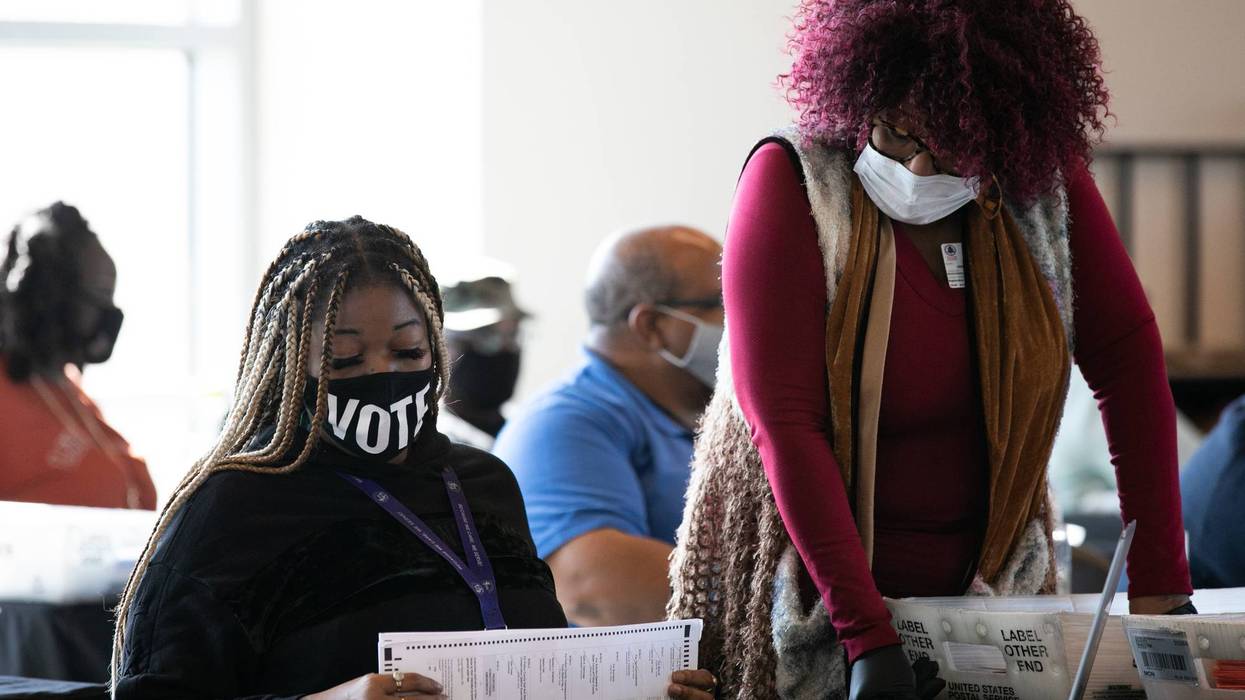
Democracy defenders sounded the alarm just over three months ago, when the Federal Bureau of Investigation executed a search warrant at a Georgia election hub. They expressed concerns again after a court filing revealed late Monday that President Donald Trump's Department of Justice is demanding the names of Fulton County's 2020 election workers.
For years, the Republican president has "obsessively propagated the debunked conspiracy theory that Fulton County 'stole' the 2020 election from him. And he has made it clear that he seeks retribution against those who refuse to indulge his baseless claims," notes the county's Monday filing aimed at blocking the April 20 grand jury subpoena for election workers' personal data.
The largely Democratic county—which includes most of Atlanta—argued that it should not have to turn over workers' names, home addresses, emails, and telephone numbers due to federal overreach and First Amendment concerns, according to CBS News. It also suggested the subpoena is politically motivated and highlighted the statute of limitations for 2020 election crimes.
"After illegally seizing our election records in January, the federal government once again is attempting to misuse criminal process," Fulton County Commission Chairman Robb Pitts said in a statement announcing the motion.
"This is yet another act of outrageous federal overreach designed to intimidate and to chill participation in elections. This harassment should not be allowed, so we have asked the court to act," he continued. "I will always stand up for our elections workers and for the truth. Let me be crystal clear. Fulton County will not be intimidated."
Voting rights advocates echoed the concerns noted by the filing and Pitts. Lauren Groh-Wargo, who leads Fair Fight Action, told The New York Times that election workers across the United States now face heightened threats and harassment.
"Roughly a third of election officials are threatened on the job, and more than half worry it's making it harder to hire and keep election workers," Groh-Wargo said. "They're trying to break our democracy by attacking the infrastructure, but we are fighting back hard."
Trump's DOJ is losing in Fulton County – so they've resorted to harassing election workers. In 2020, workers saw death threats due to false claims.This case was initially rejected by ATL's FBI Chief. It's built on false claims that were investigated and rejected, including by Republican officials.
[image or embed]
— Max Flugrath🗳️ (@maxflugrath.bsky.social) May 5, 2026 at 8:31 AM
All Voting Is Local Georgia state director Kristin Nabers stressed in a statement that "the conspiracy theories and lies that dictate White House policy have real-world consequences beyond appeasing the president's fragile ego—they are being weaponized to target the people from our communities who run our elections and ensure our votes are counted."
"This is a clear attempt to seize and hold power over our elections by sending a message that any county or state that doesn't vote in favor of the president or his preferred candidates may be subjected to a harassment campaign like that of Fulton County," she continued. "This intimidation tactic is a slap in the face to the millions of county election workers and volunteers around the country who work tirelessly to make sure our elections run smoothly."
Nabers added that "the all-out assault on Fulton County and its poll workers creates a blueprint for the administration to see what it can get away with during the midterm elections when results in key counties and states don't go its way. Election workers in Fulton County and beyond will not be intimidated by this desperate bullying."
The fight in Fulton County—where Trump and others initially faced criminal charges for their effort to overturn his 2020 loss—comes as some primary elections are underway across the country, and amid mounting concerns about what the president may try in November, particularly if the GOP-controlled Congress passes the attack on voting rights that the White House is pushing.
Michael McNulty, policy director of the group Issue One, said Tuesday that "Americans should be furious" about Trump's demands in Georgia, which "are based solely on debunked conspiracy theories from 2020 that courts and post-election audits have repeatedly rejected."
"Targeting these heroic election workers does nothing to strengthen our democracy—it puts ordinary public servants at risk in an attempt to erode trust in elections," he warned. “The Trump administration's goal is to make Americans feel distrust and cynicism about the election process. While the administration is framing its actions using the 2020 elections, it is proceeding with this year's midterms in mind."
As McNulty detailed, Trump's "election takeover playbook" includes:
"If this playbook is left unchecked, the Trump administration will continue to abuse its power and attempt to meddle in elections like authoritarian leaders in other countries," he said. "Congress must stop this."
"It should use oversight and funding authority to halt the executive branch from weaponizing federal power against the heroes who run our elections," McNulty argued. "Members of Congress swore an oath to the Constitution when they agreed to serve, and now is a test of whether they are willing to live up to that oath and protect the American people."
Some members of Congress joined voting rights advocates in speaking out against the subpoena this week. Sharing the Times report on social media Tuesday, Sen. Mark Warner (D-Va.) declared that "Trump's attacks on our free and fair elections won't stop."
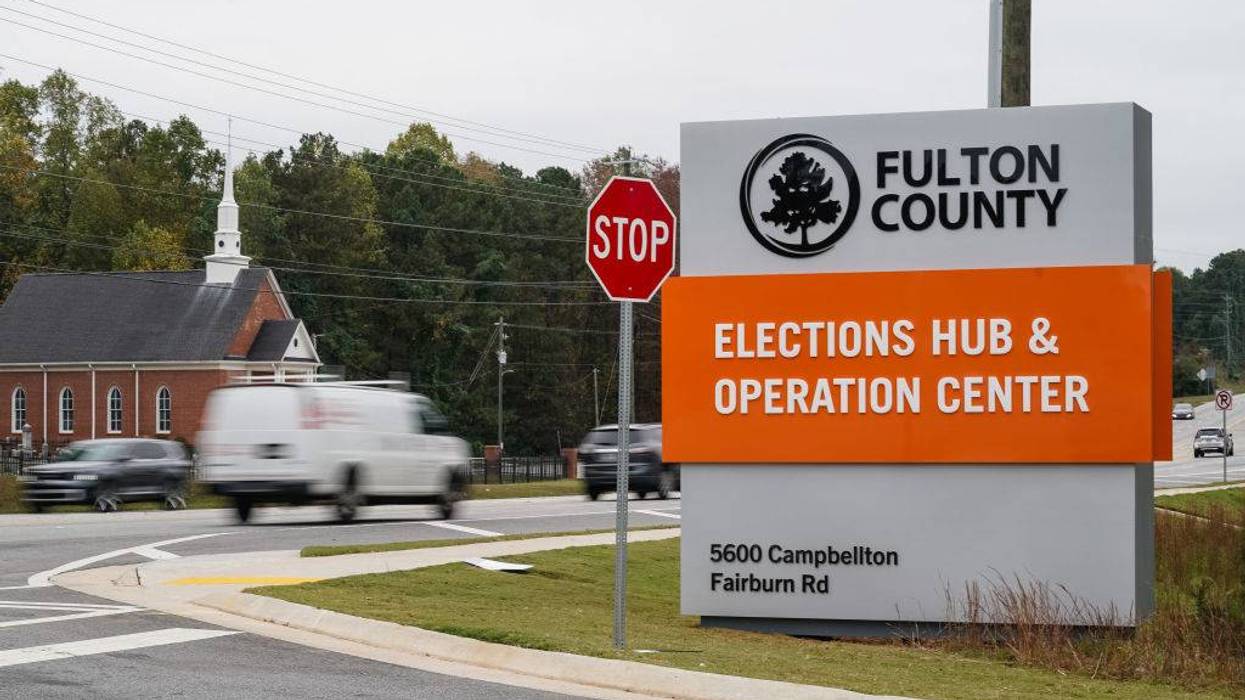
“We have very serious concerns about what the Trump administration could do with the voting records of thousands of people from Fulton County."
Civil rights organizations are demanding that a federal court place restrictions on the Trump administration's use of materials seizedduring its unprecedented raid on an elections center in Fulton County, Georgia in January.
Five groups—the Lawyers' Committee for Civil Rights Under Law, the NAACP, the Georgia State Conference of the NAACP, the Atlanta branch of the NAACP, and the Georgia Coalition for the People’s Agenda—on Monday asked the Atlanta Division of the US District Court for the Northern District of Georgia to bar the administration from using any materials seized from the Fulton County Election Hub and Operations center for anything other than the criminal investigation outlined in the search warrant used to justify the raid.
Among other things, this would bar the administration from using materials taken from the center for voter roll maintenance, election administration, or the enforcement of federal immigration laws.
The groups argued the constraints are necessary to enforce "statutory protections for the right to vote, voter privacy, and ballot secrecy, which are fundamentally critical given the unprecedented assaults on the administration of elections."
Additionally, the groups asked the court to force the administration to create and publicly disclose a full inventory of materials seized from the voting center, as well as a catalog of all people who have accessed the materials during the investigation.
Damon Hewitt, president and executive director of the Lawyers’ Committee for Civil Rights Under Law, claimed that the seizure of materials related to the 2020 presidential election was a continuation of Trump's years-long quest to overturn his loss to former President Joe Biden.
Hewitt also warned the raid on the Fulton County elections center should be seen as part of an assault on voter rights throughout the US.
"These actions are part of a larger pattern," he explained. "We are witnessing a broad-scale assault on fair elections on many fronts, from going after voting records and squeezing out Black voters through redistricting, to improperly purging voters from the rolls and making it harder for everyone to vote. Some have called what we are witnessing a ‘soft coup’. Whatever we call it, we must all understand that our democracy is at risk."
Robert Weiner, director of the voting rights project at the Lawyers’ Committee for Civil Rights Under Law, said the seizure of materials raised major privacy issues for Fulton County voters.
"We have very serious concerns about what the Trump administration could do with the voting records of thousands of people from Fulton County," said Weiner. "We are talking about sensitive private information. After the DOGE disaster, voters need to be confident their private information is in safe and trustworthy hands."
The FBI last month executed a search warrant at the Fulton County election center that allowed federal agents to seize 2020 election ballots, tabulator tapes, digital data, and voter rolls.
Shortly after the raid, Fulton County Commissioner Mo Ivory predicted that this kind of operation would likely be spreading to other counties and states.
“Fulton County is right now the target," Ivory said. "But it is coming to a place near you. This is the beginning of the chaos of 2026 that is about to ensue."
"This should have people across the country absolutely shook," said Sen. Jon Ossoff.
The FBI's Wednesday raid on an elections center in Fulton County, Georgia is raising alarms about President Donald Trump's plans to disrupt the 2026 midterm elections.
Shortly after FBI agents executed a search warrant at the Fulton County Election Hub and Operations center to search for materials related to the 2020 presidential election, Fulton County Commissioner Mo Ivory warned that this kind of operation would likely be spreading to other counties and states.
"Fulton County is right now the target, the only county right now fighting over an election that already happened," she said, referring to Trump's election loss that he has refused to concede more than five years after it happened. "But it is coming to a place near you. This is the beginning of the chaos of 2026 that is about to ensue."
Commissioner Mo Ivory: Fulton County is right now the target, the only county right now fighting over an election that already happened. But it is coming to a place near you. This is the beginning of the chaos of 2026 that is about to ensue. pic.twitter.com/0HvPMMoQO8
— Blue Georgia (@BlueATLGeorgia) January 28, 2026
In a Wednesday interview on MSNOW, Sen. Jon Ossoff (D-Ga.) described the raid on the elections center as a "seismic event" that should be a flashing red light for US voters.
"This should have people across the country absolutely shook," Ossoff said. "This is a huge deal. This is an FBI raid on the Fulton County Elections office. [Trump's] conspiracy theories about the 2020 election have been based in Georgia from the very start... this is a shot across the bow at the midterm elections. He tried to steal power when he lost it in 2020. We have to be prepared for all kinds of schemes and shenanigans."
Ossoff: "This is a seismic event. This should have people across the country absolutely shook. This is a huge deal. This is an FBI raid on the Fulton County Elections office ... This is a shot across the bow at the midterm elections. He tried to steal power when he lost it in… pic.twitter.com/vb8YwcP3Pa
— Aaron Rupar (@atrupar) January 29, 2026
Sen. Mark Warner (D-Va.) noted that US Director of National Intelligence Tulsi Gabbard was spotted at the elections center during the FBI raid, which he said was wholly unprecedented given that her job is supposed to be focused on foreign national security threats.
Warner then posited two explanations for her presence on the ground in Fulton County.
"Director Gabbard believes there was a legitimate foreign intelligence nexus," Warner wrote in a social media post, "in which case she is in clear violation of her obligation under the law to keep the intelligence committees 'fully and currently informed' of relevant national security concerns."
The other option, said Warner, is that Gabbard "is once again demonstrating her utter lack of fitness for the office that she holds by injecting the nonpartisan intelligence community she is supposed to be leading into a domestic political stunt designed to legitimize conspiracy theories that undermine our democracy."
ProPublica published a report on Thursday that dove into the specifics of the search warrant executed at the Fulton County election center that allowed federal agents to seize 2020 election ballots, tabulator tapes, digital data, and voter rolls.
Rick Hasen, a law professor at the University of California, Los Angeles, told ProPublica that he has never seen a search warrant of this nature.
"The idea that federal officials would seize ballots in an attempt to prove fraud is especially dangerous in this context," said Hasen, "when we know there is no fraud because the Georgia 2020 election has been extensively counted, recounted, and investigated."
Derek Clinger, a senior counsel at the State Democracy Research Initiative, an institute at the University of Wisconsin Law School, told ProPublica that the sweeping search warrant marked "a dramatic escalation in the Trump administration’s efforts to expand federal control over our country’s historically state-run election infrastructure."
Members of the GOP-controlled election board "are abusing their power," a voting rights group said. "Perpetuating misinformation about elections can lead to threats against local election officials who refuse to cave to lies about the 2020 election."
The FBI on Wednesday executed a search warrant at the warehouse that serves as the election hub for Fulton County, Georgia—a location central to President Donald Trump's election fraud conspiracy theories.
Bureau sources confirmed to CBS News that they had conducted a “court-authorized activity” in connection with an investigation related to the 2020 election. A spokesperson for the FBI field office in Atlanta said no additional details can be provided because "the investigation into this matter is ongoing."
Fulton County Clerk Ché Alexander told the Atlanta Journal-Constitution that a large number of agents were seen entering the warehouse and hauling out boxes of ballots.
“The FBI agents are here to get the 2020 ballots,” Alexander said. “They’re all here—trucks, everything."
Former President Joe Biden narrowly won the state of Georgia en route to defeating Trump in 2020. But Trump has long alleged—through numerous disproven claims—that his loss was the result of widespread voter fraud.
Fulton County, which contains most of the Democratic stronghold of Atlanta, was at the center of the misleading allegations spread by Trump and allies, who claimed, among other things, that election workers had surreptitiously tallied tens of thousands of fraudulent ballots.
Despite these claims being thoroughly refuted by Republican election officials in the state, Trump infamously attempted to pressure Secretary of State Brad Raffensperger to “find 11,780 votes” for him, which would allow him to win the state in the Electoral College.
In 2023, Fulton County District Attorney Fani Willis brought racketeering charges against Trump and 18 of his associates over the scheme, which was described as part of a conspiracy to illegally overturn Georgia's election result. However, that case never made it to trial after being bogged down by a scandal involving a relationship between Willis and the special prosecutor assigned to the case, which ultimately led to it being thrown out in November.
At a speech last week in Davos, Switzerland, Trump seemed to warn that retribution against those he claims to have been involved with election theft was coming. Speaking of what he said was a “rigged election,” Trump said: “People will soon be prosecuted for what they did. That’s probably breaking news.”
The US Department of Justice (DOJ) had already sued Fulton County in December for access to its ballots and other records from the 2020 presidential vote, a lawsuit Democracy Docket said "came after far-right members of the state’s GOP-controlled election board asked the department for assistance in obtaining 2020 ballots and voting records."
Prior to that, Ed Martin, the head of the DOJ’s "weaponization task force," sent a letter to a Fulton County judge demanding to “immediately access” 148,000 absentee ballots being stored in a ballot warehouse, which he said were needed as part of an "election integrity" investigation being conducted by the DOJ.
In October, the New York Times reported that a top "election integrity" official in the Trump administration had urged the president to invoke a "national emergency" to allow for more federal control over election rules typically left to state and local governments.
"I would have been unsurprised if the Fulton County DA was targeted by the administration for investigation," said Anthony Michael Kreis, a political scientist at the Georgia State University College of Law. "But going directly after the Fulton County elections office is an entirely different and potentially startling development."
The voting rights group All Voting Is Local said in a statement that "by first calling on the Trump administration's Department of Justice to investigate Fulton again, and now supporting the lawsuit, the conspiracy theorists who now make up a majority of the State Election Board are abusing their power. Perpetuating misinformation about elections can lead to threats against local election officials who refuse to cave to lies about the 2020 election."
This article has been updated with a new quote from All Voting Is Local.
One commentator called the decision a "huge victory for democracy" and a "huge defeat for Trump's attempts to scuttle the election."
Democratic officials and voting rights advocates on Tuesday celebrated "a victory for voters" in the crucial battleground state of Georgia after a county judge ruled that local officials must certify results regardless of claims of "election fraud"—an occurrence experts have found to be "vanishingly rare" despite Republican claims to the contrary.
Fulton County Superior Court Judge Robert McBurney handed down a ruling late Monday in a case brought by Fulton County Board of Elections member Julie Adams, who worked with the America First Policy Institute, a group with ties to Republican presidential nominee Donald Trump, on the lawsuit.
Adams asked McBurney to rule on her claim that her election certification duties "are discretionary not ministerial"—an assertion the judge rejected.
"Election superintendents in Georgia have a mandatory fixed obligation to certify election results," McBurney wrote in an 11-page ruling. "Consequently, no election superintendent (or member of a board of elections and registration) may refuse to certify or abstain from certifying election results under any circumstance."
Adams, he said, wanted permission "to play investigator, prosecutor, jury, and judge" with the possibility of making "a unilateral determination of error or fraud" and refusing to certify election results.
"Georgia voters would be silenced," wrote the judge. "Our constitution and our election code do not allow for that to happen."
Noting that the ruling was announced as early voting started in the state on Tuesday, voting rights reporter Ari Berman called the decision a "big victory for democratic norms and [a] loss for Trump-allied election deniers trying to subvert 2024 outcome."
"Georgia voters would be silenced. Our constitution and our election code do not allow for that to happen."
As Common Dreams reported last month, more than 100 current election officials in swing states are among the Trump loyalists who have engaged in partisan election denial in recent years.
Adams was one of 18 county election board members in Georgia who were named in a report by the Center for Media and Democracy. She refused to certify two primary elections earlier this year and is a regional coordinator for the Election Integrity Network, which has recruited election deniers in swing states to target local election offices.
Georgia was a key focus of baseless claims by Trump and his allies that the 2020 election had been "rigged" in favor of Democratic President Joe Biden. Three recounts of the state's ballots found no evidence of election fraud that could have swung the election, and legal cases and recounts in other states garnered similar results—but Trump and his allies, including vice presidential nominee Sen. JD Vance (R-Ohio) in an interview with The New York Times last week, have continued to deny that Trump lost the 2020 election.
"Election after election, in state after state, we have protected our elections from far-right Republicans trying to disrupt them, and Democrats remain ready to stand up and make sure every voter can cast their ballot knowing it will count," said the Democratic National Committee and the Democratic Party of Georgia in a joint statement on Tuesday. "The experts were clear that the 2020 election was free, fair, and secure, and Democrats are making sure that the 2024 is the same."
Critics say Trump and the Republican Party have been preparing for months to challenge the 2024 election, with the former president and House Speaker Mike Johnson (R-La.) repeatedly claiming that undocumented voters routinely vote in elections and calling for voters to prove their citizenship; the GOP targeting absentee and military ballots in Michigan; and the America First Policy Institute suing to block an Arizona law that prohibits harassment of election officials.
The ruling on Monday evening was a "huge victory for democracy," said lawyer and commentator Tristan Snell, and a "huge defeat for Trump's attempts to scuttle the election."
Kristen Nabers, state director of All Voting is Local Georgia said voters in the state won "against a shameless attempt from a prominent election denier who tried to turn the long-standing, routine duty of certification into a discretionary decision for election officials when they don't like the election results."
"Today's ruling confirmed that certifying elections in Georgia is a mandatory democratic duty of election officials, who don't get to override the will of the people by holding certification hostage," said Nabers. "The judge's decision gives Georgia voters much-deserved validation and confirms that there are systems in place to protect the voices of all Georgians. Election officials do not decide the results. Voters do."
A Fulton County Superior Court judge on Thursday rejected a request by former U.S. President Donald Trump and most of his co-defendants to have their charges for interfering in Georgia's 2020 election dismissed on First Amendment grounds.
As Judge Scott McAfee explained, Trump and 14 other defendants in the Racketeer Influenced and Corrupt Organizations (RICO) Act case "argue this prosecution violates the First Amendment's protections of political speech and activity, freedom of association, and the right to petition Congress as-applied to their alleged conduct, and further contend that the indicted charges are overbroad."
"After interpreting the indictment's language liberally in favor of the state as required at this pretrial stage," McAfee wrote in his 14-page order, "the court finds that the defendants' expressions and speech are alleged to have been made in furtherance of criminal activity and constitute false statements knowingly and willfully made in matters within a government agency's jurisdiction which threaten to deceive and harm the government."
"Even core political speech addressing matters of public concern is not impenetrable from prosecution if allegedly used to further criminal activity," he continued. "And independently lawful acts involving speech within the meaning of the First Amendment may nonetheless suffice to support a RICO conspiracy prosecution."
In other words, as University of Alabama law professor and MSNBC legal analyst Joyce Vance put it, "speech isn't protected when it's in furtherance of a crime, like saying 'stick 'em up' during a bank robbery."
The Hill noted that the judge's Thursday ruling "leaves open the possibility that Trump could still raise a First Amendment defense down the road once the factual record is more developed."
Steve Sadow, the twice-impeached former president's lawyer, said in a statement that Trump and the other defendants "respectfully disagree with Judge McAfee's order and will continue to evaluate their options regarding First Amendment challenges."
"It is significant that the court's ruling made clear that defendants were not foreclosed from again raising their 'as-applied challenges at the appropriate time after the establishment of a factual record,'" the attorney added.
The Georgia election case has been held up recently by complications related to Democratic Fulton County District Attorney Fani Willis' love life, though McAfee ruled last month that she can continue to serve as the prosecutor. A trial date has not yet been set.
Trump is fighting three other criminal cases while campaigning as the presumptive Republican nominee to face Democratic President Joe Biden in the November election. There is also a New York state case stemming from hush-money payments during the 2016 election cycle as well as a pair of federal cases: one related to 2020 election interference and another that has to do with his mishandling of classified material.
In addition to 88 felony charges across the criminal cases, Trump is facing multimillion-dollar penalties in New York for "repeated and persistent fraud" related to his business and defaming E. Jean Carroll regarding rape allegations she made against him.
U.S. District Judge Aileen Cannon, the Trump appointee overseeing the classified material case in the Southern District of Florida, on Thursday rejected the ex-president's attempt to dismiss charges based on claims that he had the right to keep the documents under federal law—though her decision also leaves him the chance to return to the argument if the case goes to trial.
In her three-page ruling, Politico reported, "Cannon also shot down a request from Special Counsel Jack Smith to promptly reveal whether she agrees with Trump's claim that the Presidential Records Act—the post-Watergate law governing White House records—may have authorized him to keep classified records indefinitely even after leaving office."
This post has been updated to include Thursday's classified material ruling and the 88 charges, reduced from 91 in March.
A Washington, D.C. jury on Friday ordered Rudy Giuliani to pay $148 million for falsely accusing two former Georgia election workers of engaging in a non-existent conspiracy to "steal" the 2020 U.S. presidential election from then-President Donald Trump.
After deliberating for roughly 10 hours over two days, the jury sided with Ruby Freeman and her daughter Wandrea ArShaye "Shaye" Moss, whom the former New York City mayor and Trump attorney accused of taking part in a fake ballot harvesting scheme while they worked as election officials in Fulton County, Georgia.
Giuliani accused the women of "surreptitiously passing around USB ports as if they are vials of heroin or cocaine" while they tallied ballots. In reality, the surveillance footage reviewed by Giuliani that informed his baseless claim showed Freeman handing Moss a ginger mint.
In August, Judge Beryl Howell of the U.S. District Court for the District of Columbia
found Giuliani liable for defaming Freeman and Moss, and tasked a jury with determining monetary damages for the women, who endured death threats and harassment from Trump supporters.
"Today's a good day," Freeman said outside the courthouse after the decision was announced, according to The Atlanta Journal-Constitution. "A jury stood witness to what Rudy Giuliani did to me and my daughter, and held him accountable."
"I can never move back into the house that I called home. I will always have to be careful about where I go and who I choose to share my name with," Freeman continued. "I miss my home. I miss my neighbors. And I miss my name."
"Rudy Giuliani was not the only one who spread lies about us, and others must be held accountable, too," she added. "But that is tomorrow's work."
Moss said, "We hope no one ever has to fight so hard just to get your name back."
Christina Harvey, executive director at the government corruption watchdog Stand Up America, said that "today's verdict not only vindicates Freeman and Moss but also serves as a reminder that we must protect the unsung heroes of democracy—our dedicated poll workers."
"Sadly, 1 in 6 local election workers has faced threats while carrying out their duties, reflecting the country's increasingly hostile political landscape," Harvey added. "Working the polls shouldn't mean putting your safety or reputation at risk. Congress should do more to protect poll workers, and that starts with including robust election infrastructure funding in the upcoming appropriations package."
Giuliani vowed to appeal the decision.
"The absurdity of the number merely underscores the absurdity of the entire proceeding, where I've not been allowed to offer one single piece of evidence in defense, which I have a lot," he said outside the courthouse. "I am quite confident when this case gets before a fair tribunal, it'll be reversed so quickly it will make your head spin."
Giuliani, Trump—who is the GOP's 2024 presidential front-runner—and others face felony criminal charges in Fulton County for trying to steal the 2020 presidential election.
In July, an attorney discipline panel ruled that Giuliani has "forfeited his right to practice law" and should be disbarred in Washington, D.C. for leading Trump's legal team as it tried to overturn the election results.
If a man entrusted with the power of the presidency commits crimes against the Constitution and our democracy, that’s more reason to insist he be subject to law, not less.
The day after Donald Trump was arraigned for his alleged effort to steal the 2020 election, he posted a naked threat: “IF YOU GO AFTER ME, I’M COMING AFTER YOU!”
That followed his federal indictment. After he was indicted in Georgia, Trump openly warned a witness not to testify. “I am reading reports that failed former Lt. Governor of Georgia, Jeff Duncan, will be testifying before the Fulton County Grand Jury,” Trump posted. “He shouldn’t.”
As Trump well knows, when he inflames his MAGA disciples, violence commonly follows.
Anyone else convicted of Trump’s crimes would plainly go to prison for years. And anyone else openly threatening witnesses would quickly see their bail revoked.
Now a woman has been arrested for threatening to kill the judge overseeing Trump’s federal election interference case. And the Georgia grand jurors who voted to charge Trump have had their addresses published on an extremist website. Supporters labeled the jurors’ collected addresses a “hit list” and suggested “long range rifles” might be useful.
Obviously, jurors in any of Trump’s trials risk retaliation should they decide the evidence proves him guilty.
Judges explicitly warned Trump not to intimidate witnesses or “prejudice potential jurors.” Which raises an uncomfortable question: Why isn’t he in jail already?
Federal judges take witness tampering seriously—they revoked bail for alleged cryptocurrency crook Sam Bankman-Fried for interfering with witness testimony. That’s simply the rule of law. If you violate the orders under which you’re released pending trial, you go to jail.
Yet Trump remains at liberty, seemingly determined to move the question of his criminal liability from a court of law into the court of public opinion—and get a chance to pardon himself if elected.
This spring, before the first charges against Trump were filed in New York, the former president threatened “potential death and destruction” if he was charged. Judges might well be worried about widespread violence from Trump supporters if he’s actually jailed. Moreover, some conservative commentators seem to regard the notion of locking up a former president as unthinkable.
Yes, things have come to a sorry pass when a president is charged with brazenly violating the law and threatens anyone who’d prosecute him. But if a man entrusted with the power of the presidency commits crimes against the Constitution and our democracy, that’s more reason to insist he be subject to law, not less.
A former top federal prosecutor opined that sending Trump to prison if he were convicted posed “enormous and unprecedented logistical issues.” “Probation, fines, community service, and home confinement are all alternatives,” claimed the former prosecutor.
These alternatives aren’t serious. If convicted, Trump must suffer punishment like anyone else.
Probation is typically reserved for the repentant, and Trump expresses no repentance. For a billionaire who lives in a luxury golf resort, fines or home confinement are a slap on the wrist. (Letting Trump continue charging Secret Service members up to $1,185 per room per night to protect him at Mar-a-Lago would only punish taxpayers.)
And what would community service even consist of?
In truth, the Secret Service can protect Trump more cheaply if he resides in Leavenworth penitentiary with other nonviolent felons. A former Secret Service agent confirmed that protecting Trump in prison poses no great challenge: “If you want to go to prison, you want to go to [a] federal prison,” he said. “They already have their security set up… It’s already safe.”
Anyone else convicted of Trump’s crimes would plainly go to prison for years. And anyone else openly threatening witnesses would quickly see their bail revoked. Applying a different standard to a powerful person reflects only contempt for the rule of law.
"Senator Still, along with others, allegedly signed documents approving electoral votes for former President Trump despite having no authority to serve as qualified electors."
A coalition of voting rights groups demanded Thursday that Georgia Gov. Brian Kemp and Attorney General Christopher Carr begin the process of removing freshman state Sen. Shawn Still, who was named alongside former President Donald Trump and 17 others in a criminal indictment handed down earlier this week by a Fulton County grand jury.
Still (R-48) faces seven charges under the indictment, including a violation of Georgia's Racketeer Influenced and Corrupt Organizations (RICO) statute, impersonating a public officer, and forgery.
In a letter to Kemp and Carr, advocates from All Voting Is Local Action, Fair Fight Action, the New Georgia Project Action Fund, and Represent GA Action Network urged the two officials to "move forward with the constitutional authority bestowed on your office to convene a review commission to remove Senator Still from office."
"Senator Still, along with others, allegedly signed documents approving electoral votes for former President Trump despite having no authority to serve as qualified electors," the letter reads. "The allegations raise serious concerns about Sen. Still's ability to fulfill his duties in a manner that upholds the values and principles an elected official must abide by. The charges also prohibit Senator Still from upholding his duties of office. The senator's alleged actions represent an alarming breach of trust and duty with the communities he serves in the legislature."
"While we recognize the presumption of innocence until proven guilty, the pending criminal charges are extremely serious."
Georgia's constitution states that when a lawmaker is indicted, the governor "shall…appoint a review commission" to determine whether "the indictment relates to and adversely affects the administration of the office of the indicted public official and that the rights and interests of the public are adversely affected thereby."
If the commission makes such a determination, the governor "shall suspend the public official immediately and without further action pending the final disposition of the case or until the expiration of the officer's term of office, whichever occurs first," the constitution states.
The voting rights groups argued in their letter that the "grave allegations" in the Fulton County indictment "make clear Senator Still's alleged activities prohibit him from carrying out his duties of office."
"We are calling on you to convene the review commission within 14 days of the indictment," the groups wrote. "While we recognize the presumption of innocence until proven guilty, the pending criminal charges are extremely serious. We firmly believe that it is in the best interest of the state of Georgia for Sen. Still to be removed."
Donald Trump, Rudy Giuliani, Mark Meadows, and others "constituted a criminal organization whose members and associates engaged in various related criminal activities," the indictment states.
A grand jury in Fulton County, Georgia indicted former President Donald Trump and 18 others on Monday for taking part in a sprawling "criminal enterprise" aimed at overturning the 2020 presidential election results in the state.
The 98-page indictment, which includes a total of 41 counts, marks the fourth time Trump has been charged in a criminal investigation since April.
The indictment states that Trump and the other defendants—including former White House Chief of Staff Mark Meadows and Trump's former personal lawyer, Rudy Giuliani—"refused to accept that Trump lost, and they knowingly and willfully joined a conspiracy to unlawfully change the outcome of the election in favor of Trump."
Trump, Giuliani, Meadows, and more than a dozen others "constituted a criminal organization whose members and associates engaged in various related criminal activities including, but not limited to, false statements and writings, impersonating a public officer, forgery, filing false documents, influencing witnesses, computer theft, computer trespass, computer invasion of privacy, conspiracy to defraud the state, acts involving theft, and perjury."
The former president faces 13 charges under the Georgia indictment, including soliciting a public officer to violate their oath and breaching the state's Racketeering Influenced and Corrupt Organizations (RICO) Act.
Georgia's RICO law carries up to 20 years in prison for those convicted.
The indictment—the product of a sweeping investigation led by Fulton County District Attorney Fani Willis—cites Trump's early December phone call to Georgia Gov. Brian Kemp, during which the former president "solicited, requested, and importuned Kemp to call a special session of the Georgia General Assembly."
"This was an overt act in furtherance of the conspiracy," the indictment reads.
Willis launched the election interference investigation after an audio recording obtained by The Washington Post revealed that Trump called Georgia Secretary of State Brad Raffensperger and said he wants "to find 11,780 votes, which is one more than we have."
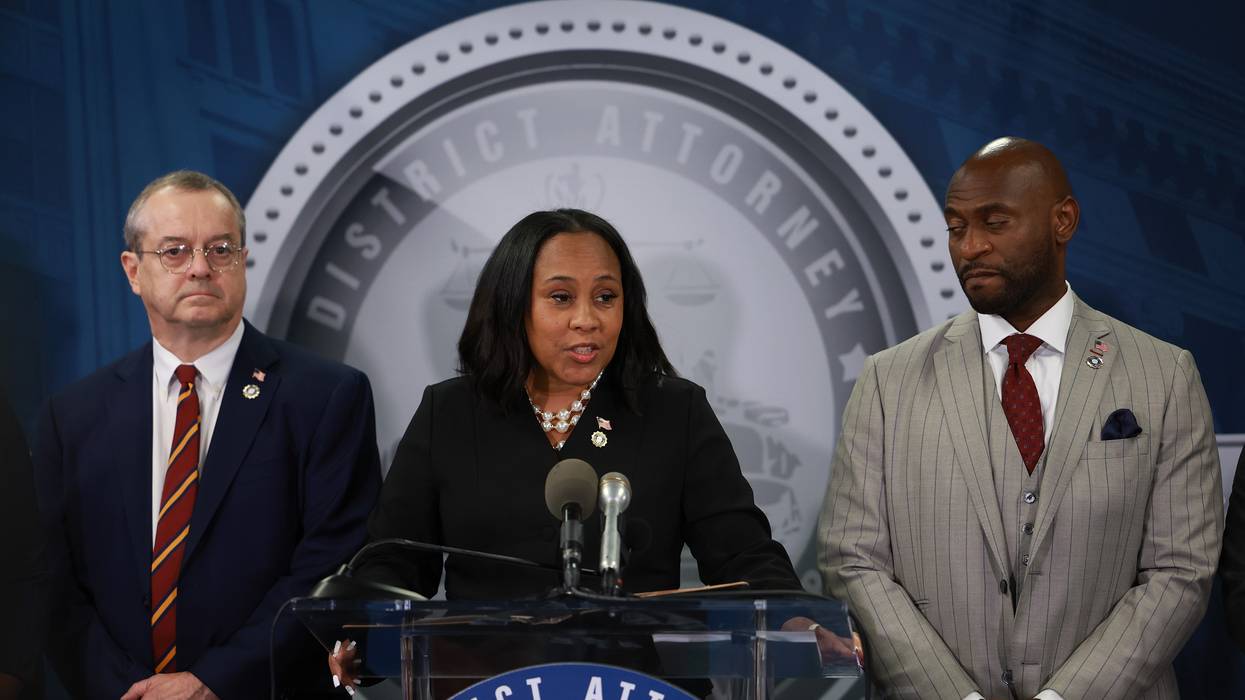
During a press conference, Willis said arrest warrants have been issued for those charged in the indictment, including Trump, who is running for president again in 2024.
"I am giving the defendants the opportunity to voluntarily surrender no later than noon on Friday, the 25th day of August 2023," said Willis.
Christina Harvey, executive director of the advocacy group Stand Up America, said in a statement that "the evidence of Trump's criminal conduct is overwhelming" and "holding the former president and his co-conspirators accountable is vital to protect our democracy and freedom to vote in future elections."
"At the heart of this indictment are Trump's concerted efforts to overturn the will of Georgia voters, Trump's attempts to deliberately spread disinformation, pressure Georgia officials to violate their oaths of office, and unlawfully change the outcome of the election in his favor demonstrate his deep-seated contempt for the law, the American people, and our democracy," said Harvey.
Common Cause Georgia executive director Aunna Dennis added that "we know today's indictment is just the beginning of what might be a long process in the courts, and that an indictment is not a conviction."
Nevertheless, Dennis said, "today's indictment of Trump and his co-conspirators highlights Georgia voters' steadfast insistence that anyone who attempts to steal our most sacred of rights must be held accountable."
"The people of Georgia can now take a moment to reflect on what type of government we want moving forward," said Dennis. "Do we want a democracy in the hands of a wealthy few, or in the hands of the people?"