

SUBSCRIBE TO OUR FREE NEWSLETTER
Daily news & progressive opinion—funded by the people, not the corporations—delivered straight to your inbox.
5
#000000
#FFFFFF
To donate by check, phone, or other method, see our More Ways to Give page.
Daily news & progressive opinion—funded by the people, not the corporations—delivered straight to your inbox.

Everything sold in the US—fear, death, darkness, and mass destruction—is handed to Palestinian children freely, but with real blood, real tears, and real destruction.
While walking through an American shopping mall, I was struck by many Halloween sections: plastic skulls, hanging ghosts, mock gravestones, jack-o’-lanterns with terrifying faces, and zombie costumes for children. Everything was crafted with care—for fun. Even private gardens and doorways were adorned with these symbols of fear. But the real shock came as I entered the halls of an international cybersecurity and technology conference. Some companies had installed dancing skeletons, singing skulls, and smoke-spewing props to attract visitors to their booths.
When I asked about it, they replied: “It’s October. People are getting ready for Halloween—with all its spooky decorations and traditions.”
Yet amid this polished spectacle, I couldn’t help but think of the children in Gaza. There, no costume is needed to experience horror. Everything sold here—fear, death, darkness, and mass destruction—is handed to them freely, but with real blood, real tears, and real destruction.
Halloween originated in Europe from the ancient Celtic festival of Samhain, when people believed spirits returned to Earth at the end of harvest. Over time, it evolved into a global commercial event, with families spending over $10 billion annually on decorations, costumes, and candy.
On this day:Jack-o’-lanterns glow with grotesque faces.
Skulls hang from doors.
Children dress as the dead or the undead.
And horror is not celebrated—it is survived.
It is a cruel irony that the final week of October—when Halloween is celebrated—is also United Nations Disarmament Week (24-30 October), a time meant to promote peace. Yet since October 2023, more than 68,000 people have been killed in Gaza, including thousands of children. Over 170,000 have been injured, and nearly 2 million displaced. Hundreds have died from hunger and malnutrition, including more than 100 children.
These children, supposedly protected by the Convention on the Rights of the Child, found no shield from death or fear.
They do not ask for candy—they search for their families and friends, if they are still alive. Moreover, they search for water, food, medicine, and survival.
On Halloween, children fear the dark.
In Gaza, children live in darkness.
On Halloween, skulls are sold.
In Gaza, skulls are pulled from the rubble.
Where is the justice the world so proudly proclaims in its forums and conferences?
Where is the voice of international humanitarian law, created to protect civilians in war?
Where is the echo of the Universal Declaration of Human Rights, which promised dignity and equality for all?
What if the billions spent on Halloween were redirected to aid children in Gaza—and everywhere?
What if we replaced manufactured horror with real joy?
What if this occasion became a moment of global solidarity?
Instead of celebrating death, let us learn to end it.
Instead of decorating our homes with skulls, let us rebuild the homes that were destroyed.
Instead of fearing ghosts, let us stand with those who have lost their loved ones.
I wish Halloween—this year and every year—could become a celebration of mercy and love, not death and fear.
That jack-o’-lanterns would glow with messages of solidarity, not monstrous grins.
That our doors, gardens, and conferences would display the faces of children who lost their families and schools—not plastic skulls.
I wish we could redefine fear as a gateway to compassion,
And redefine celebration as a call for justice and human rights.
Halloween is not a holiday that must be canceled—but one that must be understood.
In a world where images of death are consumed as entertainment, we must restore humanity to the victims.
In a time when homes are adorned with skulls, perhaps we should adorn our hearts with mercy.
As Mother Teresa once said, “If we have no peace, it is because we have forgotten that we belong to each other.”
Children in Gaza do not need masks.
They need justice and a global conscience that does not turn away—and does not disguise itself.
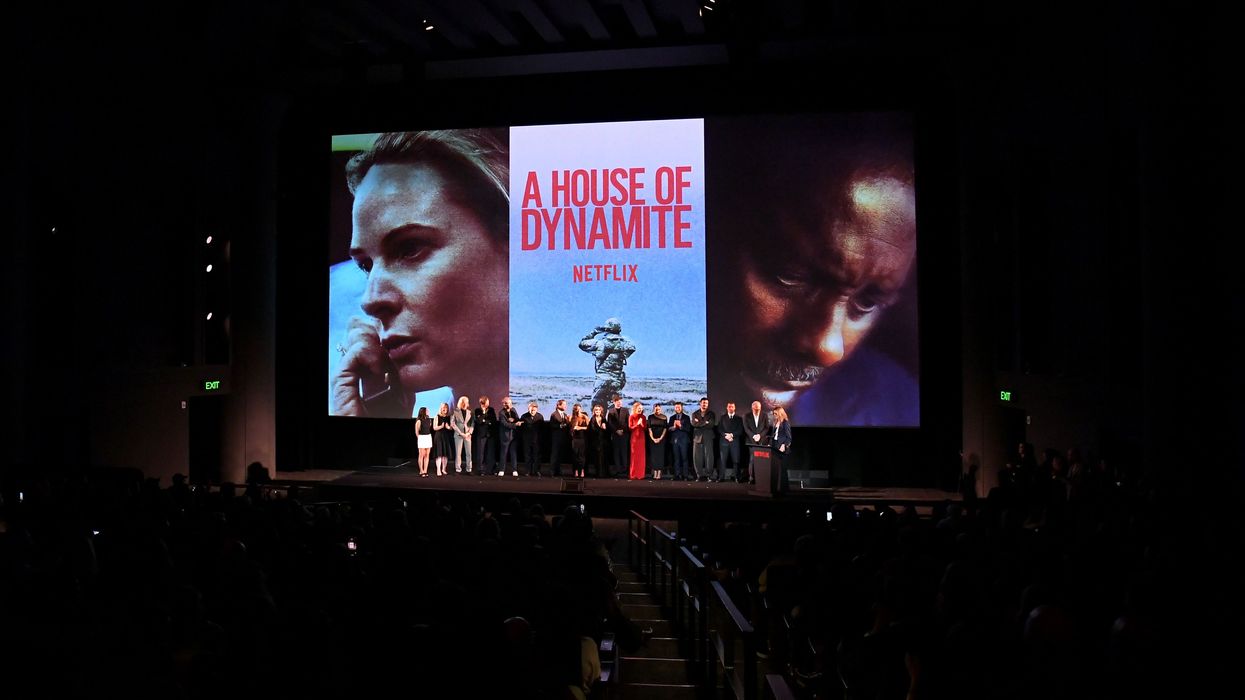
Nuclear films have been canaries in the uranium mine; each resurgence has coincided with waves of nuclear escalation. What does it mean that top directors are tackling the subject again?
As the nuclear threat once again dominates the headlines, the nuclear blockbuster has returned to screens. Following the success of Christopher Nolan’s Oppenheimer, Kathryn Bigelow’s A House of Dynamite reminds us that the atomic bomb is not mere history. Equal parts political thriller and apocalyptic horror, the film compels viewers to imagine the unimaginable, refusing any illusion of security or assurance that catastrophe could not happen here.
There is no catharsis, no safe distance from which to retreat. What we confront on screen is not fiction but the collective madness of our current reality. The dread that Bigelow conjures does not dissipate with the closing credits; it follows us out of the theater, past the exit signs, and into a world where the possibility of instant annihilation remains stitched into everyday life.
Such films are hardly new, though their resurgence should give us pause. Since 1945, Hollywood has capitalized on the mix of fear and fascination unleashed by the atomic age. In response, studios have produced roughly 1,000 nuclear-themed films, a cinematic proliferation mirroring the buildup of nuclear arsenals (70,000 warheads by 1986). As scholar Jerome Shapiro observes, these works became “a statistically important part of the American filmgoer’s diet” for decades.
Yet atomic cinema has always been more than entertainment. It has served as both warning and witness, shaping a collective consciousness of the bomb. Within the secretive and anti-democratic architecture of the nuclear security state, these films often served as cultural critique and political resistance, piercing the veil of official classification, challenging the monopoly of defense experts, and democratizing a debate otherwise foreclosed to the public.
What we need now are stories that break the spell of American innocence.
Nuclear films have been canaries in the uranium mine. Each resurgence has coincided with waves of nuclear escalation. But they have also served as calls to action, catalyzing mass movements demanding disarmament. To understand what this revival signals, and what more is needed to reignite the anti-nuclear movement, it is worth revisiting the earlier cycles of Cold War filmmaking that were shaped by and informed nuclear and popular culture.
The first major wave of atomic cinema emerged in the late 1950s and early 1960s. This was a time in which the United States had lost its temporary monopoly on nuclear force and both Washington and Moscow were producing, testing, and stockpiling weapons a thousand times more destructive than the now nearly obsolete fission bombs that had obliterated Hiroshima and Nagasaki. In less than a decade, the atomic bomb had evolved from a “city-killer” to a “nation-killer.”
The earliest films of this era confronted a growing public anxiety over radiation. They represented a response to official efforts to downplay the danger, as politicians prioritized the management of political fallout over the prevention of radioactive fallout. From the very beginning, there emerged attempts to trivialize radiation, none more infamous than General Leslie Groves’ 1945 remark that radiation poisoning was a “very pleasant way to die.”
By 1954, the Lucky Dragon incident had made the deadly consequences of nuclear contamination impossible to ignore. Science fiction movies such as Them! and Godzilla, both released that same year, translated these fears into monstrous allegories. Yet even as such films dramatized the terror of nuclear technology, official discourse worked to normalize it.
Kubrick’s dark satire exposed the Nazi-like madness underwriting “rational” deterrence, ridiculing mutual destruction while indicting the US for deepening the peril through its own policies.
Strategic war planners like Herman Kahn embodied the technocratic detachment of the emerging nuclear priesthood. By 1960, Kahn was publicly arguing that nuclear war was winnable and that even scenarios resulting in tens of millions of deaths would not ultimately preclude “normal and happy lives for the majority of survivors and their descendants.”
He also dismissed concerns about radiation, insisting that the numbers of children born “seriously defective” due to such exposure would rise by “only” 10%. Noting that there are still birth defects in peacetime, he concluded, “War is a terrible thing; but so is peace.” Such statements shocked the public, revealing the moral vacancy of those entrusted with preserving life and preventing death in the atomic age, fueling a growing fear that ordinary people might be sacrificed on the altar of Cold War credibility.
After the October 1962 Cuban Missile Crisis, when the United States came to the brink of serving as ground zero of nuclear annihilation, many Americans fully awoke to the insanity. The public backlash, led by SANE and Women’s Strike for Peace, that followed the near catastrophe helped push President John F. Kennedy to sign the Limited Test Ban Treaty of 1963, a rare moment when popular and political pressure combined to produce tangible reform.
In response also came Stanley Kubrick’s Dr. Strangelove (1964), one of the most indelible films of the Cold War. Drawing inspiration from figures such as Kahn, it confronted the suicidal nihilism of the defense intellectuals. Kubrick’s dark satire exposed the Nazi-like madness underwriting “rational” deterrence, ridiculing mutual destruction while indicting the US for deepening the peril through its own policies. These included stationing nuclear weapons in Turkey to attempting to overthrow Castro, actions that helped manufacture a crisis that threatened to extinguish the lives of as many as 200 million North Americans and even more Soviet citizens. This is not to mention the many millions dead attributed to what is perversely termed “collateral damage.”
Two decades later, a new wave of films emerged amid another period of nuclear escalation. Their arrival in 1979 marked what many remember as the spark that reignited the anti-nuclear movement after more than a decade of dormancy. That year saw the rise of presidential candidate Ronald Reagan, whose rhetoric revived the language of nuclear confrontation, alongside two disasters that reawakened fears of radiation: the partial meltdown at Three Mile Island and the uranium mill spill at Church Rock, New Mexico. Together, these events rekindled public anxiety about the existential dangers of nuclear weapons and deepened fears surrounding nuclear power.
Reagan’s campaign and subsequent presidency again advanced the chilling notion that nuclear war might be winnable, even at the cost of millions of lives. This sentiment persisted despite scientists warning of “nuclear winter,” stressing that a nuclear exchange could devastate the atmosphere and result in “omnicide,” the death of all life on Earth. The mix of apocalyptic scientific doomsaying and bellicose political posturing sent fear soaring. By the early 1980s, polls showed that nearly half of Americans believed they might die in a nuclear war.
As historian Paul Boyer observed, even the most devastating portrayals inevitably fall short, since the only truly accurate nuclear war film, he wrote, “would be two hours of a blank screen.”
Released just 12 days before the disaster at Three Mile Island, The China Syndrome (1979) captured this mounting dread with eerie prescience. What began as a fictional thriller about a near meltdown quickly became a public relations catastrophe for nuclear power. The film’s portrayal of institutionalcorruption and bureaucratic negligence, alongside the industry’s efforts to dismiss it as propaganda, exposed official narratives on nuclear safety. In a post-Vietnam, post-Watergate America defined by cynicism and mistrust, the movie crystallized public anxieties about nuclear power and the broader dangers of corporate and governmental deceit.
Under Reagan, the popular energy unleashed by this moment coalesced into a mass movement. By 1982, anti-nuclear activism had reached its apex. On June 12, some 1 million demonstrators filled the streets of New York City for what remains the largest single protest rally in American history. Their message was unambiguous: The nuclear status quo was intolerable.
Their reach extended far beyond the streets. The Nuclear Freeze campaign mobilized communities across the country, while the 1983 ABC television film The Day After brought the horror of nuclear annihilation directly into American living rooms. More than 100 million people, including the president himself, watched as a bucolic Midwestern town of Lawrence, Kansas, emblematic of the American heartland, was reduced to a radioactive wasteland. The film remains one of the most searing depictions of nuclear war ever produced. Yet, as historian Paul Boyer observed, even the most devastating portrayals inevitably fall short, since the only truly accurate nuclear war film, he wrote, “would be two hours of a blank screen.”
But public pressure grew impossible to ignore. In a remarkable reversal, Reagan declared that “a nuclear war cannot be won and must never be fought,” beginning direct talks with Soviet premier Mikhail Gorbachev to pursue arms-reductions. This marked at least the second time that protests rendered potential nuclear weapons use not only morally unimaginable but also politically untenable (the other being the 1969 Vietnam Moratorium protests which helped dissuade President Richard Nixon from carrying out a contemplated nuclear strike against North Vietnam).
The two major nuclear films of the past two years are significant cultural events. They have revived an apocalyptic imagination and a sense of nuclear consciousness that are essential if we are ever to confront the nuclear nightmare and end the arms race before it ends us. Yet they also fall short in critical ways, and risk being remembered as great films that stirred awareness but failed to inspire the resistance necessary to meet this perilous moment.
Oppenheimer, despite its cinematic brilliance, was a missed opportunity to reckon with Hiroshima and Nagasaki. Rather than compelling audiences to confront historical responsibility, it offered a familiar narrative of tragic necessity. The bomb had to be built; the bombings, though regrettable, were justified. The moral center of the story was not the victims in Japan but Oppenheimer himself, the tormented “American Prometheus.” The result was not reckoning but retreat into myth.
A House of Dynamite follows a similar trajectory. The film is powerful and unsettling, reminding viewers that any city, and the world, could be reduced to ashes within minutes. It captures the immediacy of the danger and the near impossibility of containing a “limited” exchange. Yet it ultimately retreats into American exceptionalism, reinforcing the comforting illusion that our nuclear arsenal exists only in a defensive posture to deter aggression while it is “our enemies” that recklessly endanger both us and the planet. In reality, the most perilous moments of the atomic age were less the product of foreign provocation than of American escalation.
To imagine the United States then as only a victim of a nuclear war is to obscure its role as the principal architect of prospective annihilation. For eight decades, Washington has held humanity hostage to the possibility of instant destruction, insisting that peace depends on the ever-present threat of total devastation, including in a US-initiated first strike. Moving beyond this suicidal logic of deterrence requires an honest reckoning with that history and the will to dismantle it.
What we need now are stories that break the spell of American innocence. The only sane position remains abolition, the dismantling of weapons for which there is no defense and whose risk to the continuity of human life is intolerable. Until that reckoning arrives, Oppenheimer and A House of Dynamite, and any other future films that fail to summon the courage to speak the full truth and mobilize resistance will stand as monuments to the mythology of American victimhood, stories about the terror of being attacked told by the most heavily armed nation on earth.
A House of Dynamite in limited theatrical release and will begin streaming on Netflix on October 24, 2025.
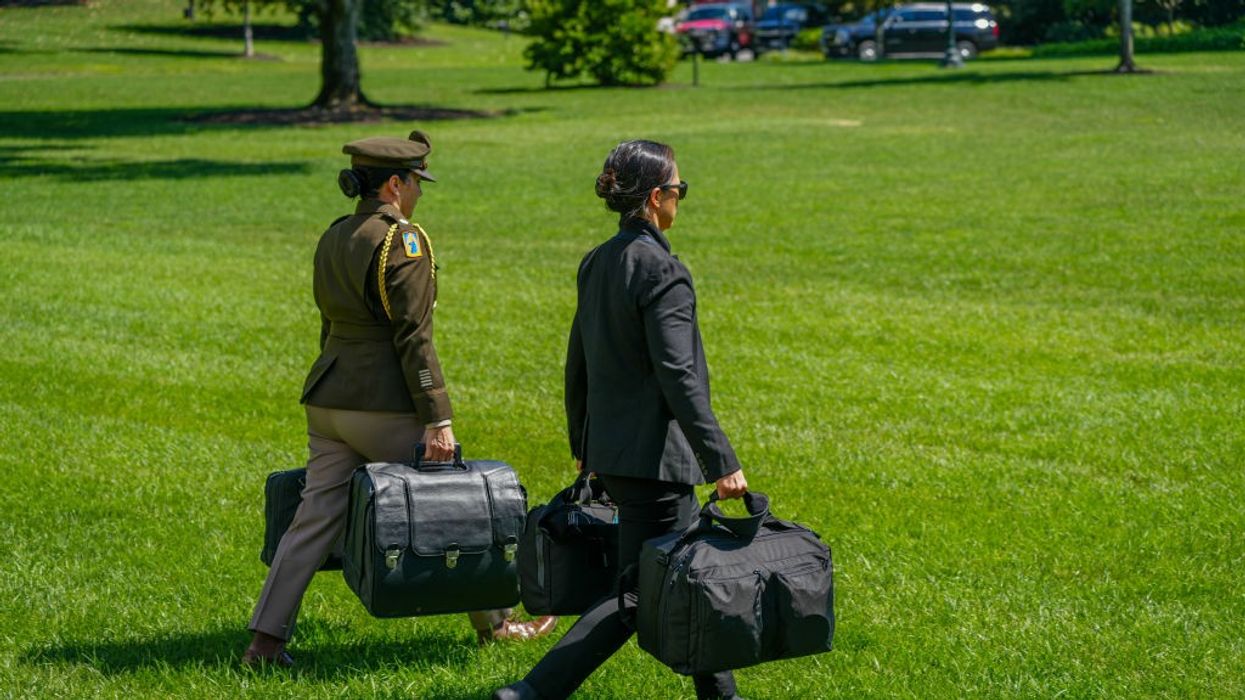
After nearly 80 years we face the very real danger that, for the first time since the atomic bombings of Hiroshima and Nagasaki in 1945, nuclear weapons will again be detonated on this planet.
The next president of the United States, whether Kamala Harris or Donald Trump, will face many contentious domestic issues that have long divided this country, including abortion rights, immigration, racial discord, and economic inequality. In the foreign policy realm, she or he will face vexing decisions over Ukraine, Israel/Gaza, and China/Taiwan. But one issue that few of us are even thinking about could pose a far greater quandary for the next president and even deeper peril for the rest of us: nuclear weapons policy.
Consider this: For the past three decades, we’ve been living through a period in which the risk of nuclear war has been far lower than at any time since the Nuclear Age began — so low, in fact, that the danger of such a holocaust has been largely invisible to most people. The collapse of the Soviet Union and the signing of agreements that substantially reduced the U.S. and Russian nuclear stockpiles eliminated the most extreme risk of thermonuclear conflict, allowing us to push thoughts of nuclear Armageddon aside (and focus on other worries). But those quiescent days should now be considered over. Relations among the major powers have deteriorated in recent years and progress on disarmament has stalled. The United States and Russia are, in fact, upgrading their nuclear arsenals with new and more powerful weapons, while China — previously an outlier in the nuclear threat equation — has begun a major expansion of its own arsenal.
The altered nuclear equation is also evident in the renewed talk of possible nuclear weapons use by leaders of the major nuclear-armed powers. Such public discussion largely ceased after the Cuban Missile Crisis of 1962, when it became evident that any thermonuclear exchange between the U.S. and the Soviet Union would result in their mutual annihilation. However, that fear has diminished in recent years and we’re again hearing talk of nuclear weapons use. Since ordering the invasion of Ukraine, Russian President Vladimir Putin has repeatedly threatened to employ nuclear munitions in response to unspecified future actions of the U.S. and NATO in support of Ukrainian forces. Citing those very threats, along with China’s growing military might, Congress has authorized a program to develop more “lower-yield” nuclear munitions supposedly meant (however madly) to provide a president with further “options” in the event of a future regional conflict with Russia or China.
Thanks to those and related developments, the world is now closer to an actual nuclear conflagration than at any time since the end of the Cold War. And while popular anxiety about a nuclear exchange may have diminished, keep in mind that the explosive power of existing arsenals has not. Imagine this, for instance: even a “limited” nuclear war — involving the use of just a dozen or so of the hundreds of intercontinental ballistic missiles (ICBMs) possessed by China, Russia, and the United States — would cause enough planetary destruction to ensure civilization’s collapse and the death of billions of people.
And consider all of that as just the backdrop against which the next president will undoubtedly face fateful decisions regarding the production and possible use of such weaponry, whether in the bilateral nuclear relationship between the U.S. and Russia or the trilateral one that incorporates China.
The U.S.-Russia Nuclear Equation
The first nuclear quandary facing the next president has an actual timeline. In approximately 500 days, on February 5, 2026, the New Strategic Arms Reduction Treaty (New START), the last remaining nuclear accord between the U.S. and Russia limiting the size of their arsenals, will expire. That treaty, signed in 2010, limits each side to a maximum of 1,550 deployed strategic nuclear warheads along with 700 delivery systems, whether ICBMs, submarine-launched ballistic missiles (SLBMs), or nuclear-capable heavy bombers. (That treaty only covers strategic warheads, or those intended for attacks on each other’s homeland; it does not include the potentially devastating stockpiles of “tactical” nuclear munitions possessed by the two countries that are intended for use in regional conflicts.)
At present, the treaty is on life support. On February 21, 2023, Vladimir Putin ominously announced that Russia had “suspended” its formal participation in New START, although claiming it would continue to abide by its warhead and delivery limits as long as the U.S. did so. The Biden administration then agreed that it, too, would continue to abide by the treaty limits. It has also signaled to Moscow that it’s willing to discuss the terms of a replacement treaty for New START when that agreement expires in 2026. The Russians have, however, declined to engage in such conversations as long as the U.S. continues its military support for Ukraine.
Accordingly, among the first major decisions the next president has to make in January 2025 will be what stance to take regarding the future status of New START (or its replacement). With the treaty’s extinction barely more than a year away, little time will remain for careful deliberation as a new administration chooses among several potentially fateful and contentious possibilities.
Its first option, of course, would be to preserve the status quo, agreeing that the U.S. will abide by that treaty’s numerical limits as long as Russia does, even in the absence of a treaty obliging it to do so. Count on one thing, though: such a decision would almost certainly be challenged and tested by nuclear hawks in both Washington and Moscow.
Of course, President Harris or Trump could decide to launch a diplomatic drive to persuade Moscow to agree to a new version of New START, a distinctly demanding undertaking, given the time remaining. Ideally, such an agreement would entail further reductions in the U.S. and Russian strategic arsenals or at least include caps on the number of tactical weapons on each side. And remember, even if such an agreement were indeed to be reached, it would also require Senate approval and undoubtedly encounter fierce resistance from the hawkish members of that body. Despite such obstacles, this probably represents the best possible outcome imaginable.
The worst — and yet most likely — would be a decision to abandon the New START limits and begin adding yet more weapons to the American nuclear arsenal, reversing a bipartisan arms control policy that goes back to the administration of President Richard Nixon. Sadly, there are too many members of Congress who favor just such a shift and are already proposing measures to initiate it.
In June, for example, in its version of the National Defense Authorization Act for fiscal year 2025, the Senate Armed Services Committee instructed the Department of Defense to begin devising plans for an increase in the number of deployed ICBMs from 400 of the existing Minuteman-IIIs to 450 of its replacement, the future Sentinel ICBM. The House Armed Services Committee version of that measure does not contain that provision but includes separate plans for ICBM force expansion. (The consolidated text of the bill has yet to be finalized.)
Should the U.S. and/or Russia abandon the New START limits and begin adding to its atomic arsenal after February 5, 2026, a new nuclear arms race would almost certainly be ignited, with no foreseeable limits. No matter which side announced such a move first, the other would undoubtedly feel compelled to follow suit and so, for the first time since the Nixon era, both nuclear powers would be expanding rather than reducing their deployed nuclear forces — only increasing, of course, the potential for mutual annihilation. And if Cold War history is any guide, such an arms-building contest would result in increased suspicion and hostility, adding a greater danger of nuclear escalation to any crisis that might arise between them.
The Three-Way Arms Race
Scary as that might prove, a two-way nuclear arms race isn’t the greatest peril we face. After all, should Moscow and Washington prove unable to agree on a successor to New START and begin expanding their arsenals, any trilateral nuclear agreement including China that might slow that country’s present nuclear buildup becomes essentially unimaginable.
Ever since it acquired nuclear weapons in 1964, the People’s Republic of China (PRC) pursued a minimalist stance when it came to deploying such weaponry, insisting that it would never initiate a nuclear conflict but would only use nuclear weapons in a second-strike retaliatory fashion following a nuclear attack on the PRC. In accordance with that policy, China long maintained a relatively small arsenal, only 200 or so nuclear warheads and a small fleet of ICBMs and SLBMs. In the past few years, however, China has launched a significant nuclear build-up, adding another 300 warheads and producing more missiles and missile-launching silos — all while insisting its no-first-use policy remains unchanged and that it is only maintaining a retaliatory force to deter potential aggression by other nuclear-armed states.
Some Western analysts believe that Xi Jinping, China’s nationalistic and authoritarian leader, considers a larger arsenal necessary to boost his country’s status in a highly competitive, multipolar world. Others argue that China fears improvements in U.S. defensive capabilities, especially the installation of anti-ballistic missile systems, that could endanger its relatively small retaliatory force and so rob it of a deterrent to any future American first strike.
Given the Chinese construction of several hundred new missile silos, Pentagon analysts contend that the country plans to deploy as many as 1,000 nuclear warheads by 2030 and 1,500 by 2035 — roughly equivalent to deployed Russian and American stockpiles under the New START guidelines. At present, there is no way to confirm such predictions, which are based on extrapolations from the recent growth of the Chinese arsenal from perhaps 200 to 500 warheads. Nonetheless, many Washington officials, especially in the Republican Party, have begun to argue that, given such a buildup, the New START limits must be abandoned in 2026 and yet more weapons added to the deployed U.S. nuclear stockpile to counter both Russia and China.
As Franklin Miller of the Washington-based Scowcroft Group and a former director of nuclear targeting in the office of the secretary of defense put it, “Deterring China and Russia simultaneously [requires] an increased level of U.S. strategic warheads.” Miller was one of 12 members of the Congressional Commission on the Strategic Posture of the United States, a bipartisan group convened in 2022 to reconsider America’s nuclear policies in light of China’s growing arsenal, Putin’s nuclear threats, and other developments. In its final October 2023 report, that commission recommended numerous alterations and additions to the American arsenal, including installing multiple warheads (instead of single ones) on the Sentinel missiles being built to replace the Minuteman ICBM and increasing the number of B-21 nuclear bombers and Columbia-class ballistic-missile submarines to be produced under the Pentagon’s $1.5 trillion nuclear “modernization” program.
The Biden administration has yet to endorse the recommendations in that report. It has, however, signaled that it’s considering the steps a future administration might take to address an expanded Chinese arsenal. In March, the White House approved a new version of a top-secret document, the Nuclear Employment Guidance, which for the first time reportedly focused as much on countering China as Russia. According to the few public comments made by administration officials about that document, it, too, sets out contingency plans for increasing the number of deployed strategic weapons in the years ahead if Russia breaks out of the current New START limits and no arms restraints have been negotiated with China.
“We have begun exploring options to increase future launcher capacity or additional deployed warheads on the land, sea, and air legs [of the nuclear delivery “triad” of ICBMs, SLBMs, and bombers] that could offer national leadership increased flexibility, if desired, and executed,” said acting Assistant Secretary of Defense Policy Vipin Narang on August 1st. While none of those options are likely to be implemented in President Biden’s remaining months, the next administration will be confronted with distinctly ominous decisions about the future composition of that already monstrous nuclear arsenal.
Whether it is kept as is or expanded, the one option you won’t hear much about in Washington is finding ways to reduce it. And count on one thing: even a decision simply to preserve the status quo in the context of today’s increasingly antagonistic international environment poses an increased risk of nuclear conflict. Any decision to expand it, along with comparable moves by Russia and China, will undoubtedly create an even greater risk of instability and potentially suicidal nuclear escalation.
The Need for Citizen Advocacy
For all too many of us, nuclear weapons policy seems like a difficult issue that should be left to the experts. This wasn’t always so. During the Cold War years, nuclear war seemed like an ever-present possibility and millions of Americans familiarized themselves with nuclear issues, participating in ban-the-bomb protests or the Nuclear Weapons Freeze Campaign of the 1980s. But with the Cold War’s end and a diminished sense of nuclear doom, most of us turned to other issues and concerns. Yet the nuclear danger is growing rapidly and so decisions regarding the U.S. arsenal could have life-or-death repercussions on a global scale.
And one thing should be made clear: adding more weaponry to the U.S. arsenal will not make us one bit safer. Given the invulnerability of this country’s missile-bearing nuclear submarines and the multitude of other weapons in our nuclear arsenal, no foreign leader could conceivably mount a first strike on this country and not expect catastrophic retaliation, which in turn would devastate the planet. Acquiring more nuclear weapons would not alter any of this in the slightest. All it could possibly do is add to international tensions and increase the risk of global annihilation.
As Daryl Kimball, executive director of the Arms Control Association, a nonpartisan research and advocacy outfit, put it recently: “Significant increases in the U.S. deployed nuclear arsenal would undermine mutual and global security by making the existing balance of nuclear terror more unpredictable and would set into motion a counterproductive, costly action-reaction cycle of nuclear competition.”
A decision to pursue such a reckless path could occur just months from now. In early 2025, the next president, whether Kamala Harris or Donald Trump, will be making critical decisions regarding the future of the New START Treaty and the composition of the U.S. nuclear arsenal. Given the vital stakes involved, such decisions should not be left to the president and a small coterie of her or his close advisers. Rather, it should be the concern of every citizen, ensuring vigorous debate on alternative options, including steps aimed at reducing and eventually eliminating the world’s nuclear arsenals. Without such public advocacy, we face the very real danger that, for the first time since the atomic bombings of Hiroshima and Nagasaki in August 1945, nuclear weapons will again be detonated on this planet, with billions of us finding ourselves in almost unimaginable peril.
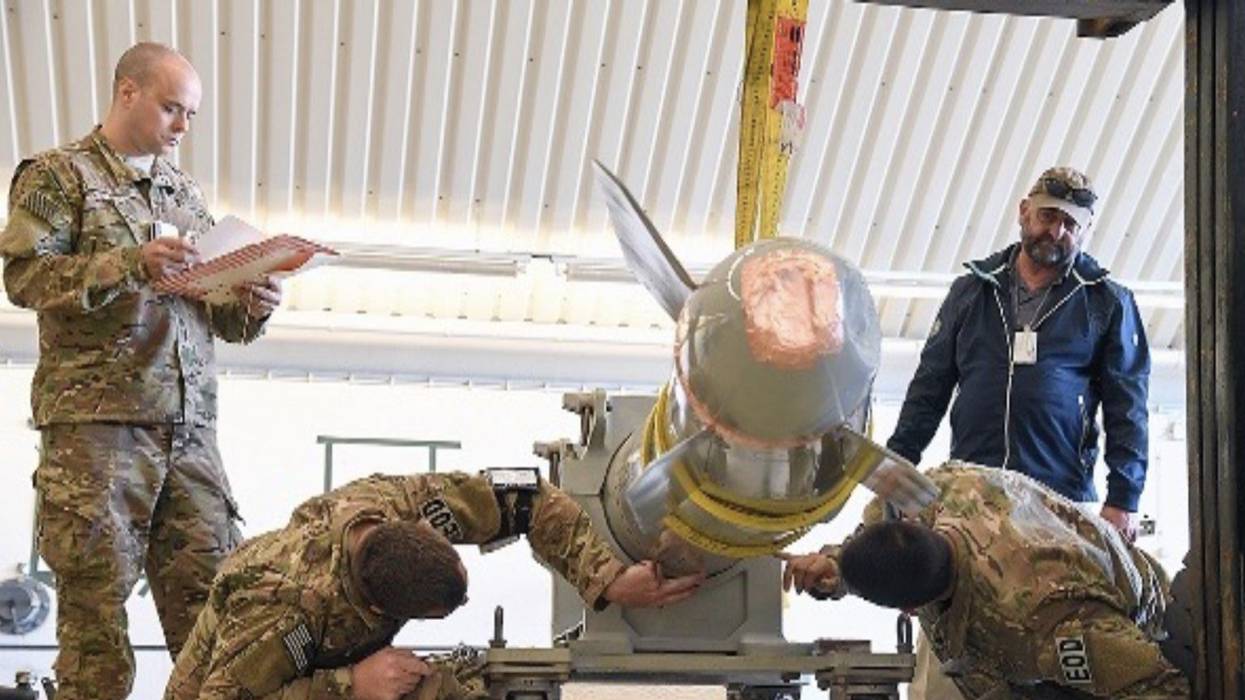
"If the image is indeed from a nuclear weapons accident, it would constitute the first publicly known case of a recent nuclear weapons accident at an air base in Europe," according to the Federation of American Scientists.
Was a U.S. nuclear bomb damaged in a recent accident at a European air base?
This question is being asked Monday after the Federation of American Scientists (FAS) discovered and published a photo—used in an April 2022 student briefing at Los Alamos National Laboratory in New Mexico—that shows four people inspecting what looks like a damaged B61 atomic bomb. The U.S. is set to soon deliver a new generation of this so-called "tactical" nuclear weapon to Europe.
"The document does not identify where the photo was taken or when, but it appears to be from inside a Protective Aircraft Shelter (PAS) at Volkel Air Base in the Netherlands," according to Hans Kristensen, director of the Nuclear Information Project at FAS, which analyzed the image in depth. "It must be emphasized up front that there is no official confirmation that the image was taken at Volkel Air Base, that the bent B61 shape is a real weapon (versus a trainer), or that the damage was the result of an accident (versus a training simulation)."
"If the image is indeed from a nuclear weapons accident," Kristensen noted, "it would constitute the first publicly known case of a recent nuclear weapons accident at an air base in Europe."
Kristensen continued:
Most people would describe a nuclear bomb getting bent as an accident, but U.S. Air Force terminology would likely categorize it as a Bent Spear incident, which is defined as "evident damage to a nuclear weapon or nuclear component that requires major rework, replacement, or examination or re-certification by the Department of Energy." The U.S. Air Force reserves "accident" for events that involve the destruction or loss of a weapon.
It is not a secret that the U.S. Air Force deploys nuclear weapons in Europe, but it is a secret where they are deployed. Volkel Air Base has stored B61s for decades. I and others have provided ample documentation for this and two former Dutch prime ministers and a defense minister in 2013 even acknowledged the presence of the weapons. Volkel Air Base is one of six air bases in Europe where the U.S. Air Force currently deploys an estimated 100 B61 nuclear bombs in total.
The United States is modernizing its air-delivered nuclear arsenal including in Europe and Volkel and the other air bases in Europe are scheduled to receive the new B61-12 nuclear bomb in the near future.
Just over a week ago, Russian President Vladimir Putin pointed to the United States' positioning of tactical nukes in the Netherlands, Belgium, Germany, Italy, and Turkey to justify his plan to station similar weapons in Belarus. Subsequently, Belarusian President Alexander Lukashenko said that he is also seeking to store more powerful intercontinental ballistic missiles.
After condemning the Kremlin's "dangerously escalating proposal," Daniel Högsta, acting executive director of the International Campaign to Abolish Nuclear Weapons (ICAN), alluded to arms-sharing among the U.S.-led NATO military alliance and argued that "as long as countries continue their complicity in considering nuclear weapons as anything other than a global problem, this helps give Putin cover to get away with this kind of behavior."
ICAN wrote Monday on social media that news of potential damage to a B61 atomic bomb "is a terrifying reminder of three things."
First, the organization observed, Dutch, Belgian, German, Italian, and Turkish civilians are being put "at risk if anything goes wrong."
Second, "if these weapons were used intentionally, it would be the military pilots from those countries—not the U.S.—dropping the bomb and committing mass murder of civilians," ICAN noted. "No one in these countries voted or consented to have that done in their name."
Finally, "accidents happen," the organization pointed out. "The long history of nuclear weapons mishaps and near-misses shows just how much luck has kept us from nuclear war."
"Luck is not a good security strategy," ICAN added. "Responsible states should join the [United Nations Treaty on the Prohibition of Nuclear Weapons] and push to eliminate nuclear weapons altogether."
Russia, the U.S., China, France, and the United Kingdom—the five permanent members of the U.N. Security Council who control more than 12,000 atomic warheads combined—have expressed opposition to the body's nuclear ban treaty, which entered into force in January 2021 when it was ratified by 50 governments.
"Luck is not a good security strategy. Responsible states should... push to eliminate nuclear weapons altogether."
Beatrice Fihn, the former executive director of ICAN who led the organization when it was awarded the Nobel Peace Prize in 2017, made the case last week that recent weapon-sharing proposals reveal the dangers of "nuclear deterrence" theory, which asserts that threatening to use atomic bombs dissuades governments from taking certain actions and therefore helps avert nuclear war.
"We have to stop being so stupid by continuing to say nuclear deterrence works," Fihn argued. "We need to urgently stigmatize and delegitimize the use, threat to use, testing, stationing, and possession of nuclear weapons."
For the first time since the 1980s, the world's nuclear arsenal—90% of which is controlled by Moscow and Washington—is projected to expand in the coming years, and the risk of weapons capable of annihilating life on Earth being used is growing.
"We need to use all available methods and tools of the international community to pressure Russia on this," Fihn said last week. "And then we need to urgently work to eliminate nuclear weapons and remove this option from all counties. For Ukraine and also for every other country and person on this planet."
U.S. President Joe Biden warned in October that Russia's war in Ukraine had brought the world closer to "Armageddon" than at any point since the Cuban missile crisis. Just days later, however, his administration published a Nuclear Posture Review that nonproliferation advocates said increases the likelihood of catastrophe, in part because it preserves the option of a nuclear first strike. The U.S. remains the only country to have used nuclear weapons in war, decimating the Japanese cities of Hiroshima and Nagasaki with atomic bombs in August 1945.
Izumi Nakamitsu, the U.N. high representative for disarmament affairs, warned Friday in a briefing to the body's Security Council that "the risk of a nuclear weapon being used is currently higher than at any time since the depths of the Cold War."
"The war in Ukraine represents the most acute example of that risk," said Nakamitsu. "The absence of dialogue and the erosion of the disarmament and arms control architecture, combined with dangerous rhetoric and veiled threats, are key drivers of this potentially existential risk."
"States must avoid taking any actions that could lead to escalation, mistake, or miscalculation," she added. "They should return to dialogue to de-escalate tensions urgently and find ways to develop and implement transparency and confidence-building measures."

"The absence of dialogue and the erosion of the disarmament and arms control architecture, combined with dangerous rhetoric and veiled threats, are key drivers of this potentially existential risk."
The United Nations disarmament chief on Friday called for de-escalatory talks to curb the risk of nuclear war amid global concerns about Russian President Vladimir Putin's plan to station so-called "tactical" nuclear weapons in Belarus.
Roughly 13 months into the Russian invasion of Ukraine, Putin announced what critics called the "extremely dangerous escalation" last weekend, as United Nations High Representative for Disarmament Affairs Izumi Nakamitsu noted at the beginning of her briefing to the U.N. Security Council—which Russia, a permanent member, is set to lead for a month starting on Saturday.
Nakamitsu's remarks came as Belarusian President Alexander Lukashenko, in a speech to his country's Parliament, claimed without evidence that the United States and other Western nations plan to take over both Belarus and neighboring Poland, and vowed that "we will protect our sovereignty and independence by any means necessary."
"States must avoid taking any actions that could lead to escalation, mistake, or miscalculation."
Nakamitsu said that "the risk of a nuclear weapon being used is currently higher than at any time since the depths of the Cold War. The war in Ukraine represents the most acute example of that risk. The absence of dialogue and the erosion of the disarmament and arms control architecture, combined with dangerous rhetoric and veiled threats, are key drivers of this potentially existential risk."
"States must avoid taking any actions that could lead to escalation, mistake, or miscalculation," she continued. "They should return to dialogue to de-escalate tensions urgently and find ways to develop and implement transparency and confidence-building measures."
Putin justified the deployment plan in part by insisting that the weapons will remain under Russian control and pointing to the U.S. nukes that have been stationed in allied European countries for decades. The United States—which has the world's second-largest nuclear arsenal after Russia—is believed to have about 100 such bombs spread across Belgium, Germany, Italy, the Netherlands, and Turkey.
Both Russia and the United States are parties to the Nuclear Nonproliferation Treaty (NPT). Nakamitsu stressed Friday that all parties to the treaty, whether or not they have nukes, "must strictly adhere to the commitments and obligations they have assumed under the treaty."
The issue of a state without its own weapons hosting some from one of the world's nine nuclear-armed nations "has existed for decades, across various regions and under different arrangements. These arrangements pre-date the NPT, with the exception of the recent announcement," Nakamitsu acknowledged. "The issue of so-called 'nuclear sharing' was debated intensely during the negotiation of the NPT" and "has been the subject of subsequent discussions."
After echoing U.N. Secretary-General António Guterres' call for Russia and the United States "to return to full implementation of the New START Treaty and commence negotiations on its successor," Nakamitsu said that "the accelerated implementation of commitments under the NPT can also contribute to undergirding international stability. I therefore appeal to all states parties of the NPT to fully adhere to their obligations to the treaty, and to immediately engage in serious efforts to reduce nuclear risk and de-escalate tensions."
Meanwhile, the U.S. and Russian ambassadors took aim at each other's countries during the U.N. Security Council meeting.
"We are pursuing cooperation with Belarus without violating obligations," argued Vassily Nebenzia, the Russian ambassador, highlighting the U.S. warheads across Europe. "We are not transferring nuclear weapons."
According to U.N. News:
Russia must take "all requisite measures" in response to "provocative steps," [Nebenzia] said, given the fraying global security architecture, dictated exclusively by Washington, along with London's recent decision to deploy armor-piercing ammunition to Ukraine.
"A nuclear war cannot be won," he said.
Russia's suggestion that this intended deployment is justified because of the use of armor-piercing ammunition supplied by Western forces, containing depleted uranium, is "ludicrous," U.S. Ambassador Robert Wood said.
"Armour-piercing ammunition is in no way analogous to tactical nuclear weapons," he said, adding that the Kremlin is attempting to limit and deter Ukraine's efforts to defend itself, and manipulate matters to win the war.
"Any use of nuclear weapons in Ukraine would have severe consequences and would fundamentally change the nature of this war," Wood added, urging Russia to reconsider its decision to deploy nukes in Belarus.
Americans are largely unaware of the vastness and lethality of U.S. nuclear weapons stockpiles, say Sisters Ardeth Platte, Carol Gilbert and Jackie Hudson, the three nuns who did time in federal prison for breaking into the N-8 Minuteman missile site in October 2002.
Now that the sisters are all back from prison, they spent some time with me to explain how their religious commitment and civic duty led them to become activists for nuclear disarmament.
In 1978 after Sisters Ardeth and Carol first heard Helen Caldicott's message on the dangers of nuclear weapons, they decided to work for the Nuclear Weapons Freeze Campaign in Michigan, their home state. At the time, Michigan held the sixth largest cache of nuclear weapons in the country. The two sisters helped to organize a statewide ballot initiative for the Freeze in 1982, which passed at 56 percent.
They continued to work to free Michigan of all nuclear weapons until the Defense Closure and Realignment Commission (BRAC) inactivated the Wurtsmith Air Force Base near Oscoda in 1993 and the K. I. Sawyer Air Force Base near Marquette in 1995.
Continuing to feel the intensity of their call to eliminate nuclear weapons, Sisters Carol and Ardeth then joined Jonah House in Baltimore and became members of Plowshares. The worldwide peace organization spotlights the dangers of militarism and weapons of mass destruction through symbolic acts like their blood-spilling on the N-8 missile site.
Sister Jackie began her activism against nuclear weapons after being inspired by Sister Marjorie Tuite (1922-86) who talked about the "burden of knowledge" that doesn't allow a person to know what's going on in the world and not do anything about it. This burden calls for a "revolutionary integrity" that challenges one's morality and calls for a continued commitment of the gospel's message of "doing justice."
"You can educate others and you can act," said Sister Jackie, 73, who served 30 months at the Victorville Federal Prison Adelanto, Ca. "This is not always easy because there are consequences. However, when the consequences come, there is something that happens within that is deepened."
Sister Jackie dedicated herself to the Ground Zero Center in Bremerton, Wash. near Seattle where she has lived since 1993. The center is located adjacent to the Trident submarine base where 2,000 nuclear warheads are stored. Peace activists regularly protest at the base and advocate its closing.
In 1996 the U.S. military stepped up its strategic capacity with Vision 2020, a plan to exploit and dominate outer space by linking all land, sea and air bases.
"Most people have no clue about Vision 2020," said Sister Carol, 59, who spent 33 months at women's prison at Alderson, W. Va. "Such a plan, if enacted, would lead to the utter devastation of the planet. So in 2000 we rang a bell saying that this was happening in our country and we must stop it."
The sisters' action against Vision 2020 occurred at Peterson Air Force Base in Colorado Springs, Co. where they poured their blood on a communications satellite and hammered a grounded fighter jet prior during an air show exhibit there. They did this because both presidential candidates that year had endorsed Vision 2020. The sisters were subsequently released without punishment.
"Nuclear weapons are the taproot of all violence," said Sister Ardeth, 71, who served 41 months in the Danbury Federal Correction Institution in Connecticut. "Because we have these weapons of mass destruction and see ourselves as the remaining superpower nation, we proceed to intervene in other nations, claim other's resources, and set up our military bases in their countries."
She cited our war in Afghanistan, where we wanted to build an oil pipeline, and in Iraq, where we wanted their oil.
"The U.S. is obliged to abide by the non-proliferation treaty, to dismantle all of these weapons, in order to gain partnership with others and begin to work together," said Sister Ardeth. "This is for our future survival, the survival of all people, of creation and the planet, herself."
Sister Ardeth noted that since 1945 the United States has spent $20 trillion on military weapons. Meanwhile, millions of people in America and throughout the world are poor, sick and hungry because they lack even a fraction of such resources.
"When I learned about how poverty and racism work from the people who experience them, I saw that these things injure Mother Earth, too," she said. "And I thank God in understanding the connection of all these violences. I thank God for the consciousness to say no to war and all violence."
The sisters consider their action at the N-8 to be their citizen duty aimed at exposing the truth about weapons of mass destruction and the country's unmitigated and bipartisan support for them.
They didn't expect to go to prison nor did they think their sentences would be so severe, however, given heightened 9/11 security concerns, the prosecutor's case against the nuns was probably used a deterrent to others who might want to plan future "symbolic" demonstrations.
Nevertheless, the sisters regard their prison time as "sacred time" not only because they "sacrificed" themselves for the cause of justice and nonviolence, but because their case received a lot more publicity than it might have. Their aim was to attract attention to the dangers of our country's WMD as we were marching toward war over Iraq's WMD.
The sisters recognize that not everyone can or is willing to go to prison as they did. As nuns they have the freedom to engage in public protest and to serve time in prison without disrupting family life.
"How could we not?" said Sister Carol without hesitation.
Actually, going to prison gave them the opportunity to "wash our hands of our complicity" with the military industrial complex.
Although the sisters' religious status (and earning capacity) does not require them to pay income taxes, they do pay sales taxes on consumer goods and services. In other words, it is nearly impossible for them or any American citizen to avoid supporting the country's war machine simply because everyone pays some kind of federal tax.
One might wonder if the sisters regard their effort and their prison time as worth it, especially as the Iraq War is nearing its fifth year and the president has been rattling sabers with Iran.
"We decided that our work is to end the war, to dismantle all WMDs, to stop all killing," said Sister Ardeth. "At every Mass, in every prayer, we ask for this. It is programmed into us."
"I don't ever want a child to say that we did nothing," said Sister Carol.
"I have a strong belief in life and love and lived to the best of my ability to practice those beliefs," said Sister Jackie.