
SUBSCRIBE TO OUR FREE NEWSLETTER
Daily news & progressive opinion—funded by the people, not the corporations—delivered straight to your inbox.
5
#000000
#FFFFFF
To donate by check, phone, or other method, see our More Ways to Give page.


Daily news & progressive opinion—funded by the people, not the corporations—delivered straight to your inbox.
The government claimed that Cornell had violated civil rights law by allowing students to protest against Israel. Even though the agreement required the school to admit no wrongdoing, it still agreed to pay a $30 million fine.
Cornell University became the latest school to cave to demands from the Trump administration on Friday, inking a deal that would restore $250 million in unpaid research funds stripped by the federal government as part of its crusade against higher education and efforts to punish schools that allowed students to freely express pro-Palestine views.
Following a months-long investigation by the government for allegedly violating Title VI of the Civil Rights Act, the Ivy League school agreed to pay a $30 million fine to the government, which claimed that Cornell had violated the law by not sufficiently cracking down on student protests against Israel's genocide in Gaza. The administration accused the school of failing “to protect Jewish students.”
In March, the Department of Education launched investigations into 60 major US universities, with Education Secretary Linda McMahon describing students' peaceful demonstrations against Israel that had swept campuses the previous year as "relentless antisemitic eruptions."
As The Guardian reported earlier this week, the civil rights investigation at Cornell had been spurred by a nonspecific, anonymous complaint that a professor “is supporting Hammas [sic] and their beliefs. He is literally brain washing students to hate and discriminate towards a certain religions [sic]–Jews." The complaint demanded that the professor be "black listed" from teaching.
Following this complaint, the Department of Education's Office of Civil Rights announced an investigation into the school for "failing to respond to incidents of harassment."
In a letter to the school community on Friday, Cornell's president, Michael Kotlikoff, said that the resolution made explicit that its agreement to pay out the lofty fine to the Trump administration was "not an admission of wrongdoing" by the university.
In addition to paying the fine, the school also had to set aside another $30 million to invest in "research programs that will directly benefit US farmers through lower costs of production and enhanced efficiency.”
And while Kotlikoff said he would refuse a deal that allowed the government to “dictate our institution’s policies,” the agreement requires the school to comply with several of the Trump administration's ideological goals.
It agreed to restrict its use of diversity, equity, and inclusion (DEI) policies and turn over data on the racial makeup of its student body to demonstrate that it is complying with the 2023 Supreme Court decision outlawing affirmative action. It also agreed to train staff using a Justice Department memo ordering colleges to abandon "transgender-friendly” policies.
Cornell also agreed to "conduct annual surveys to evaluate the campus climate for Cornell students, including the climate for students with shared Jewish ancestry." The school specifically agreed to query students about "whether they believe the changes Cornell has made since October of 2023," when Israel launched a two-year genocide in response to Hamas attack, "have benefited the Cornell community."
The Trump administration has notably ordered schools to abide by a wide-ranging definition of "antisemitism" that not only punishes displays of bigotry against Jewish people, but also criticisms of Israel's government and policies.
Cornell also agreed to seek out “experts on laws and regulations regarding sanctions enforcement, anti-money laundering, and prevention of terrorist financing,” suggesting that the school will be expected to discipline and investigate pro-Palestinian organizations on campus, which the administration has baselessly accused of "material support" for terrorism.
Cornell's agreement with the administration comes as students at more than 100 campuses across the country have launched demonstrations against Trump's efforts to coerce schools into signing his “Compact for Academic Excellence in Higher Education,” in exchange for priority federal funding and other “positive benefits.” Critics have described it as a "loyalty oath" and an "extortion agreement."
Though several schools have declined to sign onto the compact, Cornell is not the first school to bend to the Trump administration's demands to restart the flow of federal funding: Brown University, Columbia University, the University of Pennsylvania, and the University of Virginia have all cut similar deals.
Jameel Jaffer, the director of the Knight First Amendment Institute at Columbia University, has argued that there was little basis for Cornell to be fined for civil rights violations.
"If the Trump administration had evidence that Cornell systemically discriminated against Jewish students in violation of Title VI, it wouldn't let the university off the hook for a $30 million investment in research about AI, robotics, and farming," Jaffer said. "But, of course, there's no such evidence. The settlement only confirms what we already knew—that the Trump administration's Title VI allegations were baseless and made in bad faith."
"That doesn't mean there weren't antisemitic incidents on Cornell's campus. There were. But there's just no support for the notion that Cornell or other major American universities were indifferent to antisemitism," he continued. "The problem wasn't that universities were indifferent to antisemitism, but that they allowed trustees, advocacy groups, demagogues, etc. to pressure them into treating as 'antisemitism' all kinds of political expression and advocacy that was entirely legitimate."
A report from the American Association of University Professors and the Middle East Studies Association, which analyzed discrimination complaints sent to the Civil Rights Office found that "all but one of the 102 antisemitism complaint letters we have analyzed focus on speech critical of Israel; of these, 79% contain allegations of antisemitism that simply describe criticisms of Israel or Zionism with no reference to Jews or Judaism; at least 50% of complaints consist solely of such criticism."
Though the payout was far less than the $200 million settlement Columbia agreed to pay earlier this year, Spencer Beswick, a postdoctoral associate at Cornell's Humanities Scholars Program, wrote on social media that his university was guilty of "capitulation to extortion."
"The First Amendment does not come with a 'Palestine Exception,'" said the American-Arab Anti-Discrimination Committee, which filed the suit.
A lawsuit filed Saturday on behalf of two Cornell University graduates students and one professor at the Ivy League school in Upstate New York is challenging what plaintiffs are calling "the Trump administration's unconstitutional campaign against free speech—particularly as it targets international students and scholars who protest or express support for Palestinian rights."
"The lawsuit seeks a nationwide injunction of executive orders used by the administration to target and deport international students advocating for Palestinian freedom, rights, and liberation under the guise of protecting national security," explained the American-Arab Anti-Discrimination Committee (ADC), which sued on behalf of Ph.D. students Momodou Taal and Sriram Parasurama and professor Mukoma Wa Ngũgĩ.
Taal, a British-Gambian national, is facing possible deportation for his pro-Palestine activism on campus. Parasurama was arrested last October for protesting Israel's annihilation of Gaza at a career fair and was subsequently de-enrolled from Cornell and banned from the university's campus in Ithaca, New York for three years. Wa Ngũgĩ is a professor of literature who works with Taal. Parasurama and Wa Ngũgĩ are U.S. citizens.
"Defendants' attempt to bar non-citizens from criticizing the U.S. government, its institutions, American culture, or the government of Israel—and to prohibit citizens from hearing those views—serves no legitimate government interest in preventing terrorism or enforcing immigration laws," the lawsuit states. "The justifications offered are pretextual and dangerous. Criticism of the U.S. government does not constitute terrorism, and criticism of the Israeli government is not antisemitism."
Taal said in a statement that "the U.S. government claims to be zealous about free speech—except when it comes to Palestine."
"We've been here before: McCarthyism to civil rights to Vietnam, times when this country has deviated from its stated commitments to free speech," he continued. "This is another generational moment, another hour of reckoning. Why is there a Palestine exception?"
"Only in a dictatorship can the leader jail and banish political opponents for criticizing his administration" Taal added. "A nationwide injunction is therefore necessary while the court considers the merits."
Parasurama said: "These draconian executive orders aim to crack down on those willing to protest against our country's active role in the genocide of the Palestinian people. They are part of a broader moral crisis our nation is grappling with. This lawsuit allows us to recover our basic rights and protect international students like Momodou Taal."
Wa Ngũgĩ said that "I was born in the U.S. but grew up under the [Daniel arap] Moi dictatorship in Kenya in the 1980s. Students and people of conscience in Kenya were being detained, tortured, exiled or killed. My own family experienced the full brunt of this oppressive society. When I moved back to the U.S. in the early 1990s I could not foresee this attempt to chill free speech and directly attack our universities."
The Trump administration has invoked the president's January executive order authorizing the arrest, detention, and deportation of noncitizen students and others who took part in protests against Israel's assault on Gaza, which has left more than 170,000 Palestinians dead, maimed, or missing and around 2 million others forcibly displaced, starved, or sickened, according to local and international agencies. Israel's conduct in the war is the subject of an International Court of Justice genocide case brought by South Africa.
Last week, immigration authorities arrested Mahmoud Khalil, an Algerian citizen of Palestinian descent who helped Gaza protests at Columbia University while he was a graduate student there. Trump called Khalil's detention "the first arrest of many to come."
Pro-Israel activists played a role in Khalil's arrest. Shai Davidai, an assistant professor at Columbia who was temporarily banned from campus last year after harassing university employees, and Columbia student David Lederer have waged what Khalil called "a vicious, coordinated, and dehumanizing doxxing campaign" against him and other activists. The group Canary Mission last week released a video naming five other international students it says are "linked to campus extremism at Columbia."
The Department of Justice announced Friday that it is investigating whether pro-Palestinian demonstrators at over 60 colleges and universities including Columbia and Cornell violated federal anti-terrorism laws.
On Monday, ADC legal director and case co-counsel Chris Godshall-Bennett said that "this is one of those times people will look back on and ask what we did."
"We will not stand idly by while the government disappears its political opponents," he continued. "My family fled European antisemitism and came to the United States where our Constitution protects us from tyranny. My Jewish identity won't be used as an excuse to persecute the Palestinian people and its allies without a fight."
"This is one of those times people will look back on and ask what we did."
"Through this litigation, we seek both immediate and long-term relief to protect non-citizens from deportation and citizens from prosecution based on their constitutionally protected speech," Godshall-Bennett added.
Lead plaintiffs' counsel Eric Lee said that "this lawsuit aims to vindicate the rights of all non-citizens and citizens in the U.S., but the courthouse is only one arena in this fight."
"We appeal to the population: Stand up and exercise your First Amendment rights by actively and vigorously opposing the danger of dictatorship," Lee added. "As we prepare to mark the 250th anniversary of the American Revolution next year, recall the words from the Declaration of Independence: 'That whenever any Form of Government becomes destructive of these ends, it is the Right of the People to alter or to abolish it.'"
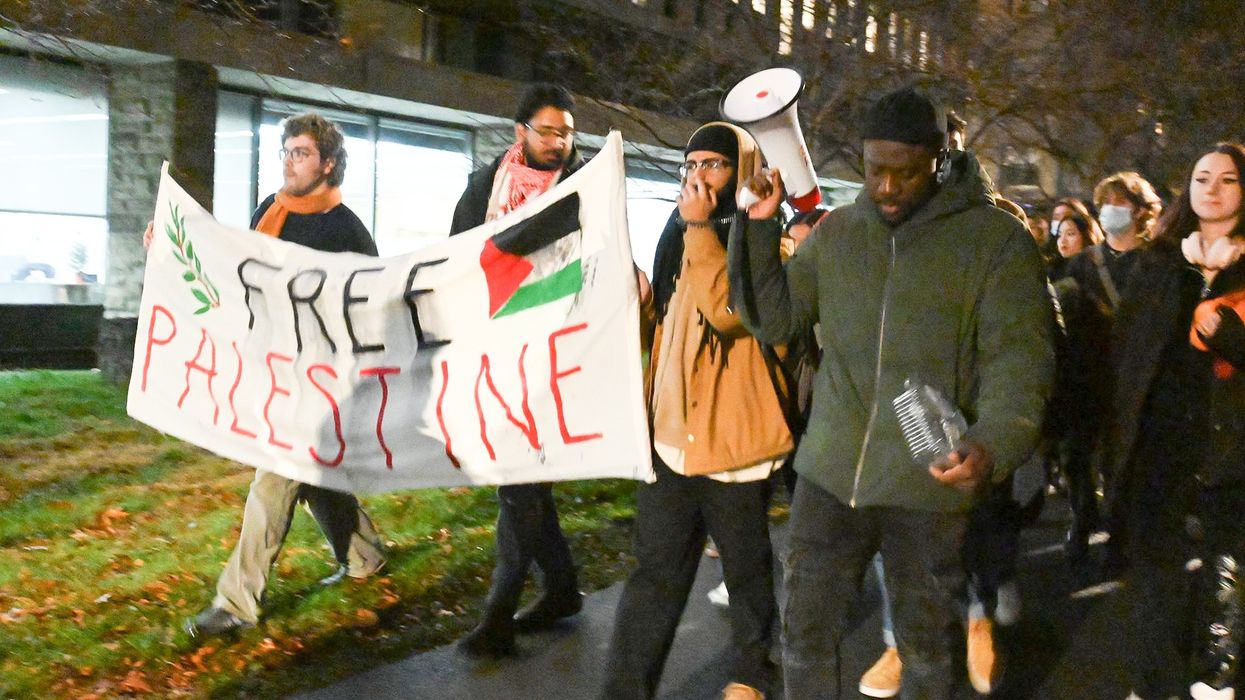
Pro-Palestine demonstrations continue at Cornell and on campuses across the nation and around the world. Last week, 17 activists led by the group Students for Justice in Palestine were
detained by police after interrupting a Cornell panel on the history of the so-called Israel-Palestine "conflict," whose members included former Israeli foreign minister and alleged war criminal Tzipi Livni.
"This is a deliberate targeting of a Black Muslim student at an institution where those two identities are increasingly unwelcome," said the Ph.D. candidate, Momodou Taal.
Two members of Congress on Friday joined the growing chorus of voices criticizing Cornell University for the administration's treatment of Ph.D. student Momodou Taal, a U.K. citizen who could be deported as a result of his pro-Palestinian activism on the Ithaca, New York campus.
"It is appalling that Cornell University appears ready to deport an international student without regard for due process, simply because of their presence at a protest. It is wrong, and I urge the university to reverse course immediately," U.S. Sen. Bernie Sanders (I-Vt.), a top congressional critic of Israel's assault on the Gaza Strip, said on social media early Friday.
Rep. Jamaal Bowman (D-N.Y.)—another opponent of genocide in Gaza who is set to leave the House of Representatives at the end of this term after losing his primary to a pro-Israel candidate—spoke out in support of Taal Friday evening.
"Momodou Taal participated in a peaceful student protest against weapons contractors' presence in a career fair—Cornell set into motion his deportation."
Former President Donald Trump, the Republican nominee for the November election, "showed us how he felt about Black immigrants, and I urge Cornell to refrain from doing the same," Bowman said on social media.
"Momodou Taal participated in a peaceful student protest against weapons contractors' presence in a career fair—Cornell set into motion his deportation," he explained. "Cornell must reverse his suspension. Student protest and free expression are critical rights that universities need to uphold for students and faculty alike."
Joel M. Malina, Cornell's vice president for university relations, has told multiple media outlets this week that "universities can disallow enrollment and bar a student from campus, but do not have deportation powers."
In response, Taal's attorney, Eric Lee, has called that statement "a cynical sleight of hand," given that "the administration has made the decision to persecute Mr. Taal for free speech activity knowing full well that doing so will subject him to serious immigration consequences," which sets "a dangerous national precedent."
Taal, 30-year-old a Ph.D. candidate in Africana studies who was teaching a writing seminar at Cornell, is part of the Coalition for Mutual Liberation. He was among over 100 students who marched into the on-campus career fair last week due to participation from Boeing and L3Harris, defense contractors that students targeted for "supporting the ongoing war in Gaza."
In a video interview with Taal published on Friday, The Cornell Daily Sun's Gabriel Levin noted that the newspaper does not know of any other students suspended because of the career fair protest. Taal suggested that he is being targeted because of his identity as a Black Muslim man and he is seen as a leader of pro-Palestinian campus activism.
Early Monday, Taal received an email about a Cornell police complaint against him related to the career fair protest—which contains allegations that the graduate student denies—and his resulting suspension. He has been barred from campus.
Because Taal has attended the Ivy League school with an F-1 visa, the suspension means he could soon be deported. As The Nation reported on Wednesday:
The F-1 visa program allows foreign nationals to reside in the United States if they are enrolled in an academic educational program, a language-training program, or a vocational program. Those with F-1 visas can also work on campus and in limited off-campus training positions. According to the Department of Homeland Security, suspension from an academic program is a valid reason for the termination of a record, which changes the immigration status of someone holding a F-1 visa.
Cornell University did not respond to questions about its policies and procedures regarding the suspension of a student with an F-1 visa.
As of publication, the university still refers to disciplinary action against Taal as a "temporary suspension." But by suspending Taal, the university set in motion immigration procedures without having to provide the level of evidence that due process would require, if the charges against Taal were criminal, which they are not.
Taal said on social media Thursday that "the VP of student and campus life, Ryan Lombardi, rejected my appeal after one business day. This demonstrates once again that my ability to stay in this country is being hastily handled without due process in a continued attempt to silence me. I have until 5:00 pm tomorrow to appeal to the provost. If the provost rejects this appeal, then I believe my withdrawal will be processed and I will promptly have to leave the country."
"Once again, there has been no investigation, nor have I had a chance to even respond to the allegations against me," he continued. "I maintain that all my actions have been peaceful and in accordance with my First Amendment rights. This is a deliberate targeting of a Black Muslim student at an institution where those two identities are increasingly unwelcome. When it comes to Palestine the university will abandon all commitments to academic freedom and free speech to protect its corporate interests."
Taal's next appeal goes to Cornell's interim provost, John Siciliano—who, in a Monday email to students, "advocated for severe punishments against pro-Palestinian activists, including legal action," as the Sun noted in a Thursday editorial.
Cornell is facing mounting pressure from students, professors, alumni, and campus groups as well as advocates and organizations in Ithaca and across the country to stop "unjustly" punishing Taal—who was also involved in pro-Palestinian advocacy at Cornell during the last academic year, as protests over Israel's assault on Gaza were held on campuses across the United States.
"What should make Taal's suspension troubling to every member of the Cornell community is not at all about whether one agrees with his beliefs—it's that the university hasn't shown Taal the due process that all students deserve," the Sun's editorial states. "Without an independent party weighing the evidence, this can't be called anything other than a kangaroo court in which the provost serves as judge, jury, and executioner."
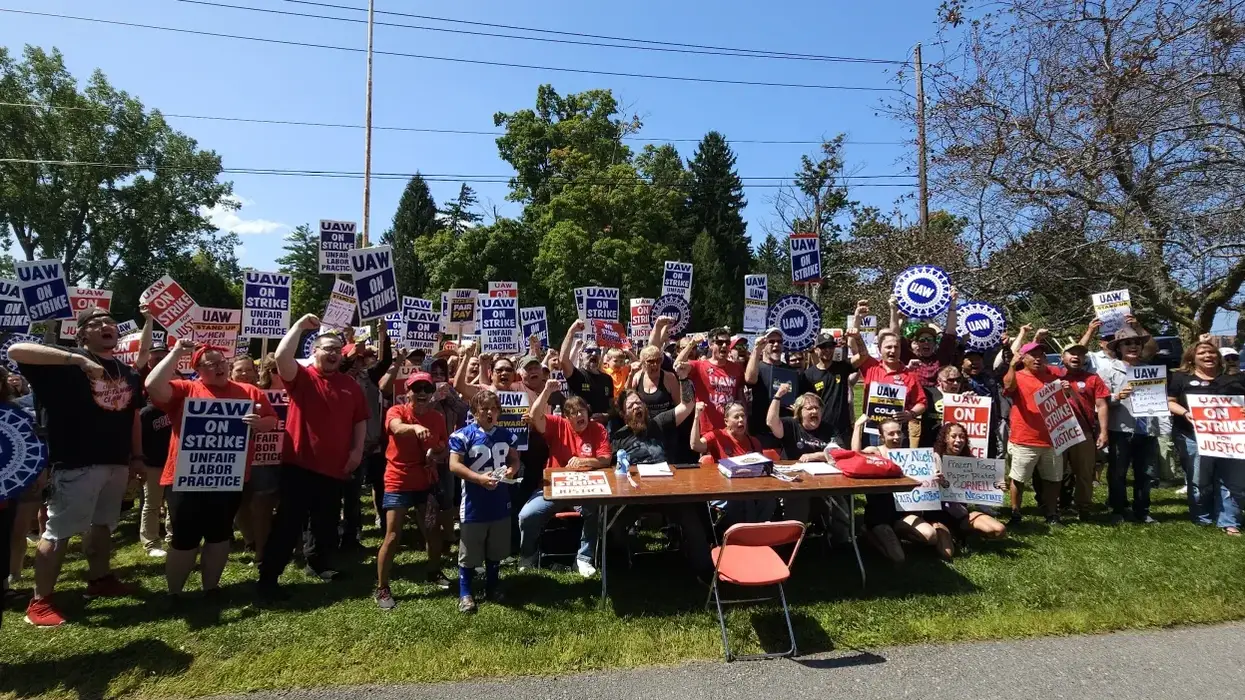
"To make matters worse, Cornell may have violated labor law, too," the newspaper detailed. "Cornell breached an agreement it had signed just three months ago with Cornell Graduate Students United, which requires the university to bargain with the union when graduate students might be de-enrolled or suspended. Here, no bargaining took place. The university simply chose to impose its will unilaterally."
Although the consequences of Taal's on-campus activism may be severe, he made clear on social media Friday evening that he "will never regret going hard for Palestine."