

SUBSCRIBE TO OUR FREE NEWSLETTER
Daily news & progressive opinion—funded by the people, not the corporations—delivered straight to your inbox.
5
#000000
#FFFFFF
To donate by check, phone, or other method, see our More Ways to Give page.
Daily news & progressive opinion—funded by the people, not the corporations—delivered straight to your inbox.
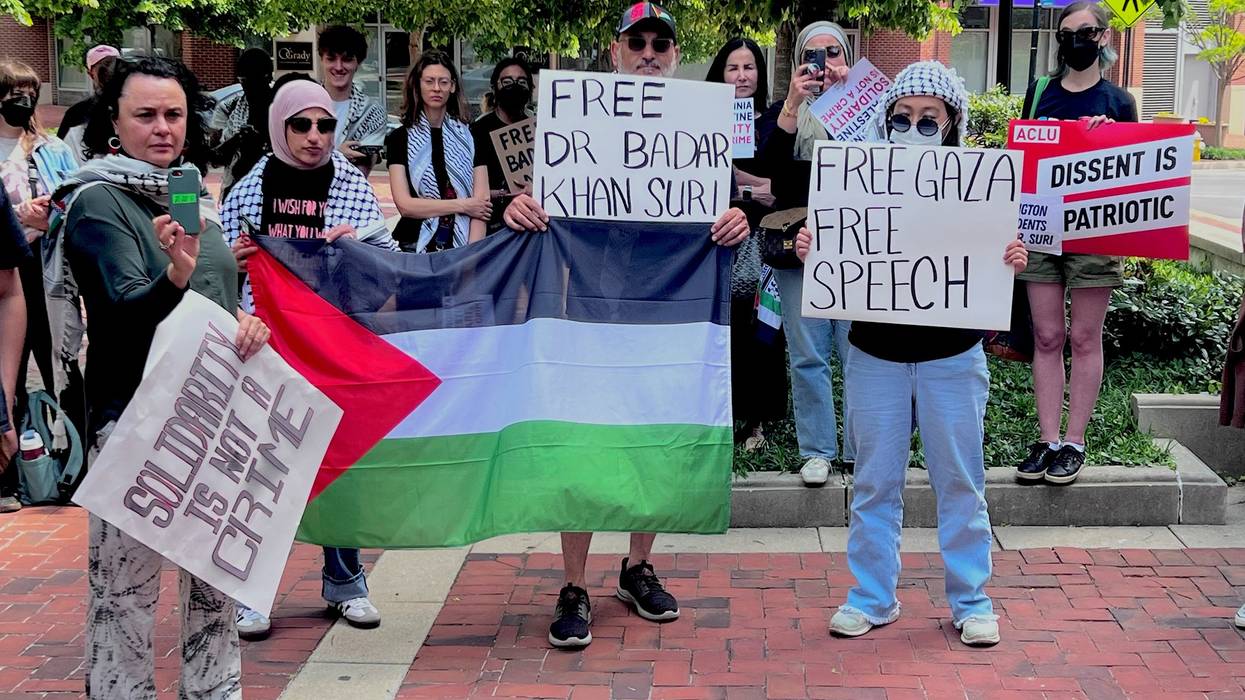
"My only 'crimes' making me a 'national security threat' are my marriage to a United States citizen of Palestinian origin and my support for the Palestinian cause," wrote Badar Khan Suri in an op-ed published on Tuesday.
After roughly two months of detention in a U.S. Immigration and Customs Enforcement facility, Georgetown University academic Badar Khan Suri is set to be released from custody following an order from a federal judge on Wednesday.
Khan Suri, an Indian national, was abducted by masked Department of Homeland Security (DHS) agents outside his home in Virginia in March—a scene similar to the arrests of foreign students who have supported Palestinian rights or criticized the U.S.-backed Israeli assault on the Gaza Strip.
In recent weeks, Mohsen Mahdawi, a Palestinian Columbia University student, and Rümeysa Öztürk, a Tufts University student, were both released from ICE detention after being arrested by federal immigration agents.
Judge Patricia Giles of the Eastern District of Virginia ordered Khan Suri's release on the condition that he attend other hearings in the case in person and continue living in Virginia, according to CNN.
Khan Suri, a postdoctoral fellow at Georgetown University, was teaching in the United States on a valid visa at the time of his arrest and is married to a U.S. citizen.
An attorney for Khan Suri, Hassan Ahmad, has indicated in media interviews that he believes Khan Suri was targeted because his father-in-law is Ahmed Yousef, a former adviser to the Hamas leader, Ismail Haniyeh. Yousef has publicly criticized Hamas' October 7, 2023 attack on Israel, according to The New York Times.
"My only 'crimes' making me a 'national security threat' are my marriage to a United States citizen of Palestinian origin and my support for the Palestinian cause," Khan Suri wrote in an op-ed published by Truthout on Tuesday.
"My beliefs do not allow me to ignore the pain of Palestinians. As a political prisoner, I face deprivation—of sleep, food, hygiene, and, worst of all, contact with my loved ones—but I take solace in knowing that I endure this ordeal for the children of Palestine, and I see my suffering as nothing compared to theirs," he wrote.

The ruling in Rümeysa Öztürk's case came less than 24 hours after courts ruled that Badar Khan Suri's case must be heard in Virginia and that Mahmoud Khalil's case must remain in New Jersey.
On Wednesday, Tufts University student Rümeysa Öztürk was the third detained international scholar in 24 hours to secure a victory in a case against the Trump administration when a federal appeals panel ordered the government to return Öztürk to Vermont from the crowded Louisiana detention center to which she was sent hours after plainclothes immigration agents arrested her in March.
The Second U.S. Circuit Court of Appeals handed down its ruling weeks after U.S. District Judge William K. Sessions III in Vermont ordered the administration to return Öztürk to the New England state, where she had been located when her attorneys filed a habeas corpus petition on her behalf.
Sessions' ruling had demanded that Öztürk be returned to Vermont for a hearing by May 1, but she remained in Louisiana—where the Trump administration has sent numerous foreign students marked for deportation to ensure their cases would be handled by conservative judges—as the White House appealed the case to the Second U.S. Circuit Court of Appeals.
That court said Wednesday that Öztürk must be sent back to Vermont by May 14, where a federal judge will hold a hearing on her habeas corpus petition on May 22. A bail hearing for Öztürk's release will also be held on May 9.
Öztürk's lawyers argue that the government is unconstitutionally retaliating against her for co-writing an op-ed in her school newspaper last year in which she called on Tufts to divest from companies tied to Israel and its bombardment of Gaza. She was detained in March by plainclothes immigration agents—some of whom wore masks—near her apartment in Somerville, Massachusetts.
"No one should be arrested and locked up for their political views," said Esha Bhandari, deputy director of the ACLU's Speech, Privacy, and Technology Project, which is helping to represent Öztürk. "Every day that Rümeysa Öztürk remains in detention is a day too long. We're grateful the court refused the government’s attempt to keep her isolated from her community and her legal counsel as she pursues her case for release."
Lawyers recently submitted new filings in Öztürk's case in Vermont, describing her living conditions for nearly two months in Louisiana.
In a cramped room with 23 other women, Öztürk has suffered progressively more severe asthma attacks and has been exposed to triggers for her asthma, including insect and rodent droppings and a lack of fresh air.
"Rümeysa has suffered six weeks in crowded confinement without adequate access to medical care and in conditions that doctors say risk exacerbating her asthma attacks. Her detention—over an op-ed she co-authored in her student newspaper—is as cruel as it is unconstitutional," said Jessie Rossman, legal director for the ACLU of Massachusetts. "Today, we moved one step closer to returning Rümeysa to her community and studies in Massachusetts."
With Öztürk expected to return to Vermont within days, the ACLU this week was also celebrating another "huge blow for the Trump administration" in the case of Georgetown University postdoctoral fellow Badar Khan Suri, who was also arrested in March by masked immigration agents before being secretly transported first to Louisiana and then to Texas.
A federal court ruled Suri's habeas corpus case should be heard in a court in Virginia, where he was living with his wife and young children when he was detained.
The Department of Homeland Security said Suri was "rendered deportable" under the Immigration and Nationality Act because he was found "spreading Hamas propaganda and promoting antisemitism on social media"—claims for which DHS offered no evidence.
His lawyers have argued he was being detained for constitutionally protected speech in support of Palestinian rights.
A federal court in Virginia is now set to hear Suri's case regarding his demand to be returned to Virginia and released on bond on May 14.
Eden Heilman, legal director for the ACLU of Virginia, said the court rejected the Trump administration's effort to "find a court it believed would be friendlier to its unlawful detention of people advocating for Palestinian rights."
"We are pleased the court saw through the Trump administration's attempts to manipulate the law, and we won't stop fighting until Dr. Khan Suri is reunited with his family," said Heilman.
Meanwhile, the Third Circuit Court of Appeals in Philadelphia on Tuesday rejected the Trump administration's effort to appeal the issue of where former Columbia University student organizer Mahmoud Khalil's habeas corpus case should be heard, ensuring that a federal court in New Jersey—where Khalil was detained when the petition was filed—will remain the venue for the case.
The administration has been pushing for Khalil's case to be heard in Louisiana, where he has also been in Immigration and Customs Enforcement detention since March, when ICE agents accosted him and his pregnant wife and took him away in an unmarked vehicle—eventually sending him 1,400 miles away from his wife and his legal counsel, where he remained last month during the birth of his first child.
Brett Max Kaufman, senior counsel with the ACLU's Speech, Privacy, and Technology Project, expressed hope that Tuesday's ruling "sends a strong message to other courts around the country facing government attempts to shop for favorable jurisdictions by moving people detained on unconstitutional immigration charges around."
"It is the fundamental job of the judiciary," said Kaufman, "to stand up to this kind of government manipulation of our basic rights."
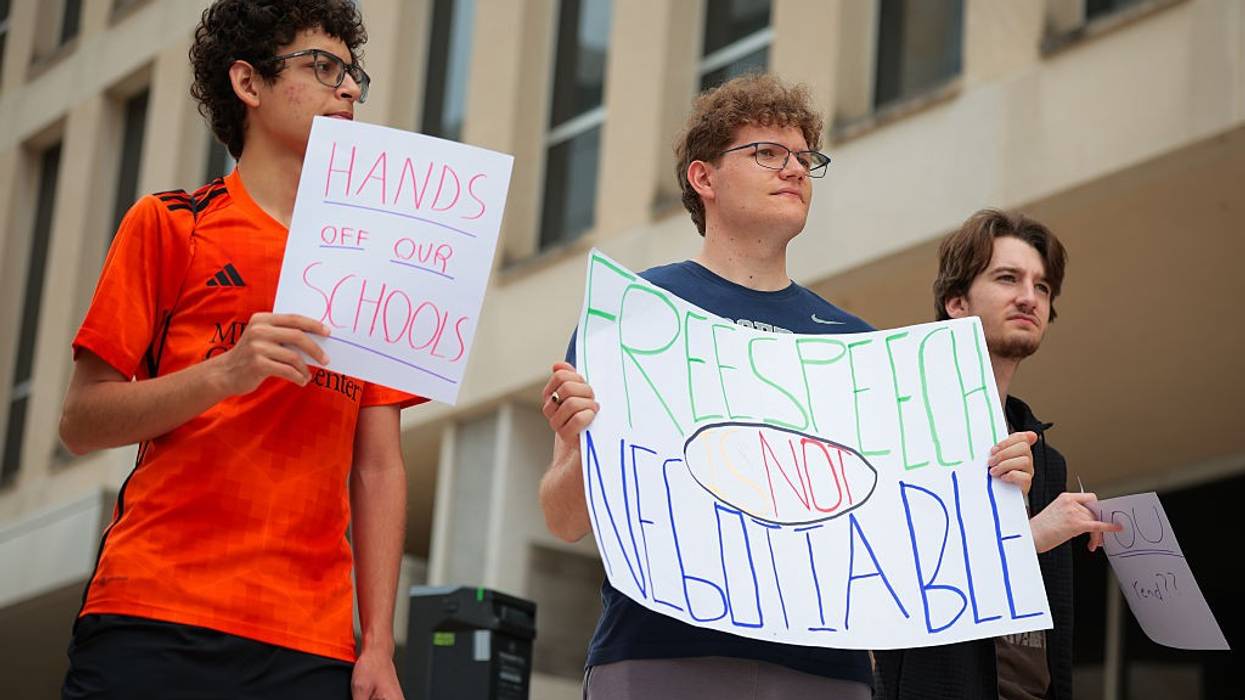
"Making Jews the face of this autocratic initiative feeds antisemitic conspiracy theories and is dangerous for Jews, on campuses and beyond," says the public statement.
Over 130 Jewish Georgetown University alumni, students, faculty, and staff on Friday collectively spoke out against the Trump administration's attempt to deport postdoctoral fellow Badar Khan Suri and declared that "the growing wave of politically motivated campus deportation efforts is an authoritarian move that harms the entire campus community."
Khan Suri, an Indian national, was abducted by masked Department of Homeland Security (DHS) agents outside his home in Virginia last month—a scene similar to the arrests of other foreign students who have supported Palestinian rights or criticized the U.S.-backed Israeli assault on the Gaza Strip, which experts across the globe condemn as genocide.
"Despite having a valid visa, the agents detained Dr. Khan Suri and rapidly transferred him to a detention center in Louisiana and then Texas," explains Friday's joint statement. "Dr. Khan Suri is a valued member of the Georgetown community. In addition to the impact this has had on him, these events have terrified his students and colleagues, his wife, three young children, and parents, and his broader family and friends."
The statement says that "the political arrest, detention, and attempted deportation of Dr. Khan Suri and others across the U.S., including Columbia University student Mahmoud Khalil and Tufts University Ph.D. candidate Rumeysa Ozturk, as well as the revocation of hundreds of student and work visas, are transgressions of civil liberties by the Trump administration and DHS that are commonly seen under authoritarian governments. This should alarm us all."
"The Trump administration is waging attacks on our spaces of learning, including by politically targeting, harassing, detaining and attempting to deport Palestinian, Arab, Muslim, international, and immigrant community members, all while claiming to do so in the name of Jewish safety," the statement continues, citing a White House social mediapost.
President Donald Trump "is weaponizing Jewish identity, faith, and fears of antisemitism as a smokescreen for his authoritarian agenda, further damaging the campus climate for everyone," the statement asserts. "Making Jews the face of this autocratic initiative feeds antisemitic conspiracy theories and is dangerous for Jews, on campuses and beyond. For multiple reasons, it is crucial that we as Jewish community members at Georgetown speak out and act against this, and we encourage Jews on and off campuses everywhere to do the same."
The statement calls for the immediate release of all who have been "unjustly detained" and an end to "all authoritarian actions" against campuses. It also urges elected officials as well as Jewish community leaders and institutions, including Hillel and the Anti-Defamation League, "to clearly and officially condemn and oppose these acts" by the federal government.
The statement—set to be published by the campus newspaper, The Hoya—also endorses the Georgetown administration's Jesuit commitment to "build an environment where all members of our community are free to express their thoughts" and that recognizes "the human dignity of all," and urges the university's leaders "to continue and strengthen these efforts."
Asked about the statement by NPR, DHS spokesperson Tricia McLaughlin responded, "Pretty absurd mental gymnastics to believe that revoking visas of individuals who glorify and support terrorists, harass Jews, and do the bidding of organizations that relish the killing of Americans and Jews, is in fact, making Jewish students less safe."
This is so telling. A bunch of Jewish students and faculty at Georgetown signed a letter protesting the arrest and detention of scholar Badar Khan Suri, saying it makes Jews less safe. The Trump administration responded saying, in short, "We know better than Jews on campus what makes Jews safe."
[image or embed]
— Joel S. (@joelhs.bsky.social) April 11, 2025 at 12:41 PM
The school is maintaining an official webpage for U.S. immigration policy and regulatory updates. The latest post, from Wednesday, states: "We are aware of approximately six community members who have had their immigration status terminated. The reasons given for such terminations are limited, and Georgetown University was not informed of them by the government."
For The Hoya's Thursday reporting on that update, the newspaper spoke with Nader Hashemi, director of the School of Foreign Service's Alwaleed Center for Muslim-Christian Understanding, where Khan Suri was a postdoctoral researcher.
"Six lives have effectively been destroyed," Hashemi said. "I hope the university will live up to its pledges to support students in this difficult moment, particularly international students who've been affected."
"I think the university's statements and the communication has been very good so far," Hashemi added. "I think most faculty and students are basically happy with what the university has been doing, and I hope the university will continue to support students who have been unjustly and illegally targeted by this authoritarian regime that's empowered now in Washington."
The newspaper
reported Friday that students with a new protest group, the GU Student Coalition Against Repression, "planned to stage a sit-in in Healy Hall but moved outside the gates after Georgetown University Police Department (GUPD) officers forcibly removed them from Healy." The action was timed to coincide with the weekend during which potential students, admitted for the following academic year, visit campus.
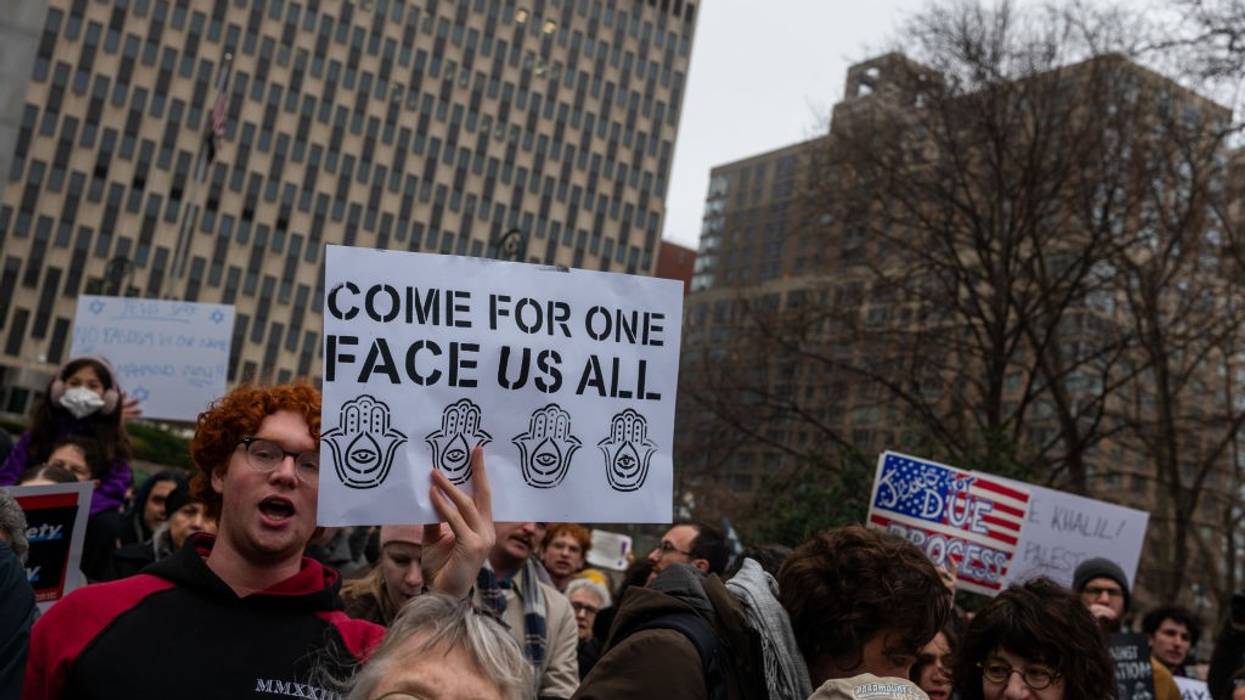
"Immigrants are not the enemy, we are part of the worker movement towards justice which includes fair wages, healthcare, education, housing, and solidarity," said one social justice group.
The Trump administration sparked a fresh wave of fury over its deportation agenda with the Tuesday detentions of Tufts University Ph.D. student Rumeysa Ozturk in Massachusetts and Alfredo "Lelo" Juarez Zeferino, a farmworker activist in Washington state.
The Boston Globe reported that Ozturk, a Turkish national, is a "student at the Tufts's doctoral program for Child Study and Human Development, according to her LinkedIn, and graduated with a master's degree from the Teachers College at Columbia University."
The Fulbright Scholar is one of several foreign academics—including multiple from Columbia in New York—targeted by Immigration and Customs Enforcement (ICE) after speaking out about the U.S.-backed Israeli assault on the Gaza Strip.
According to the Globe:
Ozturk does not appear to be a leading figure of the Pro-Palestinian protest movement at Tufts. But according to Ozturk's attorney, the student's photo and other identifying information were recently posted on Canary Mission, a website that documents individuals and organizations it considers to be antisemitic. Pro-Palestinian protesters say the site has doxxed and targeted them.
In March 2024, Ozturk co-authored an op-ed in the Tufts Daily, the university's student paper, criticizing the university's response to the pro-Palestinian movement and efforts by members of the student body to sever its ties to Israel.
"In a statement provided through her attorney, community activists said that Ozturk was 'ambushed' by ICE agents on the way to an Iftar dinner with friends after leaving her apartment," the newspaper noted. "Neighbors reported that unmarked cars had allegedly been surveilling the location for two days before apprehending her on the street."
Responding to reporting on social media, the group RootsAction
said: "Another pro-Palestine student kidnapped off the streets and disappeared by the Feds. Rumeysa Ozturk was abducted last night by ICE after leaving her apartment to go to Iftar dinner."
Jonathan Cohn, political director for the organization Progressive Mass,
declared that "the Trump administration's ICE goons are acting like kidnappers because that's what they are."
Authorities faced similar backlash for their actions toward Mahmoud Khalil, a legal permanent resident who last year helped lead protests and finished his graduate studies at Columbia. When Khalil's family released a video of his arrest earlier this month, his wife, Noor Abdalla, said, "This felt like a kidnapping because it was: Officers in plain clothes—who refused to show us a warrant, speak with our attorney, or even tell us their names—forced my husband into an unmarked car and took him away from me."
Not long after Khalil's detention, masked agents "abducted" Badar Khan Suri, a postdoctoral fellow at Georgetown University in Washington, D.C. One of Suri's attorneys called his case "emblematic of a broader strategy by the Trump administration to suppress voices—citizens and noncitizens alike—who dare to speak out against governmental policies."
An unverified video that appears to show Ozturk being taken into custody circulated on social media Wednesday.
Turkish PhD student Rumeysa Ozturk was detained by masked U.S. ICE agents yesterday while heading to an Iftar dinner in Massachusetts.
Ozturk, who held a valid F-1 visa and studied at Tufts University, was reportedly being watched for two days before her arrest.
She was on the… pic.twitter.com/eL92GyKE3J
— Clash Report (@clashreport) March 26, 2025
In a Tuesday email that did not name Ozturk, Tufts' president Sunil Kumar said: "We received reports that an international graduate student was taken into custody this evening by federal authorities outside an off-campus apartment building in Somerville. The university had no pre-knowledge of this incident and did not share any information with federal authorities prior to the event."
"From what we have been told subsequently, the student's visa has been terminated," Kumar continued. "We realize that tonight's news will be distressing to some members of our community, particularly the members of our international community. We will continue to provide information, support, and resources in the days ahead as more details become available to us."
Supporters of Ozturk are planning a rally in Powder House Square Park at 5:30 pm Eastern on Wednesday.
Meanwhile, on the other side of the country, Juarez "was detained violently by ICE," according to a Tuesday Facebook post from the social justice group Community to Community Development. "He was on his way to drop off his partner at her workplace, and ICE agents broke his car window when he tried to exercise his rights."
"We feel this is a targeted attack on farmworker leadership, and we must not allow this to continue," the group said, urging supporters to contact elected officials in Washington to demand his release. "Lelo's leadership and activism and leadership have been vital in protecting farmworkers and immigrants' rights and well-being."
"As unions, community organizations, student groups, and people who have decency, We Demand That ICE stays out of Washington and let workers be at peace," the group added. "Immigrants are not the enemy, we are part of the worker movement towards justice which includes fair wages, healthcare, education, housing, and solidarity."
The group's founder, Rosalinda Guillen, told The Seattle Times that Juarez, a 25-year-old berry picker and member of the Indigenous Mexican Mixteco community, has organized on behalf of farmworker rights in the state since he was just 14.
United Food and Commercial Workers International Union (UFCW) 3000 said in a statement that "we're furious over these credible reports of immigration enforcement violently detaining Alfredo 'Lelo' Juarez Zeferino, a longtime labor leader who fought for farmworkers and immigrant rights and who helped expose the existence of the very same unmarked ICE facility in Ferndale where he was reportedly held this afternoon."
"In response, our union members grabbed bullhorns and traveled directly to the facility to protest this injustice. We will continue to show up to worker-led actions as long as it takes," the union added. "By targeting workers like Lelo—and, reportedly, a union lab tech at the University of Washington—the Trump administration clearly aims to terrorize immigrant workers no matter how they came to this country. We will not stand for it."
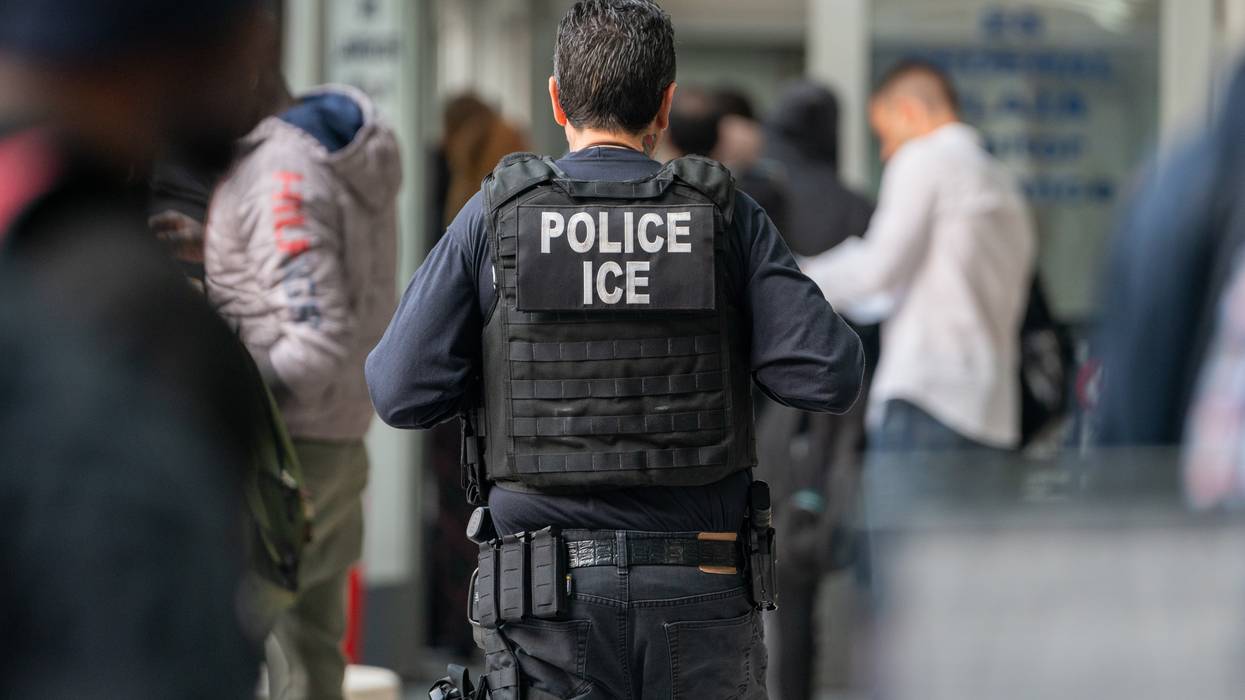
One of Badar Khan Suri's lawyers called the case "emblematic of a broader strategy by the Trump administration to suppress voices—citizens and noncitizens alike—who dare to speak out."
The Trump administration was accused of "abducting" a postdoctoral fellow at Georgetown University, following reporting that Badar Khan Suri, who was studying and teaching at the school on a student visa, was arrested by masked immigration authorities on Monday night.
Following his arrest, a spokesperson with the U.S. Department of Homeland Security said that Secretary of State Marco Rubio had determined that Suri's "activities and presence" in the United States "had rendered him deportable."
Agents who identified themselves as being with the U.S. Department of Homeland Security (DHS) arrested Suri, an Indian national, outside his home in Virginia, per Politico, which was first to report on Suri's arrest. The immigration officials told Suri that his student visa had been revoked, the outlet reported, citing court papers.
The news comes days after immigration agents arrested green-card holder Mahmoud Khalil, a graduate student at Columbia University until this past December who was involved in pro-Palestine demonstrations on the school's campus last year. U.S. President Donald Trump said that Khalil's arrest would be the "first of many."
"Another student who's legally in the U.S. was arrested for deportation, without a crime—allegedly for opposing U.S. foreign policy," said Nancy Okail, the head of the Center for International Policy. "If this absurdity continues, it won't be limited to specific groups. Any form of opposition will be punished and criminalized."
Nermeen Arastu, a member of Suri's legal team and an associate professor of law at the City University of New York similarly told the outlet Drop Site, "Mr. Suri's case is emblematic of a broader strategy by the Trump administration to suppress voices—citizens and noncitizens alike—who dare to speak out against governmental policies."
Tricia McLaughlin, assistant secretary for public affairs at DHS, wrote on X on Wednesday evening that Suri was "rendered deportable" under section of the Immigration and Nationality Act.
That is the same provision of immigration law that the Trump administration has invoked in its effort to Mahmoud Khalil.
"Suri was a foreign exchange student at Georgetown University actively spreading Hamas propaganda and promoting antisemitism on social media," McLaughlin also said. In the post, she did not add anything to bolster this claim. McLaughlin also wrote that Suri has connections to a "known or suspected terrorist, who is a senior adviser to Hamas."
Suri has not been charged with a crime, per his lawyer's petition for a writ of "habeas corpus," or an order demanding that he be brought to court to determine if he is lawfully detained, according Politico.
Suri's petition, filed on Tuesday in federal court by his lawyer Hassan Ahmed, argues that his arrest violates his First and Fifth Amendment rights, according to Drop Site, and also "challenges the legality of his detention under U.S. immigration law."
Politico reported that "Suri is being punished because of the Palestinian heritage of his wife—who is a U.S. citizen—and because the government suspects that he and his wife oppose U.S. foreign policy toward Israel," citing the petition.
Drop Site reported that Suri is currently being held at an Immigration and Customs Enforcement facility in Louisiana, though it is reportedly not the same facility as where Mahmoud Khalil is currently located.
Suri's wife, Mapheze Saleh, is a Georgetown graduate student in the Walsh School of Foreign Service's Center for Contemporary Arab Studies.
Her father, Ahmed Yousef, is a former adviser to the Hamas leader, Ismail Haniyeh, who was assassinated last year by Israeli security forces, according to The New York Times. Yousef told the Times that he departed his position as part of the Hamas-led government in Gaza over 10 years ago, and that his son-in-law is not involved in any "political activism." Yousef has also criticized Hamas' attack on Israel on October 7, 2023, per the Times.
Drop Site reported that Suri's arrest came after pro-Israel groups targeted Saleh with an "exceptionally public media campaign." The petition notes that Saleh and Suri have been targeted online due to their support for Palestinian rights, per Politico.
In February, the group CAMERA on Campus—which according to its X account helps students share "accurate education" and "correct misinformation" about Israel on campus—called Saleh a "Hamas affiliate" and alleged she "glorifie[d]" Hamas on social media. Also in February, the outlet Jewish News Syndicate published an opinion piece alleging that Suri "repeatedly endorsed Hamas terror and actively spreads its propaganda."
On Wednesday night, a Georgetown University spokesperson issued the following statement: "Dr. Khan Suri is an Indian national who was duly granted a visa to enter the United States to continue his doctoral research on peacebuilding in Iraq and Afghanistan. We are not aware of him engaging in any illegal activity, and we have not received a reason for his detention."
"We support our community members' rights to free and open inquiry, deliberation and debate, even if the underlying ideas may be difficult, controversial or objectionable. We expect the legal system to adjudicate this case fairly," the spokesperson wrote.