SUBSCRIBE TO OUR FREE NEWSLETTER
Daily news & progressive opinion—funded by the people, not the corporations—delivered straight to your inbox.
5
#000000
#FFFFFF
To donate by check, phone, or other method, see our More Ways to Give page.

I reviewed the appeals.
The CDE lacks authority to discipline school personnel, and the appeals I reviewed did not recommend teacher discipline. Teachers, however, have been told by their school districts to remove their keffiyehs and steer clear of stating as fact that Israel exemplifies “settler colonialism.” If an LEA or CDE finds a complaint has merit, it may order school districts to implement teacher training in antisemitism in consultation with a Jewish or Israeli organization. These orders open the door for Zionist organizations like the Anti-Defamation League and the American Jewish Committee to teach teachers that criticism of Israel is antisemitic and discriminates on the basis of national origin.
Teacher and Union del Barrio organizer Ron Gochez said the district’s edict that teachers remain silent in the face of a US-subsidized genocide was like telling teachers in Nazi Germany to take a neutral stance on the Holocaust.
The Civil Rights Act of 1964 prohibits discrimination in employment, education, and public accommodations based on someone’s birthplace or ancestry—but does not prohibit criticism of a sovereign state, which is protected speech according to the American Civil Liberties Union.
The CDE’s release of files reflects the department and school districts’ tendency to conflate anti-Zionism (opposition to Israel) with antisemitism (bigotry toward Jews for being Jewish). Under AB 715 (D-Zbur) legislation that establishes an antisemitism coordinator to police instruction and teacher training, this confusion could get a lot worse because AB 715 incorporates the US National Strategy to Counter Antisemitism, which promotes the International Holocaust Remembrance Alliance (IHRA) definition and examples that conflate criticism of Israel with antisemitism.
Teachers and their allies can, however, revolt: March on Sacramento, challenge Zionist teacher training, file their own complaints, and collectively teach Palestine across school departments and districts.
The following is a review of some of the CDE’s cases addressing allegations of antisemitism or discrimination against Jews or Israelis.
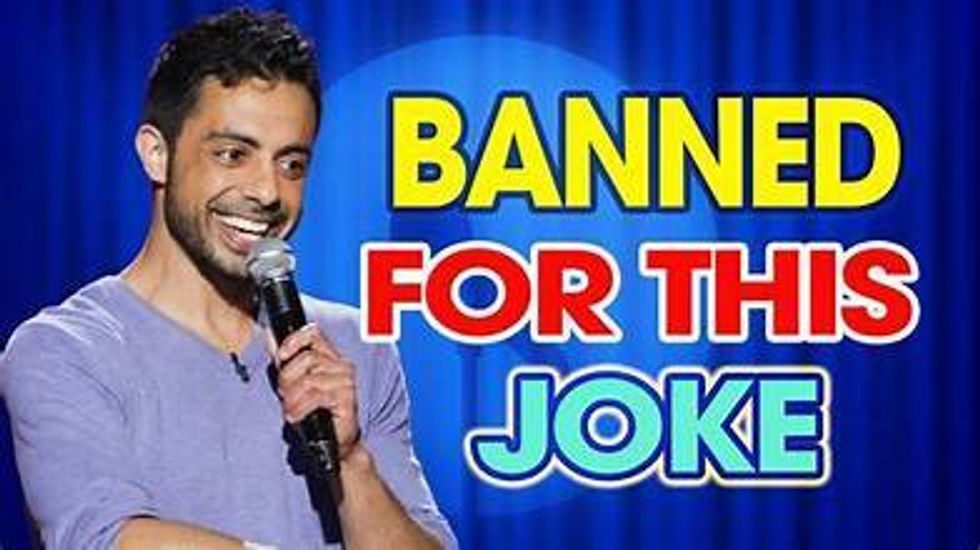 Sammy Obeid speaks on "The Abortion Joke That Got Me Banned From High School" (Image via Comedy Calculus)
In 2025, the principal of Mountain View Los Altos High School banned popular Lebanese-Palestinian American comedian Sammy Obeid after he cracked jokes about Israel at an after-school on-campus event in 2025 hosted by the Muslim Student Association (MSA). The school investigation report (IR) read, "During the event, the comedian made antisemitic remarks: about the Israeli Prime Minister getting cancer, calling the Prime Minister a supervillain, and how Israel does not believe in abortion so it can bomb more Palestinians.”
Months earlier, on November 21, 2024, the International Criminal Court (ICC) issued arrest warrants for Israeli Prime Minister Benjamin Netanyahu and then-Israeli Defense Minister Yoav Gallant for crimes against humanity in Gaza, including “starvation as a method of warfare, murder, persecution, and other inhumane acts.”
Nevertheless, the district concluded, after berating the Muslim students for inviting Obeid—that the comedian’s performance was antisemitic. The CDE agreed and ordered the district to further revise its guest speaker policies to include strict vetting and get-off-the-stage intervention should an administrator believe the speaker’s conduct discriminated against a protected group on the basis of ethnicity, nationality, immigration status, religion, sexual orientation, gender identity, gender expression, age, and physical or mental disabilities.
P.S. For the record, abortion is legal in Israel as long as women obtain approval from the Israeli Pregnancy Termination Board.
In another example of conflation, the CDE ordered (11/24/25) San Ramon Valley High School to deliver teacher training on antisemitism to all social studies teachers after the department ruled a teacher’s class statements were proof of discriminatory bias against Jewish and Israeli students. The department’s fact finding said the teacher told students that Israel was committing genocide in Gaza. Hardly breaking news. Human Rights Watch, B’Tselem, the International Association of Genocide Scholars, Doctors without Borders, and the United Nations International Commission of Inquiry had all determined Israel was committing genocide in Gaza.
Nonetheless, the CDE said the appeal had merit because the teacher did not cite sources and present an opposing viewpoint. The Department ordered San Ramon Valley High School to provide the CDE with evidence by January 30, 2026 that the school had delivered training from someone not affiliated with the school district to ensure that classroom instruction “does not promote a discriminatory bias.”
The Institute for the Understanding of Anti-Palestinian Racism (IUAPR) defines anti-Palestinian racism as a form of racism that “silences, excludes, erases, stereotypes, defames, or dehumanizes Palestinians or their narratives.”
A CDE ruling involving New Haven Unified School District might serve as an example of erasing the human rights and worth of Palestinians. After teachers in the summer 2025 Ethnic Studies Social Justice Academy (ESSJA) presented a slide deck describing actions by Israelis against Palestinians as potentially constituting “genocide, ethnic cleansing, and settler colonialism,’ the department said instruction lacked adequate balance and historical context, and cast Israel in a negative light. The department acknowledged that the slides for students also discussed the horrific impact of the Holocaust, the ancient connection of Jews to the land also claimed by Palestinians, and how “the Israeli government is separate from innocent Israeli/Jewish people who stand for justice,” but still...
The department then ordered the school district to train ESSJA teachers and administrators in the “obligation to comply with Education Code 51500, which states that a teacher shall not deliver instruction, and a school district shall not sponsor any activity that promotes a discriminatory bias.”
Points for the MAGA team.
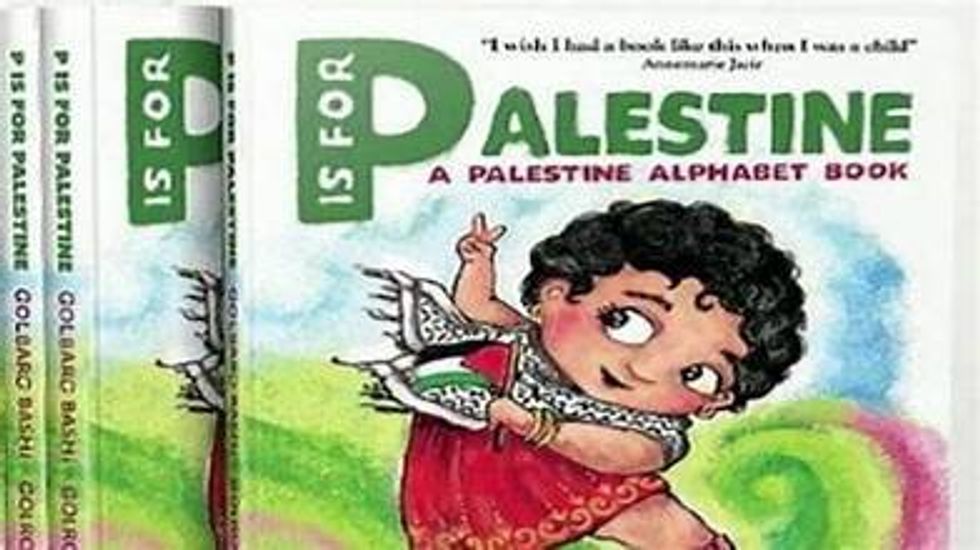 Oakland rank and file teachers included P Is for Palestine on their recommended list of resources at a December 2023 teach-in on Gaza; the Brandeis Center for Human Rights objected in a lawsuit against California.
Rank and file Oakland educators circulated an Open Letter in spring 2026 calling on the district “to resist the concerted attacks by political groups who slander as 'antisemitic' anyone who criticizes Israeli apartheid and genocide or Zionism.” Yet, the Oakland Unified School District, facing a lawsuit from the CDE, still mandated teachers watch and interact with an Anti-Defamation League 20-minute video “Antisemitism: What Do Educators Need to Know,” which defines antisemitism as “marginalization and/or oppression of people who are Jewish based on the belief in stereotypes and myths about Jewish people, Judaism, and Israel.”
The ADL training stands in dramatic contrast to a teach-in rank-and-file Oakland teachers organized in December 2023, two months after October 7, as Israel dropped 2,000-pound bombs on Gaza, one of the most densely populated areas on Earth. Objecting to district resources from Zionist-funded organizations, the teachers provided workshop participants with a recommended list of books, films, and lessons.
Across the bay, in San Francisco, in the fall of 2024, a dozen teachers declined to participate in district antisemitism training with the American Jewish Committee, a Zionist organization that boasts on its website, “We stand up for Israel.” Teachers instead chose to attend professional development with PARCEO, a non-Zionist organization anchored in the belief that ending antisemitism is part of an intersectional fight for collective liberation of all people.
Down in Los Angeles, teachers and community members rallied (5/16/26) in front of the Downtown Business Magnet to protest the Los Angeles Unified School District (LAUSD) decree that ethnic studies and social studies teachers remove “Stop Genocide” posters and Palestinian and Black Lives Matter flags, as well as undergo teacher training on the use of “neutral terms” to describe sensitive topics, including Israel’s slaughter and starvation of Gaza.
Teacher and Union del Barrio organizer Ron Gochez said the district’s edict that teachers remain silent in the face of a US-subsidized genocide was like telling teachers in Nazi Germany to take a neutral stance on the Holocaust.
In another act of resistance, K-12 Legal Defense, led by attorney Liz Jackson, and San Francisco law firm Leonard Carder, LLP, filed a motion (5/11/16) to intervene in Brandeis v California on behalf of a group of 10 California families—Jewish and Palestinian parents and students enrolled in public schools.
For teachers walking a tightrope under the watchful eye of an AB 715 enforcer, there are some lessons that lend themselves to a “both sides” debate: South Africa vs. Israel at the International Court of Justice or Zionists vs. non-Zionists on school board adoption of the IHRA definition and examples of antisemitism. In many instances, however, the “both sides” approach fails to acknowledge the power imbalance between Israel and Palestine to leave students confused.
History will not look back kindly on those demanding investigations of educators who dare to teach about Palestine during a documented genocide. Nor will history applaud those who conflate criticism of Israel with antisemitism in lawsuits against states and school districts.



Numerous AI-generated clips depicted Orthodox Jews in different settings, appearing to be obsessed with money, while other reels denied the Holocaust—questioning, for example, the possibility of preparing 6 million pizzas in 20 ovens. A few of his school friends liked the reels, thinking they were funny.
Antisemitism is alive and well in the UK and across Europe. This must be vigorously clamped down on. But, instead of focusing on this very real problem, major Jewish groups have instead followed the Israeli government by instrumentalizing antisemitism in an effort to criminalize and silence Palestinians and their supporters in the struggle for liberation and self-determination.
On the Chronicle’s pages, Corbyn appears to be much more threatening to Jews than Hitler.
The cruel irony is that, in effect, these organisations are dramatically weakening the real fight against antisemitism.
A case in point is the Jewish Chronicle, the world’s oldest Jewish newspaper. In December 2024, the Chronicle published an article by commentator Melanie Phillips, who wrote: “Deranged fear and hatred of Jews and the aim of exterminating them define the Palestinian cause… Left-wing governments that ideologically support the Palestinian cause and also kowtow to Muslim constituencies in which Jew-hatred is rife, shockingly recycle the lies about Israel.”
Claiming that the worst offenders have been “the governments in Britain, Australia and Canada,” Phillips concluded by casting all supporters of the Palestinian cause as “facilitating deranged and murderous Jew-hatred.”
Three weeks later, the Chronicle published an article entitled, “Did Elon Musk really perform a Nazi salute at Trump rally?” The subtitle assured readers that “Jewish charities deny it was a Nazi reference,” while the Anti-Defamation League was quoted as saying that Musk’s gesture was “awkward” but not a Nazi salute.
The juxtaposition of these articles—one conflating pro-Palestinian activism with murderous antisemitism, and the other downplaying the concrete dangers of antisemitism, as manifested in a nefarious salute by one of the world’s most powerful people—provides a gateway into the Chronicle’s universe, and its aggressive campaign against any demonstration of solidarity with Palestinians.
Antisemitism is often stripped of its original meaning—namely, discrimination against Jews as Jews—and used instead as an “iron dome” to defend Israel from its critics. Articles like these led me to look more closely at how the newspaper has historically understood and employed antisemitism on its own pages—a research project whose findings were recently published.
Examining the appearance of the term “antisemitism” over a period of 100 years—from 1925 to 2024—I assumed that its occurrence would be most pronounced during the Holocaust, when antisemitism led to the extermination of 6 million Jews.
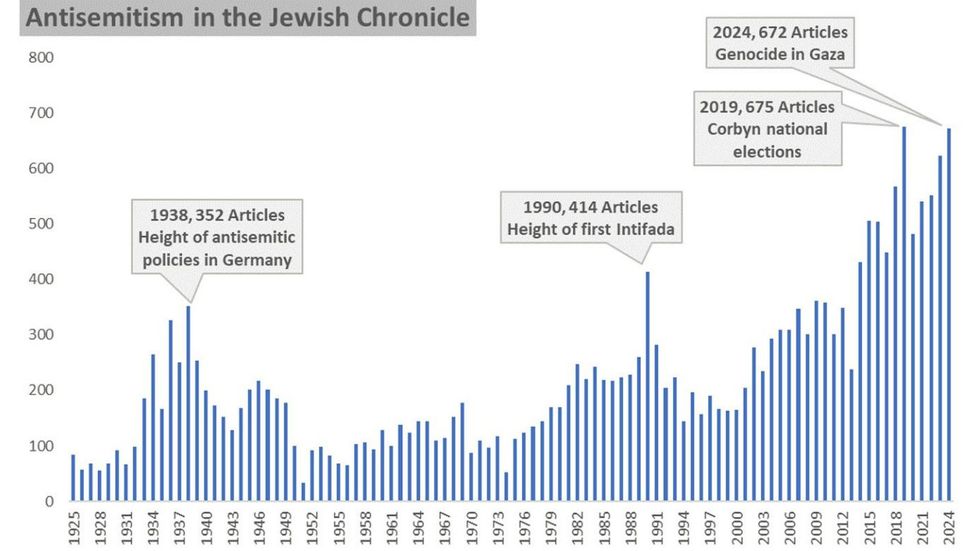 This graph shows the number of articles in the Jewish Chronicle that included the word "antisemitism," from January 1, 1925 to December 31, 2024. (Courtesy Neve Gordon)
The results, however, revealed that in 1938, at the height of the Nazi clampdown on Jews in Germany (which, unlike the “final solution,” was not shrouded in secrecy), antisemitism was mentioned in 352 articles. While this was substantially higher than its average appearance, it was substantially less than the term’s appearance during Jeremy Corbyn’s 2019 national election bid and Israel’s latest war on Gaza, where the number of articles invoking antisemitism was nearly double that.
Even though the term has become more common in recent decades, shockingly, in the Chronicle’s apparent view, the antisemitism threat is perceived as greater now than it was in the late 1930s and early 1940s.
Between January 2023 and June 2024—a period covering nine months before the 7 October attack and nine months after—the term antisemitism, almost always denoting anti-Zionism and criticism of Israel, appeared in roughly every fifth article. This suggests that the UK’s primary Jewish newspaper has been weaponizing a Zionist notion of antisemitism to produce moral panic among its readers.
The Jewish weekly, in other words, has played a role in whipping up fear and anxiety by falsely conflating antisemitism with anti-Zionism or criticism of Israel. This false and dangerous conflation explains the dramatic increase in the term’s frequency, and why on the Chronicle’s pages, Corbyn appears to be much more threatening to Jews than Hitler.
But for such spurious allegations to gain credibility, anti-Zionism and criticism of Israel must be constructed as posing an imminent threat to individual Jews around the world. This is accomplished, in part, by introducing another false conflation—this time between a person’s sense of “feeling uncomfortable” and “being unsafe.”
Given the fact that genuine antisemitism remains an all-too-present reality, the way the Chronicle has spouted the term risks displacing the threat of actual existing antisemitism.
Obviously, the claim that Israel is carrying out genocide, or that it constitutes a settler-colonial regime and an apartheid state, might make Jews who identify emotionally with Israel and Zionism “feel uncomfortable.”
But the Chronicle positions their discomfort as itself injurious, or as “being unsafe.” Ultimately, then, a fallacious notion of antisemitism is cast as a safety hazard to conjure up fears of Jewish annihilation—and this is then used as a counterinsurgency tool to silence Palestinian and pro-Palestinian activists who criticize Israel’s apartheid and, more recently, its genocidal war in Gaza.
Given the fact that genuine antisemitism remains an all-too-present reality, the way the Chronicle has spouted the term risks displacing the threat of actual existing antisemitism.
Indeed, the oldest surviving Jewish newspaper seems dead set on using antisemitism not so much to fight racism, but to defend a racist regime and cover up horrific violations. By abusing the term antisemitism, the newspaper is harming the very Jews it claims to represent—myself included.