SUBSCRIBE TO OUR FREE NEWSLETTER
Daily news & progressive opinion—funded by the people, not the corporations—delivered straight to your inbox.
5
#000000
#FFFFFF
To donate by check, phone, or other method, see our More Ways to Give page.
Daily news & progressive opinion—funded by the people, not the corporations—delivered straight to your inbox.
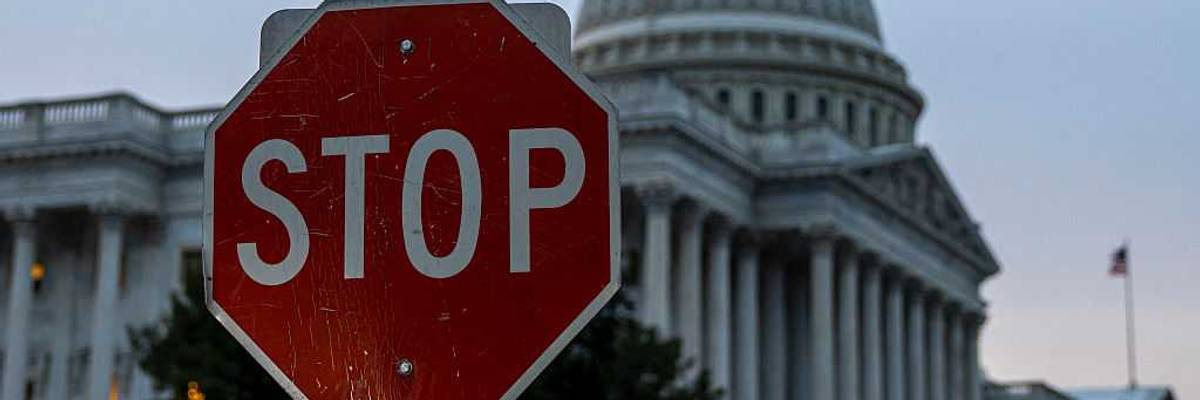
A view of the US Capitol on September 30, 2025, in Washington, DC.
It appears the shutdown will continue until there is a major reversal of positions by one side or other. In the Democrats’ case, it would mean giving up any leverage they have on spending.
Since there is a lot of confusion surrounding the shutdown, I thought it would be useful to go over some of the main points as I understand them. I will not pretend this is a comprehensive account, but there are some issues that are reasonably clear.
First, when Republicans claim that they are proposing a “clean” continuing resolution, they are ignoring a trillion-pound elephant in the room. In the past, when Congress passed a continuing resolution, it meant that the money appropriated in the resolution would be spent on the designated items. Under President Donald Trump, this is no longer true.
Trump has decided that because he was elected with a huge mandate (almost as large as Hillary Clinton’s in 2016) normal rules don’t apply to him. He has decided to unilaterally refuse to spend money appropriated by Congress.
He has done this through two routes. The first is through the recission process. Under this process, Congress can vote to reverse appropriations that were made in prior spending bills. Under the rules of the Senate, a recission bill cannot be filibustered so it can pass with just 50 votes. This was the process that Trump used to eliminate much of the foreign aid budget, as well as funding for public broadcasting.
If there is no commitment not to reverse appropriations through recission, and to prevent Trump from doing pocket recissions, Democrats cannot prevent any item in the continuing resolution from being subsequently cut.
The use of the recission process strips the Democrats of the filibuster power they hold with normal appropriations. The process had rarely been used in prior decades because it effectively means undermining the deals that were made to get an earlier budget bill approved.
But the situation gets even worse with the newly invented “pocket recission.” With a pocket recission, Trump effectively just refuses to spend appropriated money and then tells Congress towards the end of the fiscal year, “What do you know, I never got around to spending the money you appropriated in this or that area.” Congress never gets a chance to vote since the fiscal year is reaching its conclusion. It would have to reappropriate new money in the next fiscal year if it wanted the money to be spent.
In the old days, this pocket recission likely would have been ruled unconstitutional, since it makes a mockery of Congress’ power to spend, but it’s not clear what this Supreme Court would say. At this point, Trump has gotten away with pocket recissions covering several billion dollars of spending. There is certainly no guarantee that he will not do pocket recissions again in the new fiscal year.
Trump’s recent decisions to “cancel” items like a train tunnel between New York and New Jersey would also fit into this category of pocket recission. The possibility of a pocket recission means that any deal on spending with Trump is pointless, since any time he gets angry about something he can totally ignore his commitment, sort of like his trade deals.
This is why it is disingenuous to say that what the Republicans are offering is a “clean” continuing resolution. If there is no commitment not to reverse appropriations through recission, and to prevent Trump from doing pocket recissions, Democrats cannot prevent any item in the continuing resolution from being subsequently cut. This means that they effectively have no control over the budget once the continuing resolution is approved.
The treatment and rules on recissions would ordinarily be the sort of thing that would be negotiated prior to the approval of a continuing resolution, but there were no negotiations. Speaker Mike Johnson (R-La.) sent the House home shortly after July 4, in large part to avoid any vote on releasing the Epstein files, and Trump ordered Republican senators not to negotiate. There was only one negotiating session involving the congressional leaders and Trump one day before the end of the fiscal year. When no agreement was reached, we got the shutdown.
The Republicans had obviously prepared for the shutdown. They immediately started screaming about how the shutdown was because Democrats wanted to spend trillions providing Obamacare to “illegals.” They knew this was a lie but apparently hoped they could sell it anyhow. (Undocumented immigrants do not qualify for healthcare coverage, except through a Reagan-era law requiring that emergency rooms treat anyone in need of care. This obviously is not the issue, since Republicans have not even proposed repealing this law.)
It seems they have mostly given up on the lie, which Speaker Johnson bizarrely claimed to have in writing, and instead are harping on how Obamacare has been a disastrous failure. This also flies in the face of reality. The share of the population that is uninsured fell from 18% in 2010 to around 8% at present.
More importantly, the ACA ended the ability of insurers to discriminate based on preexisting conditions. In the pre-ACA insurance market, people with serious health conditions, like cancer or heart disease, would have to pay ridiculous prices for insurance, or were unable to get coverage at all. The ACA changed this, requiring that all people within an age group were charged the same.
This change is a huge deal not only for the people who directly benefit by now being able to get affordable insurance, but really the entire pre-Medicare age population. In the pre-ACA world, most of the working age population got insurance through their employer. This meant that even people with serious health issues could get insurance in their employers’ pool.
But if a heart attack or some other health problem prevented them from working, they would be forced to get individual insurance as a person with a serious health condition. The ACA effectively provides insurance that people can get insurance.
The ACA also sharply slowed healthcare cost-growth. The cost of Obamacare, Medicare, and Medicaid in the years since the ACA passed came in far below projections. The Republicans are obviously hoping that people either do not remember or do not know about the state of the insurance market before the ACA. Few who do would want to go back to that world.
The other game that Republicans are playing is the claim that they would be happy to negotiate, once the Democrats pass the continuing resolution. This is a silly game, since there is zero reason to expect Republicans to negotiate in good faith, once the Democrats have no leverage. They had all summer and September to negotiate but refused to do so.
In fact, there is absolutely no reason they can’t negotiate now. In prior shutdowns both parties had no problem carrying on negotiations. Trump himself even negotiated in the 2019 shutdown, the longest in history. If there is some principle about not negotiating during a shutdown, the Republicans have just invented it now.
Anyhow, it appears the shutdown will continue until there is a major reversal of positions by one side or other. In the Democrats’ case, it would mean giving up any leverage they have on spending. In the Republicans’ case, it would mean agreeing to negotiate.
Dear Common Dreams reader, It’s been nearly 30 years since I co-founded Common Dreams with my late wife, Lina Newhouser. We had the radical notion that journalism should serve the public good, not corporate profits. It was clear to us from the outset what it would take to build such a project. No paid advertisements. No corporate sponsors. No millionaire publisher telling us what to think or do. Many people said we wouldn't last a year, but we proved those doubters wrong. Together with a tremendous team of journalists and dedicated staff, we built an independent media outlet free from the constraints of profits and corporate control. Our mission has always been simple: To inform. To inspire. To ignite change for the common good. Building Common Dreams was not easy. Our survival was never guaranteed. When you take on the most powerful forces—Wall Street greed, fossil fuel industry destruction, Big Tech lobbyists, and uber-rich oligarchs who have spent billions upon billions rigging the economy and democracy in their favor—the only bulwark you have is supporters who believe in your work. But here’s the urgent message from me today. It's never been this bad out there. And it's never been this hard to keep us going. At the very moment Common Dreams is most needed, the threats we face are intensifying. We need your support now more than ever. We don't accept corporate advertising and never will. We don't have a paywall because we don't think people should be blocked from critical news based on their ability to pay. Everything we do is funded by the donations of readers like you. When everyone does the little they can afford, we are strong. But if that support retreats or dries up, so do we. Will you donate now to make sure Common Dreams not only survives but thrives? —Craig Brown, Co-founder |
Since there is a lot of confusion surrounding the shutdown, I thought it would be useful to go over some of the main points as I understand them. I will not pretend this is a comprehensive account, but there are some issues that are reasonably clear.
First, when Republicans claim that they are proposing a “clean” continuing resolution, they are ignoring a trillion-pound elephant in the room. In the past, when Congress passed a continuing resolution, it meant that the money appropriated in the resolution would be spent on the designated items. Under President Donald Trump, this is no longer true.
Trump has decided that because he was elected with a huge mandate (almost as large as Hillary Clinton’s in 2016) normal rules don’t apply to him. He has decided to unilaterally refuse to spend money appropriated by Congress.
He has done this through two routes. The first is through the recission process. Under this process, Congress can vote to reverse appropriations that were made in prior spending bills. Under the rules of the Senate, a recission bill cannot be filibustered so it can pass with just 50 votes. This was the process that Trump used to eliminate much of the foreign aid budget, as well as funding for public broadcasting.
If there is no commitment not to reverse appropriations through recission, and to prevent Trump from doing pocket recissions, Democrats cannot prevent any item in the continuing resolution from being subsequently cut.
The use of the recission process strips the Democrats of the filibuster power they hold with normal appropriations. The process had rarely been used in prior decades because it effectively means undermining the deals that were made to get an earlier budget bill approved.
But the situation gets even worse with the newly invented “pocket recission.” With a pocket recission, Trump effectively just refuses to spend appropriated money and then tells Congress towards the end of the fiscal year, “What do you know, I never got around to spending the money you appropriated in this or that area.” Congress never gets a chance to vote since the fiscal year is reaching its conclusion. It would have to reappropriate new money in the next fiscal year if it wanted the money to be spent.
In the old days, this pocket recission likely would have been ruled unconstitutional, since it makes a mockery of Congress’ power to spend, but it’s not clear what this Supreme Court would say. At this point, Trump has gotten away with pocket recissions covering several billion dollars of spending. There is certainly no guarantee that he will not do pocket recissions again in the new fiscal year.
Trump’s recent decisions to “cancel” items like a train tunnel between New York and New Jersey would also fit into this category of pocket recission. The possibility of a pocket recission means that any deal on spending with Trump is pointless, since any time he gets angry about something he can totally ignore his commitment, sort of like his trade deals.
This is why it is disingenuous to say that what the Republicans are offering is a “clean” continuing resolution. If there is no commitment not to reverse appropriations through recission, and to prevent Trump from doing pocket recissions, Democrats cannot prevent any item in the continuing resolution from being subsequently cut. This means that they effectively have no control over the budget once the continuing resolution is approved.
The treatment and rules on recissions would ordinarily be the sort of thing that would be negotiated prior to the approval of a continuing resolution, but there were no negotiations. Speaker Mike Johnson (R-La.) sent the House home shortly after July 4, in large part to avoid any vote on releasing the Epstein files, and Trump ordered Republican senators not to negotiate. There was only one negotiating session involving the congressional leaders and Trump one day before the end of the fiscal year. When no agreement was reached, we got the shutdown.
The Republicans had obviously prepared for the shutdown. They immediately started screaming about how the shutdown was because Democrats wanted to spend trillions providing Obamacare to “illegals.” They knew this was a lie but apparently hoped they could sell it anyhow. (Undocumented immigrants do not qualify for healthcare coverage, except through a Reagan-era law requiring that emergency rooms treat anyone in need of care. This obviously is not the issue, since Republicans have not even proposed repealing this law.)
It seems they have mostly given up on the lie, which Speaker Johnson bizarrely claimed to have in writing, and instead are harping on how Obamacare has been a disastrous failure. This also flies in the face of reality. The share of the population that is uninsured fell from 18% in 2010 to around 8% at present.
More importantly, the ACA ended the ability of insurers to discriminate based on preexisting conditions. In the pre-ACA insurance market, people with serious health conditions, like cancer or heart disease, would have to pay ridiculous prices for insurance, or were unable to get coverage at all. The ACA changed this, requiring that all people within an age group were charged the same.
This change is a huge deal not only for the people who directly benefit by now being able to get affordable insurance, but really the entire pre-Medicare age population. In the pre-ACA world, most of the working age population got insurance through their employer. This meant that even people with serious health issues could get insurance in their employers’ pool.
But if a heart attack or some other health problem prevented them from working, they would be forced to get individual insurance as a person with a serious health condition. The ACA effectively provides insurance that people can get insurance.
The ACA also sharply slowed healthcare cost-growth. The cost of Obamacare, Medicare, and Medicaid in the years since the ACA passed came in far below projections. The Republicans are obviously hoping that people either do not remember or do not know about the state of the insurance market before the ACA. Few who do would want to go back to that world.
The other game that Republicans are playing is the claim that they would be happy to negotiate, once the Democrats pass the continuing resolution. This is a silly game, since there is zero reason to expect Republicans to negotiate in good faith, once the Democrats have no leverage. They had all summer and September to negotiate but refused to do so.
In fact, there is absolutely no reason they can’t negotiate now. In prior shutdowns both parties had no problem carrying on negotiations. Trump himself even negotiated in the 2019 shutdown, the longest in history. If there is some principle about not negotiating during a shutdown, the Republicans have just invented it now.
Anyhow, it appears the shutdown will continue until there is a major reversal of positions by one side or other. In the Democrats’ case, it would mean giving up any leverage they have on spending. In the Republicans’ case, it would mean agreeing to negotiate.
Since there is a lot of confusion surrounding the shutdown, I thought it would be useful to go over some of the main points as I understand them. I will not pretend this is a comprehensive account, but there are some issues that are reasonably clear.
First, when Republicans claim that they are proposing a “clean” continuing resolution, they are ignoring a trillion-pound elephant in the room. In the past, when Congress passed a continuing resolution, it meant that the money appropriated in the resolution would be spent on the designated items. Under President Donald Trump, this is no longer true.
Trump has decided that because he was elected with a huge mandate (almost as large as Hillary Clinton’s in 2016) normal rules don’t apply to him. He has decided to unilaterally refuse to spend money appropriated by Congress.
He has done this through two routes. The first is through the recission process. Under this process, Congress can vote to reverse appropriations that were made in prior spending bills. Under the rules of the Senate, a recission bill cannot be filibustered so it can pass with just 50 votes. This was the process that Trump used to eliminate much of the foreign aid budget, as well as funding for public broadcasting.
If there is no commitment not to reverse appropriations through recission, and to prevent Trump from doing pocket recissions, Democrats cannot prevent any item in the continuing resolution from being subsequently cut.
The use of the recission process strips the Democrats of the filibuster power they hold with normal appropriations. The process had rarely been used in prior decades because it effectively means undermining the deals that were made to get an earlier budget bill approved.
But the situation gets even worse with the newly invented “pocket recission.” With a pocket recission, Trump effectively just refuses to spend appropriated money and then tells Congress towards the end of the fiscal year, “What do you know, I never got around to spending the money you appropriated in this or that area.” Congress never gets a chance to vote since the fiscal year is reaching its conclusion. It would have to reappropriate new money in the next fiscal year if it wanted the money to be spent.
In the old days, this pocket recission likely would have been ruled unconstitutional, since it makes a mockery of Congress’ power to spend, but it’s not clear what this Supreme Court would say. At this point, Trump has gotten away with pocket recissions covering several billion dollars of spending. There is certainly no guarantee that he will not do pocket recissions again in the new fiscal year.
Trump’s recent decisions to “cancel” items like a train tunnel between New York and New Jersey would also fit into this category of pocket recission. The possibility of a pocket recission means that any deal on spending with Trump is pointless, since any time he gets angry about something he can totally ignore his commitment, sort of like his trade deals.
This is why it is disingenuous to say that what the Republicans are offering is a “clean” continuing resolution. If there is no commitment not to reverse appropriations through recission, and to prevent Trump from doing pocket recissions, Democrats cannot prevent any item in the continuing resolution from being subsequently cut. This means that they effectively have no control over the budget once the continuing resolution is approved.
The treatment and rules on recissions would ordinarily be the sort of thing that would be negotiated prior to the approval of a continuing resolution, but there were no negotiations. Speaker Mike Johnson (R-La.) sent the House home shortly after July 4, in large part to avoid any vote on releasing the Epstein files, and Trump ordered Republican senators not to negotiate. There was only one negotiating session involving the congressional leaders and Trump one day before the end of the fiscal year. When no agreement was reached, we got the shutdown.
The Republicans had obviously prepared for the shutdown. They immediately started screaming about how the shutdown was because Democrats wanted to spend trillions providing Obamacare to “illegals.” They knew this was a lie but apparently hoped they could sell it anyhow. (Undocumented immigrants do not qualify for healthcare coverage, except through a Reagan-era law requiring that emergency rooms treat anyone in need of care. This obviously is not the issue, since Republicans have not even proposed repealing this law.)
It seems they have mostly given up on the lie, which Speaker Johnson bizarrely claimed to have in writing, and instead are harping on how Obamacare has been a disastrous failure. This also flies in the face of reality. The share of the population that is uninsured fell from 18% in 2010 to around 8% at present.
More importantly, the ACA ended the ability of insurers to discriminate based on preexisting conditions. In the pre-ACA insurance market, people with serious health conditions, like cancer or heart disease, would have to pay ridiculous prices for insurance, or were unable to get coverage at all. The ACA changed this, requiring that all people within an age group were charged the same.
This change is a huge deal not only for the people who directly benefit by now being able to get affordable insurance, but really the entire pre-Medicare age population. In the pre-ACA world, most of the working age population got insurance through their employer. This meant that even people with serious health issues could get insurance in their employers’ pool.
But if a heart attack or some other health problem prevented them from working, they would be forced to get individual insurance as a person with a serious health condition. The ACA effectively provides insurance that people can get insurance.
The ACA also sharply slowed healthcare cost-growth. The cost of Obamacare, Medicare, and Medicaid in the years since the ACA passed came in far below projections. The Republicans are obviously hoping that people either do not remember or do not know about the state of the insurance market before the ACA. Few who do would want to go back to that world.
The other game that Republicans are playing is the claim that they would be happy to negotiate, once the Democrats pass the continuing resolution. This is a silly game, since there is zero reason to expect Republicans to negotiate in good faith, once the Democrats have no leverage. They had all summer and September to negotiate but refused to do so.
In fact, there is absolutely no reason they can’t negotiate now. In prior shutdowns both parties had no problem carrying on negotiations. Trump himself even negotiated in the 2019 shutdown, the longest in history. If there is some principle about not negotiating during a shutdown, the Republicans have just invented it now.
Anyhow, it appears the shutdown will continue until there is a major reversal of positions by one side or other. In the Democrats’ case, it would mean giving up any leverage they have on spending. In the Republicans’ case, it would mean agreeing to negotiate.