SUBSCRIBE TO OUR FREE NEWSLETTER
Daily news & progressive opinion—funded by the people, not the corporations—delivered straight to your inbox.
5
#000000
#FFFFFF
To donate by check, phone, or other method, see our More Ways to Give page.
Daily news & progressive opinion—funded by the people, not the corporations—delivered straight to your inbox.
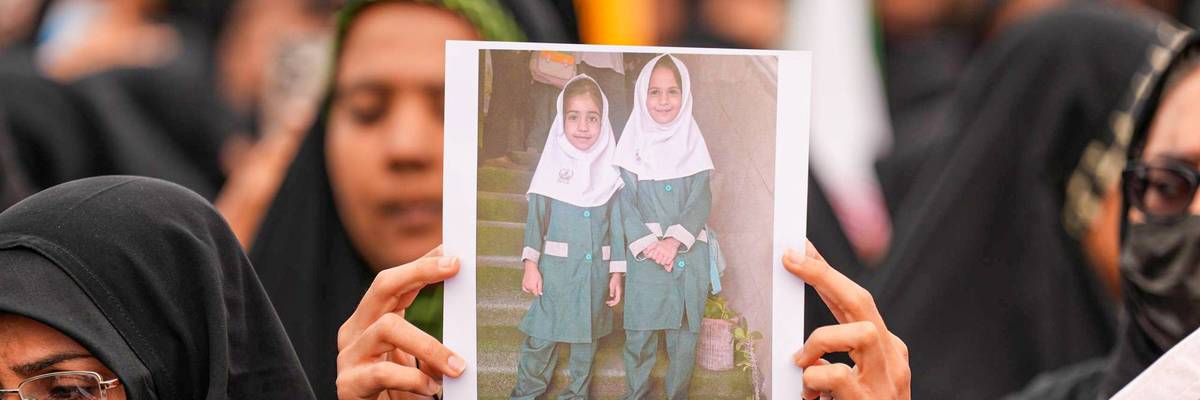
Mourners hold a portrait of a students during a funeral ceremony for children, who lost their lives after a primary school in Iran's Hormozgan province was targeted in US and Israeli attacks, on March 3, 2026 in Minab, Iran.
A child should not have to belong to our country, our community, or our side for us to recognize the value of that child’s life.
Summer passed. People traveled, went into nature, spent time with family, laughed, rested, and enjoyed life—and that is a good thing. Now school has started again, and children are walking back into classrooms with backpacks, excitement, and plans for another year.
But for many families, there is no return to normal.
Since the war in Iran began earlier this year, civilians have been killed, injured, displaced, and traumatized. Sometimes their stories reach us. Sometimes they barely break through the noise.
I still think about the girls’ elementary school in Minab, where more than 100 children were killed. They were children. Students. We call children “angels,” and then somehow their deaths become another statistic of war.
I will continue doing whatever is within my power—peacefully—to advocate, speak, question, educate, build bridges, and push back against the idea that one innocent life should matter more than another.
And now another story.
On September 1, a wedding celebration in southern Iran was struck. Families, women, and children were gathered there to celebrate a beginning. Instead, civilians were killed and dozens were injured.
A wedding.
Children.
Families.
Read those words again.
And yet stories like these can pass through the news cycle astonishingly quickly.
We have watched versions of this same human tragedy in Gaza, Sudan, Iran, and far too many other places. Different governments. Different conflicts. Different explanations. But ordinary people keep paying the price.
What a nasty world we are living in. Seriously, nasty.
What happens to us when war can be discussed in the language of “peace,” while dead civilians become “collateral damage”?
We are rightly taught: Never forget. We remember our national wounds. We remember the mornings when ordinary people left home and never returned. We remember atrocities and tragedies because remembering human suffering matters.
But “never forget” cannot be selective.
If we genuinely want a more peaceful world, remembrance must extend beyond nationality, religion, ethnicity, politics, and borders. A child should not have to belong to our country, our community, or our side for us to recognize the value of that child’s life.
And yes, I understand emotional exhaustion. Ordinary people become tired of war, death, images of suffering, and terrible news. Sometimes putting our heads in the sand feels like the only way to continue with our own lives.
I feel that exhaustion too.
But I keep coming back to something very simple:
Killing civilians is not peace.
Ignoring their deaths does not make their lives matter less.
And silence should never determine whose suffering the world is willing to see.
Politician, educator, community leader, friend—whoever we are—saying that we care about humanity and peace means very little unless, within whatever small sphere of influence we have, we are willing to protect those principles consistently.
So if you see me and ask, “How are you?”—this is part of my answer.
I am sad. I am tired. I am angry at how easily human suffering becomes normalized.
And while I sometimes want to put my own head in the sand too, I will continue doing whatever is within my power—peacefully—to advocate, speak, question, educate, build bridges, and push back against the idea that one innocent life should matter more than another.
No hatred. No revenge. No selective humanity.
Just the stubborn belief that peace has to mean something more than a word.s.
Dear Common Dreams reader, It’s been nearly 30 years since I co-founded Common Dreams with my late wife, Lina Newhouser. We had the radical notion that journalism should serve the public good, not corporate profits. It was clear to us from the outset what it would take to build such a project. No paid advertisements. No corporate sponsors. No millionaire publisher telling us what to think or do. Many people said we wouldn't last a year, but we proved those doubters wrong. Together with a tremendous team of journalists and dedicated staff, we built an independent media outlet free from the constraints of profits and corporate control. Our mission has always been simple: To inform. To inspire. To ignite change for the common good. Building Common Dreams was not easy. Our survival was never guaranteed. When you take on the most powerful forces—Wall Street greed, fossil fuel industry destruction, Big Tech lobbyists, and uber-rich oligarchs who have spent billions upon billions rigging the economy and democracy in their favor—the only bulwark you have is supporters who believe in your work. But here’s the urgent message from me today. It's never been this bad out there. And it's never been this hard to keep us going. At the very moment Common Dreams is most needed, the threats we face are intensifying. We need your support now more than ever. We don't accept corporate advertising and never will. We don't have a paywall because we don't think people should be blocked from critical news based on their ability to pay. Everything we do is funded by the donations of readers like you. When everyone does the little they can afford, we are strong. But if that support retreats or dries up, so do we. Will you donate now to make sure Common Dreams not only survives but thrives? —Craig Brown, Co-founder |
Summer passed. People traveled, went into nature, spent time with family, laughed, rested, and enjoyed life—and that is a good thing. Now school has started again, and children are walking back into classrooms with backpacks, excitement, and plans for another year.
But for many families, there is no return to normal.
Since the war in Iran began earlier this year, civilians have been killed, injured, displaced, and traumatized. Sometimes their stories reach us. Sometimes they barely break through the noise.
I still think about the girls’ elementary school in Minab, where more than 100 children were killed. They were children. Students. We call children “angels,” and then somehow their deaths become another statistic of war.
I will continue doing whatever is within my power—peacefully—to advocate, speak, question, educate, build bridges, and push back against the idea that one innocent life should matter more than another.
And now another story.
On September 1, a wedding celebration in southern Iran was struck. Families, women, and children were gathered there to celebrate a beginning. Instead, civilians were killed and dozens were injured.
A wedding.
Children.
Families.
Read those words again.
And yet stories like these can pass through the news cycle astonishingly quickly.
We have watched versions of this same human tragedy in Gaza, Sudan, Iran, and far too many other places. Different governments. Different conflicts. Different explanations. But ordinary people keep paying the price.
What a nasty world we are living in. Seriously, nasty.
What happens to us when war can be discussed in the language of “peace,” while dead civilians become “collateral damage”?
We are rightly taught: Never forget. We remember our national wounds. We remember the mornings when ordinary people left home and never returned. We remember atrocities and tragedies because remembering human suffering matters.
But “never forget” cannot be selective.
If we genuinely want a more peaceful world, remembrance must extend beyond nationality, religion, ethnicity, politics, and borders. A child should not have to belong to our country, our community, or our side for us to recognize the value of that child’s life.
And yes, I understand emotional exhaustion. Ordinary people become tired of war, death, images of suffering, and terrible news. Sometimes putting our heads in the sand feels like the only way to continue with our own lives.
I feel that exhaustion too.
But I keep coming back to something very simple:
Killing civilians is not peace.
Ignoring their deaths does not make their lives matter less.
And silence should never determine whose suffering the world is willing to see.
Politician, educator, community leader, friend—whoever we are—saying that we care about humanity and peace means very little unless, within whatever small sphere of influence we have, we are willing to protect those principles consistently.
So if you see me and ask, “How are you?”—this is part of my answer.
I am sad. I am tired. I am angry at how easily human suffering becomes normalized.
And while I sometimes want to put my own head in the sand too, I will continue doing whatever is within my power—peacefully—to advocate, speak, question, educate, build bridges, and push back against the idea that one innocent life should matter more than another.
No hatred. No revenge. No selective humanity.
Just the stubborn belief that peace has to mean something more than a word.s.
Summer passed. People traveled, went into nature, spent time with family, laughed, rested, and enjoyed life—and that is a good thing. Now school has started again, and children are walking back into classrooms with backpacks, excitement, and plans for another year.
But for many families, there is no return to normal.
Since the war in Iran began earlier this year, civilians have been killed, injured, displaced, and traumatized. Sometimes their stories reach us. Sometimes they barely break through the noise.
I still think about the girls’ elementary school in Minab, where more than 100 children were killed. They were children. Students. We call children “angels,” and then somehow their deaths become another statistic of war.
I will continue doing whatever is within my power—peacefully—to advocate, speak, question, educate, build bridges, and push back against the idea that one innocent life should matter more than another.
And now another story.
On September 1, a wedding celebration in southern Iran was struck. Families, women, and children were gathered there to celebrate a beginning. Instead, civilians were killed and dozens were injured.
A wedding.
Children.
Families.
Read those words again.
And yet stories like these can pass through the news cycle astonishingly quickly.
We have watched versions of this same human tragedy in Gaza, Sudan, Iran, and far too many other places. Different governments. Different conflicts. Different explanations. But ordinary people keep paying the price.
What a nasty world we are living in. Seriously, nasty.
What happens to us when war can be discussed in the language of “peace,” while dead civilians become “collateral damage”?
We are rightly taught: Never forget. We remember our national wounds. We remember the mornings when ordinary people left home and never returned. We remember atrocities and tragedies because remembering human suffering matters.
But “never forget” cannot be selective.
If we genuinely want a more peaceful world, remembrance must extend beyond nationality, religion, ethnicity, politics, and borders. A child should not have to belong to our country, our community, or our side for us to recognize the value of that child’s life.
And yes, I understand emotional exhaustion. Ordinary people become tired of war, death, images of suffering, and terrible news. Sometimes putting our heads in the sand feels like the only way to continue with our own lives.
I feel that exhaustion too.
But I keep coming back to something very simple:
Killing civilians is not peace.
Ignoring their deaths does not make their lives matter less.
And silence should never determine whose suffering the world is willing to see.
Politician, educator, community leader, friend—whoever we are—saying that we care about humanity and peace means very little unless, within whatever small sphere of influence we have, we are willing to protect those principles consistently.
So if you see me and ask, “How are you?”—this is part of my answer.
I am sad. I am tired. I am angry at how easily human suffering becomes normalized.
And while I sometimes want to put my own head in the sand too, I will continue doing whatever is within my power—peacefully—to advocate, speak, question, educate, build bridges, and push back against the idea that one innocent life should matter more than another.
No hatred. No revenge. No selective humanity.
Just the stubborn belief that peace has to mean something more than a word.s.