SUBSCRIBE TO OUR FREE NEWSLETTER
Daily news & progressive opinion—funded by the people, not the corporations—delivered straight to your inbox.
5
#000000
#FFFFFF
To donate by check, phone, or other method, see our More Ways to Give page.
Daily news & progressive opinion—funded by the people, not the corporations—delivered straight to your inbox.
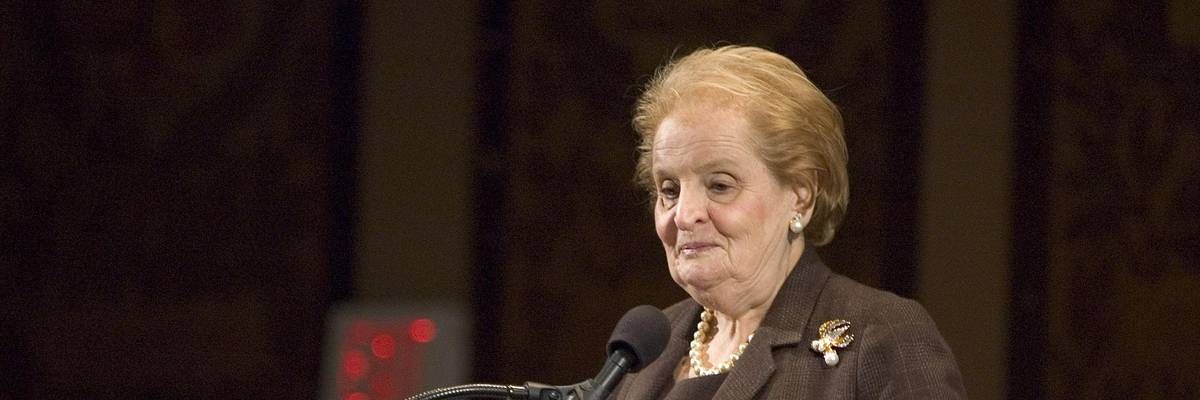
Former U.S. secretary of state Madeleine Albright (1937-2022) speaking during an event at Georgetown University in 2005. (Photo: Yakusha/flickr/cc)
Often, after the demise of political figures, their troubling histories are whitewashed in the name of respecting their memories and the feelings of their families. The passing of former United States Secretary of State Madeleine Albright on Wednesday has been no exception.
Western media responded to the news of her death with a plethora of obituaries eulogizing her achievements. Countless statements have been released, by governments, institutions and public figures, celebrating the "trailblazing" politician for being the first woman to hold the office of Secretary of State and for receiving the Presidential Medal of Freedom. Former President Bill Clinton, under whom Albright served as America's top diplomat, referred to her as "a passionate force for freedom, democracy, and human rights". President Joe Biden, meanwhile, proclaimed she "was always a force for goodness, grace, and decency - and for freedom".
Before you write or repost articles about Albright and how wonderful it is to see women pushing boundaries and breaking glass ceilings in politics, take a minute to learn what she chose to do with the power she had--how she supported the devastation and suffering of my people.
For me as an Iraqi, however, the memory of Albright will forever be tainted by the stringent sanctions she helped place on my country at a time when it was already devastated by years of war. Millions of innocent Iraqis suffered terribly and hundreds of thousands died because of the sanctions which, in the end, achieved almost none of Washington's policy objectives. As we remember Albright's life and achievements, we must also remember those innocent Iraqi lives lost because of her policy decisions.
The most prominent memory of Albright that I have in my mind is from an interview she gave to CBS 60 Minutes in 1996.
In that now-iconic interview, veteran journalist Lesley Stahl questioned Albright--then the US ambassador to the United Nations--on the catastrophic effect the rigorous US sanctions imposed after Iraq's invasion of Kuwait had on the Iraqi population.
"We have heard that half a million [Iraqi] children have died. I mean, that is more children than died in Hiroshima," asked Stahl, "And, you know, is the price worth it?"
"I think that is a very hard choice," Albright answered, "but the price, we think, the price is worth it."
With this response, Albright showed that she sees innocent Iraqi children as nothing more than disposable fodder in a conflict between the US administration and the Iraqi leadership.
She demonstrated, with no room left for any doubt, that she had no humanity--that she cannot and shall never be described as "a force for goodness, grace, and decency".
I remember sanctions era Iraq very well. It was almost impossible to maintain contact with family members and friends in the country, as telephone services remained very limited. When I visited Iraq, to my shock I saw even the most basic products - like milk - could not be found in local markets. The people were hungry and hopeless.
Indeed, the US imposed sanctions on Iraq to punish Saddam Hussein's regime, but it was innocent civilians, not the regime officials who suffered. The sanctions pushed the already struggling masses into deeper poverty, but only marginally affected the rich, widening the wealth gap in the country. As poor Iraqis struggled to put food on their tables, President Hussein and his inner circle maintained their lavish lifestyles. Despite crippling sanctions, the president managed to build 80 to 100 luxury palaces during his tenure.
By 2003, it is estimated that nearly 1.5 million Iraqis, primarily children, had died as a direct consequence of sanctions.
And this devastating toll was hardly surprising, or unexpected.
The sanctions, implemented in August 1990 by the UN Security Council Resolution 661, included a total financial and trade embargo. Not only was Iraq barred from exporting oil (its main income source) on the world market for several years, but it was also prevented from importing products from abroad.
This ban included healthcare equipment and medications, which translated into immeasurable suffering for common Iraqis, but placed no immediate pressure on Hussein's regime.
"Requested radiotherapy equipment, chemotherapy drugs and analgesics are consistently blocked by United States and British advisers [to the Sanctions Committee at the UN]," explained Professor Karol Sikora, then chief of the cancer programme of the World Health Organization, in a 1999 article published in the British Medical Journal. "There seems to be a rather ludicrous notion that such agents could be converted into chemical or other weapons."
According to UNICEF, the UN Children's Fund, the death rate of children below five crossed 4,000 a month due to the lack of food and basic medications caused by the sanctions - that is up to 200 babies and toddlers dying avoidable deaths a day.
Several UN officials resigned over the years in protest at this disastrous, ineffective and murderous sanctions policy, but Albright, the "passionate force for freedom, democracy and human rights", thought it was all "worth it".
To make matters worse, 13 years after the sanctions were first implemented to pressure the Iraqi regime, the US opted to invade the oil-rich country anyway under the pretense that Hussein managed to amass weapons of mass destruction despite the embargo. The years of suffering were for nothing - the sanctions had achieved nothing other than devastating millions of Iraqis who had no say over the actions of those ruling over them.
So, before you write or repost articles about Albright and how wonderful it is to see women pushing boundaries and breaking glass ceilings in politics, take a minute to learn what she chose to do with the power she had--how she supported the devastation and suffering of my people.
Today, with sanctions imposed on Venezuela still causing thousands of deaths among the country's poorest, and demands for more stringent sanctions on Russia getting louder, we cannot afford to whitewash Albright's mistakes.
Dear Common Dreams reader, It’s been nearly 30 years since I co-founded Common Dreams with my late wife, Lina Newhouser. We had the radical notion that journalism should serve the public good, not corporate profits. It was clear to us from the outset what it would take to build such a project. No paid advertisements. No corporate sponsors. No millionaire publisher telling us what to think or do. Many people said we wouldn't last a year, but we proved those doubters wrong. Together with a tremendous team of journalists and dedicated staff, we built an independent media outlet free from the constraints of profits and corporate control. Our mission has always been simple: To inform. To inspire. To ignite change for the common good. Building Common Dreams was not easy. Our survival was never guaranteed. When you take on the most powerful forces—Wall Street greed, fossil fuel industry destruction, Big Tech lobbyists, and uber-rich oligarchs who have spent billions upon billions rigging the economy and democracy in their favor—the only bulwark you have is supporters who believe in your work. But here’s the urgent message from me today. It's never been this bad out there. And it's never been this hard to keep us going. At the very moment Common Dreams is most needed, the threats we face are intensifying. We need your support now more than ever. We don't accept corporate advertising and never will. We don't have a paywall because we don't think people should be blocked from critical news based on their ability to pay. Everything we do is funded by the donations of readers like you. When everyone does the little they can afford, we are strong. But if that support retreats or dries up, so do we. Will you donate now to make sure Common Dreams not only survives but thrives? —Craig Brown, Co-founder |
Often, after the demise of political figures, their troubling histories are whitewashed in the name of respecting their memories and the feelings of their families. The passing of former United States Secretary of State Madeleine Albright on Wednesday has been no exception.
Western media responded to the news of her death with a plethora of obituaries eulogizing her achievements. Countless statements have been released, by governments, institutions and public figures, celebrating the "trailblazing" politician for being the first woman to hold the office of Secretary of State and for receiving the Presidential Medal of Freedom. Former President Bill Clinton, under whom Albright served as America's top diplomat, referred to her as "a passionate force for freedom, democracy, and human rights". President Joe Biden, meanwhile, proclaimed she "was always a force for goodness, grace, and decency - and for freedom".
Before you write or repost articles about Albright and how wonderful it is to see women pushing boundaries and breaking glass ceilings in politics, take a minute to learn what she chose to do with the power she had--how she supported the devastation and suffering of my people.
For me as an Iraqi, however, the memory of Albright will forever be tainted by the stringent sanctions she helped place on my country at a time when it was already devastated by years of war. Millions of innocent Iraqis suffered terribly and hundreds of thousands died because of the sanctions which, in the end, achieved almost none of Washington's policy objectives. As we remember Albright's life and achievements, we must also remember those innocent Iraqi lives lost because of her policy decisions.
The most prominent memory of Albright that I have in my mind is from an interview she gave to CBS 60 Minutes in 1996.
In that now-iconic interview, veteran journalist Lesley Stahl questioned Albright--then the US ambassador to the United Nations--on the catastrophic effect the rigorous US sanctions imposed after Iraq's invasion of Kuwait had on the Iraqi population.
"We have heard that half a million [Iraqi] children have died. I mean, that is more children than died in Hiroshima," asked Stahl, "And, you know, is the price worth it?"
"I think that is a very hard choice," Albright answered, "but the price, we think, the price is worth it."
With this response, Albright showed that she sees innocent Iraqi children as nothing more than disposable fodder in a conflict between the US administration and the Iraqi leadership.
She demonstrated, with no room left for any doubt, that she had no humanity--that she cannot and shall never be described as "a force for goodness, grace, and decency".
I remember sanctions era Iraq very well. It was almost impossible to maintain contact with family members and friends in the country, as telephone services remained very limited. When I visited Iraq, to my shock I saw even the most basic products - like milk - could not be found in local markets. The people were hungry and hopeless.
Indeed, the US imposed sanctions on Iraq to punish Saddam Hussein's regime, but it was innocent civilians, not the regime officials who suffered. The sanctions pushed the already struggling masses into deeper poverty, but only marginally affected the rich, widening the wealth gap in the country. As poor Iraqis struggled to put food on their tables, President Hussein and his inner circle maintained their lavish lifestyles. Despite crippling sanctions, the president managed to build 80 to 100 luxury palaces during his tenure.
By 2003, it is estimated that nearly 1.5 million Iraqis, primarily children, had died as a direct consequence of sanctions.
And this devastating toll was hardly surprising, or unexpected.
The sanctions, implemented in August 1990 by the UN Security Council Resolution 661, included a total financial and trade embargo. Not only was Iraq barred from exporting oil (its main income source) on the world market for several years, but it was also prevented from importing products from abroad.
This ban included healthcare equipment and medications, which translated into immeasurable suffering for common Iraqis, but placed no immediate pressure on Hussein's regime.
"Requested radiotherapy equipment, chemotherapy drugs and analgesics are consistently blocked by United States and British advisers [to the Sanctions Committee at the UN]," explained Professor Karol Sikora, then chief of the cancer programme of the World Health Organization, in a 1999 article published in the British Medical Journal. "There seems to be a rather ludicrous notion that such agents could be converted into chemical or other weapons."
According to UNICEF, the UN Children's Fund, the death rate of children below five crossed 4,000 a month due to the lack of food and basic medications caused by the sanctions - that is up to 200 babies and toddlers dying avoidable deaths a day.
Several UN officials resigned over the years in protest at this disastrous, ineffective and murderous sanctions policy, but Albright, the "passionate force for freedom, democracy and human rights", thought it was all "worth it".
To make matters worse, 13 years after the sanctions were first implemented to pressure the Iraqi regime, the US opted to invade the oil-rich country anyway under the pretense that Hussein managed to amass weapons of mass destruction despite the embargo. The years of suffering were for nothing - the sanctions had achieved nothing other than devastating millions of Iraqis who had no say over the actions of those ruling over them.
So, before you write or repost articles about Albright and how wonderful it is to see women pushing boundaries and breaking glass ceilings in politics, take a minute to learn what she chose to do with the power she had--how she supported the devastation and suffering of my people.
Today, with sanctions imposed on Venezuela still causing thousands of deaths among the country's poorest, and demands for more stringent sanctions on Russia getting louder, we cannot afford to whitewash Albright's mistakes.
Often, after the demise of political figures, their troubling histories are whitewashed in the name of respecting their memories and the feelings of their families. The passing of former United States Secretary of State Madeleine Albright on Wednesday has been no exception.
Western media responded to the news of her death with a plethora of obituaries eulogizing her achievements. Countless statements have been released, by governments, institutions and public figures, celebrating the "trailblazing" politician for being the first woman to hold the office of Secretary of State and for receiving the Presidential Medal of Freedom. Former President Bill Clinton, under whom Albright served as America's top diplomat, referred to her as "a passionate force for freedom, democracy, and human rights". President Joe Biden, meanwhile, proclaimed she "was always a force for goodness, grace, and decency - and for freedom".
Before you write or repost articles about Albright and how wonderful it is to see women pushing boundaries and breaking glass ceilings in politics, take a minute to learn what she chose to do with the power she had--how she supported the devastation and suffering of my people.
For me as an Iraqi, however, the memory of Albright will forever be tainted by the stringent sanctions she helped place on my country at a time when it was already devastated by years of war. Millions of innocent Iraqis suffered terribly and hundreds of thousands died because of the sanctions which, in the end, achieved almost none of Washington's policy objectives. As we remember Albright's life and achievements, we must also remember those innocent Iraqi lives lost because of her policy decisions.
The most prominent memory of Albright that I have in my mind is from an interview she gave to CBS 60 Minutes in 1996.
In that now-iconic interview, veteran journalist Lesley Stahl questioned Albright--then the US ambassador to the United Nations--on the catastrophic effect the rigorous US sanctions imposed after Iraq's invasion of Kuwait had on the Iraqi population.
"We have heard that half a million [Iraqi] children have died. I mean, that is more children than died in Hiroshima," asked Stahl, "And, you know, is the price worth it?"
"I think that is a very hard choice," Albright answered, "but the price, we think, the price is worth it."
With this response, Albright showed that she sees innocent Iraqi children as nothing more than disposable fodder in a conflict between the US administration and the Iraqi leadership.
She demonstrated, with no room left for any doubt, that she had no humanity--that she cannot and shall never be described as "a force for goodness, grace, and decency".
I remember sanctions era Iraq very well. It was almost impossible to maintain contact with family members and friends in the country, as telephone services remained very limited. When I visited Iraq, to my shock I saw even the most basic products - like milk - could not be found in local markets. The people were hungry and hopeless.
Indeed, the US imposed sanctions on Iraq to punish Saddam Hussein's regime, but it was innocent civilians, not the regime officials who suffered. The sanctions pushed the already struggling masses into deeper poverty, but only marginally affected the rich, widening the wealth gap in the country. As poor Iraqis struggled to put food on their tables, President Hussein and his inner circle maintained their lavish lifestyles. Despite crippling sanctions, the president managed to build 80 to 100 luxury palaces during his tenure.
By 2003, it is estimated that nearly 1.5 million Iraqis, primarily children, had died as a direct consequence of sanctions.
And this devastating toll was hardly surprising, or unexpected.
The sanctions, implemented in August 1990 by the UN Security Council Resolution 661, included a total financial and trade embargo. Not only was Iraq barred from exporting oil (its main income source) on the world market for several years, but it was also prevented from importing products from abroad.
This ban included healthcare equipment and medications, which translated into immeasurable suffering for common Iraqis, but placed no immediate pressure on Hussein's regime.
"Requested radiotherapy equipment, chemotherapy drugs and analgesics are consistently blocked by United States and British advisers [to the Sanctions Committee at the UN]," explained Professor Karol Sikora, then chief of the cancer programme of the World Health Organization, in a 1999 article published in the British Medical Journal. "There seems to be a rather ludicrous notion that such agents could be converted into chemical or other weapons."
According to UNICEF, the UN Children's Fund, the death rate of children below five crossed 4,000 a month due to the lack of food and basic medications caused by the sanctions - that is up to 200 babies and toddlers dying avoidable deaths a day.
Several UN officials resigned over the years in protest at this disastrous, ineffective and murderous sanctions policy, but Albright, the "passionate force for freedom, democracy and human rights", thought it was all "worth it".
To make matters worse, 13 years after the sanctions were first implemented to pressure the Iraqi regime, the US opted to invade the oil-rich country anyway under the pretense that Hussein managed to amass weapons of mass destruction despite the embargo. The years of suffering were for nothing - the sanctions had achieved nothing other than devastating millions of Iraqis who had no say over the actions of those ruling over them.
So, before you write or repost articles about Albright and how wonderful it is to see women pushing boundaries and breaking glass ceilings in politics, take a minute to learn what she chose to do with the power she had--how she supported the devastation and suffering of my people.
Today, with sanctions imposed on Venezuela still causing thousands of deaths among the country's poorest, and demands for more stringent sanctions on Russia getting louder, we cannot afford to whitewash Albright's mistakes.