SUBSCRIBE TO OUR FREE NEWSLETTER
Daily news & progressive opinion—funded by the people, not the corporations—delivered straight to your inbox.
5
#000000
#FFFFFF
To donate by check, phone, or other method, see our More Ways to Give page.
Daily news & progressive opinion—funded by the people, not the corporations—delivered straight to your inbox.
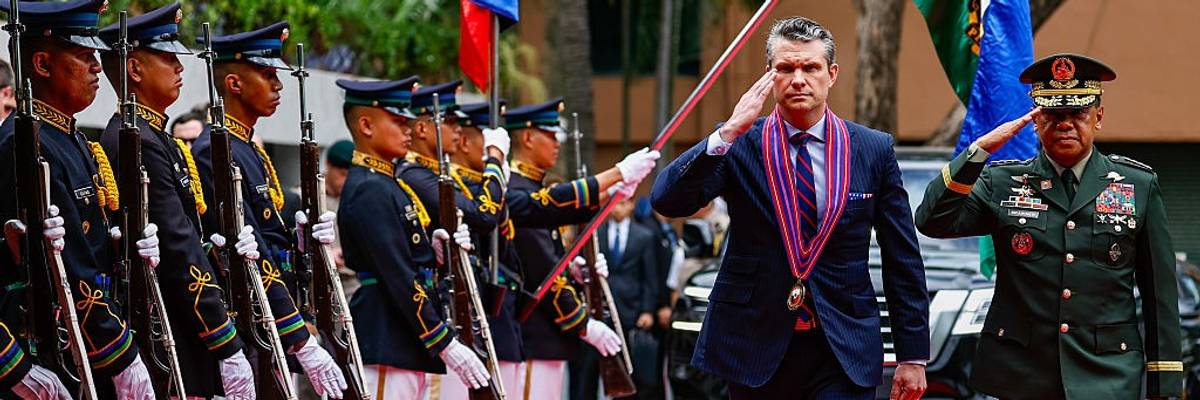
United States Secretary of Defense Pete Hegseth (L) and Chief of Staff of the Armed Forces of the Philippines Gen. Romeo Brawner Jr inspect the honor guards, as Pete Hegseth meets his counterparts to discuss regional security issues, at a military camp in Quezon City, Philippines, on March 28, 2025.
With America’s 750 or so overseas military bases in around 80 countries, it’s high time to close these bases, pocket the saving, and return to diplomacy. Our bases across Asia are a good place to start.
President Donald Trump is again loudly complaining that the U.S. military bases in Asia are too costly for the U.S. to bear. As part of the new round of tariff negotiations with Japan and Korea, Trump is calling on Japan and Korea to pay for stationing the US troops. Here’s a much better idea: close the bases and bring the U.S. servicemen home.
Trump implies that the U.S. is providing a great service to Japan and Korea by stationing 50,000 troops in Japan and nearly 30,000 in Korea. Yet these countries do not need the U.S. to defend themselves. They are wealthy and can certainly provide their own defense. Far more importantly, diplomacy can ensure the peace in northeast Asia far more effectively and far less expensively than U.S. troops.
The U.S. acts as if Japan needs to be defended against China. Let’s have a look. During the past 1,000 years, during which time China was the region’s dominant power for all but the last 150 years, how many times did China attempt to invade Japan? If you answered zero, you are correct. China did not attempt to invade Japan on a single occasion.
You might quibble. What about the two attempts in 1274 and 1281, roughly 750 years ago? It’s true that when the Mongols temporarily ruled China between 1271 and 1368, the Mongols twice sent expeditionary fleets to invade Japan, and both times were defeated by a combination of typhoons (known in Japanese lore as the Kamikaze winds) and by Japanese coastal defenses.
Japan, on the other hand, made several attempts to attack or conquer China. In 1592, the arrogant and erratic Japanese military leader Toyotomi Hideyoshi launched an invasion of Korea with the goal of conquering Ming China. He did not get far, dying in 1598 without even having subdued Korea. In 1894-5, Japan invaded and defeated China in the Sino-Japanese war, taking Taiwan as a Japanese colony. In 1931, Japan invaded northeast China (Manchuria) and created the Japanese colony of Manchukuo. In 1937, Japan invaded China, starting World War II in the Pacific region.
Nobody thinks that Japan is going to invade China today, and there is no rhyme, reason, or historical precedent to believe that China is going to invade Japan. Japan has no need for the US military bases to protect itself from China.
The same is true of China and Korea. During the past 1,000 years, China never invaded Korea, except on one occasion: when the U.S. threatened China. China entered the war in late 1950 on the side of North Korea to fight the U.S. troops advancing northward towards the Chinese border. At the time, U.S. General Douglas MacArthur recklessly recommended attacking China with atomic bombs. MacArthur also proposed to support Chinese nationalist forces, then based in Taiwan, to invade the Chinese mainland. President Harry Truman, thank God, rejected MacArthur’s recommendations.
South Korea needs deterrence against North Korea, to be sure, but that would be achieved far more effectively and credibly through a regional security system including China, Japan, Russia, North Korea, South Korea, than through the presence of the U.S., which has repeatedly stoked North Korea’s nuclear arsenal and military build-up, not diminished it.
In fact, the U.S. military bases in East Asia are really for the U.S. projection of power, not for the defense of Japan or Korea. This is even more reason why they should be removed. Though the U.S. claims that its bases in East Asia are defensive, they are understandably viewed by China and North Korea as a direct threat – for example, by creating the possibility of a decapitation strike, and by dangerously lowering the response times for China and North Korea to a U.S. provocation or some kind of misunderstanding. Russia vociferously opposed NATO in Ukraine for the same justifiable reasons. NATO has frequently intervened in U.S.-backed regime-change operations and has placed missile systems dangerously close to Russia. Indeed, just as Russia feared, NATO has actively participated in the Ukraine War, providing armaments, strategy, intelligence, and even programming and tracking for missile strikes deep inside of Russia.
Note that Trump is currently obsessed with two small port facilities in Panama owned by a Hong Kong company, claiming that China is threatening U.S. security (!), and wants the facilities sold to an American buyer. The U.S. on the other hand surrounds China not with two tiny port facilities but with major U.S. military bases in Japan, South Korea, Guam, the Philippines, and the Indian Ocean near to China’s international sea lanes.
The best strategy for the superpowers is to stay out of each other’s lanes. China and Russia should not open military bases in the Western Hemisphere, to put it mildly. The last time that was tried, when the Soviet Union placed nuclear weapons in Cuba in 1962, the world nearly ended in nuclear annihilation. (See Martin Sherwin’s remarkable book, Gambling with Armageddon for the shocking details on how close the world came to nuclear Armageddon). Neither China nor Russia shows the slightest inclination to do so today, despite all of the provocations of facing US bases in their own neighborhoods.
Trump is looking for ways to save money – an excellent idea given that the U.S. federal budget is hemorrhaging $2 trillion dollars a year, more than 6% of U.S. GDP. Closing the U.S. overseas military bases would be an excellent place to start.
Trump even seemed to point that way at the start of his second term, but the Congressional Republicans have called for increases, not decreases, in military spending. Yet with America’s 750 or so overseas military bases in around 80 countries, it’s high time to close these bases, pocket the saving, and return to diplomacy. Getting the host countries to pay for something that doesn’t help them or the U.S. is a huge drain of time, diplomacy, and resources, both for the U.S. and the host countries.
The U.S. should make a basic deal with China, Russia, and other powers. “You keep your military bases out of our neighborhood, and we’ll keep our military bases out of yours.” Basic reciprocity among the major powers would save trillions of dollars of military outlays over the coming decade and, more importantly, would push the Doomsday Clock back from 89 seconds to nuclear Armageddon.
Dear Common Dreams reader, It’s been nearly 30 years since I co-founded Common Dreams with my late wife, Lina Newhouser. We had the radical notion that journalism should serve the public good, not corporate profits. It was clear to us from the outset what it would take to build such a project. No paid advertisements. No corporate sponsors. No millionaire publisher telling us what to think or do. Many people said we wouldn't last a year, but we proved those doubters wrong. Together with a tremendous team of journalists and dedicated staff, we built an independent media outlet free from the constraints of profits and corporate control. Our mission has always been simple: To inform. To inspire. To ignite change for the common good. Building Common Dreams was not easy. Our survival was never guaranteed. When you take on the most powerful forces—Wall Street greed, fossil fuel industry destruction, Big Tech lobbyists, and uber-rich oligarchs who have spent billions upon billions rigging the economy and democracy in their favor—the only bulwark you have is supporters who believe in your work. But here’s the urgent message from me today. It's never been this bad out there. And it's never been this hard to keep us going. At the very moment Common Dreams is most needed, the threats we face are intensifying. We need your support now more than ever. We don't accept corporate advertising and never will. We don't have a paywall because we don't think people should be blocked from critical news based on their ability to pay. Everything we do is funded by the donations of readers like you. When everyone does the little they can afford, we are strong. But if that support retreats or dries up, so do we. Will you donate now to make sure Common Dreams not only survives but thrives? —Craig Brown, Co-founder |
President Donald Trump is again loudly complaining that the U.S. military bases in Asia are too costly for the U.S. to bear. As part of the new round of tariff negotiations with Japan and Korea, Trump is calling on Japan and Korea to pay for stationing the US troops. Here’s a much better idea: close the bases and bring the U.S. servicemen home.
Trump implies that the U.S. is providing a great service to Japan and Korea by stationing 50,000 troops in Japan and nearly 30,000 in Korea. Yet these countries do not need the U.S. to defend themselves. They are wealthy and can certainly provide their own defense. Far more importantly, diplomacy can ensure the peace in northeast Asia far more effectively and far less expensively than U.S. troops.
The U.S. acts as if Japan needs to be defended against China. Let’s have a look. During the past 1,000 years, during which time China was the region’s dominant power for all but the last 150 years, how many times did China attempt to invade Japan? If you answered zero, you are correct. China did not attempt to invade Japan on a single occasion.
You might quibble. What about the two attempts in 1274 and 1281, roughly 750 years ago? It’s true that when the Mongols temporarily ruled China between 1271 and 1368, the Mongols twice sent expeditionary fleets to invade Japan, and both times were defeated by a combination of typhoons (known in Japanese lore as the Kamikaze winds) and by Japanese coastal defenses.
Japan, on the other hand, made several attempts to attack or conquer China. In 1592, the arrogant and erratic Japanese military leader Toyotomi Hideyoshi launched an invasion of Korea with the goal of conquering Ming China. He did not get far, dying in 1598 without even having subdued Korea. In 1894-5, Japan invaded and defeated China in the Sino-Japanese war, taking Taiwan as a Japanese colony. In 1931, Japan invaded northeast China (Manchuria) and created the Japanese colony of Manchukuo. In 1937, Japan invaded China, starting World War II in the Pacific region.
Nobody thinks that Japan is going to invade China today, and there is no rhyme, reason, or historical precedent to believe that China is going to invade Japan. Japan has no need for the US military bases to protect itself from China.
The same is true of China and Korea. During the past 1,000 years, China never invaded Korea, except on one occasion: when the U.S. threatened China. China entered the war in late 1950 on the side of North Korea to fight the U.S. troops advancing northward towards the Chinese border. At the time, U.S. General Douglas MacArthur recklessly recommended attacking China with atomic bombs. MacArthur also proposed to support Chinese nationalist forces, then based in Taiwan, to invade the Chinese mainland. President Harry Truman, thank God, rejected MacArthur’s recommendations.
South Korea needs deterrence against North Korea, to be sure, but that would be achieved far more effectively and credibly through a regional security system including China, Japan, Russia, North Korea, South Korea, than through the presence of the U.S., which has repeatedly stoked North Korea’s nuclear arsenal and military build-up, not diminished it.
In fact, the U.S. military bases in East Asia are really for the U.S. projection of power, not for the defense of Japan or Korea. This is even more reason why they should be removed. Though the U.S. claims that its bases in East Asia are defensive, they are understandably viewed by China and North Korea as a direct threat – for example, by creating the possibility of a decapitation strike, and by dangerously lowering the response times for China and North Korea to a U.S. provocation or some kind of misunderstanding. Russia vociferously opposed NATO in Ukraine for the same justifiable reasons. NATO has frequently intervened in U.S.-backed regime-change operations and has placed missile systems dangerously close to Russia. Indeed, just as Russia feared, NATO has actively participated in the Ukraine War, providing armaments, strategy, intelligence, and even programming and tracking for missile strikes deep inside of Russia.
Note that Trump is currently obsessed with two small port facilities in Panama owned by a Hong Kong company, claiming that China is threatening U.S. security (!), and wants the facilities sold to an American buyer. The U.S. on the other hand surrounds China not with two tiny port facilities but with major U.S. military bases in Japan, South Korea, Guam, the Philippines, and the Indian Ocean near to China’s international sea lanes.
The best strategy for the superpowers is to stay out of each other’s lanes. China and Russia should not open military bases in the Western Hemisphere, to put it mildly. The last time that was tried, when the Soviet Union placed nuclear weapons in Cuba in 1962, the world nearly ended in nuclear annihilation. (See Martin Sherwin’s remarkable book, Gambling with Armageddon for the shocking details on how close the world came to nuclear Armageddon). Neither China nor Russia shows the slightest inclination to do so today, despite all of the provocations of facing US bases in their own neighborhoods.
Trump is looking for ways to save money – an excellent idea given that the U.S. federal budget is hemorrhaging $2 trillion dollars a year, more than 6% of U.S. GDP. Closing the U.S. overseas military bases would be an excellent place to start.
Trump even seemed to point that way at the start of his second term, but the Congressional Republicans have called for increases, not decreases, in military spending. Yet with America’s 750 or so overseas military bases in around 80 countries, it’s high time to close these bases, pocket the saving, and return to diplomacy. Getting the host countries to pay for something that doesn’t help them or the U.S. is a huge drain of time, diplomacy, and resources, both for the U.S. and the host countries.
The U.S. should make a basic deal with China, Russia, and other powers. “You keep your military bases out of our neighborhood, and we’ll keep our military bases out of yours.” Basic reciprocity among the major powers would save trillions of dollars of military outlays over the coming decade and, more importantly, would push the Doomsday Clock back from 89 seconds to nuclear Armageddon.
President Donald Trump is again loudly complaining that the U.S. military bases in Asia are too costly for the U.S. to bear. As part of the new round of tariff negotiations with Japan and Korea, Trump is calling on Japan and Korea to pay for stationing the US troops. Here’s a much better idea: close the bases and bring the U.S. servicemen home.
Trump implies that the U.S. is providing a great service to Japan and Korea by stationing 50,000 troops in Japan and nearly 30,000 in Korea. Yet these countries do not need the U.S. to defend themselves. They are wealthy and can certainly provide their own defense. Far more importantly, diplomacy can ensure the peace in northeast Asia far more effectively and far less expensively than U.S. troops.
The U.S. acts as if Japan needs to be defended against China. Let’s have a look. During the past 1,000 years, during which time China was the region’s dominant power for all but the last 150 years, how many times did China attempt to invade Japan? If you answered zero, you are correct. China did not attempt to invade Japan on a single occasion.
You might quibble. What about the two attempts in 1274 and 1281, roughly 750 years ago? It’s true that when the Mongols temporarily ruled China between 1271 and 1368, the Mongols twice sent expeditionary fleets to invade Japan, and both times were defeated by a combination of typhoons (known in Japanese lore as the Kamikaze winds) and by Japanese coastal defenses.
Japan, on the other hand, made several attempts to attack or conquer China. In 1592, the arrogant and erratic Japanese military leader Toyotomi Hideyoshi launched an invasion of Korea with the goal of conquering Ming China. He did not get far, dying in 1598 without even having subdued Korea. In 1894-5, Japan invaded and defeated China in the Sino-Japanese war, taking Taiwan as a Japanese colony. In 1931, Japan invaded northeast China (Manchuria) and created the Japanese colony of Manchukuo. In 1937, Japan invaded China, starting World War II in the Pacific region.
Nobody thinks that Japan is going to invade China today, and there is no rhyme, reason, or historical precedent to believe that China is going to invade Japan. Japan has no need for the US military bases to protect itself from China.
The same is true of China and Korea. During the past 1,000 years, China never invaded Korea, except on one occasion: when the U.S. threatened China. China entered the war in late 1950 on the side of North Korea to fight the U.S. troops advancing northward towards the Chinese border. At the time, U.S. General Douglas MacArthur recklessly recommended attacking China with atomic bombs. MacArthur also proposed to support Chinese nationalist forces, then based in Taiwan, to invade the Chinese mainland. President Harry Truman, thank God, rejected MacArthur’s recommendations.
South Korea needs deterrence against North Korea, to be sure, but that would be achieved far more effectively and credibly through a regional security system including China, Japan, Russia, North Korea, South Korea, than through the presence of the U.S., which has repeatedly stoked North Korea’s nuclear arsenal and military build-up, not diminished it.
In fact, the U.S. military bases in East Asia are really for the U.S. projection of power, not for the defense of Japan or Korea. This is even more reason why they should be removed. Though the U.S. claims that its bases in East Asia are defensive, they are understandably viewed by China and North Korea as a direct threat – for example, by creating the possibility of a decapitation strike, and by dangerously lowering the response times for China and North Korea to a U.S. provocation or some kind of misunderstanding. Russia vociferously opposed NATO in Ukraine for the same justifiable reasons. NATO has frequently intervened in U.S.-backed regime-change operations and has placed missile systems dangerously close to Russia. Indeed, just as Russia feared, NATO has actively participated in the Ukraine War, providing armaments, strategy, intelligence, and even programming and tracking for missile strikes deep inside of Russia.
Note that Trump is currently obsessed with two small port facilities in Panama owned by a Hong Kong company, claiming that China is threatening U.S. security (!), and wants the facilities sold to an American buyer. The U.S. on the other hand surrounds China not with two tiny port facilities but with major U.S. military bases in Japan, South Korea, Guam, the Philippines, and the Indian Ocean near to China’s international sea lanes.
The best strategy for the superpowers is to stay out of each other’s lanes. China and Russia should not open military bases in the Western Hemisphere, to put it mildly. The last time that was tried, when the Soviet Union placed nuclear weapons in Cuba in 1962, the world nearly ended in nuclear annihilation. (See Martin Sherwin’s remarkable book, Gambling with Armageddon for the shocking details on how close the world came to nuclear Armageddon). Neither China nor Russia shows the slightest inclination to do so today, despite all of the provocations of facing US bases in their own neighborhoods.
Trump is looking for ways to save money – an excellent idea given that the U.S. federal budget is hemorrhaging $2 trillion dollars a year, more than 6% of U.S. GDP. Closing the U.S. overseas military bases would be an excellent place to start.
Trump even seemed to point that way at the start of his second term, but the Congressional Republicans have called for increases, not decreases, in military spending. Yet with America’s 750 or so overseas military bases in around 80 countries, it’s high time to close these bases, pocket the saving, and return to diplomacy. Getting the host countries to pay for something that doesn’t help them or the U.S. is a huge drain of time, diplomacy, and resources, both for the U.S. and the host countries.
The U.S. should make a basic deal with China, Russia, and other powers. “You keep your military bases out of our neighborhood, and we’ll keep our military bases out of yours.” Basic reciprocity among the major powers would save trillions of dollars of military outlays over the coming decade and, more importantly, would push the Doomsday Clock back from 89 seconds to nuclear Armageddon.