SUBSCRIBE TO OUR FREE NEWSLETTER
Daily news & progressive opinion—funded by the people, not the corporations—delivered straight to your inbox.
5
#000000
#FFFFFF
To donate by check, phone, or other method, see our More Ways to Give page.
Daily news & progressive opinion—funded by the people, not the corporations—delivered straight to your inbox.
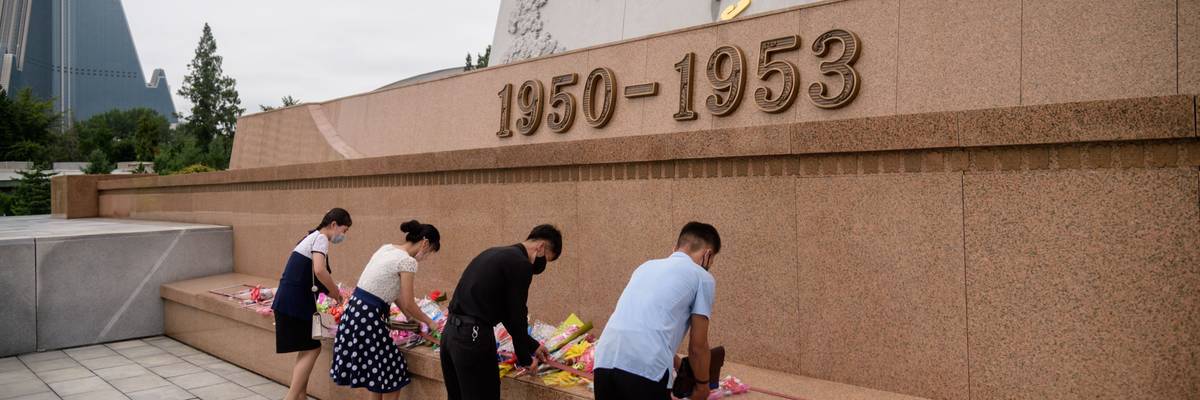
People lay flowers as they pay their respects before a sculpture entitled "Victory" at the "Victorious Fatherland Liberation War Museum" on the occasion of 67th anniversary of the signing of the Korean War armistice agreement, an event which North Korea refers to as "the Korean people's victory of the great Fatherland Liberation War," in Pyongyang on July 27, 2020.
Congress should again raise its voice to support de-escalation with North Korea, ensure policy coordination with South Korea, support formally ending the Korean War, and ensure high-level diplomacy is supported by working level talks.
Events are transpiring rapidly in US-Korea relations. The Pentagon announced recently that the 11-day Ulchi Freedom Shield joint military exercises with South Korea would be cut in half a few days after President Donald Trump’s social media announcement that he would “substantially reduce” these exercises.
South Korean President Lee Jae-myung stated he respected Trump’s decision and efforts to create conditions for dialogue toward peace. North Korea’s leadership dismissed the reduction of exercises on the basis that US policy remains “hostile,” though noted that the relationship between Trump and Kim “remains excellent.”
As reports increase on Trump’s push to meet with Kim this year, US lawmakers must ensure high-level diplomacy is supported by working level talks and support policies that enable peaceful coexistence on the Korean Peninsula.
The US-North Korea summits in 2018-19 failed to produce a durable agreement. Former National Security Adviser John Bolton later admitted to derailing that process, encouraging President Trump to walk away from negotiations by demanding full denuclearization up front. These failed summits led to a prolonged freeze in US-North Korea relations.
For 30 years, this disarmament-first policy has failed. This is why South Korea’s Unification Minister Chung Dong-young has said South Korea would no longer insist on North Korea’s complete and immediate denuclearization as the starting point for diplomacy.
The United States must act to end its longest war and pursue peace, engagement, and diplomacy. Peace cannot wait for another generation.
More than 70 years after the Korean War began, it is long past time to convert the armistice and frozen conflict into real peace. On August 15, South Korean President Lee Jae-Myung announced his desire to end hostilities and laid out a policy of peaceful coexistence with North Korea that includes respect for the North's system, no unification by absorption or hostile acts, concrete steps to restore the 2018 Comprehensive Military Agreement, resumption of economic and humanitarian cooperation, and a nuclear approach that begins with a freeze rather than demanding disarmament up front.
Recent public opinion polling shows that the majority (69%) of US respondents support diplomatic engagement with North Korea. North Korean leader Kim Jong-un has previously said that they would meet if Washington sets aside denuclearization as the goal of talks and accepts peaceful coexistence. US experts say that Washington must deal with North Korea as it is.
The US and South Korea have previously scaled back exercises in order to facilitate dialogue—including under President Bill Clinton’s administration prior to the 1994 US-DPRK Agreed Framework. During President Trump’s first-term diplomacy, a bipartisan group of 32 members of Congress argued that reducing joint exercises could serve as a confidence-building measure in negotiations. Congress should again raise its voice to support de-escalation with North Korea, ensure policy coordination with South Korea, support formally ending the Korean War, and ensure high-level diplomacy is supported by working level talks.
The US and South Korea have held joint military exercises for decades since the end of the Korean War. Past joint war drills have included nuclear-capable B-2 bombers, nuclear-powered aircraft carriers and submarines, and other weapons that cause significant harm to local residents and the environment. The drills are based on operation plans that reportedly include pre-emptive strikes and “decapitation measures” against North Korea. In his post, Trump criticized the exercises as costly. He’s not wrong. A new report from the Center for International Policy reveals that the Pentagon massively underreports its military spending to maintain US bases and troops in South Korea, spending $5.58 billion in FY24, which is almost $2.19 billion more than what the Pentagon reported to Congress. A single exercise costs US taxpayers an estimated $14 million with US and South Korea planning to conduct 159 field exercises this year.
Experts argue that joint military exercises create a more threatening security environment and elicit greater provocation, despite claims of deterrence. On the other hand, 25 years of data show that when the US is at the negotiating table with North Korea, they launch fewer missile tests. Joint Forces exercises heighten military and political tensions on the peninsula, divert critically needed resources away from urgent human needs in both the US and South Korea, and delay stability on the peninsula.
For over 70 years, the ongoing Korean War and escalating tensions have undermined human security for 80 million people living on the Korean Peninsula. The United States must act to end its longest war and pursue peace, engagement, and diplomacy. Peace cannot wait for another generation.
US lawmakers must support steps towards de-escalation and hold the Trump administration accountable by:
Dear Common Dreams reader, It’s been nearly 30 years since I co-founded Common Dreams with my late wife, Lina Newhouser. We had the radical notion that journalism should serve the public good, not corporate profits. It was clear to us from the outset what it would take to build such a project. No paid advertisements. No corporate sponsors. No millionaire publisher telling us what to think or do. Many people said we wouldn't last a year, but we proved those doubters wrong. Together with a tremendous team of journalists and dedicated staff, we built an independent media outlet free from the constraints of profits and corporate control. Our mission has always been simple: To inform. To inspire. To ignite change for the common good. Building Common Dreams was not easy. Our survival was never guaranteed. When you take on the most powerful forces—Wall Street greed, fossil fuel industry destruction, Big Tech lobbyists, and uber-rich oligarchs who have spent billions upon billions rigging the economy and democracy in their favor—the only bulwark you have is supporters who believe in your work. But here’s the urgent message from me today. It's never been this bad out there. And it's never been this hard to keep us going. At the very moment Common Dreams is most needed, the threats we face are intensifying. We need your support now more than ever. We don't accept corporate advertising and never will. We don't have a paywall because we don't think people should be blocked from critical news based on their ability to pay. Everything we do is funded by the donations of readers like you. When everyone does the little they can afford, we are strong. But if that support retreats or dries up, so do we. Will you donate now to make sure Common Dreams not only survives but thrives? —Craig Brown, Co-founder |
Events are transpiring rapidly in US-Korea relations. The Pentagon announced recently that the 11-day Ulchi Freedom Shield joint military exercises with South Korea would be cut in half a few days after President Donald Trump’s social media announcement that he would “substantially reduce” these exercises.
South Korean President Lee Jae-myung stated he respected Trump’s decision and efforts to create conditions for dialogue toward peace. North Korea’s leadership dismissed the reduction of exercises on the basis that US policy remains “hostile,” though noted that the relationship between Trump and Kim “remains excellent.”
As reports increase on Trump’s push to meet with Kim this year, US lawmakers must ensure high-level diplomacy is supported by working level talks and support policies that enable peaceful coexistence on the Korean Peninsula.
The US-North Korea summits in 2018-19 failed to produce a durable agreement. Former National Security Adviser John Bolton later admitted to derailing that process, encouraging President Trump to walk away from negotiations by demanding full denuclearization up front. These failed summits led to a prolonged freeze in US-North Korea relations.
For 30 years, this disarmament-first policy has failed. This is why South Korea’s Unification Minister Chung Dong-young has said South Korea would no longer insist on North Korea’s complete and immediate denuclearization as the starting point for diplomacy.
The United States must act to end its longest war and pursue peace, engagement, and diplomacy. Peace cannot wait for another generation.
More than 70 years after the Korean War began, it is long past time to convert the armistice and frozen conflict into real peace. On August 15, South Korean President Lee Jae-Myung announced his desire to end hostilities and laid out a policy of peaceful coexistence with North Korea that includes respect for the North's system, no unification by absorption or hostile acts, concrete steps to restore the 2018 Comprehensive Military Agreement, resumption of economic and humanitarian cooperation, and a nuclear approach that begins with a freeze rather than demanding disarmament up front.
Recent public opinion polling shows that the majority (69%) of US respondents support diplomatic engagement with North Korea. North Korean leader Kim Jong-un has previously said that they would meet if Washington sets aside denuclearization as the goal of talks and accepts peaceful coexistence. US experts say that Washington must deal with North Korea as it is.
The US and South Korea have previously scaled back exercises in order to facilitate dialogue—including under President Bill Clinton’s administration prior to the 1994 US-DPRK Agreed Framework. During President Trump’s first-term diplomacy, a bipartisan group of 32 members of Congress argued that reducing joint exercises could serve as a confidence-building measure in negotiations. Congress should again raise its voice to support de-escalation with North Korea, ensure policy coordination with South Korea, support formally ending the Korean War, and ensure high-level diplomacy is supported by working level talks.
The US and South Korea have held joint military exercises for decades since the end of the Korean War. Past joint war drills have included nuclear-capable B-2 bombers, nuclear-powered aircraft carriers and submarines, and other weapons that cause significant harm to local residents and the environment. The drills are based on operation plans that reportedly include pre-emptive strikes and “decapitation measures” against North Korea. In his post, Trump criticized the exercises as costly. He’s not wrong. A new report from the Center for International Policy reveals that the Pentagon massively underreports its military spending to maintain US bases and troops in South Korea, spending $5.58 billion in FY24, which is almost $2.19 billion more than what the Pentagon reported to Congress. A single exercise costs US taxpayers an estimated $14 million with US and South Korea planning to conduct 159 field exercises this year.
Experts argue that joint military exercises create a more threatening security environment and elicit greater provocation, despite claims of deterrence. On the other hand, 25 years of data show that when the US is at the negotiating table with North Korea, they launch fewer missile tests. Joint Forces exercises heighten military and political tensions on the peninsula, divert critically needed resources away from urgent human needs in both the US and South Korea, and delay stability on the peninsula.
For over 70 years, the ongoing Korean War and escalating tensions have undermined human security for 80 million people living on the Korean Peninsula. The United States must act to end its longest war and pursue peace, engagement, and diplomacy. Peace cannot wait for another generation.
US lawmakers must support steps towards de-escalation and hold the Trump administration accountable by:
Events are transpiring rapidly in US-Korea relations. The Pentagon announced recently that the 11-day Ulchi Freedom Shield joint military exercises with South Korea would be cut in half a few days after President Donald Trump’s social media announcement that he would “substantially reduce” these exercises.
South Korean President Lee Jae-myung stated he respected Trump’s decision and efforts to create conditions for dialogue toward peace. North Korea’s leadership dismissed the reduction of exercises on the basis that US policy remains “hostile,” though noted that the relationship between Trump and Kim “remains excellent.”
As reports increase on Trump’s push to meet with Kim this year, US lawmakers must ensure high-level diplomacy is supported by working level talks and support policies that enable peaceful coexistence on the Korean Peninsula.
The US-North Korea summits in 2018-19 failed to produce a durable agreement. Former National Security Adviser John Bolton later admitted to derailing that process, encouraging President Trump to walk away from negotiations by demanding full denuclearization up front. These failed summits led to a prolonged freeze in US-North Korea relations.
For 30 years, this disarmament-first policy has failed. This is why South Korea’s Unification Minister Chung Dong-young has said South Korea would no longer insist on North Korea’s complete and immediate denuclearization as the starting point for diplomacy.
The United States must act to end its longest war and pursue peace, engagement, and diplomacy. Peace cannot wait for another generation.
More than 70 years after the Korean War began, it is long past time to convert the armistice and frozen conflict into real peace. On August 15, South Korean President Lee Jae-Myung announced his desire to end hostilities and laid out a policy of peaceful coexistence with North Korea that includes respect for the North's system, no unification by absorption or hostile acts, concrete steps to restore the 2018 Comprehensive Military Agreement, resumption of economic and humanitarian cooperation, and a nuclear approach that begins with a freeze rather than demanding disarmament up front.
Recent public opinion polling shows that the majority (69%) of US respondents support diplomatic engagement with North Korea. North Korean leader Kim Jong-un has previously said that they would meet if Washington sets aside denuclearization as the goal of talks and accepts peaceful coexistence. US experts say that Washington must deal with North Korea as it is.
The US and South Korea have previously scaled back exercises in order to facilitate dialogue—including under President Bill Clinton’s administration prior to the 1994 US-DPRK Agreed Framework. During President Trump’s first-term diplomacy, a bipartisan group of 32 members of Congress argued that reducing joint exercises could serve as a confidence-building measure in negotiations. Congress should again raise its voice to support de-escalation with North Korea, ensure policy coordination with South Korea, support formally ending the Korean War, and ensure high-level diplomacy is supported by working level talks.
The US and South Korea have held joint military exercises for decades since the end of the Korean War. Past joint war drills have included nuclear-capable B-2 bombers, nuclear-powered aircraft carriers and submarines, and other weapons that cause significant harm to local residents and the environment. The drills are based on operation plans that reportedly include pre-emptive strikes and “decapitation measures” against North Korea. In his post, Trump criticized the exercises as costly. He’s not wrong. A new report from the Center for International Policy reveals that the Pentagon massively underreports its military spending to maintain US bases and troops in South Korea, spending $5.58 billion in FY24, which is almost $2.19 billion more than what the Pentagon reported to Congress. A single exercise costs US taxpayers an estimated $14 million with US and South Korea planning to conduct 159 field exercises this year.
Experts argue that joint military exercises create a more threatening security environment and elicit greater provocation, despite claims of deterrence. On the other hand, 25 years of data show that when the US is at the negotiating table with North Korea, they launch fewer missile tests. Joint Forces exercises heighten military and political tensions on the peninsula, divert critically needed resources away from urgent human needs in both the US and South Korea, and delay stability on the peninsula.
For over 70 years, the ongoing Korean War and escalating tensions have undermined human security for 80 million people living on the Korean Peninsula. The United States must act to end its longest war and pursue peace, engagement, and diplomacy. Peace cannot wait for another generation.
US lawmakers must support steps towards de-escalation and hold the Trump administration accountable by: