SUBSCRIBE TO OUR FREE NEWSLETTER
Daily news & progressive opinion—funded by the people, not the corporations—delivered straight to your inbox.
5
#000000
#FFFFFF
To donate by check, phone, or other method, see our More Ways to Give page.
Daily news & progressive opinion—funded by the people, not the corporations—delivered straight to your inbox.
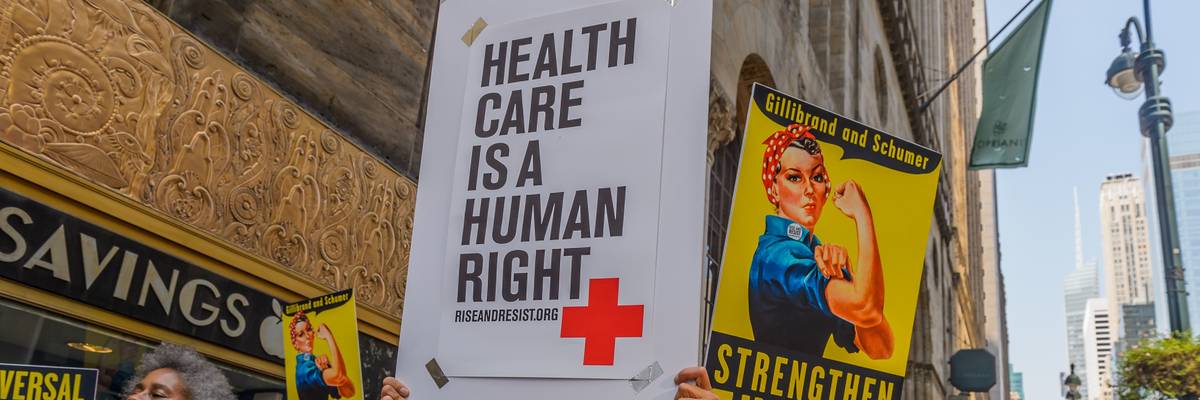
Activists march in New York City on September 5, 2017 to demand universal health coverage.
The new poll shows the highest level of support in a decade for the government ensuring all Americans have healthcare.
Public sentiment regarding the nation's for-profit healthcare system—an outlier among wealthy nations—has dominated the national news in recent days following last week's killing of an insurance executive in New York.
On Monday, just hours before a suspect in the murder of UnitedHealthcare CEO Brian Thompson was arrested by police, a new Gallup poll found a 62% majority in the U.S. believe the government should ensure all Americans have healthcare coverage—the highest percentage in more than a decade.
Just 42% of people in 2013 believed it was the government's responsibility to make sure everyone in the country had health coverage—a low since the beginning of this century.
The poll found that a majority of Republicans still believe ensuring health coverage is not the government's job, but the majority has shrunk since 2020.
That year, only 22% of Republican voters believed the government should ensure everyone in the country has healthcare, but that number has now grown to 32%.
The percentage of Independents who think the issue is in the government's purview has also gone up by six points since 2020, and Democratic support remains high, currently at 90%.
Americans have vented their frustrations about the current for-profit health insurance system in recent days as police searched for a suspect in the killing of UnitedHealthcare CEO Brian Thompson, before arresting Luigi Mangione in Pennsylvania on Monday. Mangione, according to claims by police, was found with a manifesto that railed against the insurance industry.
Anthem Blue Cross Blue Shield last week also faced public outcry and was forced to reverse a decision to slash coverage for anesthesia care, with U.S. Rep. Ro Khanna (D-Calif.) saying the move indicated that "the current system is broken."
"Democrats will regain trust by standing up to special interest insurance companies and fighting for Medicare for All," he said.
President-elect Donald Trump and other Republicans, who are set to control both chambers of Congress starting in January, have indicated that they would go in the opposite direction, working to weaken the popular, government-run Medicare program by promoting Medicare Advantage, which is administered by for-profit companies like United and is already used by half of Medicare beneficiaries.
But one of Trump's top allies, billionaire entrepreneur Elon Musk, waded into the debate last week about the current healthcare system, questioning why the U.S. pays far more in administrative healthcare costs than other wealthy countries and suggesting Americans don't "get their money's worth."
Another poll released last Friday found Americans' positive opinion of the nation's healthcare quality has declined to its lowest point since 2001, with most agreeing the U.S. system dominated by private insurers has "major problems."
Dear Common Dreams reader, It’s been nearly 30 years since I co-founded Common Dreams with my late wife, Lina Newhouser. We had the radical notion that journalism should serve the public good, not corporate profits. It was clear to us from the outset what it would take to build such a project. No paid advertisements. No corporate sponsors. No millionaire publisher telling us what to think or do. Many people said we wouldn't last a year, but we proved those doubters wrong. Together with a tremendous team of journalists and dedicated staff, we built an independent media outlet free from the constraints of profits and corporate control. Our mission has always been simple: To inform. To inspire. To ignite change for the common good. Building Common Dreams was not easy. Our survival was never guaranteed. When you take on the most powerful forces—Wall Street greed, fossil fuel industry destruction, Big Tech lobbyists, and uber-rich oligarchs who have spent billions upon billions rigging the economy and democracy in their favor—the only bulwark you have is supporters who believe in your work. But here’s the urgent message from me today. It's never been this bad out there. And it's never been this hard to keep us going. At the very moment Common Dreams is most needed, the threats we face are intensifying. We need your support now more than ever. We don't accept corporate advertising and never will. We don't have a paywall because we don't think people should be blocked from critical news based on their ability to pay. Everything we do is funded by the donations of readers like you. When everyone does the little they can afford, we are strong. But if that support retreats or dries up, so do we. Will you donate now to make sure Common Dreams not only survives but thrives? —Craig Brown, Co-founder |
Public sentiment regarding the nation's for-profit healthcare system—an outlier among wealthy nations—has dominated the national news in recent days following last week's killing of an insurance executive in New York.
On Monday, just hours before a suspect in the murder of UnitedHealthcare CEO Brian Thompson was arrested by police, a new Gallup poll found a 62% majority in the U.S. believe the government should ensure all Americans have healthcare coverage—the highest percentage in more than a decade.
Just 42% of people in 2013 believed it was the government's responsibility to make sure everyone in the country had health coverage—a low since the beginning of this century.
The poll found that a majority of Republicans still believe ensuring health coverage is not the government's job, but the majority has shrunk since 2020.
That year, only 22% of Republican voters believed the government should ensure everyone in the country has healthcare, but that number has now grown to 32%.
The percentage of Independents who think the issue is in the government's purview has also gone up by six points since 2020, and Democratic support remains high, currently at 90%.
Americans have vented their frustrations about the current for-profit health insurance system in recent days as police searched for a suspect in the killing of UnitedHealthcare CEO Brian Thompson, before arresting Luigi Mangione in Pennsylvania on Monday. Mangione, according to claims by police, was found with a manifesto that railed against the insurance industry.
Anthem Blue Cross Blue Shield last week also faced public outcry and was forced to reverse a decision to slash coverage for anesthesia care, with U.S. Rep. Ro Khanna (D-Calif.) saying the move indicated that "the current system is broken."
"Democrats will regain trust by standing up to special interest insurance companies and fighting for Medicare for All," he said.
President-elect Donald Trump and other Republicans, who are set to control both chambers of Congress starting in January, have indicated that they would go in the opposite direction, working to weaken the popular, government-run Medicare program by promoting Medicare Advantage, which is administered by for-profit companies like United and is already used by half of Medicare beneficiaries.
But one of Trump's top allies, billionaire entrepreneur Elon Musk, waded into the debate last week about the current healthcare system, questioning why the U.S. pays far more in administrative healthcare costs than other wealthy countries and suggesting Americans don't "get their money's worth."
Another poll released last Friday found Americans' positive opinion of the nation's healthcare quality has declined to its lowest point since 2001, with most agreeing the U.S. system dominated by private insurers has "major problems."
Public sentiment regarding the nation's for-profit healthcare system—an outlier among wealthy nations—has dominated the national news in recent days following last week's killing of an insurance executive in New York.
On Monday, just hours before a suspect in the murder of UnitedHealthcare CEO Brian Thompson was arrested by police, a new Gallup poll found a 62% majority in the U.S. believe the government should ensure all Americans have healthcare coverage—the highest percentage in more than a decade.
Just 42% of people in 2013 believed it was the government's responsibility to make sure everyone in the country had health coverage—a low since the beginning of this century.
The poll found that a majority of Republicans still believe ensuring health coverage is not the government's job, but the majority has shrunk since 2020.
That year, only 22% of Republican voters believed the government should ensure everyone in the country has healthcare, but that number has now grown to 32%.
The percentage of Independents who think the issue is in the government's purview has also gone up by six points since 2020, and Democratic support remains high, currently at 90%.
Americans have vented their frustrations about the current for-profit health insurance system in recent days as police searched for a suspect in the killing of UnitedHealthcare CEO Brian Thompson, before arresting Luigi Mangione in Pennsylvania on Monday. Mangione, according to claims by police, was found with a manifesto that railed against the insurance industry.
Anthem Blue Cross Blue Shield last week also faced public outcry and was forced to reverse a decision to slash coverage for anesthesia care, with U.S. Rep. Ro Khanna (D-Calif.) saying the move indicated that "the current system is broken."
"Democrats will regain trust by standing up to special interest insurance companies and fighting for Medicare for All," he said.
President-elect Donald Trump and other Republicans, who are set to control both chambers of Congress starting in January, have indicated that they would go in the opposite direction, working to weaken the popular, government-run Medicare program by promoting Medicare Advantage, which is administered by for-profit companies like United and is already used by half of Medicare beneficiaries.
But one of Trump's top allies, billionaire entrepreneur Elon Musk, waded into the debate last week about the current healthcare system, questioning why the U.S. pays far more in administrative healthcare costs than other wealthy countries and suggesting Americans don't "get their money's worth."
Another poll released last Friday found Americans' positive opinion of the nation's healthcare quality has declined to its lowest point since 2001, with most agreeing the U.S. system dominated by private insurers has "major problems."