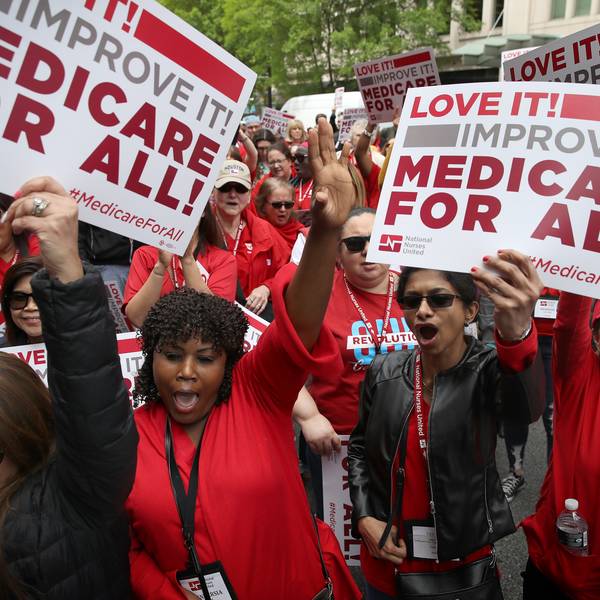
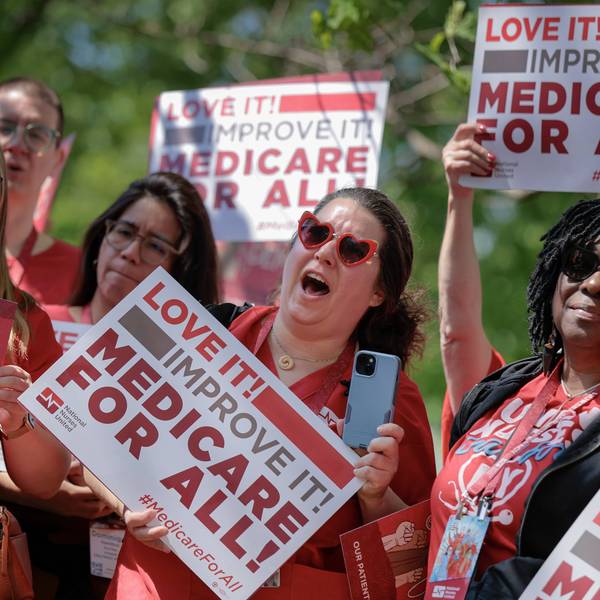

Congressman Ro Khanna (D-Calif.) speaks during a news conference in Washington, DC on September 3, 2025.
CNBC Host Doesn't Know How to Fix Runaway Healthcare Costs. Ro Khanna Says: Medicare for All
As health insurance companies rake in billions in profits, the California Democrat argues that a single-payer system would help US businesses and cut costs.
With the second-longest federal government shutdown dragging on and Americans concerned about soaring health insurance premiums and coverage losses, Congressman Ro Khanna on Thursday again made the case for Medicare for All.
On CNBC's "Squawk Box," co-host Joe Kernen made clear he doesn't support Medicare for All but expressed concern about rising premiums. He also admitted, "I don't know what the answer is."
Khanna (D-Calif.), meanwhile, reiterated his support for a single-payer system, in part by highlighting how private health insurance companies are raking in billions of dollars in profits each year, at the expense of patients.
If the United States extended eligibility for Medicare, which is now only available to Americans ages 65 and older, "it would help private business," the congressman argued. "It would lower healthcare costs."
A 2020 analysis from the Economic Policy Institute found that Medicare for All would benefit companies and workers by supporting self-employment and small business development, boosting wages, increasing job quality, and lessening the stress and economic shock of losing or changing employment. That same year, the Congressional Budget Office (CBO) estimated that shifting to Medicare for All could save $650 billion annually.
Khanna on Thursday pushed back against claims that under Medicare for All, Americans wouldn't be able to get the healthcare they need, saying: "I don't think Medicare is rationing more than the private industry. [If] you are on private insurance, that's where you get rationed. You have to get your pre-authorization. You have things denied. Medicare, actually, doesn't do that."
Although Medicare can deny coverage, KFF found in 2023 that people with employer-sponsored health insurance were twice as likely as those on Medicare for Medicaid—which covers people with low incomes and disabilities—to have a claim denied.
"Traditional Medicare, also known as Original Medicare, has historically required little in the way of pre-authorization for beneficiaries seeking services; pre-authorization was typically the domain of Medicare Advantage," or plans administered by private insurance companies, Kiplinger reported this summer. "But that's about to change."
Under President Donald Trump's "profoundly unqualified" pick to lead the Centers for Medicare and Medicaid Services, Dr. Mehmet Oz, CMS will require prior authorization for 17 services it claims "are vulnerable to fraud, waste, and abuse" in six states next year.
Beginning in January, Arizona, New Jersey, Ohio, Oklahoma, Texas, and Washington will serve as testing grounds "to provide an improved and expedited prior authorization process relative to Original Medicare's existing processes, helping patients and providers avoid unnecessary or inappropriate care and safeguarding federal taxpayer dollars," CMS said in a June statement.
Julie Alderman Boudreau, who has worked as a researcher at various organizations, warned at the time that "this is a Medicare cut by another name. This will cause seniors to delay care or forgo it altogether."
The CMS announcement came just days before Trump signed Republicans' One Big Beautiful Bill Act, which contained cuts to Medicaid and did not extend expiring Affordable Care Act premium tax credits. The current government shutdown, which began on October 1, stems from Democrats' fight to undo the GOP attacks on Medicaid and ACA subsidies.
The CBO estimates that 10 million Americans could be booted off Medicaid because of cuts. Additionally, more than 20 million Americans who buy insurance via ACA marketplaces are expected to see their premiums spike next year, and some of them may not be able to afford any plans. Multiple polls released this week show that US voters are concerned about premium hikes.
One of those surveys, released Monday by Data for Progress and Groundwork Collaborative, also shows that voters want Democrats in Congress to keep fighting for a fix to the looming healthcare crisis, even if it means the shutdown continues.
Khanna—one of several Democrats considered a potential 2028 presidential candidate—noted on social media earlier this week that KFF polling shows that "78% of Americans favor extending ACA credits."
"Republicans are once again trying to reward the ultrawealthy at the expense of regular folks," he added. "It's time to pass Medicare for All and solidify Americans' right to affordable healthcare."
We are at a crossroads
This country and this world are at a monumental crossroads. In a few short weeks, US voters will have an opportunity to beat back the forces of fascism and confront the billionaires who are rigging the economy, our media system, and our democracy, making it increasingly impossible for ordinary people to get by. We’re not just talking about the election. We’re talking about what must be done once these fascist elements are vanquished from power. We need a bolder set of solutions than what either major party has so far been willing to offer and a working-class movement ready to fight like hell for it. Trump didn't emerge from nowhere. The conditions that fueled MAGA authoritarianism were created by decades of radical neoliberal economic policies and a corrupt political system dominated by corporate interests. They slashed taxes on the super-rich, promising that the benefits would trickle down. They said giveaways to the corporate titans would make life more affordable for the rest of us. It was all bullshit. And when a bitter, betrayed populace searches for someone to blame, right-wing demagogues have little trouble finding scapegoats. People know when they're being lied to, but you won't hear any of this from the corporate media. Only independent journalism—powered and funded by people who believe in building a better world—can deliver truly trustworthy daily news. Our Fall Campaign is underway, and we need your help. To power our newsroom through the rest of the year, we need to raise $125,000 by midnight on October 31. So if you share our vision, please contribute whatever you can to sustain our work. |
With the second-longest federal government shutdown dragging on and Americans concerned about soaring health insurance premiums and coverage losses, Congressman Ro Khanna on Thursday again made the case for Medicare for All.
On CNBC's "Squawk Box," co-host Joe Kernen made clear he doesn't support Medicare for All but expressed concern about rising premiums. He also admitted, "I don't know what the answer is."
Khanna (D-Calif.), meanwhile, reiterated his support for a single-payer system, in part by highlighting how private health insurance companies are raking in billions of dollars in profits each year, at the expense of patients.
If the United States extended eligibility for Medicare, which is now only available to Americans ages 65 and older, "it would help private business," the congressman argued. "It would lower healthcare costs."
A 2020 analysis from the Economic Policy Institute found that Medicare for All would benefit companies and workers by supporting self-employment and small business development, boosting wages, increasing job quality, and lessening the stress and economic shock of losing or changing employment. That same year, the Congressional Budget Office (CBO) estimated that shifting to Medicare for All could save $650 billion annually.
Khanna on Thursday pushed back against claims that under Medicare for All, Americans wouldn't be able to get the healthcare they need, saying: "I don't think Medicare is rationing more than the private industry. [If] you are on private insurance, that's where you get rationed. You have to get your pre-authorization. You have things denied. Medicare, actually, doesn't do that."
Although Medicare can deny coverage, KFF found in 2023 that people with employer-sponsored health insurance were twice as likely as those on Medicare for Medicaid—which covers people with low incomes and disabilities—to have a claim denied.
"Traditional Medicare, also known as Original Medicare, has historically required little in the way of pre-authorization for beneficiaries seeking services; pre-authorization was typically the domain of Medicare Advantage," or plans administered by private insurance companies, Kiplinger reported this summer. "But that's about to change."
Under President Donald Trump's "profoundly unqualified" pick to lead the Centers for Medicare and Medicaid Services, Dr. Mehmet Oz, CMS will require prior authorization for 17 services it claims "are vulnerable to fraud, waste, and abuse" in six states next year.
Beginning in January, Arizona, New Jersey, Ohio, Oklahoma, Texas, and Washington will serve as testing grounds "to provide an improved and expedited prior authorization process relative to Original Medicare's existing processes, helping patients and providers avoid unnecessary or inappropriate care and safeguarding federal taxpayer dollars," CMS said in a June statement.
Julie Alderman Boudreau, who has worked as a researcher at various organizations, warned at the time that "this is a Medicare cut by another name. This will cause seniors to delay care or forgo it altogether."
The CMS announcement came just days before Trump signed Republicans' One Big Beautiful Bill Act, which contained cuts to Medicaid and did not extend expiring Affordable Care Act premium tax credits. The current government shutdown, which began on October 1, stems from Democrats' fight to undo the GOP attacks on Medicaid and ACA subsidies.
The CBO estimates that 10 million Americans could be booted off Medicaid because of cuts. Additionally, more than 20 million Americans who buy insurance via ACA marketplaces are expected to see their premiums spike next year, and some of them may not be able to afford any plans. Multiple polls released this week show that US voters are concerned about premium hikes.
One of those surveys, released Monday by Data for Progress and Groundwork Collaborative, also shows that voters want Democrats in Congress to keep fighting for a fix to the looming healthcare crisis, even if it means the shutdown continues.
Khanna—one of several Democrats considered a potential 2028 presidential candidate—noted on social media earlier this week that KFF polling shows that "78% of Americans favor extending ACA credits."
"Republicans are once again trying to reward the ultrawealthy at the expense of regular folks," he added. "It's time to pass Medicare for All and solidify Americans' right to affordable healthcare."
- Medicare for All, Says Sanders, Would Show American People 'Government Is Listening to Them' ›
- As GOP Shutdown Drags On, Poll Shows Most US Voters Concerned About Rising Healthcare Premiums ›
- More Than 70% of Democrats Back Government-Run Universal Healthcare: Poll ›
- ABC Anchor Rebuked for Claiming Popular, Cost-Saving Medicare for All Won't Happen ›
- With Premiums Set to Rise, a Reminder: 'Medicare for All Would Save $650 Billion' Annually ›
- 'Now Is the Time to Organize,' Says Medicare for All Coalition | Common Dreams ›
- Opinion | True Universal Healthcare Means Medicare For All, Not a 'Public Option' | Common Dreams ›
With the second-longest federal government shutdown dragging on and Americans concerned about soaring health insurance premiums and coverage losses, Congressman Ro Khanna on Thursday again made the case for Medicare for All.
On CNBC's "Squawk Box," co-host Joe Kernen made clear he doesn't support Medicare for All but expressed concern about rising premiums. He also admitted, "I don't know what the answer is."
Khanna (D-Calif.), meanwhile, reiterated his support for a single-payer system, in part by highlighting how private health insurance companies are raking in billions of dollars in profits each year, at the expense of patients.
If the United States extended eligibility for Medicare, which is now only available to Americans ages 65 and older, "it would help private business," the congressman argued. "It would lower healthcare costs."
A 2020 analysis from the Economic Policy Institute found that Medicare for All would benefit companies and workers by supporting self-employment and small business development, boosting wages, increasing job quality, and lessening the stress and economic shock of losing or changing employment. That same year, the Congressional Budget Office (CBO) estimated that shifting to Medicare for All could save $650 billion annually.
Khanna on Thursday pushed back against claims that under Medicare for All, Americans wouldn't be able to get the healthcare they need, saying: "I don't think Medicare is rationing more than the private industry. [If] you are on private insurance, that's where you get rationed. You have to get your pre-authorization. You have things denied. Medicare, actually, doesn't do that."
Although Medicare can deny coverage, KFF found in 2023 that people with employer-sponsored health insurance were twice as likely as those on Medicare for Medicaid—which covers people with low incomes and disabilities—to have a claim denied.
"Traditional Medicare, also known as Original Medicare, has historically required little in the way of pre-authorization for beneficiaries seeking services; pre-authorization was typically the domain of Medicare Advantage," or plans administered by private insurance companies, Kiplinger reported this summer. "But that's about to change."
Under President Donald Trump's "profoundly unqualified" pick to lead the Centers for Medicare and Medicaid Services, Dr. Mehmet Oz, CMS will require prior authorization for 17 services it claims "are vulnerable to fraud, waste, and abuse" in six states next year.
Beginning in January, Arizona, New Jersey, Ohio, Oklahoma, Texas, and Washington will serve as testing grounds "to provide an improved and expedited prior authorization process relative to Original Medicare's existing processes, helping patients and providers avoid unnecessary or inappropriate care and safeguarding federal taxpayer dollars," CMS said in a June statement.
Julie Alderman Boudreau, who has worked as a researcher at various organizations, warned at the time that "this is a Medicare cut by another name. This will cause seniors to delay care or forgo it altogether."
The CMS announcement came just days before Trump signed Republicans' One Big Beautiful Bill Act, which contained cuts to Medicaid and did not extend expiring Affordable Care Act premium tax credits. The current government shutdown, which began on October 1, stems from Democrats' fight to undo the GOP attacks on Medicaid and ACA subsidies.
The CBO estimates that 10 million Americans could be booted off Medicaid because of cuts. Additionally, more than 20 million Americans who buy insurance via ACA marketplaces are expected to see their premiums spike next year, and some of them may not be able to afford any plans. Multiple polls released this week show that US voters are concerned about premium hikes.
One of those surveys, released Monday by Data for Progress and Groundwork Collaborative, also shows that voters want Democrats in Congress to keep fighting for a fix to the looming healthcare crisis, even if it means the shutdown continues.
Khanna—one of several Democrats considered a potential 2028 presidential candidate—noted on social media earlier this week that KFF polling shows that "78% of Americans favor extending ACA credits."
"Republicans are once again trying to reward the ultrawealthy at the expense of regular folks," he added. "It's time to pass Medicare for All and solidify Americans' right to affordable healthcare."
- Medicare for All, Says Sanders, Would Show American People 'Government Is Listening to Them' ›
- As GOP Shutdown Drags On, Poll Shows Most US Voters Concerned About Rising Healthcare Premiums ›
- More Than 70% of Democrats Back Government-Run Universal Healthcare: Poll ›
- ABC Anchor Rebuked for Claiming Popular, Cost-Saving Medicare for All Won't Happen ›
- With Premiums Set to Rise, a Reminder: 'Medicare for All Would Save $650 Billion' Annually ›
- 'Now Is the Time to Organize,' Says Medicare for All Coalition | Common Dreams ›
- Opinion | True Universal Healthcare Means Medicare For All, Not a 'Public Option' | Common Dreams ›