SUBSCRIBE TO OUR FREE NEWSLETTER
Daily news & progressive opinion—funded by the people, not the corporations—delivered straight to your inbox.
5
#000000
#FFFFFF
To donate by check, phone, or other method, see our More Ways to Give page.
Daily news & progressive opinion—funded by the people, not the corporations—delivered straight to your inbox.
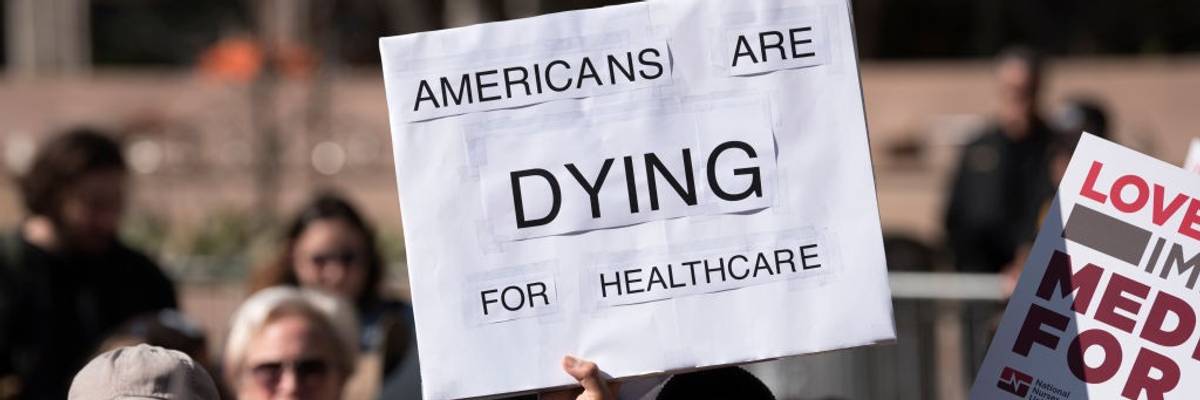
Participants hold signs in the Medicare for All Rally in Los Angeles California on February 4, 2017.
In a moment when the boundaries of what is “reasonable” or “possible” have been completely blown open, universal healthcare no longer seems so unrealistic.
Between the (likely) expiration of the Affordable Care Act enhanced subsidies, cuts to Medicaid and Medicare, and the decade-long efforts to undermine and dismantle the ACA, the casualties and costs of our current healthcare system continue to grow as Americans continue to wait for a better option. Nearly 45,000 Americans aged 17-65 die each year due to lack of insurance, a number that could rise to over 51,000 preventable deaths in the coming years.
Yet, the Senate has failed to pass either healthcare plan proposed to keep health insurance premiums from skyrocketing in the New Year and the Medicare for All bill introduced by Sen. Bernie Sanders (I-Vt.) and US Reps. Pramila Jayapal (D-Wash.) and Debbie Dingell (D-Mich.) in April 2025 has not advanced in Congress. Ideas like Medicare for All or universal healthcare often make eyes roll. “That’s unrealistic,” we’re told.
But is it? Universal healthcare is, after all, the reality for most other high-income countries. And yes, it might be disruptive, but Americans have lived through unprecedented changes and significant events in the past five years: the Covid-19 pandemic, the January 6 insurrection, and the rapid development of generative AI. Throughout history, major healthcare reforms have been born from disruption; Medicare is rooted in the civil rights movement, and the ACA passed in the wake of the 2008 financial crisis.
Now, as the United States prepares to celebrate its 250th anniversary, our foundational rights and institutions are being tested in ways that once would have been unthinkable. In a moment when the boundaries of what is “reasonable” or “possible” have been completely blown open, universal healthcare no longer seems so unrealistic.
Do we accept being the only high-income country where getting sick can cost you your home, your job, or your life?
We certainly can’t continue as we’ve been going. As a nurse scientist and postdoctoral fellow, I have a front-row seat to the healthcare crises we are facing: unaffordable medical bills, growing healthcare costs, long waits for specialty and even primary care appointments, and the growing burden of chronic illness and mental health crises. Employers are now shifting employees into high-deductible plans with high out-of-pocket costs. People are effectively locked into jobs they cannot leave because losing coverage, even temporarily, can be a significant financial risk—especially for those covering spouses and children.
We have extensive evidence, both internationally and within the US, showing what strategies produce better results. Any meaningful reform should include:
But people remain skeptical that we can achieve these goals in the US—largely because of public opinion and political will, both of which are significantly influenced by private health corporations, including insurance companies, large hospital systems, pharmaceutical companies, and other obscure middlemen that profit from the status quo.
For decades these corporations have spent hundreds of millions of dollars lobbying Congress and advertising to the public to protect their revenue and discourage solutions that most of us agree with and would benefit from. President Donald Trump himself criticized health insurers as “money-sucking,” calling them “BIG BAD insurance companies.” If policymakers on both sides of the aisle agree that corporate interests are getting in the way of healthcare reform, why do we continue to defer to them?
Opponents of single-payer, universal healthcare cite the costs, but the US already spends more on healthcare than other high-income countries with universal healthcare—and better health outcomes. It is expensive to maintain a broken system.
Major change is challenging but not impossible. Most Americans are dissatisfied with the costs, shortcomings, and complexities of our current healthcare system and support the idea of universal healthcare. We have the resources, expertise, and innovation to create a healthcare system that works for everyone. What we have not yet shown is the courage to do it.
As the country approaches its 250th anniversary, we should be asking what kind of nation we want to be. Do we accept being the only high-income country where getting sick can cost you your home, your job, or your life? Or do we finally build a system that treats healthcare as a public good rather than a commodity?
If the president really wants to “make America Healthy Again,” he can—through real healthcare reform. And for the rest of us, instead of just waiting to see what happens with the ACA subsidies, we can all work to build broad coalitions and support politicians who have a bold vision for healthcare and the courage to actually make a change.
Dear Common Dreams reader, It’s been nearly 30 years since I co-founded Common Dreams with my late wife, Lina Newhouser. We had the radical notion that journalism should serve the public good, not corporate profits. It was clear to us from the outset what it would take to build such a project. No paid advertisements. No corporate sponsors. No millionaire publisher telling us what to think or do. Many people said we wouldn't last a year, but we proved those doubters wrong. Together with a tremendous team of journalists and dedicated staff, we built an independent media outlet free from the constraints of profits and corporate control. Our mission has always been simple: To inform. To inspire. To ignite change for the common good. Building Common Dreams was not easy. Our survival was never guaranteed. When you take on the most powerful forces—Wall Street greed, fossil fuel industry destruction, Big Tech lobbyists, and uber-rich oligarchs who have spent billions upon billions rigging the economy and democracy in their favor—the only bulwark you have is supporters who believe in your work. But here’s the urgent message from me today. It's never been this bad out there. And it's never been this hard to keep us going. At the very moment Common Dreams is most needed, the threats we face are intensifying. We need your support now more than ever. We don't accept corporate advertising and never will. We don't have a paywall because we don't think people should be blocked from critical news based on their ability to pay. Everything we do is funded by the donations of readers like you. When everyone does the little they can afford, we are strong. But if that support retreats or dries up, so do we. Will you donate now to make sure Common Dreams not only survives but thrives? —Craig Brown, Co-founder |
Between the (likely) expiration of the Affordable Care Act enhanced subsidies, cuts to Medicaid and Medicare, and the decade-long efforts to undermine and dismantle the ACA, the casualties and costs of our current healthcare system continue to grow as Americans continue to wait for a better option. Nearly 45,000 Americans aged 17-65 die each year due to lack of insurance, a number that could rise to over 51,000 preventable deaths in the coming years.
Yet, the Senate has failed to pass either healthcare plan proposed to keep health insurance premiums from skyrocketing in the New Year and the Medicare for All bill introduced by Sen. Bernie Sanders (I-Vt.) and US Reps. Pramila Jayapal (D-Wash.) and Debbie Dingell (D-Mich.) in April 2025 has not advanced in Congress. Ideas like Medicare for All or universal healthcare often make eyes roll. “That’s unrealistic,” we’re told.
But is it? Universal healthcare is, after all, the reality for most other high-income countries. And yes, it might be disruptive, but Americans have lived through unprecedented changes and significant events in the past five years: the Covid-19 pandemic, the January 6 insurrection, and the rapid development of generative AI. Throughout history, major healthcare reforms have been born from disruption; Medicare is rooted in the civil rights movement, and the ACA passed in the wake of the 2008 financial crisis.
Now, as the United States prepares to celebrate its 250th anniversary, our foundational rights and institutions are being tested in ways that once would have been unthinkable. In a moment when the boundaries of what is “reasonable” or “possible” have been completely blown open, universal healthcare no longer seems so unrealistic.
Do we accept being the only high-income country where getting sick can cost you your home, your job, or your life?
We certainly can’t continue as we’ve been going. As a nurse scientist and postdoctoral fellow, I have a front-row seat to the healthcare crises we are facing: unaffordable medical bills, growing healthcare costs, long waits for specialty and even primary care appointments, and the growing burden of chronic illness and mental health crises. Employers are now shifting employees into high-deductible plans with high out-of-pocket costs. People are effectively locked into jobs they cannot leave because losing coverage, even temporarily, can be a significant financial risk—especially for those covering spouses and children.
We have extensive evidence, both internationally and within the US, showing what strategies produce better results. Any meaningful reform should include:
But people remain skeptical that we can achieve these goals in the US—largely because of public opinion and political will, both of which are significantly influenced by private health corporations, including insurance companies, large hospital systems, pharmaceutical companies, and other obscure middlemen that profit from the status quo.
For decades these corporations have spent hundreds of millions of dollars lobbying Congress and advertising to the public to protect their revenue and discourage solutions that most of us agree with and would benefit from. President Donald Trump himself criticized health insurers as “money-sucking,” calling them “BIG BAD insurance companies.” If policymakers on both sides of the aisle agree that corporate interests are getting in the way of healthcare reform, why do we continue to defer to them?
Opponents of single-payer, universal healthcare cite the costs, but the US already spends more on healthcare than other high-income countries with universal healthcare—and better health outcomes. It is expensive to maintain a broken system.
Major change is challenging but not impossible. Most Americans are dissatisfied with the costs, shortcomings, and complexities of our current healthcare system and support the idea of universal healthcare. We have the resources, expertise, and innovation to create a healthcare system that works for everyone. What we have not yet shown is the courage to do it.
As the country approaches its 250th anniversary, we should be asking what kind of nation we want to be. Do we accept being the only high-income country where getting sick can cost you your home, your job, or your life? Or do we finally build a system that treats healthcare as a public good rather than a commodity?
If the president really wants to “make America Healthy Again,” he can—through real healthcare reform. And for the rest of us, instead of just waiting to see what happens with the ACA subsidies, we can all work to build broad coalitions and support politicians who have a bold vision for healthcare and the courage to actually make a change.
Between the (likely) expiration of the Affordable Care Act enhanced subsidies, cuts to Medicaid and Medicare, and the decade-long efforts to undermine and dismantle the ACA, the casualties and costs of our current healthcare system continue to grow as Americans continue to wait for a better option. Nearly 45,000 Americans aged 17-65 die each year due to lack of insurance, a number that could rise to over 51,000 preventable deaths in the coming years.
Yet, the Senate has failed to pass either healthcare plan proposed to keep health insurance premiums from skyrocketing in the New Year and the Medicare for All bill introduced by Sen. Bernie Sanders (I-Vt.) and US Reps. Pramila Jayapal (D-Wash.) and Debbie Dingell (D-Mich.) in April 2025 has not advanced in Congress. Ideas like Medicare for All or universal healthcare often make eyes roll. “That’s unrealistic,” we’re told.
But is it? Universal healthcare is, after all, the reality for most other high-income countries. And yes, it might be disruptive, but Americans have lived through unprecedented changes and significant events in the past five years: the Covid-19 pandemic, the January 6 insurrection, and the rapid development of generative AI. Throughout history, major healthcare reforms have been born from disruption; Medicare is rooted in the civil rights movement, and the ACA passed in the wake of the 2008 financial crisis.
Now, as the United States prepares to celebrate its 250th anniversary, our foundational rights and institutions are being tested in ways that once would have been unthinkable. In a moment when the boundaries of what is “reasonable” or “possible” have been completely blown open, universal healthcare no longer seems so unrealistic.
Do we accept being the only high-income country where getting sick can cost you your home, your job, or your life?
We certainly can’t continue as we’ve been going. As a nurse scientist and postdoctoral fellow, I have a front-row seat to the healthcare crises we are facing: unaffordable medical bills, growing healthcare costs, long waits for specialty and even primary care appointments, and the growing burden of chronic illness and mental health crises. Employers are now shifting employees into high-deductible plans with high out-of-pocket costs. People are effectively locked into jobs they cannot leave because losing coverage, even temporarily, can be a significant financial risk—especially for those covering spouses and children.
We have extensive evidence, both internationally and within the US, showing what strategies produce better results. Any meaningful reform should include:
But people remain skeptical that we can achieve these goals in the US—largely because of public opinion and political will, both of which are significantly influenced by private health corporations, including insurance companies, large hospital systems, pharmaceutical companies, and other obscure middlemen that profit from the status quo.
For decades these corporations have spent hundreds of millions of dollars lobbying Congress and advertising to the public to protect their revenue and discourage solutions that most of us agree with and would benefit from. President Donald Trump himself criticized health insurers as “money-sucking,” calling them “BIG BAD insurance companies.” If policymakers on both sides of the aisle agree that corporate interests are getting in the way of healthcare reform, why do we continue to defer to them?
Opponents of single-payer, universal healthcare cite the costs, but the US already spends more on healthcare than other high-income countries with universal healthcare—and better health outcomes. It is expensive to maintain a broken system.
Major change is challenging but not impossible. Most Americans are dissatisfied with the costs, shortcomings, and complexities of our current healthcare system and support the idea of universal healthcare. We have the resources, expertise, and innovation to create a healthcare system that works for everyone. What we have not yet shown is the courage to do it.
As the country approaches its 250th anniversary, we should be asking what kind of nation we want to be. Do we accept being the only high-income country where getting sick can cost you your home, your job, or your life? Or do we finally build a system that treats healthcare as a public good rather than a commodity?
If the president really wants to “make America Healthy Again,” he can—through real healthcare reform. And for the rest of us, instead of just waiting to see what happens with the ACA subsidies, we can all work to build broad coalitions and support politicians who have a bold vision for healthcare and the courage to actually make a change.