SUBSCRIBE TO OUR FREE NEWSLETTER
Daily news & progressive opinion—funded by the people, not the corporations—delivered straight to your inbox.
5
#000000
#FFFFFF
To donate by check, phone, or other method, see our More Ways to Give page.
Daily news & progressive opinion—funded by the people, not the corporations—delivered straight to your inbox.
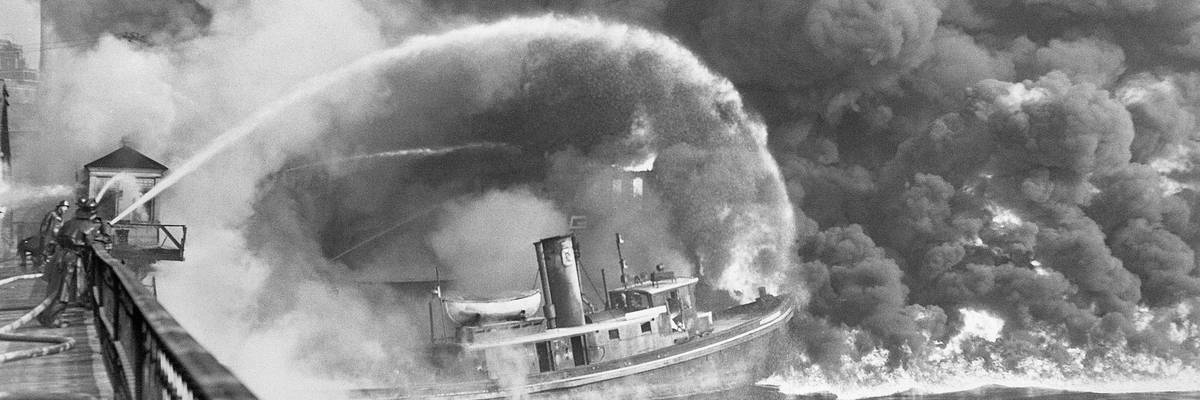
Firemen stand on a bridge over the Cuyahoga River to spray water on the tug Arizona, as a fire, started in an oil slick on the river, sweeps the docks at the Great Lakes Towing Company site in Cleveland, Ohio on November 1, 1952.
The Trump administration is trying to turn back the clock on environmental and climate regulations. But they can’t control physics. Or the falling cost and rising efficiency of renewable energy.
I spent part of the morning reading the Powell memo—the famous document written by the future Supreme Court justice in August of 1971 arguing that American business and industry had to get its act together so it could dominate the country’s political life and prevent the threats to “the American system” from “the college campus, the pulpit, the media, the intellectual and literary journals, the arts and sciences, and from politicians.”
In the short run, Justice Lewis Powell was unsuccessful—the Environmental Protection Agency (EPA) had been formed a few months before his memo, the Clean Water Act passed a few months after. As William Ruckelshaus, the first administrator of the EPA (and a Republican appointed by a Republican president) said, the agency “has no obligation to promote agriculture or commerce; only the critical obligation to protect and enhance the environment.” Over the next years the agency enacted a critical series of rules that—with surprising speed—cleaned America’s air, rivers, and lakes, and became the template for similar laws around the world.
The job for those of us who care about the future is to continue insisting on reality.
But the forces Powell helped set in motion with his memo to the Chamber of Commerce never accepted the premise that American business should be regulated—as he had recommended, they built a powerful set of institutions—think tanks, tv stations, publishers, and above all political lobbies—and now, 54 years later, they would appear, on the surface, to have won their final victory. Lee Zeldin, a distant successor to Ruckelshaus as EPA head, announced what he called the “greatest day of deregulation in American history.”
As the Times explained, under Zeldin’s plan the agency
would unwind more than two dozen protections against air and water pollution. It would overturn limits on soot from smokestacks that have been linked to respiratory problems in humans and premature deaths as well as restrictions on emissions of mercury, a neurotoxin. It would get rid of the “good neighbor rule” that requires states to address their own pollution when it’s carried by winds into neighboring states. And it would eliminate enforcement efforts that prioritize the protection of poor and minority communities.
In addition, when the agency creates environmental policy, it would no longer consider the costs to society from wildfires, droughts, storms, and other disasters that might be made worse by pollution connected to that policy, Mr. Zeldin said.
In perhaps its most consequential act, the agency said it would work to erase the EPA’s legal authority to regulate carbon dioxide and other greenhouse gases by reconsidering decades of science that show global warming is endangering humanity. In his video, Mr. Zeldin derisively referred to that legal underpinning as “the holy grail of the climate change religion.”
The reason, he said, was to help the president “usher in a golden age of American success.”
It was language echoed in a second extraordinary speech, this one by Energy Secretary Chris Wright, speaking to fellow oilmen in Houston, who promised to “unleash human potential” mostly through the use of artificial intelligence, which would require “unlimited energy.” Yes, he said, we’ve already increased the amount of carbon in the atmosphere by 50%, but climate change is simply “a global physical phenomenon that is a side effect of building the modern world.” (That is a phrase that will live in infamy)
The triumphalism of those speeches is in some ways well founded—as the Trump administration ravages university budgets, as its allies turn once-great newspapers into mouthpieces, and as the GOP Congress marches in complete lockstep threatening even to impeach those judges who might rule against this crusade, it’s hard to see precisely how they’ll be stopped. Yes, there will be widespread resistance (join us at Third Act and many other groups on April 5, for the next big round of rallies), and yes there will be lots and lots of court cases. (Some good news on that front this week, as the Supreme Court denied an industry request to keep states and cities from suing them for climate damages). But for the moment these hard-faced men with greed as their compass occupy the political high ground. For the moment they can do much of what they will.
And yet and yet and yet. There are some forces they can’t control. One is physics. You can prattle all you want, as Zeldin did, about how ending efforts to address climate change will “decrease the cost of living for American families,” but thanks to global warming the price of insurance is going through the roof—the latest data I’ve seen from, say, Summit County, Utah shows premiums doubling, and in some cases going up 300%. That’s if you can get it at all—in the wake of the LA fires, California’s largest insurer said this week that “writing new policies doesn’t make any sense at this time.”
And if you can’t control physics, you also can’t control—at least completely—engineering and economics, the disciplines that have led in recent years to the breakout of renewable energy. On the same day as Wright’s speech belittling clean power, these numbers emerged from the consultant Wood MacKenzie:
The U.S. installed 50 gigawatts (GW) of new solar capacity in 2024, the largest single year of new capacity added to the grid by any energy technology in over two decades. That’s enough to power 8.5 million households.
Why do you think the energy industry spent record amounts on Trump’s election? (Fracking baron Wright and his wife gave $475,000). It’s precisely because of the size of this threat.
As Abby Hopper, the president of the Solar Energy Industries Association put it: “Solar and storage can be built faster and more affordably than any other technology, ensuring the United States has the power needed to compete in the global economy and meet rising electricity demand. America’s solar and storage industry set historic deployment and manufacturing records in 2024, creating jobs and driving economic growth.”
As the CEO of NextEra Energy (which builds both gas and renewable plants) explained at the same conference that Wright addressed:
The cost of gas turbines and the skilled labor to install them are both up threefold from just two years ago, and new gas infrastructure faces years-long delivery backlogs. Renewables plus batteries, he said, are the cheapest, fastest, and easiest way to meet the surging power demand from data centers driven by the acceleration in artificial intelligence.
“We’ve got to be really careful here, from an affordability standpoint, about the choices that we’re making. What we don’t want to do is drive ourselves to only one solution—that being a gas-fired solution—that’s now more expensive than it ever has been in its history,” he said. “It just so happens that the most economic solution comes with clean energy benefits, as well.”
And as the technology keeps getting better, so do the numbers—a U.K. study released today found that rooftop solar alone could supply two-thirds of the world’s electricity.
Zeldin, Wright, Trump—they want to take us back to the glory days before 1970, when rivers caught on fire. And to do so they’ll try to take us back to the days before 1958—word came yesterday that the federal government was planning to break the lease on the Hawaii facility that supports the carbon observatory on Mauna Loa.
“It would be terrible if this office was closed,” atmospheric scientist Marc Alessi, a fellow with the Union of Concerned Scientists advocacy group, said.
“Not only does it provide the measurement of CO2 that we so desperately need to track climate change, but it also informs climate model simulations.”
Others said the Trump administration had already made their work harder, after the White House froze credit cards held by agency employees for a 30-day period under DOGE’S “cost efficiency initiative.”
“It has already become very difficult to continue our global greenhouse gas monitoring network,” an atmospheric scientist involved in NOAA’s measurements said, asking not to be named.
“It requires continuous shipping of sampling equipment black and forth all over the world. Suddenly, we cannot use our government-issued credit cards anymore… It looks like our monitoring program will soon be dead,” the scientist said.
But even if they stop monitoring carbon it will continue accumulating—in fact, the instrument at Mauna Loa showed that CO2 passed the 430 parts per million mark for the first time this week. And even if the federal government does all that it can to shut down renewable energy, the embarrassing numbers will keep piling up—Texas, world capital of hydrocarbons, set remarkable records this week for renewable energy generation.
In just the first week of March, the ERCOT power grid that supplies nearly all of Texas set records for most wind production (28,470 megawatts), most solar production (24,818 megawatts), and greatest battery discharge (4,833 megawatts). Only two years ago, the most that batteries had ever injected into the ERCOT grid at once was 766 megawatts. Now the battery fleet is providing nearly as much instantaneous power as Texas nuclear power plants, which contribute around 5,000 megawatts.
The job for those of us who care about the future is to continue insisting on reality (hats off to those Texans who rallied outside the conference that Wright addressed, and that’s why you’re supposed to set aside Sept 20-21 for Sun Day). Wright, Zeldin, Musk, Trump—they have powerful sticks to try and beat reality into submission. But reality has a way of biting back.
Dear Common Dreams reader, It’s been nearly 30 years since I co-founded Common Dreams with my late wife, Lina Newhouser. We had the radical notion that journalism should serve the public good, not corporate profits. It was clear to us from the outset what it would take to build such a project. No paid advertisements. No corporate sponsors. No millionaire publisher telling us what to think or do. Many people said we wouldn't last a year, but we proved those doubters wrong. Together with a tremendous team of journalists and dedicated staff, we built an independent media outlet free from the constraints of profits and corporate control. Our mission has always been simple: To inform. To inspire. To ignite change for the common good. Building Common Dreams was not easy. Our survival was never guaranteed. When you take on the most powerful forces—Wall Street greed, fossil fuel industry destruction, Big Tech lobbyists, and uber-rich oligarchs who have spent billions upon billions rigging the economy and democracy in their favor—the only bulwark you have is supporters who believe in your work. But here’s the urgent message from me today. It's never been this bad out there. And it's never been this hard to keep us going. At the very moment Common Dreams is most needed, the threats we face are intensifying. We need your support now more than ever. We don't accept corporate advertising and never will. We don't have a paywall because we don't think people should be blocked from critical news based on their ability to pay. Everything we do is funded by the donations of readers like you. When everyone does the little they can afford, we are strong. But if that support retreats or dries up, so do we. Will you donate now to make sure Common Dreams not only survives but thrives? —Craig Brown, Co-founder |
I spent part of the morning reading the Powell memo—the famous document written by the future Supreme Court justice in August of 1971 arguing that American business and industry had to get its act together so it could dominate the country’s political life and prevent the threats to “the American system” from “the college campus, the pulpit, the media, the intellectual and literary journals, the arts and sciences, and from politicians.”
In the short run, Justice Lewis Powell was unsuccessful—the Environmental Protection Agency (EPA) had been formed a few months before his memo, the Clean Water Act passed a few months after. As William Ruckelshaus, the first administrator of the EPA (and a Republican appointed by a Republican president) said, the agency “has no obligation to promote agriculture or commerce; only the critical obligation to protect and enhance the environment.” Over the next years the agency enacted a critical series of rules that—with surprising speed—cleaned America’s air, rivers, and lakes, and became the template for similar laws around the world.
The job for those of us who care about the future is to continue insisting on reality.
But the forces Powell helped set in motion with his memo to the Chamber of Commerce never accepted the premise that American business should be regulated—as he had recommended, they built a powerful set of institutions—think tanks, tv stations, publishers, and above all political lobbies—and now, 54 years later, they would appear, on the surface, to have won their final victory. Lee Zeldin, a distant successor to Ruckelshaus as EPA head, announced what he called the “greatest day of deregulation in American history.”
As the Times explained, under Zeldin’s plan the agency
would unwind more than two dozen protections against air and water pollution. It would overturn limits on soot from smokestacks that have been linked to respiratory problems in humans and premature deaths as well as restrictions on emissions of mercury, a neurotoxin. It would get rid of the “good neighbor rule” that requires states to address their own pollution when it’s carried by winds into neighboring states. And it would eliminate enforcement efforts that prioritize the protection of poor and minority communities.
In addition, when the agency creates environmental policy, it would no longer consider the costs to society from wildfires, droughts, storms, and other disasters that might be made worse by pollution connected to that policy, Mr. Zeldin said.
In perhaps its most consequential act, the agency said it would work to erase the EPA’s legal authority to regulate carbon dioxide and other greenhouse gases by reconsidering decades of science that show global warming is endangering humanity. In his video, Mr. Zeldin derisively referred to that legal underpinning as “the holy grail of the climate change religion.”
The reason, he said, was to help the president “usher in a golden age of American success.”
It was language echoed in a second extraordinary speech, this one by Energy Secretary Chris Wright, speaking to fellow oilmen in Houston, who promised to “unleash human potential” mostly through the use of artificial intelligence, which would require “unlimited energy.” Yes, he said, we’ve already increased the amount of carbon in the atmosphere by 50%, but climate change is simply “a global physical phenomenon that is a side effect of building the modern world.” (That is a phrase that will live in infamy)
The triumphalism of those speeches is in some ways well founded—as the Trump administration ravages university budgets, as its allies turn once-great newspapers into mouthpieces, and as the GOP Congress marches in complete lockstep threatening even to impeach those judges who might rule against this crusade, it’s hard to see precisely how they’ll be stopped. Yes, there will be widespread resistance (join us at Third Act and many other groups on April 5, for the next big round of rallies), and yes there will be lots and lots of court cases. (Some good news on that front this week, as the Supreme Court denied an industry request to keep states and cities from suing them for climate damages). But for the moment these hard-faced men with greed as their compass occupy the political high ground. For the moment they can do much of what they will.
And yet and yet and yet. There are some forces they can’t control. One is physics. You can prattle all you want, as Zeldin did, about how ending efforts to address climate change will “decrease the cost of living for American families,” but thanks to global warming the price of insurance is going through the roof—the latest data I’ve seen from, say, Summit County, Utah shows premiums doubling, and in some cases going up 300%. That’s if you can get it at all—in the wake of the LA fires, California’s largest insurer said this week that “writing new policies doesn’t make any sense at this time.”
And if you can’t control physics, you also can’t control—at least completely—engineering and economics, the disciplines that have led in recent years to the breakout of renewable energy. On the same day as Wright’s speech belittling clean power, these numbers emerged from the consultant Wood MacKenzie:
The U.S. installed 50 gigawatts (GW) of new solar capacity in 2024, the largest single year of new capacity added to the grid by any energy technology in over two decades. That’s enough to power 8.5 million households.
Why do you think the energy industry spent record amounts on Trump’s election? (Fracking baron Wright and his wife gave $475,000). It’s precisely because of the size of this threat.
As Abby Hopper, the president of the Solar Energy Industries Association put it: “Solar and storage can be built faster and more affordably than any other technology, ensuring the United States has the power needed to compete in the global economy and meet rising electricity demand. America’s solar and storage industry set historic deployment and manufacturing records in 2024, creating jobs and driving economic growth.”
As the CEO of NextEra Energy (which builds both gas and renewable plants) explained at the same conference that Wright addressed:
The cost of gas turbines and the skilled labor to install them are both up threefold from just two years ago, and new gas infrastructure faces years-long delivery backlogs. Renewables plus batteries, he said, are the cheapest, fastest, and easiest way to meet the surging power demand from data centers driven by the acceleration in artificial intelligence.
“We’ve got to be really careful here, from an affordability standpoint, about the choices that we’re making. What we don’t want to do is drive ourselves to only one solution—that being a gas-fired solution—that’s now more expensive than it ever has been in its history,” he said. “It just so happens that the most economic solution comes with clean energy benefits, as well.”
And as the technology keeps getting better, so do the numbers—a U.K. study released today found that rooftop solar alone could supply two-thirds of the world’s electricity.
Zeldin, Wright, Trump—they want to take us back to the glory days before 1970, when rivers caught on fire. And to do so they’ll try to take us back to the days before 1958—word came yesterday that the federal government was planning to break the lease on the Hawaii facility that supports the carbon observatory on Mauna Loa.
“It would be terrible if this office was closed,” atmospheric scientist Marc Alessi, a fellow with the Union of Concerned Scientists advocacy group, said.
“Not only does it provide the measurement of CO2 that we so desperately need to track climate change, but it also informs climate model simulations.”
Others said the Trump administration had already made their work harder, after the White House froze credit cards held by agency employees for a 30-day period under DOGE’S “cost efficiency initiative.”
“It has already become very difficult to continue our global greenhouse gas monitoring network,” an atmospheric scientist involved in NOAA’s measurements said, asking not to be named.
“It requires continuous shipping of sampling equipment black and forth all over the world. Suddenly, we cannot use our government-issued credit cards anymore… It looks like our monitoring program will soon be dead,” the scientist said.
But even if they stop monitoring carbon it will continue accumulating—in fact, the instrument at Mauna Loa showed that CO2 passed the 430 parts per million mark for the first time this week. And even if the federal government does all that it can to shut down renewable energy, the embarrassing numbers will keep piling up—Texas, world capital of hydrocarbons, set remarkable records this week for renewable energy generation.
In just the first week of March, the ERCOT power grid that supplies nearly all of Texas set records for most wind production (28,470 megawatts), most solar production (24,818 megawatts), and greatest battery discharge (4,833 megawatts). Only two years ago, the most that batteries had ever injected into the ERCOT grid at once was 766 megawatts. Now the battery fleet is providing nearly as much instantaneous power as Texas nuclear power plants, which contribute around 5,000 megawatts.
The job for those of us who care about the future is to continue insisting on reality (hats off to those Texans who rallied outside the conference that Wright addressed, and that’s why you’re supposed to set aside Sept 20-21 for Sun Day). Wright, Zeldin, Musk, Trump—they have powerful sticks to try and beat reality into submission. But reality has a way of biting back.
I spent part of the morning reading the Powell memo—the famous document written by the future Supreme Court justice in August of 1971 arguing that American business and industry had to get its act together so it could dominate the country’s political life and prevent the threats to “the American system” from “the college campus, the pulpit, the media, the intellectual and literary journals, the arts and sciences, and from politicians.”
In the short run, Justice Lewis Powell was unsuccessful—the Environmental Protection Agency (EPA) had been formed a few months before his memo, the Clean Water Act passed a few months after. As William Ruckelshaus, the first administrator of the EPA (and a Republican appointed by a Republican president) said, the agency “has no obligation to promote agriculture or commerce; only the critical obligation to protect and enhance the environment.” Over the next years the agency enacted a critical series of rules that—with surprising speed—cleaned America’s air, rivers, and lakes, and became the template for similar laws around the world.
The job for those of us who care about the future is to continue insisting on reality.
But the forces Powell helped set in motion with his memo to the Chamber of Commerce never accepted the premise that American business should be regulated—as he had recommended, they built a powerful set of institutions—think tanks, tv stations, publishers, and above all political lobbies—and now, 54 years later, they would appear, on the surface, to have won their final victory. Lee Zeldin, a distant successor to Ruckelshaus as EPA head, announced what he called the “greatest day of deregulation in American history.”
As the Times explained, under Zeldin’s plan the agency
would unwind more than two dozen protections against air and water pollution. It would overturn limits on soot from smokestacks that have been linked to respiratory problems in humans and premature deaths as well as restrictions on emissions of mercury, a neurotoxin. It would get rid of the “good neighbor rule” that requires states to address their own pollution when it’s carried by winds into neighboring states. And it would eliminate enforcement efforts that prioritize the protection of poor and minority communities.
In addition, when the agency creates environmental policy, it would no longer consider the costs to society from wildfires, droughts, storms, and other disasters that might be made worse by pollution connected to that policy, Mr. Zeldin said.
In perhaps its most consequential act, the agency said it would work to erase the EPA’s legal authority to regulate carbon dioxide and other greenhouse gases by reconsidering decades of science that show global warming is endangering humanity. In his video, Mr. Zeldin derisively referred to that legal underpinning as “the holy grail of the climate change religion.”
The reason, he said, was to help the president “usher in a golden age of American success.”
It was language echoed in a second extraordinary speech, this one by Energy Secretary Chris Wright, speaking to fellow oilmen in Houston, who promised to “unleash human potential” mostly through the use of artificial intelligence, which would require “unlimited energy.” Yes, he said, we’ve already increased the amount of carbon in the atmosphere by 50%, but climate change is simply “a global physical phenomenon that is a side effect of building the modern world.” (That is a phrase that will live in infamy)
The triumphalism of those speeches is in some ways well founded—as the Trump administration ravages university budgets, as its allies turn once-great newspapers into mouthpieces, and as the GOP Congress marches in complete lockstep threatening even to impeach those judges who might rule against this crusade, it’s hard to see precisely how they’ll be stopped. Yes, there will be widespread resistance (join us at Third Act and many other groups on April 5, for the next big round of rallies), and yes there will be lots and lots of court cases. (Some good news on that front this week, as the Supreme Court denied an industry request to keep states and cities from suing them for climate damages). But for the moment these hard-faced men with greed as their compass occupy the political high ground. For the moment they can do much of what they will.
And yet and yet and yet. There are some forces they can’t control. One is physics. You can prattle all you want, as Zeldin did, about how ending efforts to address climate change will “decrease the cost of living for American families,” but thanks to global warming the price of insurance is going through the roof—the latest data I’ve seen from, say, Summit County, Utah shows premiums doubling, and in some cases going up 300%. That’s if you can get it at all—in the wake of the LA fires, California’s largest insurer said this week that “writing new policies doesn’t make any sense at this time.”
And if you can’t control physics, you also can’t control—at least completely—engineering and economics, the disciplines that have led in recent years to the breakout of renewable energy. On the same day as Wright’s speech belittling clean power, these numbers emerged from the consultant Wood MacKenzie:
The U.S. installed 50 gigawatts (GW) of new solar capacity in 2024, the largest single year of new capacity added to the grid by any energy technology in over two decades. That’s enough to power 8.5 million households.
Why do you think the energy industry spent record amounts on Trump’s election? (Fracking baron Wright and his wife gave $475,000). It’s precisely because of the size of this threat.
As Abby Hopper, the president of the Solar Energy Industries Association put it: “Solar and storage can be built faster and more affordably than any other technology, ensuring the United States has the power needed to compete in the global economy and meet rising electricity demand. America’s solar and storage industry set historic deployment and manufacturing records in 2024, creating jobs and driving economic growth.”
As the CEO of NextEra Energy (which builds both gas and renewable plants) explained at the same conference that Wright addressed:
The cost of gas turbines and the skilled labor to install them are both up threefold from just two years ago, and new gas infrastructure faces years-long delivery backlogs. Renewables plus batteries, he said, are the cheapest, fastest, and easiest way to meet the surging power demand from data centers driven by the acceleration in artificial intelligence.
“We’ve got to be really careful here, from an affordability standpoint, about the choices that we’re making. What we don’t want to do is drive ourselves to only one solution—that being a gas-fired solution—that’s now more expensive than it ever has been in its history,” he said. “It just so happens that the most economic solution comes with clean energy benefits, as well.”
And as the technology keeps getting better, so do the numbers—a U.K. study released today found that rooftop solar alone could supply two-thirds of the world’s electricity.
Zeldin, Wright, Trump—they want to take us back to the glory days before 1970, when rivers caught on fire. And to do so they’ll try to take us back to the days before 1958—word came yesterday that the federal government was planning to break the lease on the Hawaii facility that supports the carbon observatory on Mauna Loa.
“It would be terrible if this office was closed,” atmospheric scientist Marc Alessi, a fellow with the Union of Concerned Scientists advocacy group, said.
“Not only does it provide the measurement of CO2 that we so desperately need to track climate change, but it also informs climate model simulations.”
Others said the Trump administration had already made their work harder, after the White House froze credit cards held by agency employees for a 30-day period under DOGE’S “cost efficiency initiative.”
“It has already become very difficult to continue our global greenhouse gas monitoring network,” an atmospheric scientist involved in NOAA’s measurements said, asking not to be named.
“It requires continuous shipping of sampling equipment black and forth all over the world. Suddenly, we cannot use our government-issued credit cards anymore… It looks like our monitoring program will soon be dead,” the scientist said.
But even if they stop monitoring carbon it will continue accumulating—in fact, the instrument at Mauna Loa showed that CO2 passed the 430 parts per million mark for the first time this week. And even if the federal government does all that it can to shut down renewable energy, the embarrassing numbers will keep piling up—Texas, world capital of hydrocarbons, set remarkable records this week for renewable energy generation.
In just the first week of March, the ERCOT power grid that supplies nearly all of Texas set records for most wind production (28,470 megawatts), most solar production (24,818 megawatts), and greatest battery discharge (4,833 megawatts). Only two years ago, the most that batteries had ever injected into the ERCOT grid at once was 766 megawatts. Now the battery fleet is providing nearly as much instantaneous power as Texas nuclear power plants, which contribute around 5,000 megawatts.
The job for those of us who care about the future is to continue insisting on reality (hats off to those Texans who rallied outside the conference that Wright addressed, and that’s why you’re supposed to set aside Sept 20-21 for Sun Day). Wright, Zeldin, Musk, Trump—they have powerful sticks to try and beat reality into submission. But reality has a way of biting back.