SUBSCRIBE TO OUR FREE NEWSLETTER
Daily news & progressive opinion—funded by the people, not the corporations—delivered straight to your inbox.
5
#000000
#FFFFFF
To donate by check, phone, or other method, see our More Ways to Give page.
Daily news & progressive opinion—funded by the people, not the corporations—delivered straight to your inbox.
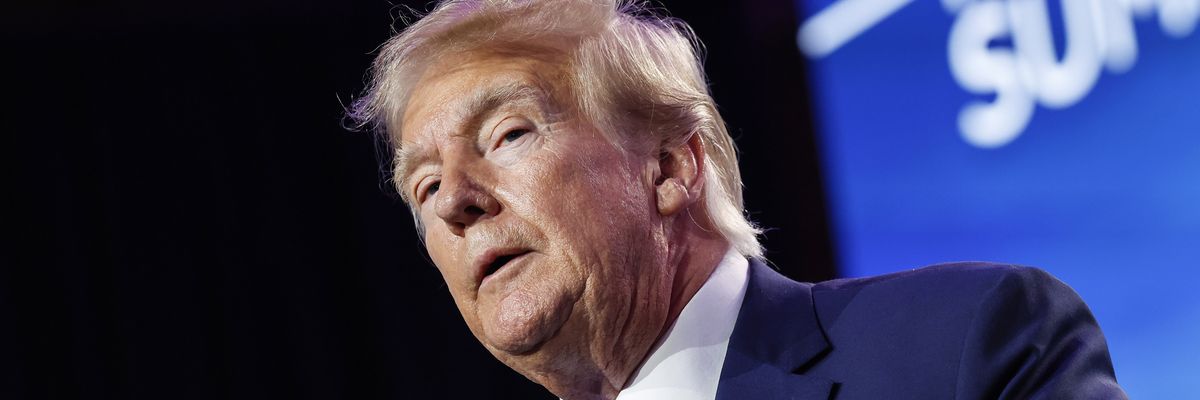
Former President Donald Trump speaks at an event on September 15, 2023 in Washington, D.C.
The former president now seeking reelection had plenty of opportunities to raise wages or offer better worker protections. We know exactly what he did instead.
Although Donald Trump, as president, proclaimed in his 2020 State of the Union address that he had produced a “blue-collar boom” in workers’ wages, the reality was quite different. Using his control of the executive branch of the U.S. government, Trump repeatedly undermined the wages of American workers by blocking raises and imposing wage reductions.
Only the preceding year, Trump derailed vital wage legislation. In July 2019―with the pathetically low federal minimum wage stuck at $7.25 per hour for a decade and some 13 million workers holding two or more jobs to support their families―the Democratic-controlled House of Representatives passed the Raise the Wage Act. If enacted, the legislation would have gradually increased the federal minimum wage to $15 per hour over a six-year period. But, instead of supporting the legislation or proposing an alternative, the Trump White House announced that, if the Senate passed the House bill, Trump would veto it. Consequently, the measure died in the Republican-controlled Senate. According to the AFL-CIO, the legislation would have raised the pay of 40 million American workers.
That same year, Trump’s Department of Labor succeeded in rolling back planned wage increases for millions of workers by restricting eligibility for overtime pay. In 2016, the last year of the Obama administration, the Labor Department had issued a rule substantially raising the income level below which workers were paid time and a half for work done beyond 40 hours per week. But the Trump Labor Department, seizing on a delay in implementation occasioned by a judicial decision, lowered the level by more than $20,000, thus depriving 8.2 million American workers of the right to overtime pay secured under Obama.
In August 2018, Trump canceled a scheduled 2 percent pay raise for millions of civilian federal employees, leading to criticism even from some Republicans. This action, plus other administration assaults on the rights of public employees, led to a massive flight of workers from government service. By the fall of 2019, there were 45,000 vacancies in the Department of Veterans Affairs alone. To fill these vacancies, the Trump administration hired large numbers of temp workers at low wages and with minimal benefits.
Yet another administration policy that undercut workers’ wages emerged with the Trump Labor Department’s issuance of a “joint-employer” rule. The Fair Labor Standards Act of 1938 had been fashioned to ensure that businesses using staffing companies or subcontractors would be accountable for complying with basic workplace protections. Even so, the Trump administration’s joint-employer rule substantially limited liability for wage and hour violations, thereby making it harder for workers to hold all parties accountable. As a result, U.S. workers lost an estimated $1 billion annually thanks to subcontracting or wage theft by employers.
Of course, not all Trump administration attempts at holding down wages succeeded. In 2017, the Trump Labor Department proposed that employers could simply pocket workers’ tips, as long as the workers were paid the minimum wage. Economists estimated that this policy would lead to the loss of $5.8 billion per year in tips for workers, 80 percent of whom were women. But after the discovery that Trump’s Secretary of Labor had gone to great lengths to hide his department’s findings about how harmful the new policy would be, Congress stepped in and amended the Fair Labor Standards Act to prohibit employers from seizing the tips of their employees.
Another Trump administration failure occurred in connection with reducing the wages of farmworkers, some of the most exploited, lowest-paid workers in the United States. In mid-2019, the Labor Department proposed a new regulation that would change the rules of the H-2A visa program, used by agricultural employers to hire migrant farmworkers for seasonal work―for example, by President Trump’s wineries. As one of the rules changes would lower wage rates for H-2A farmworkers and, consequently, for their U.S. counterparts, the United Farm Workers challenged it in federal court and, ultimately, prevailed.
Although the “real wages” (after adjusting for inflation) of American workers did rise during Trump’s presidency, the rise was minimal. According to a 2020 Congressional report, during Trump’s first three years in office, workers’ “real average hourly earnings increased by an average of just 0.9 percent.” Admittedly, there was a very substantial jump in real average earnings in the fourth year. But this jump reflected the fact that, in 2020, a disproportionate number of low-wage workers lost their jobs thanks to the COVID-19 pandemic and, therefore, were not included in wage calculations.
And even these minimal wage gains usually reflected factors other than administration actions. Responding to the failure of the federal government to ensure adequate wages for workers, many states and cities enacted minimum wage raises, fueling wage growth for the most poorly-paid. Indeed, a study by the National Employment Law Project found that the median wage for low-wage workers climbed much more sharply in states that raised their pay floors than in states that didn’t. In addition, a surge in strike activity by teachers and by unionized workers at major U.S. companies during 2018 and 2019 increased wages for yet another portion of the nation’s workforce.
Overall, then, far from sparking a wage boom, the policies of Trump and his administration depressed the wages of American workers.
Dear Common Dreams reader, It’s been nearly 30 years since I co-founded Common Dreams with my late wife, Lina Newhouser. We had the radical notion that journalism should serve the public good, not corporate profits. It was clear to us from the outset what it would take to build such a project. No paid advertisements. No corporate sponsors. No millionaire publisher telling us what to think or do. Many people said we wouldn't last a year, but we proved those doubters wrong. Together with a tremendous team of journalists and dedicated staff, we built an independent media outlet free from the constraints of profits and corporate control. Our mission has always been simple: To inform. To inspire. To ignite change for the common good. Building Common Dreams was not easy. Our survival was never guaranteed. When you take on the most powerful forces—Wall Street greed, fossil fuel industry destruction, Big Tech lobbyists, and uber-rich oligarchs who have spent billions upon billions rigging the economy and democracy in their favor—the only bulwark you have is supporters who believe in your work. But here’s the urgent message from me today. It's never been this bad out there. And it's never been this hard to keep us going. At the very moment Common Dreams is most needed, the threats we face are intensifying. We need your support now more than ever. We don't accept corporate advertising and never will. We don't have a paywall because we don't think people should be blocked from critical news based on their ability to pay. Everything we do is funded by the donations of readers like you. When everyone does the little they can afford, we are strong. But if that support retreats or dries up, so do we. Will you donate now to make sure Common Dreams not only survives but thrives? —Craig Brown, Co-founder |
Although Donald Trump, as president, proclaimed in his 2020 State of the Union address that he had produced a “blue-collar boom” in workers’ wages, the reality was quite different. Using his control of the executive branch of the U.S. government, Trump repeatedly undermined the wages of American workers by blocking raises and imposing wage reductions.
Only the preceding year, Trump derailed vital wage legislation. In July 2019―with the pathetically low federal minimum wage stuck at $7.25 per hour for a decade and some 13 million workers holding two or more jobs to support their families―the Democratic-controlled House of Representatives passed the Raise the Wage Act. If enacted, the legislation would have gradually increased the federal minimum wage to $15 per hour over a six-year period. But, instead of supporting the legislation or proposing an alternative, the Trump White House announced that, if the Senate passed the House bill, Trump would veto it. Consequently, the measure died in the Republican-controlled Senate. According to the AFL-CIO, the legislation would have raised the pay of 40 million American workers.
That same year, Trump’s Department of Labor succeeded in rolling back planned wage increases for millions of workers by restricting eligibility for overtime pay. In 2016, the last year of the Obama administration, the Labor Department had issued a rule substantially raising the income level below which workers were paid time and a half for work done beyond 40 hours per week. But the Trump Labor Department, seizing on a delay in implementation occasioned by a judicial decision, lowered the level by more than $20,000, thus depriving 8.2 million American workers of the right to overtime pay secured under Obama.
In August 2018, Trump canceled a scheduled 2 percent pay raise for millions of civilian federal employees, leading to criticism even from some Republicans. This action, plus other administration assaults on the rights of public employees, led to a massive flight of workers from government service. By the fall of 2019, there were 45,000 vacancies in the Department of Veterans Affairs alone. To fill these vacancies, the Trump administration hired large numbers of temp workers at low wages and with minimal benefits.
Yet another administration policy that undercut workers’ wages emerged with the Trump Labor Department’s issuance of a “joint-employer” rule. The Fair Labor Standards Act of 1938 had been fashioned to ensure that businesses using staffing companies or subcontractors would be accountable for complying with basic workplace protections. Even so, the Trump administration’s joint-employer rule substantially limited liability for wage and hour violations, thereby making it harder for workers to hold all parties accountable. As a result, U.S. workers lost an estimated $1 billion annually thanks to subcontracting or wage theft by employers.
Of course, not all Trump administration attempts at holding down wages succeeded. In 2017, the Trump Labor Department proposed that employers could simply pocket workers’ tips, as long as the workers were paid the minimum wage. Economists estimated that this policy would lead to the loss of $5.8 billion per year in tips for workers, 80 percent of whom were women. But after the discovery that Trump’s Secretary of Labor had gone to great lengths to hide his department’s findings about how harmful the new policy would be, Congress stepped in and amended the Fair Labor Standards Act to prohibit employers from seizing the tips of their employees.
Another Trump administration failure occurred in connection with reducing the wages of farmworkers, some of the most exploited, lowest-paid workers in the United States. In mid-2019, the Labor Department proposed a new regulation that would change the rules of the H-2A visa program, used by agricultural employers to hire migrant farmworkers for seasonal work―for example, by President Trump’s wineries. As one of the rules changes would lower wage rates for H-2A farmworkers and, consequently, for their U.S. counterparts, the United Farm Workers challenged it in federal court and, ultimately, prevailed.
Although the “real wages” (after adjusting for inflation) of American workers did rise during Trump’s presidency, the rise was minimal. According to a 2020 Congressional report, during Trump’s first three years in office, workers’ “real average hourly earnings increased by an average of just 0.9 percent.” Admittedly, there was a very substantial jump in real average earnings in the fourth year. But this jump reflected the fact that, in 2020, a disproportionate number of low-wage workers lost their jobs thanks to the COVID-19 pandemic and, therefore, were not included in wage calculations.
And even these minimal wage gains usually reflected factors other than administration actions. Responding to the failure of the federal government to ensure adequate wages for workers, many states and cities enacted minimum wage raises, fueling wage growth for the most poorly-paid. Indeed, a study by the National Employment Law Project found that the median wage for low-wage workers climbed much more sharply in states that raised their pay floors than in states that didn’t. In addition, a surge in strike activity by teachers and by unionized workers at major U.S. companies during 2018 and 2019 increased wages for yet another portion of the nation’s workforce.
Overall, then, far from sparking a wage boom, the policies of Trump and his administration depressed the wages of American workers.
Although Donald Trump, as president, proclaimed in his 2020 State of the Union address that he had produced a “blue-collar boom” in workers’ wages, the reality was quite different. Using his control of the executive branch of the U.S. government, Trump repeatedly undermined the wages of American workers by blocking raises and imposing wage reductions.
Only the preceding year, Trump derailed vital wage legislation. In July 2019―with the pathetically low federal minimum wage stuck at $7.25 per hour for a decade and some 13 million workers holding two or more jobs to support their families―the Democratic-controlled House of Representatives passed the Raise the Wage Act. If enacted, the legislation would have gradually increased the federal minimum wage to $15 per hour over a six-year period. But, instead of supporting the legislation or proposing an alternative, the Trump White House announced that, if the Senate passed the House bill, Trump would veto it. Consequently, the measure died in the Republican-controlled Senate. According to the AFL-CIO, the legislation would have raised the pay of 40 million American workers.
That same year, Trump’s Department of Labor succeeded in rolling back planned wage increases for millions of workers by restricting eligibility for overtime pay. In 2016, the last year of the Obama administration, the Labor Department had issued a rule substantially raising the income level below which workers were paid time and a half for work done beyond 40 hours per week. But the Trump Labor Department, seizing on a delay in implementation occasioned by a judicial decision, lowered the level by more than $20,000, thus depriving 8.2 million American workers of the right to overtime pay secured under Obama.
In August 2018, Trump canceled a scheduled 2 percent pay raise for millions of civilian federal employees, leading to criticism even from some Republicans. This action, plus other administration assaults on the rights of public employees, led to a massive flight of workers from government service. By the fall of 2019, there were 45,000 vacancies in the Department of Veterans Affairs alone. To fill these vacancies, the Trump administration hired large numbers of temp workers at low wages and with minimal benefits.
Yet another administration policy that undercut workers’ wages emerged with the Trump Labor Department’s issuance of a “joint-employer” rule. The Fair Labor Standards Act of 1938 had been fashioned to ensure that businesses using staffing companies or subcontractors would be accountable for complying with basic workplace protections. Even so, the Trump administration’s joint-employer rule substantially limited liability for wage and hour violations, thereby making it harder for workers to hold all parties accountable. As a result, U.S. workers lost an estimated $1 billion annually thanks to subcontracting or wage theft by employers.
Of course, not all Trump administration attempts at holding down wages succeeded. In 2017, the Trump Labor Department proposed that employers could simply pocket workers’ tips, as long as the workers were paid the minimum wage. Economists estimated that this policy would lead to the loss of $5.8 billion per year in tips for workers, 80 percent of whom were women. But after the discovery that Trump’s Secretary of Labor had gone to great lengths to hide his department’s findings about how harmful the new policy would be, Congress stepped in and amended the Fair Labor Standards Act to prohibit employers from seizing the tips of their employees.
Another Trump administration failure occurred in connection with reducing the wages of farmworkers, some of the most exploited, lowest-paid workers in the United States. In mid-2019, the Labor Department proposed a new regulation that would change the rules of the H-2A visa program, used by agricultural employers to hire migrant farmworkers for seasonal work―for example, by President Trump’s wineries. As one of the rules changes would lower wage rates for H-2A farmworkers and, consequently, for their U.S. counterparts, the United Farm Workers challenged it in federal court and, ultimately, prevailed.
Although the “real wages” (after adjusting for inflation) of American workers did rise during Trump’s presidency, the rise was minimal. According to a 2020 Congressional report, during Trump’s first three years in office, workers’ “real average hourly earnings increased by an average of just 0.9 percent.” Admittedly, there was a very substantial jump in real average earnings in the fourth year. But this jump reflected the fact that, in 2020, a disproportionate number of low-wage workers lost their jobs thanks to the COVID-19 pandemic and, therefore, were not included in wage calculations.
And even these minimal wage gains usually reflected factors other than administration actions. Responding to the failure of the federal government to ensure adequate wages for workers, many states and cities enacted minimum wage raises, fueling wage growth for the most poorly-paid. Indeed, a study by the National Employment Law Project found that the median wage for low-wage workers climbed much more sharply in states that raised their pay floors than in states that didn’t. In addition, a surge in strike activity by teachers and by unionized workers at major U.S. companies during 2018 and 2019 increased wages for yet another portion of the nation’s workforce.
Overall, then, far from sparking a wage boom, the policies of Trump and his administration depressed the wages of American workers.