

SUBSCRIBE TO OUR FREE NEWSLETTER
Daily news & progressive opinion—funded by the people, not the corporations—delivered straight to your inbox.
5
#000000
#FFFFFF
To donate by check, phone, or other method, see our More Ways to Give page.
Daily news & progressive opinion—funded by the people, not the corporations—delivered straight to your inbox.
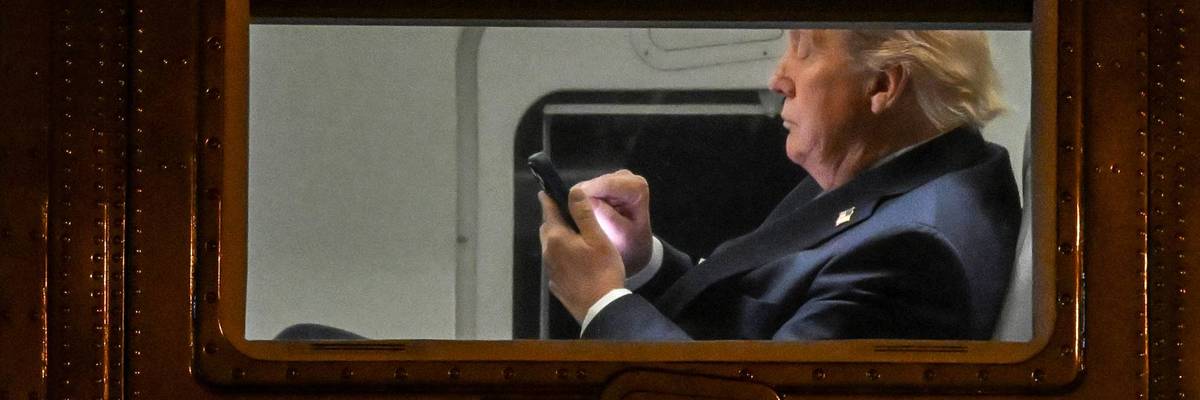
US President Donald Trump uses a cell phone aboard Marine One before it departs Leesburg Executive Airport in Leesburg, Virginia, on April 24, 2025.
The racist imagery that briefly appeared on the official feed is not a rogue error. It is consistent with an administration that has repeatedly deflected harm while avoiding responsibility.
On a February morning in 2026, the opening days of Black History Month, something unthinkable appeared on the official social media platform of the president of the United States: a video inserting the faces of Barack and Michelle Obama onto cartoon apes, set to "The Lion Sleeps Tonight." It flashed at the end of a broader montage promoting 2020 election conspiracies and remained online for roughly 12 hours before deletion.
This was not a careless post. It tapped directly into a long, cruel lineage of racist caricature used to demean and dehumanize Black people. That this imagery came from the nation’s highest office demanded more than embarrassment, it demanded accountability. But what followed was predictable: dismissive deflection, minimization, and no consequences. The White House initially labeled criticism “fake outrage,” claimed it was “just a meme,” and then said it was “erroneously posted by a staffer.” No staffer has been named, and the president publicly declared no one would face repercussions. When pressed on an apology, he said he “didn’t make a mistake” because he had not seen the offensive portion.
Rhetoric cannot erase history. This episode, jarring as it was, is most meaningful as a mirror: It reflects a longstanding pattern of denial, obfuscation, and racialized harm that extends far beyond any single meme or social post.
Long before this video ever appeared, Donald Trump’s public life was intertwined with racial controversy. In 2011, he propelled himself into national headlines by demanding Barack Obama release his birth certificate, questioning whether the first Black president was even born in the United States. He called Obama a “foreign-born fraud,” despite clear evidence to the contrary. This birther campaign wasn’t a slip of judgment; it was a deliberate, sustained effort to delegitimize and diminish the first Black occupant of the White House—a strategy that inflamed racial distrust and energized nativist resentments across the country.
Trump’s repeated insistence that he is “not a racist” functions as a rhetorical shield. It resonates rhetorically but cannot wipe away decades of documented behavior, public statements, and the lived experiences of those harmed by policy and symbolism.
That pattern continued. In 2018, Trump reportedly referred to Haiti, El Salvador, and several African nations as “shithole countries,” expressing preference for immigrants from Norway. Such language dehumanizes entire nations and the predominantly non-white populations within them, shaping global perception and domestic attitudes alike.
The harm extends into domestic policy and public memory. In the late 1980s, during the Central Park Five case, Trump took out full‑page newspaper ads calling for the death penalty for five Black and Latino teenagers later exonerated by DNA evidence. Even after their innocence was proven, he publicly insisted on their guilt, reinforcing false narratives that fanned racial fear and distrust.
Long before he was in politics, his real estate company was sued by the US Department of Justice for discriminating against Black tenants, steering them away from apartments while offering vacancies to white applicants. The case was settled under a consent decree—but the episode underscores a pattern of exclusion that predates his political career.
Through all of this, denial has been central to the strategy. Trump routinely insists personal friendships with Black Americans prove he cannot be racist. But anecdotes do not outweigh outcomes. Leadership is not measured by denials or self‑serving narratives; it is measured by decisions, actions, and real consequences for communities.
Viewed in this light, the racist imagery that briefly appeared on the official feed is not a rogue error. It is consistent with an administration that has repeatedly deflected harm while avoiding responsibility. When damaging content appears and the response is to blame an unnamed staffer, with no transparency, no accountability, no corrective action, it signals at best a tolerance for racial insensitivity and at worst tacit acceptance of damaging narratives from the nation’s official channels.
Beyond symbolic offenses, the lived realities of millions reflect deeper injury. Immigration enforcement under the administration has subjected families from Latin America, Africa, and Asia to detention, deportation, and family separation, deterring entire communities—disproportionately people of color—from seeking healthcare, education, and legal protections. Threats to Medicare jeopardize access to care for Black, Latino, and Indigenous seniors already navigating health disparities, compounding generational inequities. Efforts to slash support for public education disproportionately affect students in underfunded schools—disproportionately Black, Latino, and Indigenous—by stripping Title I funding, free lunch programs, after‑school initiatives, and protections against discriminatory practices. Proposals to restrict the Supplemental Nutrition Assistance Program (SNAP) leave hundreds of thousands, again disproportionately people of color, struggling with food insecurity and impossible choices between rent, medicine, and nourishment.
These threads are not separate. Families impacted by immigration enforcement often rely on SNAP or local schools, all parts of a social fabric that, when weakened, frays most quickly at its most vulnerable edges.
Representation at the top matters, too. In the second Trump administration, only a handful of Black officials hold top leadership roles, including Scott Turner as Housing and Urban Development secretary and Lynne Patton in White House outreach. Most high‑level offices remain overwhelmingly white, signaling whose voices shape policy and whose perspectives are absent from critical debates.
Language and civic rituals shape how a nation understands justice, belonging, and whose histories are honored. Martin Luther King Jr. Day is more than ceremony; it is a moral touchstone. Yet this year, the administration failed to recognize the holiday officially and removed it from the federal list of free pass days in national parks, a symbolic demotion that strips public access and diminishes public commemoration. Such action may seem bureaucratic, but it is telling: When national institutions downgrade the public recognition of a civil rights icon while championing narratives that demean Black leadership, the message is clear.
Trump’s repeated insistence that he is “not a racist” functions as a rhetorical shield. It resonates rhetorically but cannot wipe away decades of documented behavior, public statements, and the lived experiences of those harmed by policy and symbolism. True leadership is not measured by denials but by accountability and moral clarity.
The Obama video, the birther attacks, the attempts to delegitimize Black leadership, the Central Park Five advertisements, the housing discrimination lawsuit, and the “shithole country” comments are not isolated incidents. They form a pattern in which racialized harm is consistently dismissed, deflected, or minimized, even as policies continue to disproportionately affect communities of color.
Moral leadership demands more than words. It demands recognition of harm, centering those most affected in decision‑making, and ensuring that power and opportunity are equitably shared. On these measures, the administration’s pattern of deflection, denial, and exclusion is a failure, one that cannot be concealed behind memes, conspiracy theories, or personal relationships. For a nation still wrestling with the legacy of race, the cost of inaction is lived, generational, and real.
Dear Common Dreams reader, It’s been nearly 30 years since I co-founded Common Dreams with my late wife, Lina Newhouser. We had the radical notion that journalism should serve the public good, not corporate profits. It was clear to us from the outset what it would take to build such a project. No paid advertisements. No corporate sponsors. No millionaire publisher telling us what to think or do. Many people said we wouldn't last a year, but we proved those doubters wrong. Together with a tremendous team of journalists and dedicated staff, we built an independent media outlet free from the constraints of profits and corporate control. Our mission has always been simple: To inform. To inspire. To ignite change for the common good. Building Common Dreams was not easy. Our survival was never guaranteed. When you take on the most powerful forces—Wall Street greed, fossil fuel industry destruction, Big Tech lobbyists, and uber-rich oligarchs who have spent billions upon billions rigging the economy and democracy in their favor—the only bulwark you have is supporters who believe in your work. But here’s the urgent message from me today. It's never been this bad out there. And it's never been this hard to keep us going. At the very moment Common Dreams is most needed, the threats we face are intensifying. We need your support now more than ever. We don't accept corporate advertising and never will. We don't have a paywall because we don't think people should be blocked from critical news based on their ability to pay. Everything we do is funded by the donations of readers like you. When everyone does the little they can afford, we are strong. But if that support retreats or dries up, so do we. Will you donate now to make sure Common Dreams not only survives but thrives? —Craig Brown, Co-founder |
On a February morning in 2026, the opening days of Black History Month, something unthinkable appeared on the official social media platform of the president of the United States: a video inserting the faces of Barack and Michelle Obama onto cartoon apes, set to "The Lion Sleeps Tonight." It flashed at the end of a broader montage promoting 2020 election conspiracies and remained online for roughly 12 hours before deletion.
This was not a careless post. It tapped directly into a long, cruel lineage of racist caricature used to demean and dehumanize Black people. That this imagery came from the nation’s highest office demanded more than embarrassment, it demanded accountability. But what followed was predictable: dismissive deflection, minimization, and no consequences. The White House initially labeled criticism “fake outrage,” claimed it was “just a meme,” and then said it was “erroneously posted by a staffer.” No staffer has been named, and the president publicly declared no one would face repercussions. When pressed on an apology, he said he “didn’t make a mistake” because he had not seen the offensive portion.
Rhetoric cannot erase history. This episode, jarring as it was, is most meaningful as a mirror: It reflects a longstanding pattern of denial, obfuscation, and racialized harm that extends far beyond any single meme or social post.
Long before this video ever appeared, Donald Trump’s public life was intertwined with racial controversy. In 2011, he propelled himself into national headlines by demanding Barack Obama release his birth certificate, questioning whether the first Black president was even born in the United States. He called Obama a “foreign-born fraud,” despite clear evidence to the contrary. This birther campaign wasn’t a slip of judgment; it was a deliberate, sustained effort to delegitimize and diminish the first Black occupant of the White House—a strategy that inflamed racial distrust and energized nativist resentments across the country.
Trump’s repeated insistence that he is “not a racist” functions as a rhetorical shield. It resonates rhetorically but cannot wipe away decades of documented behavior, public statements, and the lived experiences of those harmed by policy and symbolism.
That pattern continued. In 2018, Trump reportedly referred to Haiti, El Salvador, and several African nations as “shithole countries,” expressing preference for immigrants from Norway. Such language dehumanizes entire nations and the predominantly non-white populations within them, shaping global perception and domestic attitudes alike.
The harm extends into domestic policy and public memory. In the late 1980s, during the Central Park Five case, Trump took out full‑page newspaper ads calling for the death penalty for five Black and Latino teenagers later exonerated by DNA evidence. Even after their innocence was proven, he publicly insisted on their guilt, reinforcing false narratives that fanned racial fear and distrust.
Long before he was in politics, his real estate company was sued by the US Department of Justice for discriminating against Black tenants, steering them away from apartments while offering vacancies to white applicants. The case was settled under a consent decree—but the episode underscores a pattern of exclusion that predates his political career.
Through all of this, denial has been central to the strategy. Trump routinely insists personal friendships with Black Americans prove he cannot be racist. But anecdotes do not outweigh outcomes. Leadership is not measured by denials or self‑serving narratives; it is measured by decisions, actions, and real consequences for communities.
Viewed in this light, the racist imagery that briefly appeared on the official feed is not a rogue error. It is consistent with an administration that has repeatedly deflected harm while avoiding responsibility. When damaging content appears and the response is to blame an unnamed staffer, with no transparency, no accountability, no corrective action, it signals at best a tolerance for racial insensitivity and at worst tacit acceptance of damaging narratives from the nation’s official channels.
Beyond symbolic offenses, the lived realities of millions reflect deeper injury. Immigration enforcement under the administration has subjected families from Latin America, Africa, and Asia to detention, deportation, and family separation, deterring entire communities—disproportionately people of color—from seeking healthcare, education, and legal protections. Threats to Medicare jeopardize access to care for Black, Latino, and Indigenous seniors already navigating health disparities, compounding generational inequities. Efforts to slash support for public education disproportionately affect students in underfunded schools—disproportionately Black, Latino, and Indigenous—by stripping Title I funding, free lunch programs, after‑school initiatives, and protections against discriminatory practices. Proposals to restrict the Supplemental Nutrition Assistance Program (SNAP) leave hundreds of thousands, again disproportionately people of color, struggling with food insecurity and impossible choices between rent, medicine, and nourishment.
These threads are not separate. Families impacted by immigration enforcement often rely on SNAP or local schools, all parts of a social fabric that, when weakened, frays most quickly at its most vulnerable edges.
Representation at the top matters, too. In the second Trump administration, only a handful of Black officials hold top leadership roles, including Scott Turner as Housing and Urban Development secretary and Lynne Patton in White House outreach. Most high‑level offices remain overwhelmingly white, signaling whose voices shape policy and whose perspectives are absent from critical debates.
Language and civic rituals shape how a nation understands justice, belonging, and whose histories are honored. Martin Luther King Jr. Day is more than ceremony; it is a moral touchstone. Yet this year, the administration failed to recognize the holiday officially and removed it from the federal list of free pass days in national parks, a symbolic demotion that strips public access and diminishes public commemoration. Such action may seem bureaucratic, but it is telling: When national institutions downgrade the public recognition of a civil rights icon while championing narratives that demean Black leadership, the message is clear.
Trump’s repeated insistence that he is “not a racist” functions as a rhetorical shield. It resonates rhetorically but cannot wipe away decades of documented behavior, public statements, and the lived experiences of those harmed by policy and symbolism. True leadership is not measured by denials but by accountability and moral clarity.
The Obama video, the birther attacks, the attempts to delegitimize Black leadership, the Central Park Five advertisements, the housing discrimination lawsuit, and the “shithole country” comments are not isolated incidents. They form a pattern in which racialized harm is consistently dismissed, deflected, or minimized, even as policies continue to disproportionately affect communities of color.
Moral leadership demands more than words. It demands recognition of harm, centering those most affected in decision‑making, and ensuring that power and opportunity are equitably shared. On these measures, the administration’s pattern of deflection, denial, and exclusion is a failure, one that cannot be concealed behind memes, conspiracy theories, or personal relationships. For a nation still wrestling with the legacy of race, the cost of inaction is lived, generational, and real.
On a February morning in 2026, the opening days of Black History Month, something unthinkable appeared on the official social media platform of the president of the United States: a video inserting the faces of Barack and Michelle Obama onto cartoon apes, set to "The Lion Sleeps Tonight." It flashed at the end of a broader montage promoting 2020 election conspiracies and remained online for roughly 12 hours before deletion.
This was not a careless post. It tapped directly into a long, cruel lineage of racist caricature used to demean and dehumanize Black people. That this imagery came from the nation’s highest office demanded more than embarrassment, it demanded accountability. But what followed was predictable: dismissive deflection, minimization, and no consequences. The White House initially labeled criticism “fake outrage,” claimed it was “just a meme,” and then said it was “erroneously posted by a staffer.” No staffer has been named, and the president publicly declared no one would face repercussions. When pressed on an apology, he said he “didn’t make a mistake” because he had not seen the offensive portion.
Rhetoric cannot erase history. This episode, jarring as it was, is most meaningful as a mirror: It reflects a longstanding pattern of denial, obfuscation, and racialized harm that extends far beyond any single meme or social post.
Long before this video ever appeared, Donald Trump’s public life was intertwined with racial controversy. In 2011, he propelled himself into national headlines by demanding Barack Obama release his birth certificate, questioning whether the first Black president was even born in the United States. He called Obama a “foreign-born fraud,” despite clear evidence to the contrary. This birther campaign wasn’t a slip of judgment; it was a deliberate, sustained effort to delegitimize and diminish the first Black occupant of the White House—a strategy that inflamed racial distrust and energized nativist resentments across the country.
Trump’s repeated insistence that he is “not a racist” functions as a rhetorical shield. It resonates rhetorically but cannot wipe away decades of documented behavior, public statements, and the lived experiences of those harmed by policy and symbolism.
That pattern continued. In 2018, Trump reportedly referred to Haiti, El Salvador, and several African nations as “shithole countries,” expressing preference for immigrants from Norway. Such language dehumanizes entire nations and the predominantly non-white populations within them, shaping global perception and domestic attitudes alike.
The harm extends into domestic policy and public memory. In the late 1980s, during the Central Park Five case, Trump took out full‑page newspaper ads calling for the death penalty for five Black and Latino teenagers later exonerated by DNA evidence. Even after their innocence was proven, he publicly insisted on their guilt, reinforcing false narratives that fanned racial fear and distrust.
Long before he was in politics, his real estate company was sued by the US Department of Justice for discriminating against Black tenants, steering them away from apartments while offering vacancies to white applicants. The case was settled under a consent decree—but the episode underscores a pattern of exclusion that predates his political career.
Through all of this, denial has been central to the strategy. Trump routinely insists personal friendships with Black Americans prove he cannot be racist. But anecdotes do not outweigh outcomes. Leadership is not measured by denials or self‑serving narratives; it is measured by decisions, actions, and real consequences for communities.
Viewed in this light, the racist imagery that briefly appeared on the official feed is not a rogue error. It is consistent with an administration that has repeatedly deflected harm while avoiding responsibility. When damaging content appears and the response is to blame an unnamed staffer, with no transparency, no accountability, no corrective action, it signals at best a tolerance for racial insensitivity and at worst tacit acceptance of damaging narratives from the nation’s official channels.
Beyond symbolic offenses, the lived realities of millions reflect deeper injury. Immigration enforcement under the administration has subjected families from Latin America, Africa, and Asia to detention, deportation, and family separation, deterring entire communities—disproportionately people of color—from seeking healthcare, education, and legal protections. Threats to Medicare jeopardize access to care for Black, Latino, and Indigenous seniors already navigating health disparities, compounding generational inequities. Efforts to slash support for public education disproportionately affect students in underfunded schools—disproportionately Black, Latino, and Indigenous—by stripping Title I funding, free lunch programs, after‑school initiatives, and protections against discriminatory practices. Proposals to restrict the Supplemental Nutrition Assistance Program (SNAP) leave hundreds of thousands, again disproportionately people of color, struggling with food insecurity and impossible choices between rent, medicine, and nourishment.
These threads are not separate. Families impacted by immigration enforcement often rely on SNAP or local schools, all parts of a social fabric that, when weakened, frays most quickly at its most vulnerable edges.
Representation at the top matters, too. In the second Trump administration, only a handful of Black officials hold top leadership roles, including Scott Turner as Housing and Urban Development secretary and Lynne Patton in White House outreach. Most high‑level offices remain overwhelmingly white, signaling whose voices shape policy and whose perspectives are absent from critical debates.
Language and civic rituals shape how a nation understands justice, belonging, and whose histories are honored. Martin Luther King Jr. Day is more than ceremony; it is a moral touchstone. Yet this year, the administration failed to recognize the holiday officially and removed it from the federal list of free pass days in national parks, a symbolic demotion that strips public access and diminishes public commemoration. Such action may seem bureaucratic, but it is telling: When national institutions downgrade the public recognition of a civil rights icon while championing narratives that demean Black leadership, the message is clear.
Trump’s repeated insistence that he is “not a racist” functions as a rhetorical shield. It resonates rhetorically but cannot wipe away decades of documented behavior, public statements, and the lived experiences of those harmed by policy and symbolism. True leadership is not measured by denials but by accountability and moral clarity.
The Obama video, the birther attacks, the attempts to delegitimize Black leadership, the Central Park Five advertisements, the housing discrimination lawsuit, and the “shithole country” comments are not isolated incidents. They form a pattern in which racialized harm is consistently dismissed, deflected, or minimized, even as policies continue to disproportionately affect communities of color.
Moral leadership demands more than words. It demands recognition of harm, centering those most affected in decision‑making, and ensuring that power and opportunity are equitably shared. On these measures, the administration’s pattern of deflection, denial, and exclusion is a failure, one that cannot be concealed behind memes, conspiracy theories, or personal relationships. For a nation still wrestling with the legacy of race, the cost of inaction is lived, generational, and real.

