
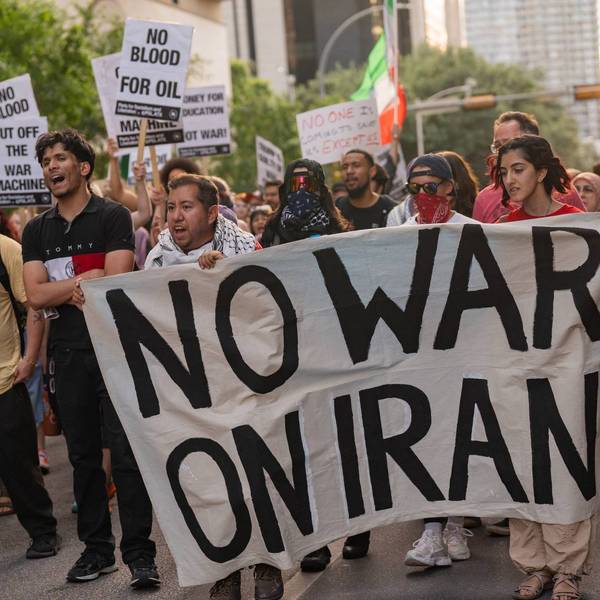
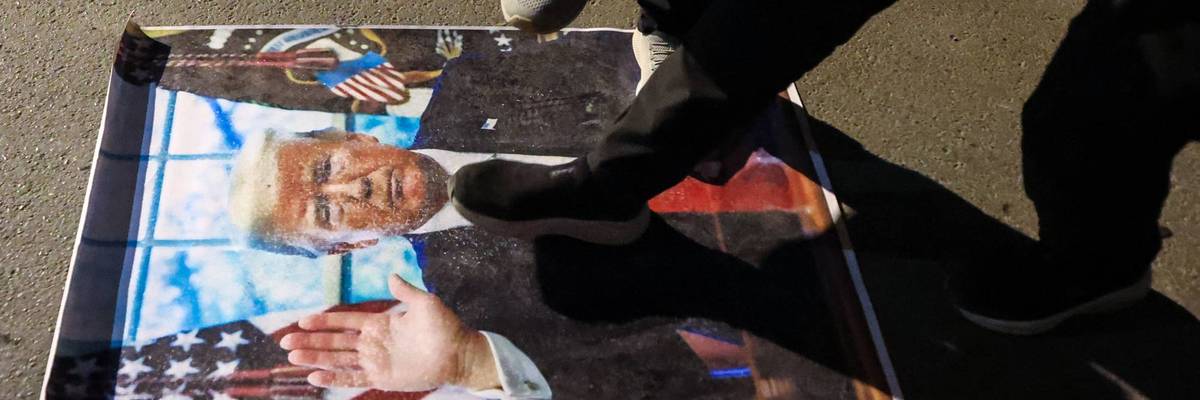
Demonstrators trample on a portrait of US President Donald Trump during a protest against the attacks by Israel and the US on Iran, as they march towards the US embassy in Baghdad on March 5, 2026.
Trump’s Incompetent War
Why did the US attack Iran? How long will the war last? What will the implications be? Don't ask President Donald Trump!
Minimally competent leaders would have considered at least five obvious questions before launching the nation into war. President Donald Trump considered none of them.
No. 1: What’s the Objective?
It’s not surprising that more than half of all Americans oppose Trump’s War. From the outset, his administration has offered numerous and contradictory justifications for it.
February 28:
Trump cited 47 years of grievances, a desire to destroy Iran’s missiles, and a message that the Iranian people should “seize the moment” because now was their chance to “be brave, be bold, be heroic, and take back your country.”
But he also said that the attack was a campaign to “eliminate the imminent nuclear threat,” although Trump had boasted in June that the United States had already accomplished that goal.
The next day, Pentagon officials told congressional staff members that no intelligence supported the notion that Iran was planning to attack the US first.
The same day, Trump told the Washington Post, “All I want is freedom for the people.”
United Nations Ambassador Mike Walz claimed to the UN Security Council that the US was invoking the right of self-defense in response to Iran’s imminent threat.
But the next day, Pentagon officials told congressional staff members that no intelligence supported the notion that Iran was planning to attack the US first.
March 2:
Secretary of Defense Pete Hegseth told the press that the objective was retaliation for decades of Iranian behavior, destruction of their missiles, and providing an opportunity for Iranians to “take advantage of this incredible opportunity.”
But only hours later, Secretary of State Marco Rubio offered a new justification for the war: Israel was going to attack Iran and, if that happened, Iran would then attack US interests in the region. He made it sound as if Israel’s Prime Minister Benjamin Netanyahu had maneuvered Trump into a corner.
The next day, Trump contradicted Rubio, saying: “It was my opinion that they [Iran] were going to attack first. They were going to attack if we didn’t do it.” Rebutting any impression that Netanyahu had manipulated him, Trump added, “If anything, I might have forced Israel’s hand.”
Rubio complained that his earlier remarks had been taken out of context and the operation “had to happen anyway.”
March 6:
Trump posted on social media that only “unconditional surrender” would end the war.
No. 2: How Long Will It Last?
March 1: Trump told the New York Times that the operation could take “four to five weeks.” He didn’t mention the Pentagon’s concerns that the war could further deplete reserves that military strategists have said are critical for scenarios such as a conflict over Taiwan or Russian incursions into Europe.
March 2: Trump said that the war could go on longer than four to five weeks.
March 4: Hegseth said that the Iran war is “far from over” and has “only just begun.”
March 6: Trump told the New York Post that he hadn’t ruled out putting “boots on the ground, if necessary.”
No. 3: Who Will Lead Iran After US Strikes Kill Its Supreme Leader?
March 1: Trump told the New York Times that he had “three very good choices” for who could lead Iran.
March 3: Trump admitted: “Most of the people we had in mind are dead… Now we have another group. They may be dead also, based on reports. So I guess you have a third wave coming. Pretty soon we’re not going to know anybody.” Asked about the worst-case scenario for the war, Trump said, “I guess the worst case would be we do this and somebody takes over who’s as bad as the previous person.”
More than a dozen Mideast countries are now embroiled in Trump’s war, including Israel, Saudi Arabia, UAE, Qatar, Kuwait, Bahrain, Oman, Jordan, Iraq, Syria, Lebanon, and Yemen.
March 5: Trump told Axios, “I have to be involved in the appointment [of Iran Supreme Leader Ayatollah Khamenei’s successor], like with Delcy in Venezuela"—referring to Vice President Delcy Rodriguez, who remained in charge of President Nicolás Maduro’s corrupt and repressive regime after the US abducted him. Trump said that Khamenei’s son—rumored to be a leading candidate as successor—is “unacceptable to me” and “a light weight.”
The same day, he told NBC News, “We have some people who I think would do a good job.”
March 7: The Washington Post reported that a classified National Intelligence Committee study issued prior to the war found that even if the US launched a large-scale assault on Iran, it likely would not oust the Islamic republic’s entrenched military and clerical establishment.
March 9: Iran chose Khamenei’s son, a cleric expected to continue his father’s hard-line policies, as the country’s Supreme Leader.
No. 4: How Would a US-Iran War Affect the Mideast?
Before US bombs began to fall, thousands of American citizens were in the war zone. But ahead of the strikes, the State Department didn’t issue official alerts advising Americans that the risk of travel in the region had increased.
Yael Lempert, who helped organize the evacuation of Americans in Libya in 2011 observed, “It is stunning there were no orders for authorized departure for nonessential US government employees and family members in almost all the affected diplomatic missions in the region—nor public recommendations to American citizens to depart—until days into the war.”
After attacks and counterattacks closed airspace and airports throughout the region, on Wednesday, March 4—four days into the war—the State Department finally began evacuations by charter flight. The following day, the New York Times reported:
Until midweek, the State Department had mainly provided stranded travelers with basic information about security conditions and commercial travel options via a telephone hotline and text messages. Before Wednesday, desperate people calling the hotline got an automated message that said the US government could not help get them out of the region.
No. 5: Could the War Lead to Humanitarian, Economic, or Geopolitical Crises?
Only a week into the war, the UN humanitarian chief warned, “This is a moment of grave, grave peril.”
Iran is a country of 90 million people. US-Israel bombing has already displaced more than 100,000 of them.
Israel’s companion attack on Lebanon has displaced more than 300,000 residents.
Asked to rate his Iran war performance on a scale of one to 10, Trump gave himself a “15.”
More than a dozen Mideast countries are now embroiled in Trump’s war, including Israel, Saudi Arabia, UAE, Qatar, Kuwait, Bahrain, Oman, Jordan, Iraq, Syria, Lebanon, and Yemen.
The ripple effects span the globe as oil prices spike and Iran disrupts tanker traffic in the Strait of Hormuz—through which one-fifth of the world’s oil flows. During his state of the union message, Trump boasted that the price of gasoline was down to $2,00 per gallon in some states. Last week, the national average price in the US was $3.41 per gallon.
Ominously, on March 6 the Washington Post reported that Russia is providing intelligence assistance to the Iranian military attacking US targets. But Hegseth is “not concerned about that.”
Asked to rate his Iran war performance on a scale of one to 10, Trump gave himself a “15.”
Introspection rarely accompanies incompetence.
We are at a crossroads
This country and this world are at a monumental crossroads. In a few short weeks, US voters will have an opportunity to beat back the forces of fascism and confront the billionaires who are rigging the economy, our media system, and our democracy, making it increasingly impossible for ordinary people to get by. We’re not just talking about the election. We’re talking about what must be done once these fascist elements are vanquished from power. We need a bolder set of solutions than what either major party has so far been willing to offer and a working-class movement ready to fight like hell for it. Trump didn't emerge from nowhere. The conditions that fueled MAGA authoritarianism were created by decades of radical neoliberal economic policies and a corrupt political system dominated by corporate interests. They slashed taxes on the super-rich, promising that the benefits would trickle down. They said giveaways to the corporate titans would make life more affordable for the rest of us. It was all bullshit. And when a bitter, betrayed populace searches for someone to blame, right-wing demagogues have little trouble finding scapegoats. People know when they're being lied to, but you won't hear any of this from the corporate media. Only independent journalism—powered and funded by people who believe in building a better world—can deliver truly trustworthy daily news. Our Fall Campaign is underway, and we need your help. To power our newsroom through the rest of the year, we need to raise $125,000 by midnight on October 31. So if you share our vision, please contribute whatever you can to sustain our work. |
Minimally competent leaders would have considered at least five obvious questions before launching the nation into war. President Donald Trump considered none of them.
No. 1: What’s the Objective?
It’s not surprising that more than half of all Americans oppose Trump’s War. From the outset, his administration has offered numerous and contradictory justifications for it.
February 28:
Trump cited 47 years of grievances, a desire to destroy Iran’s missiles, and a message that the Iranian people should “seize the moment” because now was their chance to “be brave, be bold, be heroic, and take back your country.”
But he also said that the attack was a campaign to “eliminate the imminent nuclear threat,” although Trump had boasted in June that the United States had already accomplished that goal.
The next day, Pentagon officials told congressional staff members that no intelligence supported the notion that Iran was planning to attack the US first.
The same day, Trump told the Washington Post, “All I want is freedom for the people.”
United Nations Ambassador Mike Walz claimed to the UN Security Council that the US was invoking the right of self-defense in response to Iran’s imminent threat.
But the next day, Pentagon officials told congressional staff members that no intelligence supported the notion that Iran was planning to attack the US first.
March 2:
Secretary of Defense Pete Hegseth told the press that the objective was retaliation for decades of Iranian behavior, destruction of their missiles, and providing an opportunity for Iranians to “take advantage of this incredible opportunity.”
But only hours later, Secretary of State Marco Rubio offered a new justification for the war: Israel was going to attack Iran and, if that happened, Iran would then attack US interests in the region. He made it sound as if Israel’s Prime Minister Benjamin Netanyahu had maneuvered Trump into a corner.
The next day, Trump contradicted Rubio, saying: “It was my opinion that they [Iran] were going to attack first. They were going to attack if we didn’t do it.” Rebutting any impression that Netanyahu had manipulated him, Trump added, “If anything, I might have forced Israel’s hand.”
Rubio complained that his earlier remarks had been taken out of context and the operation “had to happen anyway.”
March 6:
Trump posted on social media that only “unconditional surrender” would end the war.
No. 2: How Long Will It Last?
March 1: Trump told the New York Times that the operation could take “four to five weeks.” He didn’t mention the Pentagon’s concerns that the war could further deplete reserves that military strategists have said are critical for scenarios such as a conflict over Taiwan or Russian incursions into Europe.
March 2: Trump said that the war could go on longer than four to five weeks.
March 4: Hegseth said that the Iran war is “far from over” and has “only just begun.”
March 6: Trump told the New York Post that he hadn’t ruled out putting “boots on the ground, if necessary.”
No. 3: Who Will Lead Iran After US Strikes Kill Its Supreme Leader?
March 1: Trump told the New York Times that he had “three very good choices” for who could lead Iran.
March 3: Trump admitted: “Most of the people we had in mind are dead… Now we have another group. They may be dead also, based on reports. So I guess you have a third wave coming. Pretty soon we’re not going to know anybody.” Asked about the worst-case scenario for the war, Trump said, “I guess the worst case would be we do this and somebody takes over who’s as bad as the previous person.”
More than a dozen Mideast countries are now embroiled in Trump’s war, including Israel, Saudi Arabia, UAE, Qatar, Kuwait, Bahrain, Oman, Jordan, Iraq, Syria, Lebanon, and Yemen.
March 5: Trump told Axios, “I have to be involved in the appointment [of Iran Supreme Leader Ayatollah Khamenei’s successor], like with Delcy in Venezuela"—referring to Vice President Delcy Rodriguez, who remained in charge of President Nicolás Maduro’s corrupt and repressive regime after the US abducted him. Trump said that Khamenei’s son—rumored to be a leading candidate as successor—is “unacceptable to me” and “a light weight.”
The same day, he told NBC News, “We have some people who I think would do a good job.”
March 7: The Washington Post reported that a classified National Intelligence Committee study issued prior to the war found that even if the US launched a large-scale assault on Iran, it likely would not oust the Islamic republic’s entrenched military and clerical establishment.
March 9: Iran chose Khamenei’s son, a cleric expected to continue his father’s hard-line policies, as the country’s Supreme Leader.
No. 4: How Would a US-Iran War Affect the Mideast?
Before US bombs began to fall, thousands of American citizens were in the war zone. But ahead of the strikes, the State Department didn’t issue official alerts advising Americans that the risk of travel in the region had increased.
Yael Lempert, who helped organize the evacuation of Americans in Libya in 2011 observed, “It is stunning there were no orders for authorized departure for nonessential US government employees and family members in almost all the affected diplomatic missions in the region—nor public recommendations to American citizens to depart—until days into the war.”
After attacks and counterattacks closed airspace and airports throughout the region, on Wednesday, March 4—four days into the war—the State Department finally began evacuations by charter flight. The following day, the New York Times reported:
Until midweek, the State Department had mainly provided stranded travelers with basic information about security conditions and commercial travel options via a telephone hotline and text messages. Before Wednesday, desperate people calling the hotline got an automated message that said the US government could not help get them out of the region.
No. 5: Could the War Lead to Humanitarian, Economic, or Geopolitical Crises?
Only a week into the war, the UN humanitarian chief warned, “This is a moment of grave, grave peril.”
Iran is a country of 90 million people. US-Israel bombing has already displaced more than 100,000 of them.
Israel’s companion attack on Lebanon has displaced more than 300,000 residents.
Asked to rate his Iran war performance on a scale of one to 10, Trump gave himself a “15.”
More than a dozen Mideast countries are now embroiled in Trump’s war, including Israel, Saudi Arabia, UAE, Qatar, Kuwait, Bahrain, Oman, Jordan, Iraq, Syria, Lebanon, and Yemen.
The ripple effects span the globe as oil prices spike and Iran disrupts tanker traffic in the Strait of Hormuz—through which one-fifth of the world’s oil flows. During his state of the union message, Trump boasted that the price of gasoline was down to $2,00 per gallon in some states. Last week, the national average price in the US was $3.41 per gallon.
Ominously, on March 6 the Washington Post reported that Russia is providing intelligence assistance to the Iranian military attacking US targets. But Hegseth is “not concerned about that.”
Asked to rate his Iran war performance on a scale of one to 10, Trump gave himself a “15.”
Introspection rarely accompanies incompetence.
- 'Bombs Will Be Dropping Everywhere': Trump Launches Illegal Regime Change War Against Iran ›
- Experts Pillory Trump Case for War on Iran: 'Flimsiest Excuse for Initiating a Major Attack' in Decades ›
- Trump's Iran War Is an Affordability Disaster - News & Opinion - The Commons ›
- 'We Can All See': Platner Rips Collins for Choosing War Profits Over Children Killed by US in Iran ›
- Video of Trump Warning 'Our President Will Start a War With Iran Because He Has Absolutely No Ability to Negotiate' Resurfaces ›
- 'Deranged and Dangerous': Trump Says 'I Guess' Americans Should Expect a Deadly Attack on US ›
- Opinion | Is Trump's Iran War the US Version of the Suez Crisis? | Common Dreams ›
- Opinion | Incompetent Trump Is Driving Us Toward Global Political-Economic Collapse | Common Dreams ›
Minimally competent leaders would have considered at least five obvious questions before launching the nation into war. President Donald Trump considered none of them.
No. 1: What’s the Objective?
It’s not surprising that more than half of all Americans oppose Trump’s War. From the outset, his administration has offered numerous and contradictory justifications for it.
February 28:
Trump cited 47 years of grievances, a desire to destroy Iran’s missiles, and a message that the Iranian people should “seize the moment” because now was their chance to “be brave, be bold, be heroic, and take back your country.”
But he also said that the attack was a campaign to “eliminate the imminent nuclear threat,” although Trump had boasted in June that the United States had already accomplished that goal.
The next day, Pentagon officials told congressional staff members that no intelligence supported the notion that Iran was planning to attack the US first.
The same day, Trump told the Washington Post, “All I want is freedom for the people.”
United Nations Ambassador Mike Walz claimed to the UN Security Council that the US was invoking the right of self-defense in response to Iran’s imminent threat.
But the next day, Pentagon officials told congressional staff members that no intelligence supported the notion that Iran was planning to attack the US first.
March 2:
Secretary of Defense Pete Hegseth told the press that the objective was retaliation for decades of Iranian behavior, destruction of their missiles, and providing an opportunity for Iranians to “take advantage of this incredible opportunity.”
But only hours later, Secretary of State Marco Rubio offered a new justification for the war: Israel was going to attack Iran and, if that happened, Iran would then attack US interests in the region. He made it sound as if Israel’s Prime Minister Benjamin Netanyahu had maneuvered Trump into a corner.
The next day, Trump contradicted Rubio, saying: “It was my opinion that they [Iran] were going to attack first. They were going to attack if we didn’t do it.” Rebutting any impression that Netanyahu had manipulated him, Trump added, “If anything, I might have forced Israel’s hand.”
Rubio complained that his earlier remarks had been taken out of context and the operation “had to happen anyway.”
March 6:
Trump posted on social media that only “unconditional surrender” would end the war.
No. 2: How Long Will It Last?
March 1: Trump told the New York Times that the operation could take “four to five weeks.” He didn’t mention the Pentagon’s concerns that the war could further deplete reserves that military strategists have said are critical for scenarios such as a conflict over Taiwan or Russian incursions into Europe.
March 2: Trump said that the war could go on longer than four to five weeks.
March 4: Hegseth said that the Iran war is “far from over” and has “only just begun.”
March 6: Trump told the New York Post that he hadn’t ruled out putting “boots on the ground, if necessary.”
No. 3: Who Will Lead Iran After US Strikes Kill Its Supreme Leader?
March 1: Trump told the New York Times that he had “three very good choices” for who could lead Iran.
March 3: Trump admitted: “Most of the people we had in mind are dead… Now we have another group. They may be dead also, based on reports. So I guess you have a third wave coming. Pretty soon we’re not going to know anybody.” Asked about the worst-case scenario for the war, Trump said, “I guess the worst case would be we do this and somebody takes over who’s as bad as the previous person.”
More than a dozen Mideast countries are now embroiled in Trump’s war, including Israel, Saudi Arabia, UAE, Qatar, Kuwait, Bahrain, Oman, Jordan, Iraq, Syria, Lebanon, and Yemen.
March 5: Trump told Axios, “I have to be involved in the appointment [of Iran Supreme Leader Ayatollah Khamenei’s successor], like with Delcy in Venezuela"—referring to Vice President Delcy Rodriguez, who remained in charge of President Nicolás Maduro’s corrupt and repressive regime after the US abducted him. Trump said that Khamenei’s son—rumored to be a leading candidate as successor—is “unacceptable to me” and “a light weight.”
The same day, he told NBC News, “We have some people who I think would do a good job.”
March 7: The Washington Post reported that a classified National Intelligence Committee study issued prior to the war found that even if the US launched a large-scale assault on Iran, it likely would not oust the Islamic republic’s entrenched military and clerical establishment.
March 9: Iran chose Khamenei’s son, a cleric expected to continue his father’s hard-line policies, as the country’s Supreme Leader.
No. 4: How Would a US-Iran War Affect the Mideast?
Before US bombs began to fall, thousands of American citizens were in the war zone. But ahead of the strikes, the State Department didn’t issue official alerts advising Americans that the risk of travel in the region had increased.
Yael Lempert, who helped organize the evacuation of Americans in Libya in 2011 observed, “It is stunning there were no orders for authorized departure for nonessential US government employees and family members in almost all the affected diplomatic missions in the region—nor public recommendations to American citizens to depart—until days into the war.”
After attacks and counterattacks closed airspace and airports throughout the region, on Wednesday, March 4—four days into the war—the State Department finally began evacuations by charter flight. The following day, the New York Times reported:
Until midweek, the State Department had mainly provided stranded travelers with basic information about security conditions and commercial travel options via a telephone hotline and text messages. Before Wednesday, desperate people calling the hotline got an automated message that said the US government could not help get them out of the region.
No. 5: Could the War Lead to Humanitarian, Economic, or Geopolitical Crises?
Only a week into the war, the UN humanitarian chief warned, “This is a moment of grave, grave peril.”
Iran is a country of 90 million people. US-Israel bombing has already displaced more than 100,000 of them.
Israel’s companion attack on Lebanon has displaced more than 300,000 residents.
Asked to rate his Iran war performance on a scale of one to 10, Trump gave himself a “15.”
More than a dozen Mideast countries are now embroiled in Trump’s war, including Israel, Saudi Arabia, UAE, Qatar, Kuwait, Bahrain, Oman, Jordan, Iraq, Syria, Lebanon, and Yemen.
The ripple effects span the globe as oil prices spike and Iran disrupts tanker traffic in the Strait of Hormuz—through which one-fifth of the world’s oil flows. During his state of the union message, Trump boasted that the price of gasoline was down to $2,00 per gallon in some states. Last week, the national average price in the US was $3.41 per gallon.
Ominously, on March 6 the Washington Post reported that Russia is providing intelligence assistance to the Iranian military attacking US targets. But Hegseth is “not concerned about that.”
Asked to rate his Iran war performance on a scale of one to 10, Trump gave himself a “15.”
Introspection rarely accompanies incompetence.
- 'Bombs Will Be Dropping Everywhere': Trump Launches Illegal Regime Change War Against Iran ›
- Experts Pillory Trump Case for War on Iran: 'Flimsiest Excuse for Initiating a Major Attack' in Decades ›
- Trump's Iran War Is an Affordability Disaster - News & Opinion - The Commons ›
- 'We Can All See': Platner Rips Collins for Choosing War Profits Over Children Killed by US in Iran ›
- Video of Trump Warning 'Our President Will Start a War With Iran Because He Has Absolutely No Ability to Negotiate' Resurfaces ›
- 'Deranged and Dangerous': Trump Says 'I Guess' Americans Should Expect a Deadly Attack on US ›
- Opinion | Is Trump's Iran War the US Version of the Suez Crisis? | Common Dreams ›
- Opinion | Incompetent Trump Is Driving Us Toward Global Political-Economic Collapse | Common Dreams ›