5
#000000
#FFFFFF
To donate by check, phone, or other method, see our More Ways to Give page.
Daily news & progressive opinion—funded by the people, not the corporations—delivered straight to your inbox.
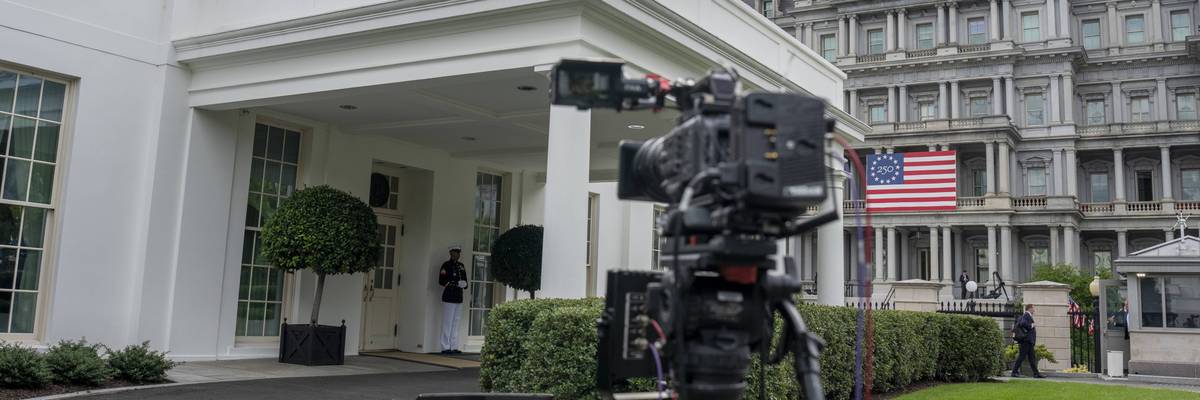
A television camera is pointed at the entrance to the West Wing of the White House on September 18, 2026 in Washington, DC.
As the many disasters of his presidency pile up, President Donald Trump turned to a familiar foil and a proven strategy: Attack the press to distract public attention from his failures.
President Donald Trump is in trouble and he knows it.
The list goes on and on. So Trump turned to a familiar foil and a proven strategy: Attack the press to divert public attention from his failures.
CNN, MSNOW, and Politico won the first round in Trump’s latest attempt to subvert the First Amendment. But Trump’s shiny object consumed the media. His goal now is to extend the controversy.
Act I
While many of his most senior advisers were away at 3:00 pm on Friday, September 18, Trump announced on social media that he was banning CNN, MSNOW, and Politico from the White House. At first nothing happened, but by Saturday morning the press passes for reporters at those organizations no longer allowed them past White House security.
On Monday morning, September 21, the news organizations sued the Trump administration for violating their First Amendment right to a free press and their Fifth Amendment right to due process of law.
On Tuesday, September 22, the White House sent the organizations what it purported were notices of the revocations, giving them until Friday to respond.
Act II
At a court hearing on Wednesday, September 23, Trump’s Department of Justice (DOJ) asserted the laughable argument that the White House letter sent to the news organizations on Tuesday, September 22—days after Trump revoked the press passes—somehow satisfied the Fifth Amendment requirement of due process prior to any revocation.
The DOJ also told the judge that amorphous “national security” concerns justified revoking the passes. But Trump’s own statements of his reasons for the revocation undercut that argument.
Without reaching the First Amendment issues, the court based its constitutional ruling on Trump’s failure to provide due process. Judge Timothy J. Kelly—a Trump appointee—granted a temporary restraining order requiring Trump to restore the revoked press credentials immediately.
Act III
Judge Kelly issued his opinion around 1:00 am on Thursday, September 24. But as the business day began, the affected reporters’ press passes were still disabled, prompting the news organizations to file an emergency motion before Judge Kelly. The Justice Department responded with a declaration stating that press access had been restored at 9:55 am, so the judge cancelled the hearing.
But that evening, reporters for CNN and MSNOW were turned away from the state dinner arrivals at the White House, where Trump was hosting Chinese President Xi Jinping.
Act IV
To satisfy Trump, government attorneys are probably working on a new strategy. Here’s one possible scenario:
Trump has been eager to tear down the East Wing, reshape the White House grounds, turn the interior into a gilded spectacle, and otherwise impose his dramatic construction ideas at 1600 Pennsylvania Avenue.
Yet shortly after revoking the press credentials of CNN, MSNOW, and Politico, he told reporters: "It's sick. I mean, there's something wrong with a country that can allow people to write purposely negative stuff.”
In the next sentence, he revealed himself: “Now, if they want to write them, that's fine. But I don't have to let them into my, into the people's house."
Trump thinks the White House belongs exclusively to him. But his lease ends in two years, and no security deposit is sufficient to cover the profound damage he is inflicting on the nation.
Meanwhile, it is vital to beat back Trump’s repeated assaults in the Constitution. But it’s also important to remember that among the most important underlying goals of his most outrageous actions is diverting Americans from the mess that he has made of the country.
Dear Common Dreams reader, It’s been nearly 30 years since I co-founded Common Dreams with my late wife, Lina Newhouser. We had the radical notion that journalism should serve the public good, not corporate profits. It was clear to us from the outset what it would take to build such a project. No paid advertisements. No corporate sponsors. No millionaire publisher telling us what to think or do. Many people said we wouldn't last a year, but we proved those doubters wrong. Together with a tremendous team of journalists and dedicated staff, we built an independent media outlet free from the constraints of profits and corporate control. Our mission has always been simple: To inform. To inspire. To ignite change for the common good. Building Common Dreams was not easy. Our survival was never guaranteed. When you take on the most powerful forces—Wall Street greed, fossil fuel industry destruction, Big Tech lobbyists, and uber-rich oligarchs who have spent billions upon billions rigging the economy and democracy in their favor—the only bulwark you have is supporters who believe in your work. But here’s the urgent message from me today. It's never been this bad out there. And it's never been this hard to keep us going. At the very moment Common Dreams is most needed, the threats we face are intensifying. We need your support now more than ever. We don't accept corporate advertising and never will. We don't have a paywall because we don't think people should be blocked from critical news based on their ability to pay. Everything we do is funded by the donations of readers like you. When everyone does the little they can afford, we are strong. But if that support retreats or dries up, so do we. Will you donate now to make sure Common Dreams not only survives but thrives? —Craig Brown, Co-founder |
President Donald Trump is in trouble and he knows it.
The list goes on and on. So Trump turned to a familiar foil and a proven strategy: Attack the press to divert public attention from his failures.
CNN, MSNOW, and Politico won the first round in Trump’s latest attempt to subvert the First Amendment. But Trump’s shiny object consumed the media. His goal now is to extend the controversy.
Act I
While many of his most senior advisers were away at 3:00 pm on Friday, September 18, Trump announced on social media that he was banning CNN, MSNOW, and Politico from the White House. At first nothing happened, but by Saturday morning the press passes for reporters at those organizations no longer allowed them past White House security.
On Monday morning, September 21, the news organizations sued the Trump administration for violating their First Amendment right to a free press and their Fifth Amendment right to due process of law.
On Tuesday, September 22, the White House sent the organizations what it purported were notices of the revocations, giving them until Friday to respond.
Act II
At a court hearing on Wednesday, September 23, Trump’s Department of Justice (DOJ) asserted the laughable argument that the White House letter sent to the news organizations on Tuesday, September 22—days after Trump revoked the press passes—somehow satisfied the Fifth Amendment requirement of due process prior to any revocation.
The DOJ also told the judge that amorphous “national security” concerns justified revoking the passes. But Trump’s own statements of his reasons for the revocation undercut that argument.
Without reaching the First Amendment issues, the court based its constitutional ruling on Trump’s failure to provide due process. Judge Timothy J. Kelly—a Trump appointee—granted a temporary restraining order requiring Trump to restore the revoked press credentials immediately.
Act III
Judge Kelly issued his opinion around 1:00 am on Thursday, September 24. But as the business day began, the affected reporters’ press passes were still disabled, prompting the news organizations to file an emergency motion before Judge Kelly. The Justice Department responded with a declaration stating that press access had been restored at 9:55 am, so the judge cancelled the hearing.
But that evening, reporters for CNN and MSNOW were turned away from the state dinner arrivals at the White House, where Trump was hosting Chinese President Xi Jinping.
Act IV
To satisfy Trump, government attorneys are probably working on a new strategy. Here’s one possible scenario:
Trump has been eager to tear down the East Wing, reshape the White House grounds, turn the interior into a gilded spectacle, and otherwise impose his dramatic construction ideas at 1600 Pennsylvania Avenue.
Yet shortly after revoking the press credentials of CNN, MSNOW, and Politico, he told reporters: "It's sick. I mean, there's something wrong with a country that can allow people to write purposely negative stuff.”
In the next sentence, he revealed himself: “Now, if they want to write them, that's fine. But I don't have to let them into my, into the people's house."
Trump thinks the White House belongs exclusively to him. But his lease ends in two years, and no security deposit is sufficient to cover the profound damage he is inflicting on the nation.
Meanwhile, it is vital to beat back Trump’s repeated assaults in the Constitution. But it’s also important to remember that among the most important underlying goals of his most outrageous actions is diverting Americans from the mess that he has made of the country.
President Donald Trump is in trouble and he knows it.
The list goes on and on. So Trump turned to a familiar foil and a proven strategy: Attack the press to divert public attention from his failures.
CNN, MSNOW, and Politico won the first round in Trump’s latest attempt to subvert the First Amendment. But Trump’s shiny object consumed the media. His goal now is to extend the controversy.
Act I
While many of his most senior advisers were away at 3:00 pm on Friday, September 18, Trump announced on social media that he was banning CNN, MSNOW, and Politico from the White House. At first nothing happened, but by Saturday morning the press passes for reporters at those organizations no longer allowed them past White House security.
On Monday morning, September 21, the news organizations sued the Trump administration for violating their First Amendment right to a free press and their Fifth Amendment right to due process of law.
On Tuesday, September 22, the White House sent the organizations what it purported were notices of the revocations, giving them until Friday to respond.
Act II
At a court hearing on Wednesday, September 23, Trump’s Department of Justice (DOJ) asserted the laughable argument that the White House letter sent to the news organizations on Tuesday, September 22—days after Trump revoked the press passes—somehow satisfied the Fifth Amendment requirement of due process prior to any revocation.
The DOJ also told the judge that amorphous “national security” concerns justified revoking the passes. But Trump’s own statements of his reasons for the revocation undercut that argument.
Without reaching the First Amendment issues, the court based its constitutional ruling on Trump’s failure to provide due process. Judge Timothy J. Kelly—a Trump appointee—granted a temporary restraining order requiring Trump to restore the revoked press credentials immediately.
Act III
Judge Kelly issued his opinion around 1:00 am on Thursday, September 24. But as the business day began, the affected reporters’ press passes were still disabled, prompting the news organizations to file an emergency motion before Judge Kelly. The Justice Department responded with a declaration stating that press access had been restored at 9:55 am, so the judge cancelled the hearing.
But that evening, reporters for CNN and MSNOW were turned away from the state dinner arrivals at the White House, where Trump was hosting Chinese President Xi Jinping.
Act IV
To satisfy Trump, government attorneys are probably working on a new strategy. Here’s one possible scenario:
Trump has been eager to tear down the East Wing, reshape the White House grounds, turn the interior into a gilded spectacle, and otherwise impose his dramatic construction ideas at 1600 Pennsylvania Avenue.
Yet shortly after revoking the press credentials of CNN, MSNOW, and Politico, he told reporters: "It's sick. I mean, there's something wrong with a country that can allow people to write purposely negative stuff.”
In the next sentence, he revealed himself: “Now, if they want to write them, that's fine. But I don't have to let them into my, into the people's house."
Trump thinks the White House belongs exclusively to him. But his lease ends in two years, and no security deposit is sufficient to cover the profound damage he is inflicting on the nation.
Meanwhile, it is vital to beat back Trump’s repeated assaults in the Constitution. But it’s also important to remember that among the most important underlying goals of his most outrageous actions is diverting Americans from the mess that he has made of the country.