SUBSCRIBE TO OUR FREE NEWSLETTER
Daily news & progressive opinion—funded by the people, not the corporations—delivered straight to your inbox.
5
#000000
#FFFFFF
To donate by check, phone, or other method, see our More Ways to Give page.
Daily news & progressive opinion—funded by the people, not the corporations—delivered straight to your inbox.
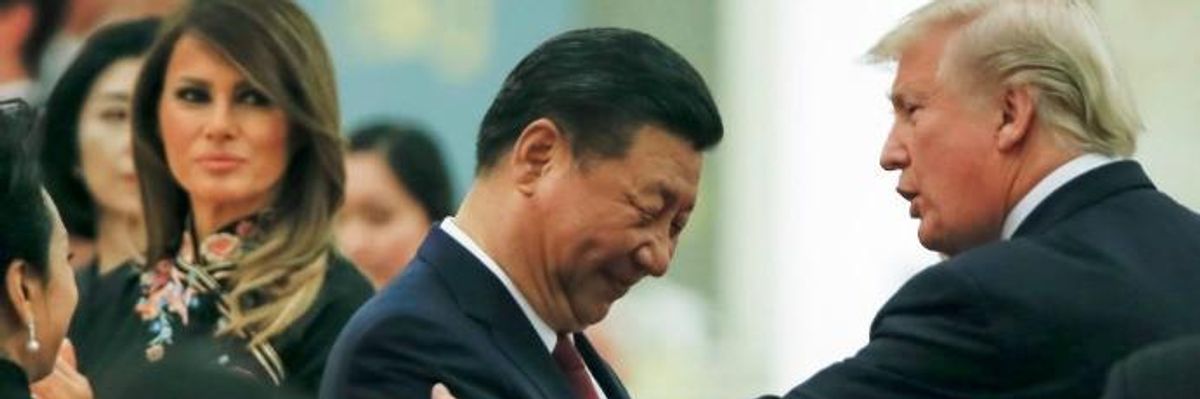
Chinese President Xi Jinping meets U.S. President Donald Trump on November 9, 2017 in Beijing.
A "'what's-in-it-for-me' approach to world affairs may enable Trump to jettison Washington's mythmaking about its coalition-of-the-willing international order."
Donald Trump was hardly a steward of responsible global governance in his first term. His withdrawal from multilateral agreements, including the Iran nuclear deal and the Paris climate accords, showcased an unusual disdain for international institutions and cooperation. He has little evident regard for the “rules-based international order” favored by the Biden administration. However, therein lies an opportunity.
The idea that the United States upholds global stability by leading a “rules-based” order tends to generate more ill will than goodwill in many parts of the world. Rather than offering a positive American vision, it has come to symbolize American hypocrisy and double standards. Trump would be wise to drop the phrase from the U.S. lexicon.
The concept of a rules-based order gained popularity in the D.C. foreign policy establishment, known as the “blob,” in recent years because it encapsulated how experts — liberals and neoconservatives alike, many blindsided by Trump and thrown out of power — viewed what they, and America, stood for.
The Biden administration made the rules-based formulation an organizing principle of its foreign policy. The idea played a key role in shoring up like-minded states to counter China and Russia, which Washington accuses of seeking to overturn the current world order. Yet the order’s fallacies have been laid bare by Washington’s weaponization of this concept against its geopolitical foes even as, for example, the U.S. provides arms to Israel despite its repeated violations of international law.
More important, the rules-based concept has masked revisionist motivations of its own. Aiming to sustain America’s dominance of the international system has precluded a functional global legal framework. That risks inciting the formation of numerous competing orders rather than a more collaborative system following a single set of laws.
China has indicted rules-based talk for masking one-power rule of the globe. Its response so far, however, has been to operate within the existing system while seeking to reform it to its own liking. But if Biden had succeeded in turning the rules-based international order into a bloc, China might have responded by teaming up with Russia and Global South states to form a rival bloc with its own sets of laws.
Though nations in the Global South have disagreements with Russia and China, many are united in their opposition to the rules-based conceit, which they see as largely designed to prolong American unipolarity at the expense of rising powers such as Brazil and India. “I am struck by how much we have lost the trust of the Global South,” French President Emanuel Macron admitted at the 2023 Munich Security Conference.
A world in which states no longer differ over competing interpretations of one legal regime but instead proffer competing sets of rules is more frightening than anything Trump has done so far.
The more America and its allies fracture the global and legal order in the name of their rules, the less anyone follows them. We can’t forge an international order by imposing rules on states that have been excluded from their formulation. No wonder many international law experts view the rules-based order concept not as complementary to international law, but as a threat to it.
A multi-order world lacking a working framework for engagement, collaboration and de-escalation would fuel conflict and great-power competition at a fragile moment. It would be less capable of containing military aggression, preventing nuclear proliferation or managing shared crises such as climate change. If great-power competition is already happening, the key question is whether it proceeds under some common framework or becomes a matter of every great power for itself.
That makes Trump’s choices essential. He appears to be open to a multipolar world, though his investment in rules and laws is a different matter. But if he is serious about reducing America’s global military footprint, bringing our troops home and ceasing to play the increasingly unwanted role of world police, then avoiding anarchy and promoting peace by sustaining a multilateral system will serve U.S. interests and thus Trump’s.
Trump is a keen advocate for his own interests. His first-term foreign policy was marked by a transactionalism that occasionally enabled him to transcend Washington’s typical moralizing in favor of advancing U.S. interests through engagement, such as negotiating the withdrawal from Afghanistan with the Taliban. This “what’s-in-it-for-me” approach to world affairs may enable Trump to jettison Washington’s mythmaking about its coalition-of-the-willing international order.
A working world order is an important condition for Trump’s apparent foreign policy goals — including winning the economic competition with China and forging peace in Ukraine. Those goals can’t be achieved without a healthy, predictable security framework that prevents disagreements and conflicts from spiraling into mutually destructive wars.
Some existing norms, laws and institutions encourage a range of good outcomes and deserve to stay in place, among them United Nations Charter rules that constrain force and the United Nations itself. As for ending the ongoing wars in Ukraine and Gaza, that will depend on the art of the deal. But everything depends on whether the bargaining occurs in the shadow of some belief that it is better to have fair, common standards.
The rules-based international order has betrayed that possibility. Over the next four years, America needs to do better.
Dear Common Dreams reader, It’s been nearly 30 years since I co-founded Common Dreams with my late wife, Lina Newhouser. We had the radical notion that journalism should serve the public good, not corporate profits. It was clear to us from the outset what it would take to build such a project. No paid advertisements. No corporate sponsors. No millionaire publisher telling us what to think or do. Many people said we wouldn't last a year, but we proved those doubters wrong. Together with a tremendous team of journalists and dedicated staff, we built an independent media outlet free from the constraints of profits and corporate control. Our mission has always been simple: To inform. To inspire. To ignite change for the common good. Building Common Dreams was not easy. Our survival was never guaranteed. When you take on the most powerful forces—Wall Street greed, fossil fuel industry destruction, Big Tech lobbyists, and uber-rich oligarchs who have spent billions upon billions rigging the economy and democracy in their favor—the only bulwark you have is supporters who believe in your work. But here’s the urgent message from me today. It's never been this bad out there. And it's never been this hard to keep us going. At the very moment Common Dreams is most needed, the threats we face are intensifying. We need your support now more than ever. We don't accept corporate advertising and never will. We don't have a paywall because we don't think people should be blocked from critical news based on their ability to pay. Everything we do is funded by the donations of readers like you. When everyone does the little they can afford, we are strong. But if that support retreats or dries up, so do we. Will you donate now to make sure Common Dreams not only survives but thrives? —Craig Brown, Co-founder |
Donald Trump was hardly a steward of responsible global governance in his first term. His withdrawal from multilateral agreements, including the Iran nuclear deal and the Paris climate accords, showcased an unusual disdain for international institutions and cooperation. He has little evident regard for the “rules-based international order” favored by the Biden administration. However, therein lies an opportunity.
The idea that the United States upholds global stability by leading a “rules-based” order tends to generate more ill will than goodwill in many parts of the world. Rather than offering a positive American vision, it has come to symbolize American hypocrisy and double standards. Trump would be wise to drop the phrase from the U.S. lexicon.
The concept of a rules-based order gained popularity in the D.C. foreign policy establishment, known as the “blob,” in recent years because it encapsulated how experts — liberals and neoconservatives alike, many blindsided by Trump and thrown out of power — viewed what they, and America, stood for.
The Biden administration made the rules-based formulation an organizing principle of its foreign policy. The idea played a key role in shoring up like-minded states to counter China and Russia, which Washington accuses of seeking to overturn the current world order. Yet the order’s fallacies have been laid bare by Washington’s weaponization of this concept against its geopolitical foes even as, for example, the U.S. provides arms to Israel despite its repeated violations of international law.
More important, the rules-based concept has masked revisionist motivations of its own. Aiming to sustain America’s dominance of the international system has precluded a functional global legal framework. That risks inciting the formation of numerous competing orders rather than a more collaborative system following a single set of laws.
China has indicted rules-based talk for masking one-power rule of the globe. Its response so far, however, has been to operate within the existing system while seeking to reform it to its own liking. But if Biden had succeeded in turning the rules-based international order into a bloc, China might have responded by teaming up with Russia and Global South states to form a rival bloc with its own sets of laws.
Though nations in the Global South have disagreements with Russia and China, many are united in their opposition to the rules-based conceit, which they see as largely designed to prolong American unipolarity at the expense of rising powers such as Brazil and India. “I am struck by how much we have lost the trust of the Global South,” French President Emanuel Macron admitted at the 2023 Munich Security Conference.
A world in which states no longer differ over competing interpretations of one legal regime but instead proffer competing sets of rules is more frightening than anything Trump has done so far.
The more America and its allies fracture the global and legal order in the name of their rules, the less anyone follows them. We can’t forge an international order by imposing rules on states that have been excluded from their formulation. No wonder many international law experts view the rules-based order concept not as complementary to international law, but as a threat to it.
A multi-order world lacking a working framework for engagement, collaboration and de-escalation would fuel conflict and great-power competition at a fragile moment. It would be less capable of containing military aggression, preventing nuclear proliferation or managing shared crises such as climate change. If great-power competition is already happening, the key question is whether it proceeds under some common framework or becomes a matter of every great power for itself.
That makes Trump’s choices essential. He appears to be open to a multipolar world, though his investment in rules and laws is a different matter. But if he is serious about reducing America’s global military footprint, bringing our troops home and ceasing to play the increasingly unwanted role of world police, then avoiding anarchy and promoting peace by sustaining a multilateral system will serve U.S. interests and thus Trump’s.
Trump is a keen advocate for his own interests. His first-term foreign policy was marked by a transactionalism that occasionally enabled him to transcend Washington’s typical moralizing in favor of advancing U.S. interests through engagement, such as negotiating the withdrawal from Afghanistan with the Taliban. This “what’s-in-it-for-me” approach to world affairs may enable Trump to jettison Washington’s mythmaking about its coalition-of-the-willing international order.
A working world order is an important condition for Trump’s apparent foreign policy goals — including winning the economic competition with China and forging peace in Ukraine. Those goals can’t be achieved without a healthy, predictable security framework that prevents disagreements and conflicts from spiraling into mutually destructive wars.
Some existing norms, laws and institutions encourage a range of good outcomes and deserve to stay in place, among them United Nations Charter rules that constrain force and the United Nations itself. As for ending the ongoing wars in Ukraine and Gaza, that will depend on the art of the deal. But everything depends on whether the bargaining occurs in the shadow of some belief that it is better to have fair, common standards.
The rules-based international order has betrayed that possibility. Over the next four years, America needs to do better.
Donald Trump was hardly a steward of responsible global governance in his first term. His withdrawal from multilateral agreements, including the Iran nuclear deal and the Paris climate accords, showcased an unusual disdain for international institutions and cooperation. He has little evident regard for the “rules-based international order” favored by the Biden administration. However, therein lies an opportunity.
The idea that the United States upholds global stability by leading a “rules-based” order tends to generate more ill will than goodwill in many parts of the world. Rather than offering a positive American vision, it has come to symbolize American hypocrisy and double standards. Trump would be wise to drop the phrase from the U.S. lexicon.
The concept of a rules-based order gained popularity in the D.C. foreign policy establishment, known as the “blob,” in recent years because it encapsulated how experts — liberals and neoconservatives alike, many blindsided by Trump and thrown out of power — viewed what they, and America, stood for.
The Biden administration made the rules-based formulation an organizing principle of its foreign policy. The idea played a key role in shoring up like-minded states to counter China and Russia, which Washington accuses of seeking to overturn the current world order. Yet the order’s fallacies have been laid bare by Washington’s weaponization of this concept against its geopolitical foes even as, for example, the U.S. provides arms to Israel despite its repeated violations of international law.
More important, the rules-based concept has masked revisionist motivations of its own. Aiming to sustain America’s dominance of the international system has precluded a functional global legal framework. That risks inciting the formation of numerous competing orders rather than a more collaborative system following a single set of laws.
China has indicted rules-based talk for masking one-power rule of the globe. Its response so far, however, has been to operate within the existing system while seeking to reform it to its own liking. But if Biden had succeeded in turning the rules-based international order into a bloc, China might have responded by teaming up with Russia and Global South states to form a rival bloc with its own sets of laws.
Though nations in the Global South have disagreements with Russia and China, many are united in their opposition to the rules-based conceit, which they see as largely designed to prolong American unipolarity at the expense of rising powers such as Brazil and India. “I am struck by how much we have lost the trust of the Global South,” French President Emanuel Macron admitted at the 2023 Munich Security Conference.
A world in which states no longer differ over competing interpretations of one legal regime but instead proffer competing sets of rules is more frightening than anything Trump has done so far.
The more America and its allies fracture the global and legal order in the name of their rules, the less anyone follows them. We can’t forge an international order by imposing rules on states that have been excluded from their formulation. No wonder many international law experts view the rules-based order concept not as complementary to international law, but as a threat to it.
A multi-order world lacking a working framework for engagement, collaboration and de-escalation would fuel conflict and great-power competition at a fragile moment. It would be less capable of containing military aggression, preventing nuclear proliferation or managing shared crises such as climate change. If great-power competition is already happening, the key question is whether it proceeds under some common framework or becomes a matter of every great power for itself.
That makes Trump’s choices essential. He appears to be open to a multipolar world, though his investment in rules and laws is a different matter. But if he is serious about reducing America’s global military footprint, bringing our troops home and ceasing to play the increasingly unwanted role of world police, then avoiding anarchy and promoting peace by sustaining a multilateral system will serve U.S. interests and thus Trump’s.
Trump is a keen advocate for his own interests. His first-term foreign policy was marked by a transactionalism that occasionally enabled him to transcend Washington’s typical moralizing in favor of advancing U.S. interests through engagement, such as negotiating the withdrawal from Afghanistan with the Taliban. This “what’s-in-it-for-me” approach to world affairs may enable Trump to jettison Washington’s mythmaking about its coalition-of-the-willing international order.
A working world order is an important condition for Trump’s apparent foreign policy goals — including winning the economic competition with China and forging peace in Ukraine. Those goals can’t be achieved without a healthy, predictable security framework that prevents disagreements and conflicts from spiraling into mutually destructive wars.
Some existing norms, laws and institutions encourage a range of good outcomes and deserve to stay in place, among them United Nations Charter rules that constrain force and the United Nations itself. As for ending the ongoing wars in Ukraine and Gaza, that will depend on the art of the deal. But everything depends on whether the bargaining occurs in the shadow of some belief that it is better to have fair, common standards.
The rules-based international order has betrayed that possibility. Over the next four years, America needs to do better.