
SUBSCRIBE TO OUR FREE NEWSLETTER
Daily news & progressive opinion—funded by the people, not the corporations—delivered straight to your inbox.
5
#000000
#FFFFFF
To donate by check, phone, or other method, see our More Ways to Give page.
Daily news & progressive opinion—funded by the people, not the corporations—delivered straight to your inbox.
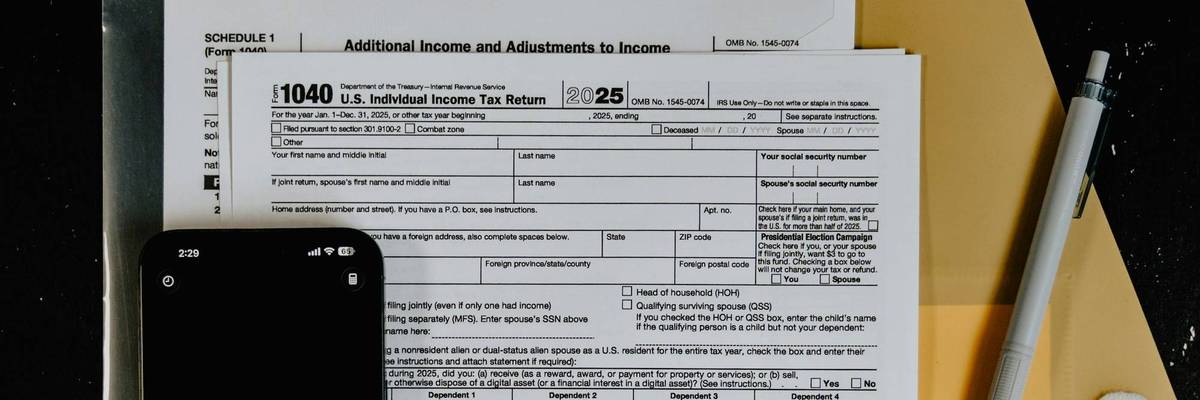
Tax forms are seen with a calculator and pen on desk.
Lawmakers face a choice: They can continue their vote-pandering through “no tax on” proposals, or they can address the glaring structural flaws in the federal income tax and, in doing so, perhaps save our tax system and our democracy.
A tale of two couples:
Barney and Betty are both 66. Betty works as a hostess at a local restaurant. She makes $15,000 in hourly pay, plus another $25,000 in tips. Barney owns an interest in his family’s business, organized as a Subchapter S corporation, from which his annual income is $50,000. Over the holidays, Barney works long hours at a local big box store. He makes $10,000, $2,500 of which is the premium for overtime.
At tax time, Barney and Betty report $100,000 of adjusted gross income. In computing their taxable income, they take deductions of $25,000 for Betty’s tips, $12,000 in deductions for seniors, a $10,000 qualified business income deduction for Barney’s income from the family business, a $2,500 deduction for Barney’s overtime pay, and a standard deduction of $35,500, leaving them with taxable income of $15,000 and a federal income tax bill liability of $1,500.
The only path out of this mess is to rebalance our income tax structure. The Working Americans Tax Cut Act, a bill introduced by Sen. Chris Van Hollen (D-Md.) and Rep. Don Beyer (D-Va.O would accomplish that rebalancing.
Fred and Wilma are both 64. Wilma no longer works. Fred makes $100,000 per year as an accountant with a local firm. Although he works long hours during tax season, he is not paid overtime because of his base compensation and position, which includes managerial duties. At tax time, Fred and Wilma report $100,000 of adjusted gross income. They take a standard deduction of $32,200, leaving them with taxable income of $67,800 and a federal income tax liability of $7,640.
These are, of course, concocted examples. But they show how tax policy in the US under President Donald Trump has returned to the Stone Age. There are couples with tax pictures virtually identical to Barney and Betty’s and other couples with tax pictures virtually identical to Fred and Wilma’s. Do they ever compare their respective situations? Do they question the Swiss cheese tax code we have courtesy of two Trump tax bills?
Could it get worse? Absolutely. As Brian Faler at Politico reported, members of Congress have a slew of new “no tax on” proposals ready to campaign on. No Tax on Boat Loan Interest? Yep. Taxes on Utility Bills? Absolutely, and it’s bipartisan no less! I spoke to a senior congressional staffer a few months ago who was just giddy about all the “no tax on” proposals his office hoped to include in a 2029 budget reconciliation bill.
The “no tax on” provisions currently in the tax code are set to expire after 2028. Will they be extended? Of course they will. As I commented to Politico, if you do away with no tax on tips, you can kiss the state of Nevada goodbye. And imagine how this will play in the other swing states in 2028. “No tax on auto workers” sure will sound sweet in Michigan. And if you want to carry Georgia, you damn well better sign on to “no tax on peanut farm workers.” By the time we get to the 2032 campaign, the pandering will be stripped of all pretense and we’ll be hearing “no tax on Pennsylvanians.”
How problematic is this from a tax policy perspective? Huge. The federal income tax system depends on voluntary compliance. The system must make sense to taxpayers for them to voluntarily comply. If you’re Fred or Wilma, would our tax system still make sense to you? Hardly.
How, then, do we rein this craziness in? We start by identifying the source of the problem. As gimmicky as provisions like no tax on tips are, and even though they benefit only a tiny percentage of workers, they address a need millions of Americans feel and millions more Americans understand. When people hear “tipped worker,” they don’t picture the blackjack dealer at the Venetian making $150,000 a year. They don’t even picture a worker like Betty, who together with her husband enjoys a comfortable income. They picture the struggling unmarried server at their local Denny’s slinging dishes for $35,000. And they understand well she doesn’t have enough income before federal income tax, let alone after, to pay her basic living expenses.
Now, consider struggling non-tipped workers and their reaction to no tax on tips. Do they think their tipped counterparts are getting an unfair break like the ultra rich get on their lightly-taxed investment gains? Or do they think that they should have their income tax burdens reduced as well, and that the rich should be required to pay more?
Asking those questions, of course, answers them, and shines a light on the real problem: The federal income tax is fundamentally flawed at both ends of the income spectrum. At the lower end, incomes not even sufficient to cover basic living expenses are subject to federal income tax. At the upper end, marginal rates top out at a fraction of the country’s highest income levels. Doctors making in the high six figures face the same marginal tax rate as CEOs making 50 times that much.
The only path out of this mess is to rebalance our income tax structure. The Working Americans Tax Cut Act, a bill introduced by Sen. Chris Van Hollen (D-Md.) and Rep. Don Beyer (D-Va.O would accomplish that rebalancing. Their bill provides an exemption from federal income tax for income up to the basic cost of living, with a progressively smaller income tax reduction for those with incomes just above the basic cost of living. At the same time, the bill imposes a surtax on income in excess of $1 million, and larger surtaxes on incomes above $2 million and $5 million.
If the Working Americans Tax Cut Act becomes law, the ghastly “no tax on” provisions could be allowed to expire. The great majority of tipped workers, like that struggling server at Denny’s, won’t care, since they’d pay no federal income tax either way. A handful of taxpayers would still benefit from no tax on tips. But nobody will waste political capital on a tax break for affluent blackjack dealers.
Members of Congress face a choice. They can continue their vote-pandering through “no tax on” proposals. Or they can address the glaring structural flaws in the federal income tax and, in doing so, perhaps save our tax system and our democracy.
Let’s hope they make the right choice. Stone Age tax policy won’t end well for any of us.
This article was originally published on Bob Lord's Substack.
This country and this world are at a monumental crossroads. US voters have an opportunity to beat back the forces of fascism and confront the billionaires who are rigging the economy, our media system, and our democracy, making it increasingly impossible for ordinary people to get by. We’re not just talking about the election. We’re talking about what must be done once these fascist elements are vanquished from power. We need a bolder set of solutions than what either major party has so far been willing to offer and a working-class movement ready to fight like hell for it. Trump didn't emerge from nowhere. The conditions that fueled MAGA authoritarianism were created by decades of radical neoliberal economic policies and a corrupt political system dominated by corporate interests. They slashed taxes on the super-rich, promising that the benefits would trickle down. They said giveaways to the corporate titans would make life more affordable for the rest of us. It was all bullshit. And when a bitter, betrayed populace searches for someone to blame, right-wing demagogues have little trouble finding scapegoats. People know when they're being lied to, but you won't hear any of this from the corporate media. Only independent journalism—powered and funded by people who believe in building a better world—can deliver truly trustworthy daily news. If you share our vision, please contribute whatever you can to sustain our work. |
A tale of two couples:
Barney and Betty are both 66. Betty works as a hostess at a local restaurant. She makes $15,000 in hourly pay, plus another $25,000 in tips. Barney owns an interest in his family’s business, organized as a Subchapter S corporation, from which his annual income is $50,000. Over the holidays, Barney works long hours at a local big box store. He makes $10,000, $2,500 of which is the premium for overtime.
At tax time, Barney and Betty report $100,000 of adjusted gross income. In computing their taxable income, they take deductions of $25,000 for Betty’s tips, $12,000 in deductions for seniors, a $10,000 qualified business income deduction for Barney’s income from the family business, a $2,500 deduction for Barney’s overtime pay, and a standard deduction of $35,500, leaving them with taxable income of $15,000 and a federal income tax bill liability of $1,500.
The only path out of this mess is to rebalance our income tax structure. The Working Americans Tax Cut Act, a bill introduced by Sen. Chris Van Hollen (D-Md.) and Rep. Don Beyer (D-Va.O would accomplish that rebalancing.
Fred and Wilma are both 64. Wilma no longer works. Fred makes $100,000 per year as an accountant with a local firm. Although he works long hours during tax season, he is not paid overtime because of his base compensation and position, which includes managerial duties. At tax time, Fred and Wilma report $100,000 of adjusted gross income. They take a standard deduction of $32,200, leaving them with taxable income of $67,800 and a federal income tax liability of $7,640.
These are, of course, concocted examples. But they show how tax policy in the US under President Donald Trump has returned to the Stone Age. There are couples with tax pictures virtually identical to Barney and Betty’s and other couples with tax pictures virtually identical to Fred and Wilma’s. Do they ever compare their respective situations? Do they question the Swiss cheese tax code we have courtesy of two Trump tax bills?
Could it get worse? Absolutely. As Brian Faler at Politico reported, members of Congress have a slew of new “no tax on” proposals ready to campaign on. No Tax on Boat Loan Interest? Yep. Taxes on Utility Bills? Absolutely, and it’s bipartisan no less! I spoke to a senior congressional staffer a few months ago who was just giddy about all the “no tax on” proposals his office hoped to include in a 2029 budget reconciliation bill.
The “no tax on” provisions currently in the tax code are set to expire after 2028. Will they be extended? Of course they will. As I commented to Politico, if you do away with no tax on tips, you can kiss the state of Nevada goodbye. And imagine how this will play in the other swing states in 2028. “No tax on auto workers” sure will sound sweet in Michigan. And if you want to carry Georgia, you damn well better sign on to “no tax on peanut farm workers.” By the time we get to the 2032 campaign, the pandering will be stripped of all pretense and we’ll be hearing “no tax on Pennsylvanians.”
How problematic is this from a tax policy perspective? Huge. The federal income tax system depends on voluntary compliance. The system must make sense to taxpayers for them to voluntarily comply. If you’re Fred or Wilma, would our tax system still make sense to you? Hardly.
How, then, do we rein this craziness in? We start by identifying the source of the problem. As gimmicky as provisions like no tax on tips are, and even though they benefit only a tiny percentage of workers, they address a need millions of Americans feel and millions more Americans understand. When people hear “tipped worker,” they don’t picture the blackjack dealer at the Venetian making $150,000 a year. They don’t even picture a worker like Betty, who together with her husband enjoys a comfortable income. They picture the struggling unmarried server at their local Denny’s slinging dishes for $35,000. And they understand well she doesn’t have enough income before federal income tax, let alone after, to pay her basic living expenses.
Now, consider struggling non-tipped workers and their reaction to no tax on tips. Do they think their tipped counterparts are getting an unfair break like the ultra rich get on their lightly-taxed investment gains? Or do they think that they should have their income tax burdens reduced as well, and that the rich should be required to pay more?
Asking those questions, of course, answers them, and shines a light on the real problem: The federal income tax is fundamentally flawed at both ends of the income spectrum. At the lower end, incomes not even sufficient to cover basic living expenses are subject to federal income tax. At the upper end, marginal rates top out at a fraction of the country’s highest income levels. Doctors making in the high six figures face the same marginal tax rate as CEOs making 50 times that much.
The only path out of this mess is to rebalance our income tax structure. The Working Americans Tax Cut Act, a bill introduced by Sen. Chris Van Hollen (D-Md.) and Rep. Don Beyer (D-Va.O would accomplish that rebalancing. Their bill provides an exemption from federal income tax for income up to the basic cost of living, with a progressively smaller income tax reduction for those with incomes just above the basic cost of living. At the same time, the bill imposes a surtax on income in excess of $1 million, and larger surtaxes on incomes above $2 million and $5 million.
If the Working Americans Tax Cut Act becomes law, the ghastly “no tax on” provisions could be allowed to expire. The great majority of tipped workers, like that struggling server at Denny’s, won’t care, since they’d pay no federal income tax either way. A handful of taxpayers would still benefit from no tax on tips. But nobody will waste political capital on a tax break for affluent blackjack dealers.
Members of Congress face a choice. They can continue their vote-pandering through “no tax on” proposals. Or they can address the glaring structural flaws in the federal income tax and, in doing so, perhaps save our tax system and our democracy.
Let’s hope they make the right choice. Stone Age tax policy won’t end well for any of us.
This article was originally published on Bob Lord's Substack.
A tale of two couples:
Barney and Betty are both 66. Betty works as a hostess at a local restaurant. She makes $15,000 in hourly pay, plus another $25,000 in tips. Barney owns an interest in his family’s business, organized as a Subchapter S corporation, from which his annual income is $50,000. Over the holidays, Barney works long hours at a local big box store. He makes $10,000, $2,500 of which is the premium for overtime.
At tax time, Barney and Betty report $100,000 of adjusted gross income. In computing their taxable income, they take deductions of $25,000 for Betty’s tips, $12,000 in deductions for seniors, a $10,000 qualified business income deduction for Barney’s income from the family business, a $2,500 deduction for Barney’s overtime pay, and a standard deduction of $35,500, leaving them with taxable income of $15,000 and a federal income tax bill liability of $1,500.
The only path out of this mess is to rebalance our income tax structure. The Working Americans Tax Cut Act, a bill introduced by Sen. Chris Van Hollen (D-Md.) and Rep. Don Beyer (D-Va.O would accomplish that rebalancing.
Fred and Wilma are both 64. Wilma no longer works. Fred makes $100,000 per year as an accountant with a local firm. Although he works long hours during tax season, he is not paid overtime because of his base compensation and position, which includes managerial duties. At tax time, Fred and Wilma report $100,000 of adjusted gross income. They take a standard deduction of $32,200, leaving them with taxable income of $67,800 and a federal income tax liability of $7,640.
These are, of course, concocted examples. But they show how tax policy in the US under President Donald Trump has returned to the Stone Age. There are couples with tax pictures virtually identical to Barney and Betty’s and other couples with tax pictures virtually identical to Fred and Wilma’s. Do they ever compare their respective situations? Do they question the Swiss cheese tax code we have courtesy of two Trump tax bills?
Could it get worse? Absolutely. As Brian Faler at Politico reported, members of Congress have a slew of new “no tax on” proposals ready to campaign on. No Tax on Boat Loan Interest? Yep. Taxes on Utility Bills? Absolutely, and it’s bipartisan no less! I spoke to a senior congressional staffer a few months ago who was just giddy about all the “no tax on” proposals his office hoped to include in a 2029 budget reconciliation bill.
The “no tax on” provisions currently in the tax code are set to expire after 2028. Will they be extended? Of course they will. As I commented to Politico, if you do away with no tax on tips, you can kiss the state of Nevada goodbye. And imagine how this will play in the other swing states in 2028. “No tax on auto workers” sure will sound sweet in Michigan. And if you want to carry Georgia, you damn well better sign on to “no tax on peanut farm workers.” By the time we get to the 2032 campaign, the pandering will be stripped of all pretense and we’ll be hearing “no tax on Pennsylvanians.”
How problematic is this from a tax policy perspective? Huge. The federal income tax system depends on voluntary compliance. The system must make sense to taxpayers for them to voluntarily comply. If you’re Fred or Wilma, would our tax system still make sense to you? Hardly.
How, then, do we rein this craziness in? We start by identifying the source of the problem. As gimmicky as provisions like no tax on tips are, and even though they benefit only a tiny percentage of workers, they address a need millions of Americans feel and millions more Americans understand. When people hear “tipped worker,” they don’t picture the blackjack dealer at the Venetian making $150,000 a year. They don’t even picture a worker like Betty, who together with her husband enjoys a comfortable income. They picture the struggling unmarried server at their local Denny’s slinging dishes for $35,000. And they understand well she doesn’t have enough income before federal income tax, let alone after, to pay her basic living expenses.
Now, consider struggling non-tipped workers and their reaction to no tax on tips. Do they think their tipped counterparts are getting an unfair break like the ultra rich get on their lightly-taxed investment gains? Or do they think that they should have their income tax burdens reduced as well, and that the rich should be required to pay more?
Asking those questions, of course, answers them, and shines a light on the real problem: The federal income tax is fundamentally flawed at both ends of the income spectrum. At the lower end, incomes not even sufficient to cover basic living expenses are subject to federal income tax. At the upper end, marginal rates top out at a fraction of the country’s highest income levels. Doctors making in the high six figures face the same marginal tax rate as CEOs making 50 times that much.
The only path out of this mess is to rebalance our income tax structure. The Working Americans Tax Cut Act, a bill introduced by Sen. Chris Van Hollen (D-Md.) and Rep. Don Beyer (D-Va.O would accomplish that rebalancing. Their bill provides an exemption from federal income tax for income up to the basic cost of living, with a progressively smaller income tax reduction for those with incomes just above the basic cost of living. At the same time, the bill imposes a surtax on income in excess of $1 million, and larger surtaxes on incomes above $2 million and $5 million.
If the Working Americans Tax Cut Act becomes law, the ghastly “no tax on” provisions could be allowed to expire. The great majority of tipped workers, like that struggling server at Denny’s, won’t care, since they’d pay no federal income tax either way. A handful of taxpayers would still benefit from no tax on tips. But nobody will waste political capital on a tax break for affluent blackjack dealers.
Members of Congress face a choice. They can continue their vote-pandering through “no tax on” proposals. Or they can address the glaring structural flaws in the federal income tax and, in doing so, perhaps save our tax system and our democracy.
Let’s hope they make the right choice. Stone Age tax policy won’t end well for any of us.
This article was originally published on Bob Lord's Substack.