SUBSCRIBE TO OUR FREE NEWSLETTER
Daily news & progressive opinion—funded by the people, not the corporations—delivered straight to your inbox.
5
#000000
#FFFFFF
To donate by check, phone, or other method, see our More Ways to Give page.
Daily news & progressive opinion—funded by the people, not the corporations—delivered straight to your inbox.
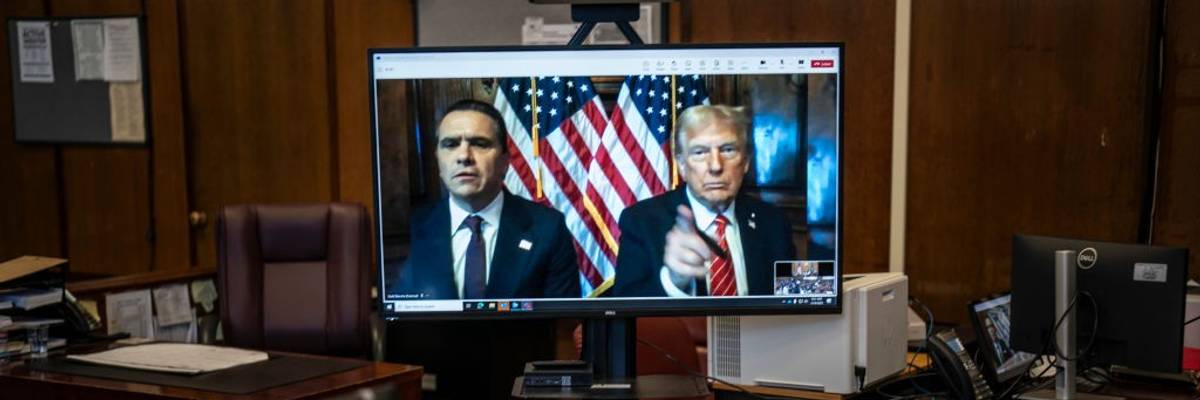
Then-US President-elect Donald Trump appears remotely for a sentencing hearing with his attorney Todd Blanche (L) at Manhattan Criminal Court on January 10, 2025 in New York City.
The president's obviously corrupt effort to gain immunity for himself and his sons through an IRS settlement is unlikely to succeed.
Whoever designed President Donald Trump’s $10 billion lawsuit against the Internal Revenue Service and the Treasury Department must be a fan of the Ocean’s Eleven movie franchise. The multi-act plot lines are strikingly similar: Put together a motley crew of risk takers; pick a seemingly invincible target rich in treasure; infiltrate the target; exploit its weaknesses; and get away with an improbable heist while the guards are asleep, distracted, or otherwise occupied.
Act One of Trump’s story arc began on January 29, when he and his eldest sons and the Trump Organization filed the lawsuit in federal district court in Miami. If only briefly, it seemed like the plan just might work. In 2019, an IRS contractor named Charles Littlejohn leaked multiple years of the Trumps’ confidential tax records, along with those of over 7,000 other wealthy individuals, to The New York Times and ProPublica. The Trumps alleged in their complaint that the IRS and the Treasury Department had willfully failed to safeguard their tax information, and that each viewing of a news article mentioning the data constituted a separate $1,000 violation. The total—accounting for harm from embarrassment and reputational and financial injury—ran into the stratosphere.
There is no doubt that Littlejohn broke the law. In October 2023, he pleaded guilty to the unauthorized disclosures and was later sentenced to five years in prison.
But a few things stood in the way of a courtroom victory for Trump and his family: First and foremost, Trump filed his complaint in his individual capacity, placing himself, as the nation’s chief executive, on both sides of the litigation, with his former personal lawyer and now-acting Attorney General Todd Blanche representing the defense.
Neither Blanche nor Trump has backed away from the addendum to the settlement agreement reached in the Miami case that confers civil and criminal immunity on the president and his sons.
The arrangement came to the attention of various public watchdog groups that quickly filed amicus briefs in the case, decrying the litigation as collusive and riddled with irreconcilable conflicts of interest. Collusive litigation is illegal and, if proven, warrants dismissal and court-ordered sanctions. It could also conceivably lead to a future criminal prosecution for conspiracy to defraud the United States, in addition to other offenses. And, because Trump filed the case in his individual capacity, he would not be protected from future prosecutions by the immunity the Supreme Court accorded him two years ago for actions taken within the scope of his official duties.
Another problem for Trump: The case was assigned to Judge Kathleen Williams, a no-BS jurist appointed by Barack Obama. On April 24, Judge Williams ordered the parties to submit briefs on the collusion issue by May 20. The order specifically mentioned remarks made by Trump in press interviews that indicated he understood the nature of the case and that if the litigation were to be settled, he would be in the unique position of negotiating with himself, an admission that could prove critical in future investigations to establish criminal intent.
The order prompted Blanche, Trump, and the Department of Justice (DOJ) to open the second act of their Ocean’s Eleven ploy. Instead of filing the requested briefs, they submitted a request to voluntarily dismiss the case on May 18. Believing she no longer had jurisdiction over the case, Judge Williams granted the request.
Later that same day, Blanche announced that the lawsuit had been resolved with the DOJ entering into a “settlement agreement” that created a $1.776 billion “anti-weaponization” slush fund to be drawn from the Treasury Department’s general “judgment fund,” created by Congress in 1956 as a permanent appropriation to pay litigation judgments entered against the United States. Under the agreement, Trump’s allies, including the January 6 insurrectionists, would be authorized to file claims for monetary compensation due to the alleged weaponization of President Joe Biden’s Justice Department against them. The claims would be adjudicated by a committee, selected by the attorney general, that would operate in secrecy with no public reporting requirements and whose members could be fired at will by the president.
The following day, Blanche tacked on an “addendum” to the settlement that ordered the IRS and the DOJ to permanently end all current and possible future tax audits and investigations into the Trump family that were or could have been pending at the time of the settlement. The actual language of the addendum is so nebulous, according to some analysts, that it could be read to immunize the Trumps from any future investigations, civil or criminal, initiated by any and all federal agencies, including the Securities and Exchange Commission and the FBI.
The settlement prompted immediate and uncommon bipartisan criticism in Congress and outrage in the media. It also sparked additional litigation with new lawsuits aimed at blocking the anti-weaponization fund filed in Virginia and the District of Columbia. On May 29, District Court Judge Leonie Brinkema, sitting in Alexandria, Virginia, issued a temporary restraining order preventing the transfer of any money from the Treasury Department to the fund, and precluding the DOJ from taking any further action on the fund. The judge set a June 12 hearing date for oral arguments on the TRO.
Meanwhile, on May 27 in Miami, a group of 35 former federal judges filed a motion to reopen the case, urging Judge Williams to investigate whether the parties had perpetrated a fraud on the court. The judge responded swiftly with an order requiring Trump and his sons to submit a reply brief by June 12. This highly unusual step was necessary, she explained, in light of the “grievous allegations [raised by the 35 judges] that Plaintiffs voluntarily dismissed this litigation solely to avoid judicial scrutiny of a lawsuit that ‘was collusive from the start’ and was only filed to provide the imprimatur of legality for an unlawful settlement.”
We are now in Act 3 of the administration’s Ocean’s Eleven drama, the part where Trump and his minions back down and regroup. In a hearing before a House Appropriations subcommittee on June 2, Blanche said that the administration would not go forward with the anti-weaponization fund. On June 5, in filings in both the DC and Virginia cases, the DOJ put Blanche’s pledge in writing in motions requesting that both cases be dismissed as moot.
To date, however, neither Blanche nor Trump has backed away from the addendum to the settlement agreement reached in the Miami case that confers civil and criminal immunity on the president and his sons. That benefit, if implemented, would accord the Trumps even more protection than a presidential pardon. It may also have been the real goal of the litigation from the outset.
But the scheme is unlikely to succeed. Whether Judge Williams or her colleagues in DC and Virginia strike down the addendum, the granting of immunity remains an act of blatant corruption. There is no reason to believe a future Department of Justice in a Democratic administration will honor the grant. It may take a few years for the curtain to fall on the president’s Ocean’s Eleven heist, but in the end, he may emerge as the caper’s biggest loser.
Rock Solid Journalis
Dear Common Dreams reader, It’s been nearly 30 years since I co-founded Common Dreams with my late wife, Lina Newhouser. We had the radical notion that journalism should serve the public good, not corporate profits. It was clear to us from the outset what it would take to build such a project. No paid advertisements. No corporate sponsors. No millionaire publisher telling us what to think or do. Many people said we wouldn't last a year, but we proved those doubters wrong. Together with a tremendous team of journalists and dedicated staff, we built an independent media outlet free from the constraints of profits and corporate control. Our mission has always been simple: To inform. To inspire. To ignite change for the common good. Building Common Dreams was not easy. Our survival was never guaranteed. When you take on the most powerful forces—Wall Street greed, fossil fuel industry destruction, Big Tech lobbyists, and uber-rich oligarchs who have spent billions upon billions rigging the economy and democracy in their favor—the only bulwark you have is supporters who believe in your work. But here’s the urgent message from me today. It's never been this bad out there. And it's never been this hard to keep us going. At the very moment Common Dreams is most needed, the threats we face are intensifying. We need your support now more than ever. We don't accept corporate advertising and never will. We don't have a paywall because we don't think people should be blocked from critical news based on their ability to pay. Everything we do is funded by the donations of readers like you. When everyone does the little they can afford, we are strong. But if that support retreats or dries up, so do we. Will you donate now to make sure Common Dreams not only survives but thrives? —Craig Brown, Co-founder |
Whoever designed President Donald Trump’s $10 billion lawsuit against the Internal Revenue Service and the Treasury Department must be a fan of the Ocean’s Eleven movie franchise. The multi-act plot lines are strikingly similar: Put together a motley crew of risk takers; pick a seemingly invincible target rich in treasure; infiltrate the target; exploit its weaknesses; and get away with an improbable heist while the guards are asleep, distracted, or otherwise occupied.
Act One of Trump’s story arc began on January 29, when he and his eldest sons and the Trump Organization filed the lawsuit in federal district court in Miami. If only briefly, it seemed like the plan just might work. In 2019, an IRS contractor named Charles Littlejohn leaked multiple years of the Trumps’ confidential tax records, along with those of over 7,000 other wealthy individuals, to The New York Times and ProPublica. The Trumps alleged in their complaint that the IRS and the Treasury Department had willfully failed to safeguard their tax information, and that each viewing of a news article mentioning the data constituted a separate $1,000 violation. The total—accounting for harm from embarrassment and reputational and financial injury—ran into the stratosphere.
There is no doubt that Littlejohn broke the law. In October 2023, he pleaded guilty to the unauthorized disclosures and was later sentenced to five years in prison.
But a few things stood in the way of a courtroom victory for Trump and his family: First and foremost, Trump filed his complaint in his individual capacity, placing himself, as the nation’s chief executive, on both sides of the litigation, with his former personal lawyer and now-acting Attorney General Todd Blanche representing the defense.
Neither Blanche nor Trump has backed away from the addendum to the settlement agreement reached in the Miami case that confers civil and criminal immunity on the president and his sons.
The arrangement came to the attention of various public watchdog groups that quickly filed amicus briefs in the case, decrying the litigation as collusive and riddled with irreconcilable conflicts of interest. Collusive litigation is illegal and, if proven, warrants dismissal and court-ordered sanctions. It could also conceivably lead to a future criminal prosecution for conspiracy to defraud the United States, in addition to other offenses. And, because Trump filed the case in his individual capacity, he would not be protected from future prosecutions by the immunity the Supreme Court accorded him two years ago for actions taken within the scope of his official duties.
Another problem for Trump: The case was assigned to Judge Kathleen Williams, a no-BS jurist appointed by Barack Obama. On April 24, Judge Williams ordered the parties to submit briefs on the collusion issue by May 20. The order specifically mentioned remarks made by Trump in press interviews that indicated he understood the nature of the case and that if the litigation were to be settled, he would be in the unique position of negotiating with himself, an admission that could prove critical in future investigations to establish criminal intent.
The order prompted Blanche, Trump, and the Department of Justice (DOJ) to open the second act of their Ocean’s Eleven ploy. Instead of filing the requested briefs, they submitted a request to voluntarily dismiss the case on May 18. Believing she no longer had jurisdiction over the case, Judge Williams granted the request.
Later that same day, Blanche announced that the lawsuit had been resolved with the DOJ entering into a “settlement agreement” that created a $1.776 billion “anti-weaponization” slush fund to be drawn from the Treasury Department’s general “judgment fund,” created by Congress in 1956 as a permanent appropriation to pay litigation judgments entered against the United States. Under the agreement, Trump’s allies, including the January 6 insurrectionists, would be authorized to file claims for monetary compensation due to the alleged weaponization of President Joe Biden’s Justice Department against them. The claims would be adjudicated by a committee, selected by the attorney general, that would operate in secrecy with no public reporting requirements and whose members could be fired at will by the president.
The following day, Blanche tacked on an “addendum” to the settlement that ordered the IRS and the DOJ to permanently end all current and possible future tax audits and investigations into the Trump family that were or could have been pending at the time of the settlement. The actual language of the addendum is so nebulous, according to some analysts, that it could be read to immunize the Trumps from any future investigations, civil or criminal, initiated by any and all federal agencies, including the Securities and Exchange Commission and the FBI.
The settlement prompted immediate and uncommon bipartisan criticism in Congress and outrage in the media. It also sparked additional litigation with new lawsuits aimed at blocking the anti-weaponization fund filed in Virginia and the District of Columbia. On May 29, District Court Judge Leonie Brinkema, sitting in Alexandria, Virginia, issued a temporary restraining order preventing the transfer of any money from the Treasury Department to the fund, and precluding the DOJ from taking any further action on the fund. The judge set a June 12 hearing date for oral arguments on the TRO.
Meanwhile, on May 27 in Miami, a group of 35 former federal judges filed a motion to reopen the case, urging Judge Williams to investigate whether the parties had perpetrated a fraud on the court. The judge responded swiftly with an order requiring Trump and his sons to submit a reply brief by June 12. This highly unusual step was necessary, she explained, in light of the “grievous allegations [raised by the 35 judges] that Plaintiffs voluntarily dismissed this litigation solely to avoid judicial scrutiny of a lawsuit that ‘was collusive from the start’ and was only filed to provide the imprimatur of legality for an unlawful settlement.”
We are now in Act 3 of the administration’s Ocean’s Eleven drama, the part where Trump and his minions back down and regroup. In a hearing before a House Appropriations subcommittee on June 2, Blanche said that the administration would not go forward with the anti-weaponization fund. On June 5, in filings in both the DC and Virginia cases, the DOJ put Blanche’s pledge in writing in motions requesting that both cases be dismissed as moot.
To date, however, neither Blanche nor Trump has backed away from the addendum to the settlement agreement reached in the Miami case that confers civil and criminal immunity on the president and his sons. That benefit, if implemented, would accord the Trumps even more protection than a presidential pardon. It may also have been the real goal of the litigation from the outset.
But the scheme is unlikely to succeed. Whether Judge Williams or her colleagues in DC and Virginia strike down the addendum, the granting of immunity remains an act of blatant corruption. There is no reason to believe a future Department of Justice in a Democratic administration will honor the grant. It may take a few years for the curtain to fall on the president’s Ocean’s Eleven heist, but in the end, he may emerge as the caper’s biggest loser.
Rock Solid Journalis
Whoever designed President Donald Trump’s $10 billion lawsuit against the Internal Revenue Service and the Treasury Department must be a fan of the Ocean’s Eleven movie franchise. The multi-act plot lines are strikingly similar: Put together a motley crew of risk takers; pick a seemingly invincible target rich in treasure; infiltrate the target; exploit its weaknesses; and get away with an improbable heist while the guards are asleep, distracted, or otherwise occupied.
Act One of Trump’s story arc began on January 29, when he and his eldest sons and the Trump Organization filed the lawsuit in federal district court in Miami. If only briefly, it seemed like the plan just might work. In 2019, an IRS contractor named Charles Littlejohn leaked multiple years of the Trumps’ confidential tax records, along with those of over 7,000 other wealthy individuals, to The New York Times and ProPublica. The Trumps alleged in their complaint that the IRS and the Treasury Department had willfully failed to safeguard their tax information, and that each viewing of a news article mentioning the data constituted a separate $1,000 violation. The total—accounting for harm from embarrassment and reputational and financial injury—ran into the stratosphere.
There is no doubt that Littlejohn broke the law. In October 2023, he pleaded guilty to the unauthorized disclosures and was later sentenced to five years in prison.
But a few things stood in the way of a courtroom victory for Trump and his family: First and foremost, Trump filed his complaint in his individual capacity, placing himself, as the nation’s chief executive, on both sides of the litigation, with his former personal lawyer and now-acting Attorney General Todd Blanche representing the defense.
Neither Blanche nor Trump has backed away from the addendum to the settlement agreement reached in the Miami case that confers civil and criminal immunity on the president and his sons.
The arrangement came to the attention of various public watchdog groups that quickly filed amicus briefs in the case, decrying the litigation as collusive and riddled with irreconcilable conflicts of interest. Collusive litigation is illegal and, if proven, warrants dismissal and court-ordered sanctions. It could also conceivably lead to a future criminal prosecution for conspiracy to defraud the United States, in addition to other offenses. And, because Trump filed the case in his individual capacity, he would not be protected from future prosecutions by the immunity the Supreme Court accorded him two years ago for actions taken within the scope of his official duties.
Another problem for Trump: The case was assigned to Judge Kathleen Williams, a no-BS jurist appointed by Barack Obama. On April 24, Judge Williams ordered the parties to submit briefs on the collusion issue by May 20. The order specifically mentioned remarks made by Trump in press interviews that indicated he understood the nature of the case and that if the litigation were to be settled, he would be in the unique position of negotiating with himself, an admission that could prove critical in future investigations to establish criminal intent.
The order prompted Blanche, Trump, and the Department of Justice (DOJ) to open the second act of their Ocean’s Eleven ploy. Instead of filing the requested briefs, they submitted a request to voluntarily dismiss the case on May 18. Believing she no longer had jurisdiction over the case, Judge Williams granted the request.
Later that same day, Blanche announced that the lawsuit had been resolved with the DOJ entering into a “settlement agreement” that created a $1.776 billion “anti-weaponization” slush fund to be drawn from the Treasury Department’s general “judgment fund,” created by Congress in 1956 as a permanent appropriation to pay litigation judgments entered against the United States. Under the agreement, Trump’s allies, including the January 6 insurrectionists, would be authorized to file claims for monetary compensation due to the alleged weaponization of President Joe Biden’s Justice Department against them. The claims would be adjudicated by a committee, selected by the attorney general, that would operate in secrecy with no public reporting requirements and whose members could be fired at will by the president.
The following day, Blanche tacked on an “addendum” to the settlement that ordered the IRS and the DOJ to permanently end all current and possible future tax audits and investigations into the Trump family that were or could have been pending at the time of the settlement. The actual language of the addendum is so nebulous, according to some analysts, that it could be read to immunize the Trumps from any future investigations, civil or criminal, initiated by any and all federal agencies, including the Securities and Exchange Commission and the FBI.
The settlement prompted immediate and uncommon bipartisan criticism in Congress and outrage in the media. It also sparked additional litigation with new lawsuits aimed at blocking the anti-weaponization fund filed in Virginia and the District of Columbia. On May 29, District Court Judge Leonie Brinkema, sitting in Alexandria, Virginia, issued a temporary restraining order preventing the transfer of any money from the Treasury Department to the fund, and precluding the DOJ from taking any further action on the fund. The judge set a June 12 hearing date for oral arguments on the TRO.
Meanwhile, on May 27 in Miami, a group of 35 former federal judges filed a motion to reopen the case, urging Judge Williams to investigate whether the parties had perpetrated a fraud on the court. The judge responded swiftly with an order requiring Trump and his sons to submit a reply brief by June 12. This highly unusual step was necessary, she explained, in light of the “grievous allegations [raised by the 35 judges] that Plaintiffs voluntarily dismissed this litigation solely to avoid judicial scrutiny of a lawsuit that ‘was collusive from the start’ and was only filed to provide the imprimatur of legality for an unlawful settlement.”
We are now in Act 3 of the administration’s Ocean’s Eleven drama, the part where Trump and his minions back down and regroup. In a hearing before a House Appropriations subcommittee on June 2, Blanche said that the administration would not go forward with the anti-weaponization fund. On June 5, in filings in both the DC and Virginia cases, the DOJ put Blanche’s pledge in writing in motions requesting that both cases be dismissed as moot.
To date, however, neither Blanche nor Trump has backed away from the addendum to the settlement agreement reached in the Miami case that confers civil and criminal immunity on the president and his sons. That benefit, if implemented, would accord the Trumps even more protection than a presidential pardon. It may also have been the real goal of the litigation from the outset.
But the scheme is unlikely to succeed. Whether Judge Williams or her colleagues in DC and Virginia strike down the addendum, the granting of immunity remains an act of blatant corruption. There is no reason to believe a future Department of Justice in a Democratic administration will honor the grant. It may take a few years for the curtain to fall on the president’s Ocean’s Eleven heist, but in the end, he may emerge as the caper’s biggest loser.
Rock Solid Journalis