SUBSCRIBE TO OUR FREE NEWSLETTER
Daily news & progressive opinion—funded by the people, not the corporations—delivered straight to your inbox.
5
#000000
#FFFFFF
To donate by check, phone, or other method, see our More Ways to Give page.
Daily news & progressive opinion—funded by the people, not the corporations—delivered straight to your inbox.
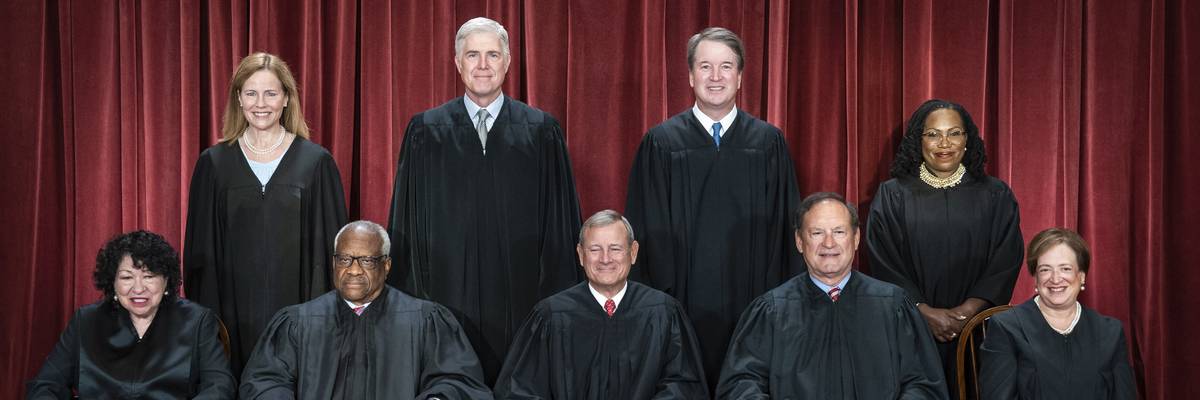
Members of the Supreme Court sit for a group photo following the recent addition of Associate Justice Ketanji Brown Jackson, at the Supreme Court building on Capitol Hill on Friday, Oct 7, 2022 in Washington, DC.
The term may be remembered most as a time when the supermajority of very conservative, very pro-business justices bent the shape of American government to empower the president at the expense of Congress.
How will we remember this Supreme Court term?
For Louisiana v. Callais, which demolished the 1965 Voting Rights Act. For near misses, too, as when the Constitution’s plain-language guarantee of birthright citizenship was recognized by only a bare majority of the justices. (As JD Vance crowed, that core protection is now “hanging by a thread.”)
I think the term may be remembered most as a time when the supermajority of very conservative, very pro-business justices bent the shape of American government. It was a power grab in legal garb, undermining Congress, granting presidents more authority, but with key decisions ultimately in the hands of the nine unelected officials now redesigning government.
In 2005, The New York Times Magazine published a story about a cadre of intense anti-government legal activists. They bemoaned “the Constitution in exile,” what they saw as an epic wrong turn in the 20th century. That was the era when Congress and presidents created expert independent agencies, such as the Securities and Exchange Commission, to police Wall Street, and the Federal Trade Commission, to protect consumers. To most Americans, that was how we grew a modern, fair, prosperous economy. To those activists, it was all a terrible mistake.
A future president may be a populist progressive, now with new levers of power to address climate change or boost union power. To quote Justice Brett Kavanaugh, “What goes around comes around.”
One of the few adherents of this eccentric theory, the Times reported, was an unknown young federal judge named John Roberts. Soon he would become chief justice.
Trump v. Slaughter, announced on Monday, marked a key moment in Roberts’s long drive to write pro-business dogma into the Constitution. On this, Roberts is far from a Midwestern country club Republican cheerfully calling “balls and strikes.” This is not about wins or losses for Donald Trump. These justices have wanted to do this since Trump was cavorting at Studio 54.
Congress established the first independent agency, the Interstate Commerce Commission, to set railroad rates in the 1880s. Since then, laws created nearly 60 agencies to police the economy or serve as watchdogs over the government, and tried to wall them off a bit from political pressure and partisan politics.
Congress has now been blocked from imposing removal protections for the heads of most federal agencies, a critical bulwark against presidential meddling. Consider a consequential, complex current question: Could an effective new agency regulate artificial intelligence? The Slaughter ruling could make it considerably harder to insulate such a powerful body from political interference.
Of course, independent agencies are not a purely partisan issue. Over the course of American history, they have frustrated presidents of both parties, who want control of the sprawling federal bureaucracy.
The Slaughter ruling overturned a 1935 case, Humphrey’s Executor. William Humphrey was a reactionary and thoroughly unpleasant Federal Trade Commission member whom President Franklin D. Roosevelt wanted to fire. Humphrey kept going to work even after he was dismissed, then died while the legal challenge to pry him from his office was being heard. His heirs sued for his back pay.
The Supreme Court ruled that even FDR, at the peak of his power, could not fire grumpy old Mr. Humphrey. “That damn little case,” recalled FDR aide Robert Jackson (later a justice himself), “made Roosevelt madder at the court than any other decision... [He] thought they went out of their way to spite him personally.”
Slaughter is one of the most significant expressions of the pretentiously named “unitary executive theory.” This is the idea that because a single individual, the president, is elected to lead the executive branch, that means the whole executive branch serves at his whim. Of note, this case revolved around one aspect of it, firing of agency officials.
Indeed, the justices seemed to recognize the havoc their new doctrine would cause. On the same day, a different lineup of justices blocked Trump from firing Federal Reserve governor Lisa Cook. The Fed, too, is an independent agency, signed into law by President Woodrow Wilson in the Progressive Era, but the rationale for independent central banking is well known. The Cook ruling mumbles about tradition and history, but the real answer for the divergent outcomes seemed to be, well, the Fed is just... different. (Of course, business interests revere the Fed and often loathe the FTC.)
A limited version of the unitary executive theory is not entirely crazy. We want a strong president able to guide the balky executive branch. But advocates have taken this idea to a dangerous extreme, turning it into a fancy cloak for an authoritarian executive. By their logic, if all federal employees work personally for a president, as if they were gardeners at Mar-a-Lago, that could demolish civil service protections and other rules that can keep government from being the instrument of executive whim.
Who knows how far this rhetoric of presidential power will go? Russell Vought, the White House budget director, says we live in a “post-constitutional time.” And in Trump v. United States, Roberts wrote that the president is “the only person who alone composes a branch of government.”
Policymakers now must grapple with the justices’ handiwork. How can we have strong inspectors general or independent military lawyers if a president can bark “you’re fired” at will? Can Congress step up by, say, giving the Government Accountability Office greater responsibility to police the executive branch? Such obscure questions will determine how government can work going forward. Necessary reforms can follow abuse and scandal. That’s what happened after Watergate. Now such safeguards must be designed in a world where the Supreme Court has supercharged presidential power.
Let’s not forget Donald Trump is a lame duck. (He is! Really!) A future president may be a populist progressive, now with new levers of power to address climate change or boost union power. To quote Justice Brett Kavanaugh, “What goes around comes around.” Of course, this court has also invented tools to stop policies it doesn’t like, such as the “major questions” doctrine it used to block Biden-era climate change rules. Stay tuned.
But it’s hard to escape the conclusion that this ruling will make government less effective, more chaotic, and more driven by politics and personality—steered there by a Supreme Court with too much power, now in thrall to an obscure and dangerous philosophy.
Dear Common Dreams reader, It’s been nearly 30 years since I co-founded Common Dreams with my late wife, Lina Newhouser. We had the radical notion that journalism should serve the public good, not corporate profits. It was clear to us from the outset what it would take to build such a project. No paid advertisements. No corporate sponsors. No millionaire publisher telling us what to think or do. Many people said we wouldn't last a year, but we proved those doubters wrong. Together with a tremendous team of journalists and dedicated staff, we built an independent media outlet free from the constraints of profits and corporate control. Our mission has always been simple: To inform. To inspire. To ignite change for the common good. Building Common Dreams was not easy. Our survival was never guaranteed. When you take on the most powerful forces—Wall Street greed, fossil fuel industry destruction, Big Tech lobbyists, and uber-rich oligarchs who have spent billions upon billions rigging the economy and democracy in their favor—the only bulwark you have is supporters who believe in your work. But here’s the urgent message from me today. It's never been this bad out there. And it's never been this hard to keep us going. At the very moment Common Dreams is most needed, the threats we face are intensifying. We need your support now more than ever. We don't accept corporate advertising and never will. We don't have a paywall because we don't think people should be blocked from critical news based on their ability to pay. Everything we do is funded by the donations of readers like you. When everyone does the little they can afford, we are strong. But if that support retreats or dries up, so do we. Will you donate now to make sure Common Dreams not only survives but thrives? —Craig Brown, Co-founder |
How will we remember this Supreme Court term?
For Louisiana v. Callais, which demolished the 1965 Voting Rights Act. For near misses, too, as when the Constitution’s plain-language guarantee of birthright citizenship was recognized by only a bare majority of the justices. (As JD Vance crowed, that core protection is now “hanging by a thread.”)
I think the term may be remembered most as a time when the supermajority of very conservative, very pro-business justices bent the shape of American government. It was a power grab in legal garb, undermining Congress, granting presidents more authority, but with key decisions ultimately in the hands of the nine unelected officials now redesigning government.
In 2005, The New York Times Magazine published a story about a cadre of intense anti-government legal activists. They bemoaned “the Constitution in exile,” what they saw as an epic wrong turn in the 20th century. That was the era when Congress and presidents created expert independent agencies, such as the Securities and Exchange Commission, to police Wall Street, and the Federal Trade Commission, to protect consumers. To most Americans, that was how we grew a modern, fair, prosperous economy. To those activists, it was all a terrible mistake.
A future president may be a populist progressive, now with new levers of power to address climate change or boost union power. To quote Justice Brett Kavanaugh, “What goes around comes around.”
One of the few adherents of this eccentric theory, the Times reported, was an unknown young federal judge named John Roberts. Soon he would become chief justice.
Trump v. Slaughter, announced on Monday, marked a key moment in Roberts’s long drive to write pro-business dogma into the Constitution. On this, Roberts is far from a Midwestern country club Republican cheerfully calling “balls and strikes.” This is not about wins or losses for Donald Trump. These justices have wanted to do this since Trump was cavorting at Studio 54.
Congress established the first independent agency, the Interstate Commerce Commission, to set railroad rates in the 1880s. Since then, laws created nearly 60 agencies to police the economy or serve as watchdogs over the government, and tried to wall them off a bit from political pressure and partisan politics.
Congress has now been blocked from imposing removal protections for the heads of most federal agencies, a critical bulwark against presidential meddling. Consider a consequential, complex current question: Could an effective new agency regulate artificial intelligence? The Slaughter ruling could make it considerably harder to insulate such a powerful body from political interference.
Of course, independent agencies are not a purely partisan issue. Over the course of American history, they have frustrated presidents of both parties, who want control of the sprawling federal bureaucracy.
The Slaughter ruling overturned a 1935 case, Humphrey’s Executor. William Humphrey was a reactionary and thoroughly unpleasant Federal Trade Commission member whom President Franklin D. Roosevelt wanted to fire. Humphrey kept going to work even after he was dismissed, then died while the legal challenge to pry him from his office was being heard. His heirs sued for his back pay.
The Supreme Court ruled that even FDR, at the peak of his power, could not fire grumpy old Mr. Humphrey. “That damn little case,” recalled FDR aide Robert Jackson (later a justice himself), “made Roosevelt madder at the court than any other decision... [He] thought they went out of their way to spite him personally.”
Slaughter is one of the most significant expressions of the pretentiously named “unitary executive theory.” This is the idea that because a single individual, the president, is elected to lead the executive branch, that means the whole executive branch serves at his whim. Of note, this case revolved around one aspect of it, firing of agency officials.
Indeed, the justices seemed to recognize the havoc their new doctrine would cause. On the same day, a different lineup of justices blocked Trump from firing Federal Reserve governor Lisa Cook. The Fed, too, is an independent agency, signed into law by President Woodrow Wilson in the Progressive Era, but the rationale for independent central banking is well known. The Cook ruling mumbles about tradition and history, but the real answer for the divergent outcomes seemed to be, well, the Fed is just... different. (Of course, business interests revere the Fed and often loathe the FTC.)
A limited version of the unitary executive theory is not entirely crazy. We want a strong president able to guide the balky executive branch. But advocates have taken this idea to a dangerous extreme, turning it into a fancy cloak for an authoritarian executive. By their logic, if all federal employees work personally for a president, as if they were gardeners at Mar-a-Lago, that could demolish civil service protections and other rules that can keep government from being the instrument of executive whim.
Who knows how far this rhetoric of presidential power will go? Russell Vought, the White House budget director, says we live in a “post-constitutional time.” And in Trump v. United States, Roberts wrote that the president is “the only person who alone composes a branch of government.”
Policymakers now must grapple with the justices’ handiwork. How can we have strong inspectors general or independent military lawyers if a president can bark “you’re fired” at will? Can Congress step up by, say, giving the Government Accountability Office greater responsibility to police the executive branch? Such obscure questions will determine how government can work going forward. Necessary reforms can follow abuse and scandal. That’s what happened after Watergate. Now such safeguards must be designed in a world where the Supreme Court has supercharged presidential power.
Let’s not forget Donald Trump is a lame duck. (He is! Really!) A future president may be a populist progressive, now with new levers of power to address climate change or boost union power. To quote Justice Brett Kavanaugh, “What goes around comes around.” Of course, this court has also invented tools to stop policies it doesn’t like, such as the “major questions” doctrine it used to block Biden-era climate change rules. Stay tuned.
But it’s hard to escape the conclusion that this ruling will make government less effective, more chaotic, and more driven by politics and personality—steered there by a Supreme Court with too much power, now in thrall to an obscure and dangerous philosophy.
How will we remember this Supreme Court term?
For Louisiana v. Callais, which demolished the 1965 Voting Rights Act. For near misses, too, as when the Constitution’s plain-language guarantee of birthright citizenship was recognized by only a bare majority of the justices. (As JD Vance crowed, that core protection is now “hanging by a thread.”)
I think the term may be remembered most as a time when the supermajority of very conservative, very pro-business justices bent the shape of American government. It was a power grab in legal garb, undermining Congress, granting presidents more authority, but with key decisions ultimately in the hands of the nine unelected officials now redesigning government.
In 2005, The New York Times Magazine published a story about a cadre of intense anti-government legal activists. They bemoaned “the Constitution in exile,” what they saw as an epic wrong turn in the 20th century. That was the era when Congress and presidents created expert independent agencies, such as the Securities and Exchange Commission, to police Wall Street, and the Federal Trade Commission, to protect consumers. To most Americans, that was how we grew a modern, fair, prosperous economy. To those activists, it was all a terrible mistake.
A future president may be a populist progressive, now with new levers of power to address climate change or boost union power. To quote Justice Brett Kavanaugh, “What goes around comes around.”
One of the few adherents of this eccentric theory, the Times reported, was an unknown young federal judge named John Roberts. Soon he would become chief justice.
Trump v. Slaughter, announced on Monday, marked a key moment in Roberts’s long drive to write pro-business dogma into the Constitution. On this, Roberts is far from a Midwestern country club Republican cheerfully calling “balls and strikes.” This is not about wins or losses for Donald Trump. These justices have wanted to do this since Trump was cavorting at Studio 54.
Congress established the first independent agency, the Interstate Commerce Commission, to set railroad rates in the 1880s. Since then, laws created nearly 60 agencies to police the economy or serve as watchdogs over the government, and tried to wall them off a bit from political pressure and partisan politics.
Congress has now been blocked from imposing removal protections for the heads of most federal agencies, a critical bulwark against presidential meddling. Consider a consequential, complex current question: Could an effective new agency regulate artificial intelligence? The Slaughter ruling could make it considerably harder to insulate such a powerful body from political interference.
Of course, independent agencies are not a purely partisan issue. Over the course of American history, they have frustrated presidents of both parties, who want control of the sprawling federal bureaucracy.
The Slaughter ruling overturned a 1935 case, Humphrey’s Executor. William Humphrey was a reactionary and thoroughly unpleasant Federal Trade Commission member whom President Franklin D. Roosevelt wanted to fire. Humphrey kept going to work even after he was dismissed, then died while the legal challenge to pry him from his office was being heard. His heirs sued for his back pay.
The Supreme Court ruled that even FDR, at the peak of his power, could not fire grumpy old Mr. Humphrey. “That damn little case,” recalled FDR aide Robert Jackson (later a justice himself), “made Roosevelt madder at the court than any other decision... [He] thought they went out of their way to spite him personally.”
Slaughter is one of the most significant expressions of the pretentiously named “unitary executive theory.” This is the idea that because a single individual, the president, is elected to lead the executive branch, that means the whole executive branch serves at his whim. Of note, this case revolved around one aspect of it, firing of agency officials.
Indeed, the justices seemed to recognize the havoc their new doctrine would cause. On the same day, a different lineup of justices blocked Trump from firing Federal Reserve governor Lisa Cook. The Fed, too, is an independent agency, signed into law by President Woodrow Wilson in the Progressive Era, but the rationale for independent central banking is well known. The Cook ruling mumbles about tradition and history, but the real answer for the divergent outcomes seemed to be, well, the Fed is just... different. (Of course, business interests revere the Fed and often loathe the FTC.)
A limited version of the unitary executive theory is not entirely crazy. We want a strong president able to guide the balky executive branch. But advocates have taken this idea to a dangerous extreme, turning it into a fancy cloak for an authoritarian executive. By their logic, if all federal employees work personally for a president, as if they were gardeners at Mar-a-Lago, that could demolish civil service protections and other rules that can keep government from being the instrument of executive whim.
Who knows how far this rhetoric of presidential power will go? Russell Vought, the White House budget director, says we live in a “post-constitutional time.” And in Trump v. United States, Roberts wrote that the president is “the only person who alone composes a branch of government.”
Policymakers now must grapple with the justices’ handiwork. How can we have strong inspectors general or independent military lawyers if a president can bark “you’re fired” at will? Can Congress step up by, say, giving the Government Accountability Office greater responsibility to police the executive branch? Such obscure questions will determine how government can work going forward. Necessary reforms can follow abuse and scandal. That’s what happened after Watergate. Now such safeguards must be designed in a world where the Supreme Court has supercharged presidential power.
Let’s not forget Donald Trump is a lame duck. (He is! Really!) A future president may be a populist progressive, now with new levers of power to address climate change or boost union power. To quote Justice Brett Kavanaugh, “What goes around comes around.” Of course, this court has also invented tools to stop policies it doesn’t like, such as the “major questions” doctrine it used to block Biden-era climate change rules. Stay tuned.
But it’s hard to escape the conclusion that this ruling will make government less effective, more chaotic, and more driven by politics and personality—steered there by a Supreme Court with too much power, now in thrall to an obscure and dangerous philosophy.