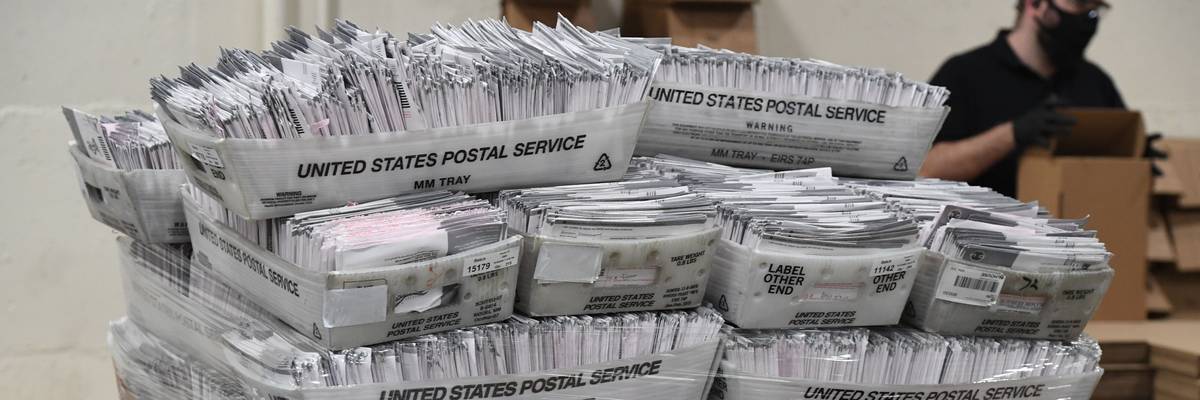
Mail-in ballots in their envelopes await processing at the Los Angeles County Registrar Recorders' mail-in ballot processing center at the Pomona Fairplex in Pomona, California on October 28, 2020.
The Supreme Court's Mail Voting Ruling Is Manufactured Chaos
On Monday, the Supreme Court made headlines and sowed confusion, but it did not change much. Here’s what you should know.
A year ago we warned that President Donald Trump had a concerted strategy to undermine the midterm elections.
Here’s news you can use: That effort is failing so far. For every move, there’s a countermove from voting rights groups, local and state governments, and more. In November, we should be able to have elections that are free, fair, and secure. But it will take a lot of work between now and then.
We saw that for sure this week. On Monday, the Supreme Court made headlines and sowed confusion, but it did not change much. Here’s what you should know.
Earlier this year, Trump signed an executive order to upend mail voting. That is the way 1 in 3 Americans vote. Trump purported to order the US Postal Service to refuse to deliver lawfully cast ballots unless the voter is on a list—which doesn’t exist yet—created by each state and sent to the post office for checking against mail ballots. It’s absurd. And, no surprise, it’s illegal.
Trump’s executive order is not in effect. Mail voting continues as before. There have been no changes to the Postal Service practices.
Earlier this summer, in a lawsuit brought by 23 states, a federal court blocked the executive order in part of the country. The judge also blocked the order nationwide in a lawsuit the Brennan Center and others brought on behalf of the League of Women Voters of Massachusetts.
On August 24, the US Supreme Court jumped into the states’ case. It issued an unsigned order holding that the states did not yet have legal standing to sue. In particular, it concluded the states had not suffered an injury, because the Postal Service had not implemented the policy. In other words, the trial court had ruled too early.
This made big news, understandably, but those headlines confused matters a bit.
This was a procedural vote that let the Trump administration continue working on its plan to have the Postal Service decide who receives a ballot.
As the court itself explained, “The Court’s disposition of this application does not mean that any measure taken by the Government to implement the Order will necessarily be lawful.”
And in fact, late last Friday, under pressure from the administration, the Postal Service published a “Final Rule” to implement Trump’s scheme. The agency explained that it had the power to set rules for mail ballot delivery because ballots are like “animal remains” or “replica explosives” and deserve special treatment.
Both the states’ case and the case brought by the Brennan Center and other voting rights groups remain ongoing. The Supreme Court’s Monday ruling is not the final word. Our attorneys are assessing next steps, and things will no doubt move quickly in this complex legal back-and-forth.
But a few things are as true today as they were before the court’s order.
This executive order is still illegal and unconstitutional. The Constitution’s Elections Clause is clear, as courts have ruled over and over: States run elections. Congress has a legitimate role in passing national legislation and can override states. You know who has no role in elections, under the Constitution? The president.
And the Supreme Court? This is the “shadow docket” at work. Rather than letting the legal process unfold, the justices jumped into the litigation to help Trump. Justices like Samuel Alito bristle at the ominous phrase “shadow docket” and complain it should be called an “emergency” order instead. Here, the only “emergency” would be that Trump could not move forward with his push to restrict voting, just weeks before an election.
It’s hard to avoid noticing that, while the order is unsigned, it was backed by the Republican-appointed justices. Democratic-appointed Justices Sonia Sotomayor, Elena Kagan, and Ketanji Brown Jackson wrote dissents. Trump has repeatedly said, as he wrote in June about the SAVE Act, that without voting restrictions, “The Republican Party will never win another Election.” The Supreme Court, already at record lows in public trust, will further bleed credibility if it is seen as a partisan electoral actor.
And as for voters—what should we know?
This legal fracas is happening so close to the election that, however it turns out, it is highly unlikely that changes will affect voting this year. Federal law requires that the first mail ballots be sent to military voters starting September 4. We cannot let chaos engulf our elections.
All of which means that, in one sense, this is a lot of noise and manufactured chaos. Trump’s executive order is not in effect. Mail voting continues as before. There have been no changes to the Postal Service practices.
You know who knows that? Someone who voted by mail this month from his house in Mar-a-Lago: Donald Trump.
His campaign to undermine the midterm elections is losing. The only way it wins is if people stay home.
We are at a crossroads
This country and this world are at a monumental crossroads. In a few short weeks, US voters will have an opportunity to beat back the forces of fascism and confront the billionaires who are rigging the economy, our media system, and our democracy, making it increasingly impossible for ordinary people to get by. We’re not just talking about the election. We’re talking about what must be done once these fascist elements are vanquished from power. We need a bolder set of solutions than what either major party has so far been willing to offer and a working-class movement ready to fight like hell for it. Trump didn't emerge from nowhere. The conditions that fueled MAGA authoritarianism were created by decades of radical neoliberal economic policies and a corrupt political system dominated by corporate interests. They slashed taxes on the super-rich, promising that the benefits would trickle down. They said giveaways to the corporate titans would make life more affordable for the rest of us. It was all bullshit. And when a bitter, betrayed populace searches for someone to blame, right-wing demagogues have little trouble finding scapegoats. People know when they're being lied to, but you won't hear any of this from the corporate media. Only independent journalism—powered and funded by people who believe in building a better world—can deliver truly trustworthy daily news. Our Fall Campaign is underway, and we need your help. To power our newsroom through the rest of the year, we need to raise $125,000 by midnight on October 31. So if you share our vision, please contribute whatever you can to sustain our work. |
A year ago we warned that President Donald Trump had a concerted strategy to undermine the midterm elections.
Here’s news you can use: That effort is failing so far. For every move, there’s a countermove from voting rights groups, local and state governments, and more. In November, we should be able to have elections that are free, fair, and secure. But it will take a lot of work between now and then.
We saw that for sure this week. On Monday, the Supreme Court made headlines and sowed confusion, but it did not change much. Here’s what you should know.
Earlier this year, Trump signed an executive order to upend mail voting. That is the way 1 in 3 Americans vote. Trump purported to order the US Postal Service to refuse to deliver lawfully cast ballots unless the voter is on a list—which doesn’t exist yet—created by each state and sent to the post office for checking against mail ballots. It’s absurd. And, no surprise, it’s illegal.
Trump’s executive order is not in effect. Mail voting continues as before. There have been no changes to the Postal Service practices.
Earlier this summer, in a lawsuit brought by 23 states, a federal court blocked the executive order in part of the country. The judge also blocked the order nationwide in a lawsuit the Brennan Center and others brought on behalf of the League of Women Voters of Massachusetts.
On August 24, the US Supreme Court jumped into the states’ case. It issued an unsigned order holding that the states did not yet have legal standing to sue. In particular, it concluded the states had not suffered an injury, because the Postal Service had not implemented the policy. In other words, the trial court had ruled too early.
This made big news, understandably, but those headlines confused matters a bit.
This was a procedural vote that let the Trump administration continue working on its plan to have the Postal Service decide who receives a ballot.
As the court itself explained, “The Court’s disposition of this application does not mean that any measure taken by the Government to implement the Order will necessarily be lawful.”
And in fact, late last Friday, under pressure from the administration, the Postal Service published a “Final Rule” to implement Trump’s scheme. The agency explained that it had the power to set rules for mail ballot delivery because ballots are like “animal remains” or “replica explosives” and deserve special treatment.
Both the states’ case and the case brought by the Brennan Center and other voting rights groups remain ongoing. The Supreme Court’s Monday ruling is not the final word. Our attorneys are assessing next steps, and things will no doubt move quickly in this complex legal back-and-forth.
But a few things are as true today as they were before the court’s order.
This executive order is still illegal and unconstitutional. The Constitution’s Elections Clause is clear, as courts have ruled over and over: States run elections. Congress has a legitimate role in passing national legislation and can override states. You know who has no role in elections, under the Constitution? The president.
And the Supreme Court? This is the “shadow docket” at work. Rather than letting the legal process unfold, the justices jumped into the litigation to help Trump. Justices like Samuel Alito bristle at the ominous phrase “shadow docket” and complain it should be called an “emergency” order instead. Here, the only “emergency” would be that Trump could not move forward with his push to restrict voting, just weeks before an election.
It’s hard to avoid noticing that, while the order is unsigned, it was backed by the Republican-appointed justices. Democratic-appointed Justices Sonia Sotomayor, Elena Kagan, and Ketanji Brown Jackson wrote dissents. Trump has repeatedly said, as he wrote in June about the SAVE Act, that without voting restrictions, “The Republican Party will never win another Election.” The Supreme Court, already at record lows in public trust, will further bleed credibility if it is seen as a partisan electoral actor.
And as for voters—what should we know?
This legal fracas is happening so close to the election that, however it turns out, it is highly unlikely that changes will affect voting this year. Federal law requires that the first mail ballots be sent to military voters starting September 4. We cannot let chaos engulf our elections.
All of which means that, in one sense, this is a lot of noise and manufactured chaos. Trump’s executive order is not in effect. Mail voting continues as before. There have been no changes to the Postal Service practices.
You know who knows that? Someone who voted by mail this month from his house in Mar-a-Lago: Donald Trump.
His campaign to undermine the midterm elections is losing. The only way it wins is if people stay home.
- In 'Win for Voters,' Another Federal Court Blocks Trump Attack on Mailed Ballots ›
- Court Lands Latest Blow to Trump's 'Anti-Voting Agenda' by Blocking USPS Attack on Mailed Ballots ›
- 'Painful Setback': Supreme Court Lets Trump Enforce Mailed Ballot Rules—But Punts on Their Legality ›
- Opinion | The Supreme Court's Mail-In Voting Decision Could Determine the Future of US Democracy | Common Dreams ›