

SUBSCRIBE TO OUR FREE NEWSLETTER
Daily news & progressive opinion—funded by the people, not the corporations—delivered straight to your inbox.
5
#000000
#FFFFFF
To donate by check, phone, or other method, see our More Ways to Give page.

The release of the 2026 Social Security Trustees Report got the usual suspects (a.k.a. “very serious people”) genuflecting about the large projected shortfall. As of 2034, the program is projected to be unable to pay full benefits. This would mean a 22 percent cut in benefits if no additional revenue is added.
There are three points worth making here.
On the first point, the spending to repay the bonds held from the trust fund in 2033 comes from the Treasury. Its impact on the economy would be the same as the spending in 2034, when the trust fund no longer holds any bonds.
There is an issue that the law gives the program a claim to the funds needed to repay the bonds it holds. Social Security does not have a claim to the money needed to pay full benefits once the last bonds are sold and the trust fund is depleted.
This is an important legal point, but from an economic standpoint, it is money from the Treasury in both cases. If the country could afford to pay full benefits in 2033 when the trust fund held bonds. It can afford to pay full benefits after it has sold all its bonds, however the law would need to be changed.
In 1982, the last time the program had a major overhaul, just 10 percent of wage income went to high wage earners whose income escaped taxation by being over the cap (currently around $185,000) for wages subject to the 12.4 percent Social Security tax. In the last quarter century, close to 17 percent of wage income went over the cap.
This upward redistribution of wage income, coupled with the redistribution from wages to profits in the last quarter century, has substantially reduced the amount of revenue going into the trust fund. It shouldn’t be surprising that the people who engineered the upward redistribution of the last half-century — through trade policy, stronger patent and copyright protections, bank bailouts, and tech policy — now want to reduce people’s Social Security benefits.
The media seem to take pride in reporting huge budget numbers without providing any context that would make them meaningful to their audience. The projected Social Security shortfall is a great example. The usual group of budget hawks is being brought out to tell us that it is a huge program, which we can’t afford, and requires cuts.
Yet, we did not hear the same chorus in response to Donald Trump’s proposed increase in the military budget from $864 billion in the last year of the Biden presidency to $1,500 billion in 2027. Even adjusting for inflation between the two years, the increase would still be close to $590 billion. There was no rationale given for why the country suddenly needs to spend so much more on its military. Trump certainly did not propose this sort of massive increase in spending in his campaign.
The proposed increase in military spending dwarfs the shortfall projected in the Social Security program for 2034.
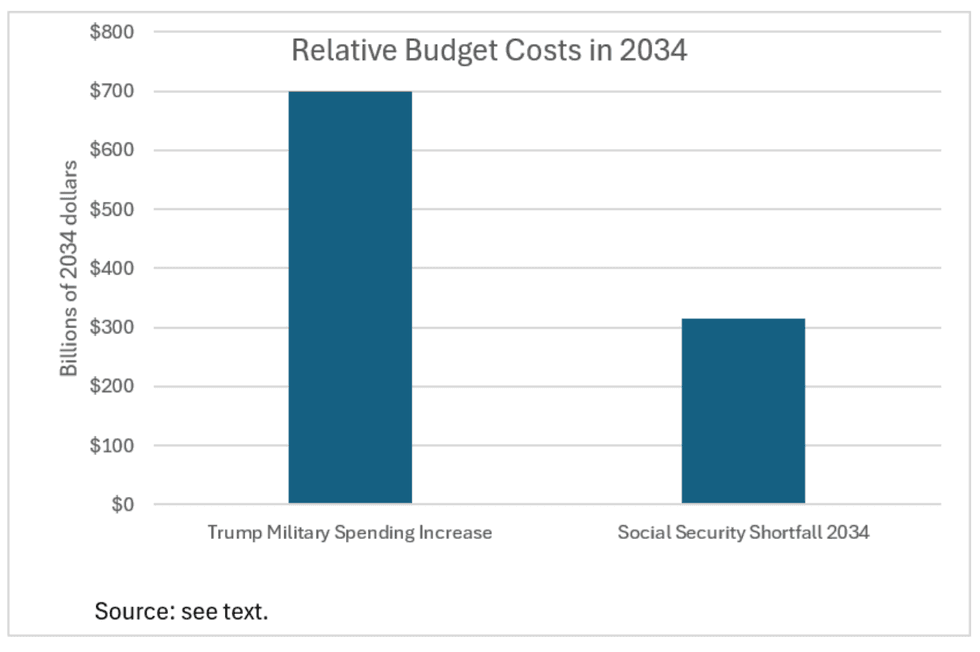
Adjusting for inflation (assuming 2.5 percent annually), Trump’s requested increase would be just under $700 billion in 2034 dollars. By contrast, the Social Security Trustees project that the program will face a $314 billion shortfall in its annual budget in 2034.
We can argue about what should be considered big and what should be considered small, but there is zero doubt that Trump’s proposed increase in military spending is hugely larger than the projected shortfall in Social Security. If anyone thinks that Social Security poses a big problem for the budget, they must believe that Trump’s military spending poses a much bigger problem, since it is more than twice as large.
And, as noted earlier, we are already paying the money for Social Security; it is just coming out of a different pocket. The proposed increase in military spending, at 1.6 percent of GDP, will be newly committed funds coming from the Treasury, which will impose substantial demands on the economy. Any honest person who says funding Social Security poses a serious budget problem must believe that Trump’s military spending poses a far bigger problem.
The release of the 2026 Social Security Trustees Report got the usual suspects (a.k.a. “very serious people”) genuflecting about the large projected shortfall. As of 2034, the program is projected to be unable to pay full benefits. This would mean a 22 percent cut in benefits if no additional revenue is added.
There are three points worth making here.
On the first point, the spending to repay the bonds held from the trust fund in 2033 comes from the Treasury. Its impact on the economy would be the same as the spending in 2034, when the trust fund no longer holds any bonds.
There is an issue that the law gives the program a claim to the funds needed to repay the bonds it holds. Social Security does not have a claim to the money needed to pay full benefits once the last bonds are sold and the trust fund is depleted.
This is an important legal point, but from an economic standpoint, it is money from the Treasury in both cases. If the country could afford to pay full benefits in 2033 when the trust fund held bonds. It can afford to pay full benefits after it has sold all its bonds, however the law would need to be changed.
In 1982, the last time the program had a major overhaul, just 10 percent of wage income went to high wage earners whose income escaped taxation by being over the cap (currently around $185,000) for wages subject to the 12.4 percent Social Security tax. In the last quarter century, close to 17 percent of wage income went over the cap.
This upward redistribution of wage income, coupled with the redistribution from wages to profits in the last quarter century, has substantially reduced the amount of revenue going into the trust fund. It shouldn’t be surprising that the people who engineered the upward redistribution of the last half-century — through trade policy, stronger patent and copyright protections, bank bailouts, and tech policy — now want to reduce people’s Social Security benefits.
The media seem to take pride in reporting huge budget numbers without providing any context that would make them meaningful to their audience. The projected Social Security shortfall is a great example. The usual group of budget hawks is being brought out to tell us that it is a huge program, which we can’t afford, and requires cuts.
Yet, we did not hear the same chorus in response to Donald Trump’s proposed increase in the military budget from $864 billion in the last year of the Biden presidency to $1,500 billion in 2027. Even adjusting for inflation between the two years, the increase would still be close to $590 billion. There was no rationale given for why the country suddenly needs to spend so much more on its military. Trump certainly did not propose this sort of massive increase in spending in his campaign.
The proposed increase in military spending dwarfs the shortfall projected in the Social Security program for 2034.
Adjusting for inflation (assuming 2.5 percent annually), Trump’s requested increase would be just under $700 billion in 2034 dollars. By contrast, the Social Security Trustees project that the program will face a $314 billion shortfall in its annual budget in 2034.
We can argue about what should be considered big and what should be considered small, but there is zero doubt that Trump’s proposed increase in military spending is hugely larger than the projected shortfall in Social Security. If anyone thinks that Social Security poses a big problem for the budget, they must believe that Trump’s military spending poses a much bigger problem, since it is more than twice as large.
And, as noted earlier, we are already paying the money for Social Security; it is just coming out of a different pocket. The proposed increase in military spending, at 1.6 percent of GDP, will be newly committed funds coming from the Treasury, which will impose substantial demands on the economy. Any honest person who says funding Social Security poses a serious budget problem must believe that Trump’s military spending poses a far bigger problem.
The release of the 2026 Social Security Trustees Report got the usual suspects (a.k.a. “very serious people”) genuflecting about the large projected shortfall. As of 2034, the program is projected to be unable to pay full benefits. This would mean a 22 percent cut in benefits if no additional revenue is added.
There are three points worth making here.
On the first point, the spending to repay the bonds held from the trust fund in 2033 comes from the Treasury. Its impact on the economy would be the same as the spending in 2034, when the trust fund no longer holds any bonds.
There is an issue that the law gives the program a claim to the funds needed to repay the bonds it holds. Social Security does not have a claim to the money needed to pay full benefits once the last bonds are sold and the trust fund is depleted.
This is an important legal point, but from an economic standpoint, it is money from the Treasury in both cases. If the country could afford to pay full benefits in 2033 when the trust fund held bonds. It can afford to pay full benefits after it has sold all its bonds, however the law would need to be changed.
In 1982, the last time the program had a major overhaul, just 10 percent of wage income went to high wage earners whose income escaped taxation by being over the cap (currently around $185,000) for wages subject to the 12.4 percent Social Security tax. In the last quarter century, close to 17 percent of wage income went over the cap.
This upward redistribution of wage income, coupled with the redistribution from wages to profits in the last quarter century, has substantially reduced the amount of revenue going into the trust fund. It shouldn’t be surprising that the people who engineered the upward redistribution of the last half-century — through trade policy, stronger patent and copyright protections, bank bailouts, and tech policy — now want to reduce people’s Social Security benefits.
The media seem to take pride in reporting huge budget numbers without providing any context that would make them meaningful to their audience. The projected Social Security shortfall is a great example. The usual group of budget hawks is being brought out to tell us that it is a huge program, which we can’t afford, and requires cuts.
Yet, we did not hear the same chorus in response to Donald Trump’s proposed increase in the military budget from $864 billion in the last year of the Biden presidency to $1,500 billion in 2027. Even adjusting for inflation between the two years, the increase would still be close to $590 billion. There was no rationale given for why the country suddenly needs to spend so much more on its military. Trump certainly did not propose this sort of massive increase in spending in his campaign.
The proposed increase in military spending dwarfs the shortfall projected in the Social Security program for 2034.
Adjusting for inflation (assuming 2.5 percent annually), Trump’s requested increase would be just under $700 billion in 2034 dollars. By contrast, the Social Security Trustees project that the program will face a $314 billion shortfall in its annual budget in 2034.
We can argue about what should be considered big and what should be considered small, but there is zero doubt that Trump’s proposed increase in military spending is hugely larger than the projected shortfall in Social Security. If anyone thinks that Social Security poses a big problem for the budget, they must believe that Trump’s military spending poses a much bigger problem, since it is more than twice as large.
And, as noted earlier, we are already paying the money for Social Security; it is just coming out of a different pocket. The proposed increase in military spending, at 1.6 percent of GDP, will be newly committed funds coming from the Treasury, which will impose substantial demands on the economy. Any honest person who says funding Social Security poses a serious budget problem must believe that Trump’s military spending poses a far bigger problem.

