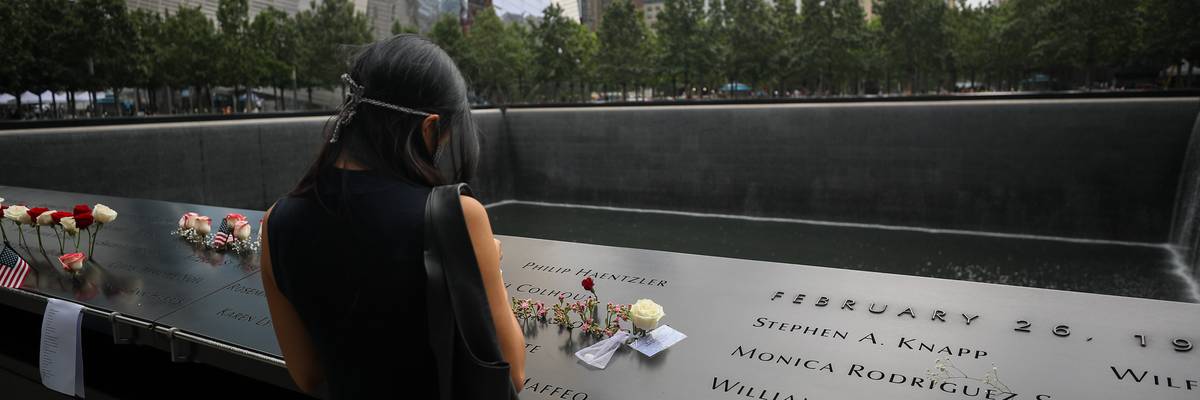
Family members of 9/11 victims tribute their loved ones on the 19th anniversary of September 11 attacks in New York City, United States on September 11, 2020.
Opening the Book of Life on the Day the Towers Fell
The convergence of September 11 and Rosh Hashanah is an opportunity to look back at what we did and did not do in the aftermath.
I am such a caricature of a native New Yorker that my first date, at age of 12, was at the observation deck of the World Trade Center. I thought there was nothing more romantic than showing someone a full view of the place that was simultaneously my shtetl and the greatest city in the world. I said a shechechiyanu when we walked up to the glass, because the beauty of the moment called for a blessing.
Years later I was a freshman in college in September of 2001, and when I came home for a long weekend that October, the air across Manhattan still smelled unholy, like burning wires, melted concrete, and mass organic decay. There were an unspeakable number of lives, whole universes unto themselves, lost that day, and their memories being a blessing remains a cold comfort. For many of us in the aftermath of that terrible day, we watched the national conversation shift to be entirely about who we should be afraid of—and too often, the answer was some of our fellow Americans.
This year, Rosh Hashanah begins on the 25th anniversary of the September 11 attacks. The convergence is an opportunity and a gift. Together, Jews in New York and around the country will experience several hours of extraordinary potency: one part of our hearts focused on the opening of the book of life, and the other on the day the towers fell, and everything that came after.
This is an opportunity to understand what Jewish tradition offers us, as well as what it demands.
The legal frameworks this regime is currently using to terrorize immigrant communities were born in the fall of 2001 in New York City. And just like 25 years ago, these attempts to terrorize and target immigrant communities rely on fear.
Judaism teaches us that there is no pathway to atonement with God until you have first atoned with the people you harmed; the gateway to divine repair is closed until interpersonal repair is complete. Crucially, Jewish theology holds it as an impossibility rather than a preference: You cannot approach God while your neighbor still bears the wound you gave them.
There is no such thing as atonement without honest accounting. There is no repair without looking the harm in the eye.
This is the fundamental spiritual nature of the High Holidays. The convergence of September 11 and Rosh Hashanah is an opportunity to look back at what we did in the aftermath. But we must also simultaneously account for the acute political crisis unfolding around us. The multiracial democracy that has kept Jews safer in this country than anywhere else in the history of the world is under attack.
A legal fact that must be part of our accounting: It was in the increased pressure to target American Muslim and American Arab communities that Immigration Customs Enforcement (ICE) was formed post-9/11. There is a direct line from that targeting in the early 2000s to ICE’s attacks these past years in places like Portland, Washington, DC and Minneapolis. Immigrants have been terrorized—surveilled and made to fear their own government when leaving their homes. Immigrants and innocent bystanders alike have been shot and killed, and families have yet again lost loved ones to both violence and detention. The legal frameworks this regime is currently using to terrorize immigrant communities were born in the fall of 2001 in New York City. And just like 25 years ago, these attempts to terrorize and target immigrant communities rely on fear.
Twenty-five years ago we decided it was an acceptable trade-off for our safety to treat Muslim- and Arab-American men as suspects first and neighbors second. Indefinite detention, the erosion of due process, and the normalization of disappearing people were tested on them. Now, twenty-five years later, we are watching those same frameworks on steroids
If Jews, of all people, cannot recognize the peril here, then we are truly lost.
To be clear, some Jews spoke up in the fall of 2001. They joined the Jewish prophetic tradition of decrying injustice and protested the attack on civil liberties for Muslim- and Arab Americans. But most of us did not.
As Jews, we understand what it means to feel afraid. Antisemitism is a real threat to our safety, bigotry that manifests as real violence—in our places of worship, our neighborhoods, and in halls of power. Our immigrant neighbors, our American Muslim and American Arab neighbors, are not our enemy and we must not be silent when they are targeted in the name of our safety as Jews or Americans.
Those in power right now who are using their power to target so-called outsiders need our support to enact their agenda—to create a country only of people who look and think exactly like them. An agenda where white Christian nationalism is the norm, and where it’s become acceptable to use violence and force to keep the rest of us in line.
This is where our tradition meets us with exquisite moral clarity. Where we must account for what we did—or in this case did not—do. The Talmud teaches that someone who can protest the wrongs of their household, their city, their country, their world and does not is held responsible for those wrongs. English unhelpfully softens the words that matter here. What we translate as "protest"—limchot—really means rebuke or forceful confrontation; the Talmud is not asking for polite dissent. And what we translate as "held responsible"—nitpas—comes from a root meaning to physically grab, to catch, to seize. The sin snags you. It wraps itself around you until the injustice is indisputably as much yours as anyone else's.
This is the warning, and this is the theology of the season. We cannot atone for what we refuse to name. You cannot get right with God while you are still refusing to get right with your neighbor. And you cannot get right with your neighbor while you are still pretending you did not participate in the harm.
We must not treat the 25th anniversary of September 11 and the beginning of Rosh Hashanah as separate events. Instead, we should welcome this invitation to stand in our fear, and our pain, and our integrity, and face what we did. Only then can we truly move into a different world. Our spiritual health and the health of our democracy are both depending on it.
We are at a crossroads
This country and this world are at a monumental crossroads. In a few short weeks, US voters will have an opportunity to beat back the forces of fascism and confront the billionaires who are rigging the economy, our media system, and our democracy, making it increasingly impossible for ordinary people to get by. We’re not just talking about the election. We’re talking about what must be done once these fascist elements are vanquished from power. We need a bolder set of solutions than what either major party has so far been willing to offer and a working-class movement ready to fight like hell for it. Trump didn't emerge from nowhere. The conditions that fueled MAGA authoritarianism were created by decades of radical neoliberal economic policies and a corrupt political system dominated by corporate interests. They slashed taxes on the super-rich, promising that the benefits would trickle down. They said giveaways to the corporate titans would make life more affordable for the rest of us. It was all bullshit. And when a bitter, betrayed populace searches for someone to blame, right-wing demagogues have little trouble finding scapegoats. People know when they're being lied to, but you won't hear any of this from the corporate media. Only independent journalism—powered and funded by people who believe in building a better world—can deliver truly trustworthy daily news. Our Fall Campaign is underway, and we need your help. To power our newsroom through the rest of the year, we need to raise $125,000 by midnight on October 31. So if you share our vision, please contribute whatever you can to sustain our work. |
I am such a caricature of a native New Yorker that my first date, at age of 12, was at the observation deck of the World Trade Center. I thought there was nothing more romantic than showing someone a full view of the place that was simultaneously my shtetl and the greatest city in the world. I said a shechechiyanu when we walked up to the glass, because the beauty of the moment called for a blessing.
Years later I was a freshman in college in September of 2001, and when I came home for a long weekend that October, the air across Manhattan still smelled unholy, like burning wires, melted concrete, and mass organic decay. There were an unspeakable number of lives, whole universes unto themselves, lost that day, and their memories being a blessing remains a cold comfort. For many of us in the aftermath of that terrible day, we watched the national conversation shift to be entirely about who we should be afraid of—and too often, the answer was some of our fellow Americans.
This year, Rosh Hashanah begins on the 25th anniversary of the September 11 attacks. The convergence is an opportunity and a gift. Together, Jews in New York and around the country will experience several hours of extraordinary potency: one part of our hearts focused on the opening of the book of life, and the other on the day the towers fell, and everything that came after.
This is an opportunity to understand what Jewish tradition offers us, as well as what it demands.
The legal frameworks this regime is currently using to terrorize immigrant communities were born in the fall of 2001 in New York City. And just like 25 years ago, these attempts to terrorize and target immigrant communities rely on fear.
Judaism teaches us that there is no pathway to atonement with God until you have first atoned with the people you harmed; the gateway to divine repair is closed until interpersonal repair is complete. Crucially, Jewish theology holds it as an impossibility rather than a preference: You cannot approach God while your neighbor still bears the wound you gave them.
There is no such thing as atonement without honest accounting. There is no repair without looking the harm in the eye.
This is the fundamental spiritual nature of the High Holidays. The convergence of September 11 and Rosh Hashanah is an opportunity to look back at what we did in the aftermath. But we must also simultaneously account for the acute political crisis unfolding around us. The multiracial democracy that has kept Jews safer in this country than anywhere else in the history of the world is under attack.
A legal fact that must be part of our accounting: It was in the increased pressure to target American Muslim and American Arab communities that Immigration Customs Enforcement (ICE) was formed post-9/11. There is a direct line from that targeting in the early 2000s to ICE’s attacks these past years in places like Portland, Washington, DC and Minneapolis. Immigrants have been terrorized—surveilled and made to fear their own government when leaving their homes. Immigrants and innocent bystanders alike have been shot and killed, and families have yet again lost loved ones to both violence and detention. The legal frameworks this regime is currently using to terrorize immigrant communities were born in the fall of 2001 in New York City. And just like 25 years ago, these attempts to terrorize and target immigrant communities rely on fear.
Twenty-five years ago we decided it was an acceptable trade-off for our safety to treat Muslim- and Arab-American men as suspects first and neighbors second. Indefinite detention, the erosion of due process, and the normalization of disappearing people were tested on them. Now, twenty-five years later, we are watching those same frameworks on steroids
If Jews, of all people, cannot recognize the peril here, then we are truly lost.
To be clear, some Jews spoke up in the fall of 2001. They joined the Jewish prophetic tradition of decrying injustice and protested the attack on civil liberties for Muslim- and Arab Americans. But most of us did not.
As Jews, we understand what it means to feel afraid. Antisemitism is a real threat to our safety, bigotry that manifests as real violence—in our places of worship, our neighborhoods, and in halls of power. Our immigrant neighbors, our American Muslim and American Arab neighbors, are not our enemy and we must not be silent when they are targeted in the name of our safety as Jews or Americans.
Those in power right now who are using their power to target so-called outsiders need our support to enact their agenda—to create a country only of people who look and think exactly like them. An agenda where white Christian nationalism is the norm, and where it’s become acceptable to use violence and force to keep the rest of us in line.
This is where our tradition meets us with exquisite moral clarity. Where we must account for what we did—or in this case did not—do. The Talmud teaches that someone who can protest the wrongs of their household, their city, their country, their world and does not is held responsible for those wrongs. English unhelpfully softens the words that matter here. What we translate as "protest"—limchot—really means rebuke or forceful confrontation; the Talmud is not asking for polite dissent. And what we translate as "held responsible"—nitpas—comes from a root meaning to physically grab, to catch, to seize. The sin snags you. It wraps itself around you until the injustice is indisputably as much yours as anyone else's.
This is the warning, and this is the theology of the season. We cannot atone for what we refuse to name. You cannot get right with God while you are still refusing to get right with your neighbor. And you cannot get right with your neighbor while you are still pretending you did not participate in the harm.
We must not treat the 25th anniversary of September 11 and the beginning of Rosh Hashanah as separate events. Instead, we should welcome this invitation to stand in our fear, and our pain, and our integrity, and face what we did. Only then can we truly move into a different world. Our spiritual health and the health of our democracy are both depending on it.
I am such a caricature of a native New Yorker that my first date, at age of 12, was at the observation deck of the World Trade Center. I thought there was nothing more romantic than showing someone a full view of the place that was simultaneously my shtetl and the greatest city in the world. I said a shechechiyanu when we walked up to the glass, because the beauty of the moment called for a blessing.
Years later I was a freshman in college in September of 2001, and when I came home for a long weekend that October, the air across Manhattan still smelled unholy, like burning wires, melted concrete, and mass organic decay. There were an unspeakable number of lives, whole universes unto themselves, lost that day, and their memories being a blessing remains a cold comfort. For many of us in the aftermath of that terrible day, we watched the national conversation shift to be entirely about who we should be afraid of—and too often, the answer was some of our fellow Americans.
This year, Rosh Hashanah begins on the 25th anniversary of the September 11 attacks. The convergence is an opportunity and a gift. Together, Jews in New York and around the country will experience several hours of extraordinary potency: one part of our hearts focused on the opening of the book of life, and the other on the day the towers fell, and everything that came after.
This is an opportunity to understand what Jewish tradition offers us, as well as what it demands.
The legal frameworks this regime is currently using to terrorize immigrant communities were born in the fall of 2001 in New York City. And just like 25 years ago, these attempts to terrorize and target immigrant communities rely on fear.
Judaism teaches us that there is no pathway to atonement with God until you have first atoned with the people you harmed; the gateway to divine repair is closed until interpersonal repair is complete. Crucially, Jewish theology holds it as an impossibility rather than a preference: You cannot approach God while your neighbor still bears the wound you gave them.
There is no such thing as atonement without honest accounting. There is no repair without looking the harm in the eye.
This is the fundamental spiritual nature of the High Holidays. The convergence of September 11 and Rosh Hashanah is an opportunity to look back at what we did in the aftermath. But we must also simultaneously account for the acute political crisis unfolding around us. The multiracial democracy that has kept Jews safer in this country than anywhere else in the history of the world is under attack.
A legal fact that must be part of our accounting: It was in the increased pressure to target American Muslim and American Arab communities that Immigration Customs Enforcement (ICE) was formed post-9/11. There is a direct line from that targeting in the early 2000s to ICE’s attacks these past years in places like Portland, Washington, DC and Minneapolis. Immigrants have been terrorized—surveilled and made to fear their own government when leaving their homes. Immigrants and innocent bystanders alike have been shot and killed, and families have yet again lost loved ones to both violence and detention. The legal frameworks this regime is currently using to terrorize immigrant communities were born in the fall of 2001 in New York City. And just like 25 years ago, these attempts to terrorize and target immigrant communities rely on fear.
Twenty-five years ago we decided it was an acceptable trade-off for our safety to treat Muslim- and Arab-American men as suspects first and neighbors second. Indefinite detention, the erosion of due process, and the normalization of disappearing people were tested on them. Now, twenty-five years later, we are watching those same frameworks on steroids
If Jews, of all people, cannot recognize the peril here, then we are truly lost.
To be clear, some Jews spoke up in the fall of 2001. They joined the Jewish prophetic tradition of decrying injustice and protested the attack on civil liberties for Muslim- and Arab Americans. But most of us did not.
As Jews, we understand what it means to feel afraid. Antisemitism is a real threat to our safety, bigotry that manifests as real violence—in our places of worship, our neighborhoods, and in halls of power. Our immigrant neighbors, our American Muslim and American Arab neighbors, are not our enemy and we must not be silent when they are targeted in the name of our safety as Jews or Americans.
Those in power right now who are using their power to target so-called outsiders need our support to enact their agenda—to create a country only of people who look and think exactly like them. An agenda where white Christian nationalism is the norm, and where it’s become acceptable to use violence and force to keep the rest of us in line.
This is where our tradition meets us with exquisite moral clarity. Where we must account for what we did—or in this case did not—do. The Talmud teaches that someone who can protest the wrongs of their household, their city, their country, their world and does not is held responsible for those wrongs. English unhelpfully softens the words that matter here. What we translate as "protest"—limchot—really means rebuke or forceful confrontation; the Talmud is not asking for polite dissent. And what we translate as "held responsible"—nitpas—comes from a root meaning to physically grab, to catch, to seize. The sin snags you. It wraps itself around you until the injustice is indisputably as much yours as anyone else's.
This is the warning, and this is the theology of the season. We cannot atone for what we refuse to name. You cannot get right with God while you are still refusing to get right with your neighbor. And you cannot get right with your neighbor while you are still pretending you did not participate in the harm.
We must not treat the 25th anniversary of September 11 and the beginning of Rosh Hashanah as separate events. Instead, we should welcome this invitation to stand in our fear, and our pain, and our integrity, and face what we did. Only then can we truly move into a different world. Our spiritual health and the health of our democracy are both depending on it.