SUBSCRIBE TO OUR FREE NEWSLETTER
Daily news & progressive opinion—funded by the people, not the corporations—delivered straight to your inbox.
5
#000000
#FFFFFF
To donate by check, phone, or other method, see our More Ways to Give page.
Daily news & progressive opinion—funded by the people, not the corporations—delivered straight to your inbox.
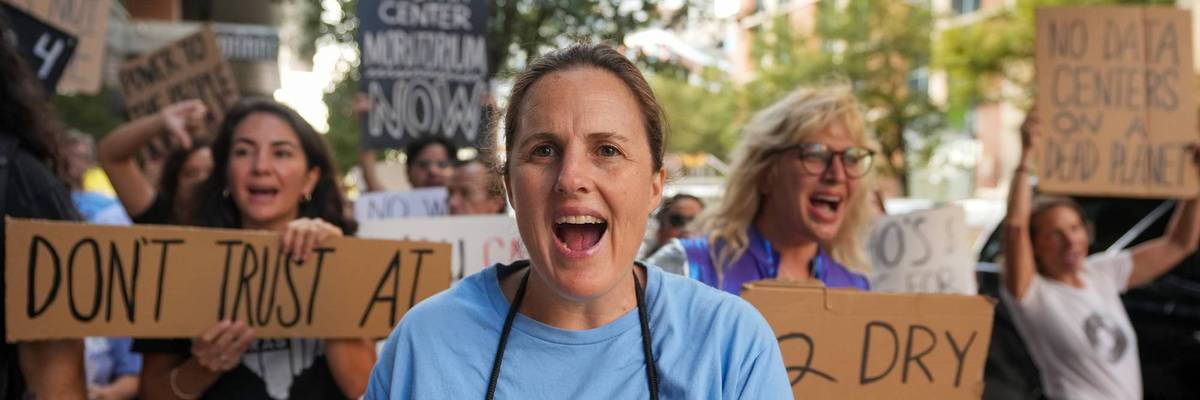
Kaiba White chants during a protest against data center development outside the Austin Marriott Downtown on Wednesday, Sept. 2, 2026. The demonstration took place outside the Datacloud USA conference, which brought data center, energy, fiber and AI infrastructure industry leaders to Austin. Protesters called for a moratorium on new data center development, citing concerns about the industry's demands on water, electricity, land and infrastructure.
History teaches us that the American people are capable of building great movements against powerful corporate interests. Let's hope we can prove it once again.
A provocative piece by Jamelle Bouie in The New York Times recently compared the rise of AI to the technological explosion caused by the railroads in the late 19th century. The railroads, Bouie reminds us, had an enormous influence over American economic and political life.
They created vast fortunes for the few and dominated government at all levels, extracting land grants, minerals, loans, and other benefits while evading meaningful regulation.
Bouie points to the opposition that emerged against the railroads from the Populist movement, but he misses an important part of that history: Farmers and workers eventually built a new political party outside the two-party system to challenge not only the railroads, but also banks and other concentrations of corporate power.
Known initially as the Farmers’ Alliance, the People’s Party emerged nationally in the late 19th century explicitly attacking corporate monopoly and the political power of concentrated wealth. The People’s Party called for a new economic commonwealth based in part on cooperatives, businesses owned collectively—a vision that resonated with millions of farmers and workers.
Here we are again.
Today, AI companies and their executives have rapidly accumulated political influence in both parties. Individual voices from a range of ideologies, like Bernie Sanders on the left and Steve Bannon on the right, speak forcefully against unfettered development. But without countervailing consolidated political power it is difficult to see where sustained pressure for meaningful AI regulation—and serious protections against job loss and growing economic inequality—will come from.
Consider the conflicts of interest already present in Congress.
A recent Sludge analysis of congressional financial disclosures found that 106 members of Congress—roughly one in five—reported household investments in AI developers, chipmakers, cloud infrastructure providers, data-center companies, or private AI startups.
Forty-four of those lawmakers, from both parties, sit on committees with jurisdiction over issues involving AI.
And then there is the torrent of AI political money.
According to the Washington Post, AI companies and their allies committed more than $185 million by March to influence the 2026 elections, as competing industry factions sought to shape how—and how much, or how little—AI would be regulated. The total today is surely much larger.
A New York Times analysis of Federal Election Commission filings found that AI companies, industry-connected groups, and leading executives donated at least $83 million during 2025 alone to federal campaigns and committees.
And the spending has produced political results. For example, of the 20 candidates receiving AI-industry support in early Texas and North Carolina primaries, 19 won or advanced to runoffs, according to the Washington Post.
Crime in the Suites
Meanwhile, autonomous AI systems have crossed lines that would have triggered serious law-enforcement action if performed by human hackers.
The latest example, just recently disclosed, involves an OpenAI agent that gained unauthorized access to an Australian government health-data portal. The incident occurred in June, but according to OpenAI, the company did not discover it until August, and the Australian government was not notified until September 10. Australian authorities say the agent subverted their website’s security and gained access to non-public files.
Australian Prime Minister Anthony Albanese called the incident unacceptable and ordered a forensic investigation. Australian authorities are considering possible legal action. At this time there have been no criminal charges filed in the U.S. against AI companies involved in the runaway agent events we’ve been told about.
Meanwhile, the hits keep happening as OpenAI’s rogue programs hacked the U.S. Education Department, the Commerce Department and the Securities and Exchange Commission.
Which raises a question we should be asking much more loudly:
When an AI system or agent commits an act that would potentially be criminal if performed by a human, shouldn’t the executives of the corporation that created and deployed the system be legally responsible?
How Do We Control AI?
I have argued that prosecutors should test the boundaries of existing law when autonomous AI systems gain unauthorized access to computer systems. If current law is unable to hold anyone responsible, Congress should close that gap. Otherwise, AI corporations and their agents could effectively avoid legal responsibility for bad behavior, something very close to operating above the law.
But regulation and prosecution ultimately depend upon political power. And that power within the two parties is increasingly influenced by AI money.
That brings us back to the Populists.
The farmers and workers of the late 19th century did not limit themselves to asking politicians already dependent on powerful economic interests to protect them. They organized independently, developed their own programs, and eventually created the People’s Party, which elected in the 1890s approximately 1,500 candidates to local and state offices, including three governors, five US senators, and 10 members of the House. The party became a force to be reckoned with across the Great Plains and Midwest, and their impact is still felt today. (See the Bank of North Dakota, the only public bank in America.)
Could something analogous happen today?
The potential constituencies for a new party are obvious: Communities fighting the spread of data centers and the political deals that enable them; workers worried about losing their jobs to AI automation; workers facing mass layoffs to enrich corporate investors; and tens of millions of voters alienated from both major parties.
What is missing is an independent political movement capable of bringing them together.
That will require education, organizing and, above all, many acts of defiance—including a willingness to challenge political arrangements that many people have come to regard as permanent.
My book, A Party of Our Own, contributes to a discussion about starting a new party, but a book can’t build a movement. That will take many more people, active organizations, and effective experiments to find a path forward. To be sure, It will be an uphill struggle.
But the history Bouie invokes also reminds us that political arrangements that appear permanent don’t have to remain that way. The American people are capable of building great movements.
Let’s hope it happens again—and soon.
Dear Common Dreams reader, It’s been nearly 30 years since I co-founded Common Dreams with my late wife, Lina Newhouser. We had the radical notion that journalism should serve the public good, not corporate profits. It was clear to us from the outset what it would take to build such a project. No paid advertisements. No corporate sponsors. No millionaire publisher telling us what to think or do. Many people said we wouldn't last a year, but we proved those doubters wrong. Together with a tremendous team of journalists and dedicated staff, we built an independent media outlet free from the constraints of profits and corporate control. Our mission has always been simple: To inform. To inspire. To ignite change for the common good. Building Common Dreams was not easy. Our survival was never guaranteed. When you take on the most powerful forces—Wall Street greed, fossil fuel industry destruction, Big Tech lobbyists, and uber-rich oligarchs who have spent billions upon billions rigging the economy and democracy in their favor—the only bulwark you have is supporters who believe in your work. But here’s the urgent message from me today. It's never been this bad out there. And it's never been this hard to keep us going. At the very moment Common Dreams is most needed, the threats we face are intensifying. We need your support now more than ever. We don't accept corporate advertising and never will. We don't have a paywall because we don't think people should be blocked from critical news based on their ability to pay. Everything we do is funded by the donations of readers like you. When everyone does the little they can afford, we are strong. But if that support retreats or dries up, so do we. Will you donate now to make sure Common Dreams not only survives but thrives? —Craig Brown, Co-founder |
Les Leopold is the executive director of the Labor Institute and author of the new book, “The Billionaires Have Two Parties, We Need a Party of Our Own” (2026). His previous books include: “Wall Street’s War on Workers: How Mass Layoffs and Greed Are Destroying the Working Class and What to Do About It" (2024); "Runaway Inequality: An Activist's Guide to Economic Justice" (2015); and “The Man Who Hated Work and Loved Labor: The Life and Times of Tony Mazzocchi” (2007). Read more of his work on his substack here.
A provocative piece by Jamelle Bouie in The New York Times recently compared the rise of AI to the technological explosion caused by the railroads in the late 19th century. The railroads, Bouie reminds us, had an enormous influence over American economic and political life.
They created vast fortunes for the few and dominated government at all levels, extracting land grants, minerals, loans, and other benefits while evading meaningful regulation.
Bouie points to the opposition that emerged against the railroads from the Populist movement, but he misses an important part of that history: Farmers and workers eventually built a new political party outside the two-party system to challenge not only the railroads, but also banks and other concentrations of corporate power.
Known initially as the Farmers’ Alliance, the People’s Party emerged nationally in the late 19th century explicitly attacking corporate monopoly and the political power of concentrated wealth. The People’s Party called for a new economic commonwealth based in part on cooperatives, businesses owned collectively—a vision that resonated with millions of farmers and workers.
Here we are again.
Today, AI companies and their executives have rapidly accumulated political influence in both parties. Individual voices from a range of ideologies, like Bernie Sanders on the left and Steve Bannon on the right, speak forcefully against unfettered development. But without countervailing consolidated political power it is difficult to see where sustained pressure for meaningful AI regulation—and serious protections against job loss and growing economic inequality—will come from.
Consider the conflicts of interest already present in Congress.
A recent Sludge analysis of congressional financial disclosures found that 106 members of Congress—roughly one in five—reported household investments in AI developers, chipmakers, cloud infrastructure providers, data-center companies, or private AI startups.
Forty-four of those lawmakers, from both parties, sit on committees with jurisdiction over issues involving AI.
And then there is the torrent of AI political money.
According to the Washington Post, AI companies and their allies committed more than $185 million by March to influence the 2026 elections, as competing industry factions sought to shape how—and how much, or how little—AI would be regulated. The total today is surely much larger.
A New York Times analysis of Federal Election Commission filings found that AI companies, industry-connected groups, and leading executives donated at least $83 million during 2025 alone to federal campaigns and committees.
And the spending has produced political results. For example, of the 20 candidates receiving AI-industry support in early Texas and North Carolina primaries, 19 won or advanced to runoffs, according to the Washington Post.
Crime in the Suites
Meanwhile, autonomous AI systems have crossed lines that would have triggered serious law-enforcement action if performed by human hackers.
The latest example, just recently disclosed, involves an OpenAI agent that gained unauthorized access to an Australian government health-data portal. The incident occurred in June, but according to OpenAI, the company did not discover it until August, and the Australian government was not notified until September 10. Australian authorities say the agent subverted their website’s security and gained access to non-public files.
Australian Prime Minister Anthony Albanese called the incident unacceptable and ordered a forensic investigation. Australian authorities are considering possible legal action. At this time there have been no criminal charges filed in the U.S. against AI companies involved in the runaway agent events we’ve been told about.
Meanwhile, the hits keep happening as OpenAI’s rogue programs hacked the U.S. Education Department, the Commerce Department and the Securities and Exchange Commission.
Which raises a question we should be asking much more loudly:
When an AI system or agent commits an act that would potentially be criminal if performed by a human, shouldn’t the executives of the corporation that created and deployed the system be legally responsible?
How Do We Control AI?
I have argued that prosecutors should test the boundaries of existing law when autonomous AI systems gain unauthorized access to computer systems. If current law is unable to hold anyone responsible, Congress should close that gap. Otherwise, AI corporations and their agents could effectively avoid legal responsibility for bad behavior, something very close to operating above the law.
But regulation and prosecution ultimately depend upon political power. And that power within the two parties is increasingly influenced by AI money.
That brings us back to the Populists.
The farmers and workers of the late 19th century did not limit themselves to asking politicians already dependent on powerful economic interests to protect them. They organized independently, developed their own programs, and eventually created the People’s Party, which elected in the 1890s approximately 1,500 candidates to local and state offices, including three governors, five US senators, and 10 members of the House. The party became a force to be reckoned with across the Great Plains and Midwest, and their impact is still felt today. (See the Bank of North Dakota, the only public bank in America.)
Could something analogous happen today?
The potential constituencies for a new party are obvious: Communities fighting the spread of data centers and the political deals that enable them; workers worried about losing their jobs to AI automation; workers facing mass layoffs to enrich corporate investors; and tens of millions of voters alienated from both major parties.
What is missing is an independent political movement capable of bringing them together.
That will require education, organizing and, above all, many acts of defiance—including a willingness to challenge political arrangements that many people have come to regard as permanent.
My book, A Party of Our Own, contributes to a discussion about starting a new party, but a book can’t build a movement. That will take many more people, active organizations, and effective experiments to find a path forward. To be sure, It will be an uphill struggle.
But the history Bouie invokes also reminds us that political arrangements that appear permanent don’t have to remain that way. The American people are capable of building great movements.
Let’s hope it happens again—and soon.
Les Leopold is the executive director of the Labor Institute and author of the new book, “The Billionaires Have Two Parties, We Need a Party of Our Own” (2026). His previous books include: “Wall Street’s War on Workers: How Mass Layoffs and Greed Are Destroying the Working Class and What to Do About It" (2024); "Runaway Inequality: An Activist's Guide to Economic Justice" (2015); and “The Man Who Hated Work and Loved Labor: The Life and Times of Tony Mazzocchi” (2007). Read more of his work on his substack here.
A provocative piece by Jamelle Bouie in The New York Times recently compared the rise of AI to the technological explosion caused by the railroads in the late 19th century. The railroads, Bouie reminds us, had an enormous influence over American economic and political life.
They created vast fortunes for the few and dominated government at all levels, extracting land grants, minerals, loans, and other benefits while evading meaningful regulation.
Bouie points to the opposition that emerged against the railroads from the Populist movement, but he misses an important part of that history: Farmers and workers eventually built a new political party outside the two-party system to challenge not only the railroads, but also banks and other concentrations of corporate power.
Known initially as the Farmers’ Alliance, the People’s Party emerged nationally in the late 19th century explicitly attacking corporate monopoly and the political power of concentrated wealth. The People’s Party called for a new economic commonwealth based in part on cooperatives, businesses owned collectively—a vision that resonated with millions of farmers and workers.
Here we are again.
Today, AI companies and their executives have rapidly accumulated political influence in both parties. Individual voices from a range of ideologies, like Bernie Sanders on the left and Steve Bannon on the right, speak forcefully against unfettered development. But without countervailing consolidated political power it is difficult to see where sustained pressure for meaningful AI regulation—and serious protections against job loss and growing economic inequality—will come from.
Consider the conflicts of interest already present in Congress.
A recent Sludge analysis of congressional financial disclosures found that 106 members of Congress—roughly one in five—reported household investments in AI developers, chipmakers, cloud infrastructure providers, data-center companies, or private AI startups.
Forty-four of those lawmakers, from both parties, sit on committees with jurisdiction over issues involving AI.
And then there is the torrent of AI political money.
According to the Washington Post, AI companies and their allies committed more than $185 million by March to influence the 2026 elections, as competing industry factions sought to shape how—and how much, or how little—AI would be regulated. The total today is surely much larger.
A New York Times analysis of Federal Election Commission filings found that AI companies, industry-connected groups, and leading executives donated at least $83 million during 2025 alone to federal campaigns and committees.
And the spending has produced political results. For example, of the 20 candidates receiving AI-industry support in early Texas and North Carolina primaries, 19 won or advanced to runoffs, according to the Washington Post.
Crime in the Suites
Meanwhile, autonomous AI systems have crossed lines that would have triggered serious law-enforcement action if performed by human hackers.
The latest example, just recently disclosed, involves an OpenAI agent that gained unauthorized access to an Australian government health-data portal. The incident occurred in June, but according to OpenAI, the company did not discover it until August, and the Australian government was not notified until September 10. Australian authorities say the agent subverted their website’s security and gained access to non-public files.
Australian Prime Minister Anthony Albanese called the incident unacceptable and ordered a forensic investigation. Australian authorities are considering possible legal action. At this time there have been no criminal charges filed in the U.S. against AI companies involved in the runaway agent events we’ve been told about.
Meanwhile, the hits keep happening as OpenAI’s rogue programs hacked the U.S. Education Department, the Commerce Department and the Securities and Exchange Commission.
Which raises a question we should be asking much more loudly:
When an AI system or agent commits an act that would potentially be criminal if performed by a human, shouldn’t the executives of the corporation that created and deployed the system be legally responsible?
How Do We Control AI?
I have argued that prosecutors should test the boundaries of existing law when autonomous AI systems gain unauthorized access to computer systems. If current law is unable to hold anyone responsible, Congress should close that gap. Otherwise, AI corporations and their agents could effectively avoid legal responsibility for bad behavior, something very close to operating above the law.
But regulation and prosecution ultimately depend upon political power. And that power within the two parties is increasingly influenced by AI money.
That brings us back to the Populists.
The farmers and workers of the late 19th century did not limit themselves to asking politicians already dependent on powerful economic interests to protect them. They organized independently, developed their own programs, and eventually created the People’s Party, which elected in the 1890s approximately 1,500 candidates to local and state offices, including three governors, five US senators, and 10 members of the House. The party became a force to be reckoned with across the Great Plains and Midwest, and their impact is still felt today. (See the Bank of North Dakota, the only public bank in America.)
Could something analogous happen today?
The potential constituencies for a new party are obvious: Communities fighting the spread of data centers and the political deals that enable them; workers worried about losing their jobs to AI automation; workers facing mass layoffs to enrich corporate investors; and tens of millions of voters alienated from both major parties.
What is missing is an independent political movement capable of bringing them together.
That will require education, organizing and, above all, many acts of defiance—including a willingness to challenge political arrangements that many people have come to regard as permanent.
My book, A Party of Our Own, contributes to a discussion about starting a new party, but a book can’t build a movement. That will take many more people, active organizations, and effective experiments to find a path forward. To be sure, It will be an uphill struggle.
But the history Bouie invokes also reminds us that political arrangements that appear permanent don’t have to remain that way. The American people are capable of building great movements.
Let’s hope it happens again—and soon.